
Bond Capital | Market & Sector Intelligence | September 3, 2026
Private Credit’s Lender-Friendly Reset: Spreads Widen, Discipline Returns, and Sector Rotation Accelerates
A confluence of spread widening, rising default signals, AI-driven disruption in software, and sweeping FSB regulatory scrutiny has shifted private credit decisively into a lender-favored environment. Here is what the data says, and what operators and investors must act on now.
I. Macro Headline: A Lender-Friendly Reset Takes Hold
Private credit entered 2026 carrying significant momentum from a multi-year bull run, but the first half of the year delivered a course correction that few allocators had fully modeled. Three converging shocks catalyzed the shift: a U.S.-Iran military conflict in late February that disrupted energy costs and stalled M&A pipelines; an AI-driven wholesale reassessment of software and SaaS credit quality; and a wave of BDC redemption requests that exposed structural liquidity mismatches inside semi-liquid vehicles. Together, they ended the borrower-friendly era and installed a new market regime that rewards lender discipline over capital deployment velocity.
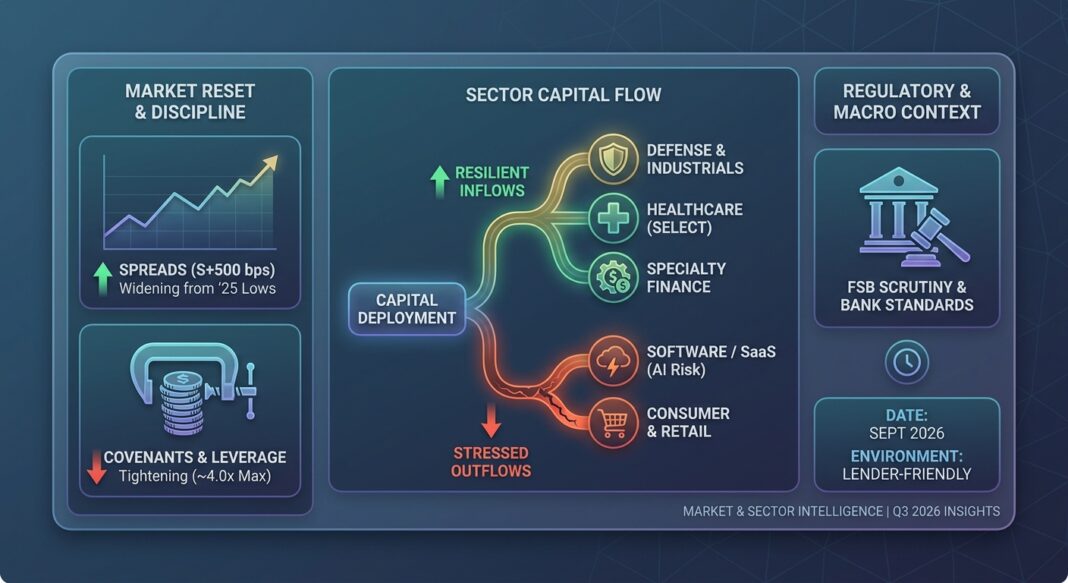
The pendulum has swung. Spreads are wider. Covenant packages are improving. Lenders with dry powder can now be selective about the credits they choose to finance. As Lord Abbett noted in its June 2026 midyear outlook, spreads have widened by roughly 50 to 100 basis points since late 2025 while defensive terms have also improved, according to PitchBook. Simultaneously, the Federal Reserve’s July 2026 SLOOS, the most recent read on bank behavior, confirmed that C&I lending standards for large and middle-market firms were basically unchanged in Q2 2026, a stabilization after the outright tightening reported in Q1 2026. Banks also reported stronger C&I loan demand from large and middle-market firms, per the Federal Reserve’s July 2026 SLOOS. That combination, stable bank standards plus improving demand, suggests the institutional credit market is neither in free fall nor fully recovered.
The macro backdrop remains complicated. Valuation Research Corporation’s Q2 2026 Private Markets Update notes that market expectations continue to reflect a higher-for-longer rate environment, with the forward curve broadly flat as of June 2026. Three-month Term SOFR sat at 3.68% in June, while five-year U.S. Treasury yields rose to approximately 4.23% from 3.92% in March, a meaningful upward shift that is sustaining all-in financing costs for floating-rate borrowers and compressing debt service coverage headroom across levered portfolios.
The regulatory dimension now adds a new layer of structural pressure. On May 6, 2026, the Financial Stability Board issued a formal report warning that the private credit sector’s complexity, leverage, and interconnectedness could amplify stress in adverse scenarios, posing broader risks to financial stability. The FSB (comprising G20 central bankers, finance ministers, and regulators) identified valuation opacity, inconsistent default definitions, leverage stacked at both fund and portfolio company levels, and redemption-liquidity mismatches as core vulnerabilities. Four formal supervisory workstreams are now underway. This is no longer observer-level scrutiny. Regulatory drag on private credit structures, fundraising timelines, and LP confidence is now a live operational risk for fund managers and borrowers alike.
II. Quantitative Market Snapshot
The table below captures the most current available data points across the key metrics that drive borrower cost of capital and lender underwriting decisions.
| Metric | Current Level | Prior Period | Source |
|---|---|---|---|
| Middle Market Private Credit Spreads | S+500 bps (approx.) | S+450–475 bps (late 2025) | Hamilton Lane, 2026 |
| 3-Month Term SOFR (Base Rate) | 3.68% (June 2026) | ~3.67% (March 2026) | VRC Q2 2026 Update |
| High Yield Bond Spreads | ~250 bps | Wider in Q1 2026 | Chicago Atlantic, Q2 2026 |
| Leveraged Loan Spreads (BSL) | ~500 bps | ~433 bps (year-end 2025) | Chicago Atlantic, Q2 2026 |
| Software / SaaS Secondary Spreads (vs. Broad B-Rated Loan Index) | ~229 bps wider than B-rated index | ~245 bps above year-end levels | PitchBook LCD via VRC, June 2026 |
| Typical Direct Lending Structure: Max Leverage Covenant | ~4.0x EBITDA | 4.5–5.0x (2023–2024 avg.) | Investing.com, August 2026 |
| Typical Direct Lending Structure: Min. Interest Coverage (FCCR Proxy) | ~2.5x EBITDA-to-interest | ~2.0x (peak borrower-friendly era) | Investing.com, August 2026 |
| Proskauer Private Credit Default Rate (Q1 2026) | 2.73% | 1.84% (Q3 2025) | Forbes / Proskauer Default Index, May 2026 |
| Fitch Broad Private Credit Default Rate (TTM through Jan 2026) | 5.8% (highest since tracking began) | ~3.5–4.5% (2025 range) | Forbes / Fitch Ratings, May 2026 |
| Q2 2026 Direct Lending Origination Volume | $33.6B (154 deals) | $74.7B (217 deals) in Q1 2026 | PitchBook/LCD via Angel Investors Network, Aug 2026 |
| Median PE Deal EV/EBITDA Multiple (H1 2026) | 13.4x | 14.6x (full-year 2025) | CohnReznick / PitchBook, July 2026 |
Note: All-in direct lending yields for senior secured unitranche structures currently approximate 9.0%–10.5% (SOFR 3.68% + S+500–600 bps range), depending on deal size, borrower quality, and sector. Data as of most recently available period; see sources for specific dates.
III. Sector Analysis: Where Capital Is Moving, and Where It Is Retreating
🟢 Healthcare: Dominant Sector, But Increasingly Scrutinized
Healthcare has emerged as the most significant sector story in private credit in 2026. RSM US reports that healthcare now accounts for roughly 22% of all U.S. direct lending issuance year-to-date through March 2026, up from 18% in 2025, making it the single largest sector for direct lending by share. The sector’s appeal is well-understood: demographic tailwinds, non-cyclical demand, and predictable cash flows from physician platforms, behavioral health, post-acute care, and hospital systems. However, concentration has created a dual-edged dynamic. As redemption requests mount and lender scrutiny intensifies, the very concentration that made healthcare attractive to lenders is now a point of exposure. Underwriters are increasingly focused on cash-flow stability, payer mix, labor costs, and governance, signaling that the era of broad-brush healthcare lending is giving way to issuer-level differentiation.
🔴 Software / SaaS: The Sector in Stress
No sector has experienced a more dramatic repricing in 2026 than enterprise software and SaaS. The Bank for International Settlements (BIS) documented that outstanding private credit loans to SaaS firms grew from roughly $8 billion in 2015 to over $500 billion, representing 19% of total direct loans, by end-2025. A third of private credit funds now hold SaaS exposure. That concentration has become a systemic overhang as AI disruption fears accelerated throughout H1 2026. PitchBook LCD data shows software secondary spreads now trade approximately 229 basis points above the broader B-rated loan index, with secondary spreads roughly 245 basis points wider than year-end levels. BDC stocks with above-median SaaS exposure have underperformed peers by approximately 5 percentage points since October 2025. CAIA’s May 2026 analysis flags that Morgan Stanley projects direct lending default rates, currently running at approximately 5.6%, could reach 8% as AI disruption compounds existing leverage pressure. The challenge is structural: many of these loans carry five-to-seven year maturities, meaning businesses that appeared insulated from AI disruption at origination will face a fundamentally different competitive landscape by maturity. Lenders are now implementing explicit AI disruption risk frameworks as a standard underwriting component in new software transactions.
🟢 Defense, Aerospace & Industrials: The Standout Opportunity
Paul Weiss’s 2026 private credit outlook identifies energy infrastructure, digital infrastructure, defense and national security, and next-generation manufacturing as priority sectors requiring patient institutional capital. This is borne out by deal flow data. Penn Mutual Asset Management reports that private equity’s appetite for defense and aerospace has moved from niche to one of the hottest areas of capital deployment, driven by expanding government defense budgets and bipartisan political support that provides long-term revenue visibility. Defense-adjacent industrials offer what software cannot in the current environment: government-contract-backed cash flows, low AI disruption exposure, and lender protections that hold up under stress scenarios. Lenders offering leverage to well-contracted defense suppliers are finding favorable underwriting dynamics and willing institutional co-investors.
🟡 Specialty Finance & Asset-Backed Credit: The Rising Diversifier
The composition of private credit fundraising is shifting. Investing.com’s August 2026 analysis notes that direct lending’s share of all private debt capital raised globally fell from 58.4% in 2024 to roughly 31% by Q1 2026, as allocators diversified into infrastructure debt, real estate credit, special situations, and asset-backed strategies. Specialty finance (which lends against pools of receivables, equipment leases, consumer loans, and real assets rather than against a single company’s EBITDA) raised $37 billion in 2025, more than the prior two years combined, and second only to direct lending’s $79 billion. This structural rotation reflects allocators’ growing appetite for lower concentration risk and more predictable collateral coverage in a higher-default environment.
🔴 Consumer, Retail & Automotive: Under Elevated Stress
PwC’s Global Private Credit Survey 2026 finds that managers expect stress to be most acute over the next one to two years in consumer and retail (cited by 56% of respondents), automotive (42%), hospitality and leisure (27%), and technology (24%). These sectors face a combination of elevated floating-rate debt service burdens, weakening consumer spending power, tariff pass-through risks, and limited ability to grow EBITDA fast enough to maintain fixed charge coverage at current interest rates.
IV. Implications for Borrowers and Institutional Investors
For Borrowers and Operators
The financing environment for middle-market operators has become materially more demanding across all major KPIs. The reversion in leverage covenant caps, from 4.5–5.0x EBITDA at the peak borrower-friendly era toward a current standard maximum of approximately 4.0x, represents a real reduction in available debt capacity for businesses seeking acquisition financing or recapitalizations. The tightening of minimum interest coverage requirements toward 2.5x EBITDA-to-interest means that any business carrying higher debt loads relative to earnings will face meaningful structuring constraints or be priced to reflect risk. With five-year U.S. Treasuries at 4.23% and direct lending spreads at S+500 bps, all-in financing costs for senior secured unitranche debt are running in the 9.0%–10.5% range, a cost structure that demands credible EBITDA growth or FCCR headroom to be serviceable without structural deterioration.
The key operational imperative for borrowers right now is capital strategy clarity. As RSM US advises for healthcare operators specifically, this is a moment to shift from opportunistic financing to intentional capital strategy, strengthening lender communications with clearer performance narratives and disciplined forecasting. That guidance applies market-wide. Borrowers who can document EBITDA trajectory, payer mix stability (healthcare), contract backlog visibility (defense/industrials), or AI strategy resilience (technology) will access capital on meaningfully better terms than peers who cannot.
For Institutional Investors and Lenders
The deployment gap is the key portfolio risk to monitor. Q2 2026 PitchBook/LCD data shows origination volume collapsed 55% quarter-on-quarter to $33.6 billion from $74.7 billion in Q1, with deal count falling to 154, the weakest quarter since Q2 2023. Funds are sitting on undeployed capital while the deal market remains selective. That gap can flip from a sign of discipline to a sign of structural strain if GP pressure to show deployment progress causes credit standards to soften. LPs should actively monitor both deployment pace and credit standard maintenance.
The FSB’s four-workstream regulatory program (targeting data gaps, cross-border supervision, nonbank interconnectedness, and liquidity mismatches) creates concrete near-term risk for funds operating semi-liquid structures. The FSB has identified over $220 billion in drawn and undrawn bank credit lines to private credit funds, with commercial data suggesting the true figure may exceed $500 billion. Banks reporting tighter standards for non-depository financial institution (NDFI) loans, as confirmed in the April 2026 SLOOS, signal that the subscription line and NAV facility market is contracting at the margin, which will affect fund-level leverage and return profiles.
V. Forward-Looking View: Liquidity & Lending Dynamics (Next 3–6 Months)
Lord Abbett’s midyear 2026 outlook is direct: the second half of 2026 will be defined by dispersion. The market is no longer moving as a single asset class. Returns and outcomes will diverge sharply by manager, sector concentration, documentation quality, and covenant structure. VRC’s Q2 2026 update notes that conditions stabilized during Q2 following Q1’s volatility, and that lending activity remains competitive for higher-quality deals even as banks re-entered the upper middle market in June, alleviating some upward pressure on spreads in that segment.
The M&A recovery (with private equity deal value rising approximately 10.7% year-over-year and exit activity up 14%, per PitchBook) is the primary volume catalyst that the private credit market needs to deploy its substantial dry powder. CohnReznick’s mid-year 2026 report makes clear that returns for the remainder of 2026 will be driven less by multiple expansion and financial engineering, and more by operational improvement and disciplined capital deployment. For private credit lenders, that means the most durable positions will be in sectors with visible cash flow, contractual revenue, and defensive FCCR floors: characteristics that describe defense/industrials, healthcare services (selectively), and specialty finance far better than they describe legacy software.
Fitch forecasts the direct lending default rate rising to approximately 2.5% by full-year 2026 on a volume basis, with a count-based rate of approximately 3.5%. UBS’s more severe AI disruption scenario projects private credit defaults reaching 13% (versus 8% for leveraged loans and 4% for high yield) if software disruption accelerates faster than portfolios can adapt. The probability-weighted base case sits well below that tail, but the distribution is notably fat. That asymmetry argues for conservative covenant structuring, active portfolio monitoring, and genuine underwriting differentiation, not passive yield harvesting.
📋 Key Market Insights
- Spreads reset higher, lender terms improve: Middle market private credit spreads have widened to the S+500 bps context, up from mid-400s in late 2025, and covenant packages are tightening, marking the clearest lender-favorable shift in two-plus years. All-in yields on senior secured unitranche transactions are running approximately 9.0%–10.5%.
- Underwriting KPIs are recalibrating: Standard direct lending transactions are reverting toward 4.0x maximum leverage and 2.5x minimum EBITDA-to-interest coverage. Borrowers whose capital structures were built on 4.5–5.0x leverage assumptions face near-term refinancing friction as those covenants normalize.
- Software/SaaS is the critical risk concentration: With ~19% of direct lending portfolios in SaaS, secondary spreads 229+ bps above the B-rated loan index, and Fitch’s broad default rate at 5.8% (a record high), AI disruption risk is not theoretical; it is live underwriting triage. Lender diligence now requires explicit AI disruption analysis for any technology-sector credit.
- Defense, healthcare services, and specialty finance are the rotation beneficiaries: Capital is flowing toward sectors with government-contract visibility, non-cyclical cash flows, and asset-backed collateral structures. Specialty finance raised $37 billion in 2025, more than the prior two years combined, as allocators diversify away from pure-play corporate direct lending.
- Regulatory pressure is not a future risk; it is a present operating condition: The FSB’s May 2026 report, the SEC’s inquiries into large private credit managers, and the SLOOS confirmation of tighter bank standards for NDFI loans collectively signal that the cost of running complex private credit structures is rising. Funds relying on semi-liquid vehicles, NAV facilities, or opaque valuation practices face the highest near-term compliance and reputational exposure.


