
One Loan, Two Risk Profiles, and Why That Distinction Matters
Private credit’s most widely used financing tool hides a structural secret. When a private equity-backed company closes a unitranche loan, it signs a single credit agreement, pays one blended interest rate, and deals with one administrative agent. Simple on the surface. Behind that simplicity, however, is a carefully engineered risk allocation that divides the lender group into two very different economic positions, and understanding that division is essential for anyone evaluating private credit, whether as an institutional investor or as a business owner seeking capital.
The unitranche structure has become the default financing mechanism for middle-market leveraged buyouts. According to AlternativeFortune (March 2026), the large-cap unitranche market roughly doubled to $210 billion of activity in 2024, up from $94 billion in 2023. Europe mirrors the trend: Houlihan Lokey’s MidCapMonitor recorded 250 European unitranche transactions in the first half of 2025 alone, up 13% year-on-year. This is not a passing innovation. It is the architecture of modern private credit.
What a Unitranche Loan Actually Is
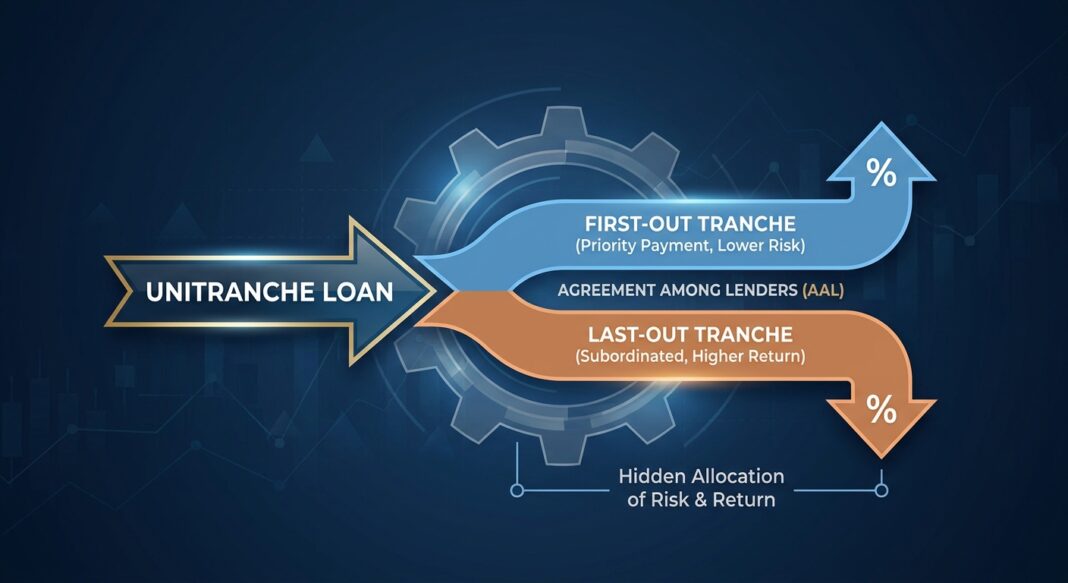
A unitranche facility is a single secured credit facility in which two or more groups of lenders share the same security interest on a borrower’s collateral but agree among themselves to a payment priority and other arrangements through a side agreement known as an Agreement Among Lenders (AAL). As Mayer Brown explained (July 2026), the facility is typically documented in a single credit agreement with a blended interest rate applicable to all obligations, the borrower never sees the AAL.
The AAL splits the loan into two internal segments:
- First-Out (FO) Tranche: Typically a revolving credit facility or an asset-based lending component. First-out lenders receive priority in cash flow distributions and collateral recoveries. In exchange, they accept a lower interest rate, reflecting their reduced risk position.
- Last-Out (LO) Tranche: Usually the term loan, and almost always the larger portion of the facility. Last-out lenders absorb losses before first-out lenders in a default scenario, and in exchange they receive a higher interest rate reflecting that subordinated risk. Per Glacier Lake Partners (August 2026), the borrower may owe a single blended rate even though the lenders allocate interest differently among themselves.
This structure is explicitly not the same as a traditional first lien/second lien arrangement. In a first lien/second lien deal, two separate liens govern two distinct creditor groups under a formal intercreditor agreement, all visible to the borrower. In a unitranche, the subordination lives privately in the AAL, kept confidential from the borrower entirely.
How the Economics Work: A Concrete Example
Consider a hypothetical $100 million unitranche loan financing a private equity buyout of a manufacturing company with $20 million in EBITDA, a 5.0x leverage ratio. The borrower sees one loan at SOFR + 550 bps (approximately 10.3% all-in at current rates). Here is how that single rate conceals two very different risk-return profiles:
- First-Out Lender ($30M revolver): Receives SOFR + 300 bps (~8.0% all-in). First to be repaid from collateral. Faces minimal loss risk in most default scenarios. Typically a bank or senior-focused credit fund.
- Last-Out Lender ($70M term loan): Receives SOFR + 650 bps (~12.0% all-in). Absorbs losses after first-out is made whole. The blended math works: (30/100 × 8%) + (70/100 × 12%) = 10.8%, which roughly approximates the borrower’s stated 10.3% blended rate (differences reflect fees and OID).
The operator sees one clean obligation. The investors have two fundamentally different risk-adjusted positions. This elegance is why the structure dominates: AlternativeFortune (March 2026) notes unitranche became dominant because it gives private equity sponsors speed, certainty of close, and confidentiality, not necessarily because it is cheaper or inherently safer than alternatives.
Current Market Reality: Data That Shapes the Decision
The unitranche market does not exist in a vacuum. Three intersecting forces are reshaping how these structures price and perform in mid-2026:
1. Bank Retrenchment Continues to Drive Private Credit Demand
The Federal Reserve’s April 2026 SLOOS reported that banks tightened lending standards for commercial and industrial loans to firms of all sizes during Q1 2026. This persistent tightening, recorded across every survey from Q3 2025 through Q1 2026, reinforces why middle-market borrowers increasingly turn to private credit. When traditional bank channels narrow, unitranche facilities fill the gap.
2. Spreads Have Widened From Their Tightest Levels, Improving Lender Terms
McKinsey’s Global Private Markets Report (June 2026) documented that global new-issue direct loan median spreads peaked at 716 bps in March 2023, compressed to 544 bps by year-end 2025, and have since shown signs of recovery. Lord Abbett’s 2026 Midyear Outlook (June 2026) confirmed spreads widened roughly 50–100 bps since late 2025, with new loans also carrying less leverage, more covenants, and tighter documentation. For last-out lenders specifically, wider spreads mean meaningfully better risk-adjusted compensation.
3. The Covenant-Lite Tension: Protections Are Eroding at the Top of the Market
Proskauer’s 15th Annual Private Credit Insights Report (February 2026), based on over 450 deals representing $124 billion in transaction value, found that covenant-lite structures rose to 21% of all private credit deals in 2025, up sharply from just 4% in 2023. Critically, 91% of cov-lite deals involved borrowers with EBITDA of at least $50 million, suggesting the erosion is concentrated in upper-market transactions competing directly with broadly syndicated loans. For last-out lenders in covenant-lite unitranches, the loss of maintenance test triggers reduces early warning time if a borrower’s performance deteriorates.
| Metric | Data Point | Source |
|---|---|---|
| Global Private Credit AUM | ~$3.2 trillion | PIMCO, June 2026 |
| Cliffwater CDLI Return (2025) | 9.3% (20-yr avg: 9.5%) | Cliffwater / Morningstar, March 2026 |
| Median Direct Lending Spread (YE 2025) | 544 bps (down from 716 bps peak in 2023) | McKinsey Global Private Markets Report, June 2026 |
| Private Credit Cov-Lite Share (2025) | 21% of deals (vs. 4% in 2023) | Proskauer / PitchBook LCD, February 2026 |
| KBRA Projected Default Rate (US, 2025) | 1.5% annualized (rising to ~2.0% by YE 2026) | Northleaf / KBRA, May 2026 |
Decision Framework: Investors and Operators
For Investors Evaluating Unitranche Exposure:
- Know your tranche position. Whether you hold first-out or last-out exposure inside a unitranche defines your actual risk profile. A fund that reports “senior secured” exposure may still carry material last-out subordination. Investors consider asking managers for tranche-level breakdowns, not just top-line collateral descriptions.
- Covenant package quality is now a differentiator. With cov-lite structures at 21% and rising, analysts evaluate whether maintenance covenants remain in place, particularly the financial covenants on revolving credit facilities that can preserve early-intervention rights even when term loans are cov-lite, as Proskauer noted.
- Spread versus structure tradeoff. The recent widening of 50–100 bps in spreads improves income, but the structural question, is this first-out or last-out? is the borrower cov-lite?, matters at least as much as the raw yield number when assessing risk-adjusted returns.
For Business Operators Evaluating Unitranche Financing:
- Speed and simplicity have real value. One credit agreement, one agent, one closing process can compress a deal timeline by weeks compared to a traditional senior-plus-mezzanine stack. For time-sensitive acquisitions, this operational certainty often justifies the blended cost.
- Understand the AAL even though you cannot see it. The Agreement Among Lenders governs lender enforcement rights and voting dynamics. Operators benefit from understanding that first-out lenders often control early-stage enforcement remedies, which can shape how quickly lenders act in a covenant breach scenario.
- Cost comparison: blended vs. stacked. A unitranche at SOFR + 550 bps may appear more expensive than a bank revolver alone, but relative to the combined all-in cost of a senior-plus-mezz structure, which would layer SOFR + 300 bps on senior debt plus 12–14% cash/PIK on mezzanine, the blended unitranche rate is often competitive and structurally cleaner.
Key Takeaways
- One loan, two risk profiles: Unitranche facilities present a single borrower-facing instrument but conceal a first-out/last-out risk division inside a confidential Agreement Among Lenders, understanding which position a fund holds is fundamental to assessing actual credit risk.
- The structure won on execution, not just pricing: Unitranche financing became dominant because it delivers speed, certainty, and confidentiality to PE sponsors, not because it is the cheapest or safest structure in every scenario.
- Bank retrenchment continues to expand the opportunity set: Persistent tightening in bank C&I lending standards through Q1 2026 reinforces the structural demand for private credit, and the unitranche is the primary vehicle filling that gap in the middle market.
- Covenant erosion is a last-out risk, not just a market trend: As cov-lite transactions rise to 21% of private credit deals, concentrated in upper-market borrowers, last-out lenders face reduced early-warning capacity; investors evaluate whether revolving credit covenant triggers remain in place as a compensating mechanism.
- The spread environment is improving for lenders: After compressing to multi-year lows, direct lending spreads have widened 50–100 bps since late 2025, new loan structures carry less leverage and tighter documentation, and the Cliffwater CDLI delivered 9.3% in 2025, a market entering a potentially more lender-friendly configuration after years of borrower-friendly dynamics.


