
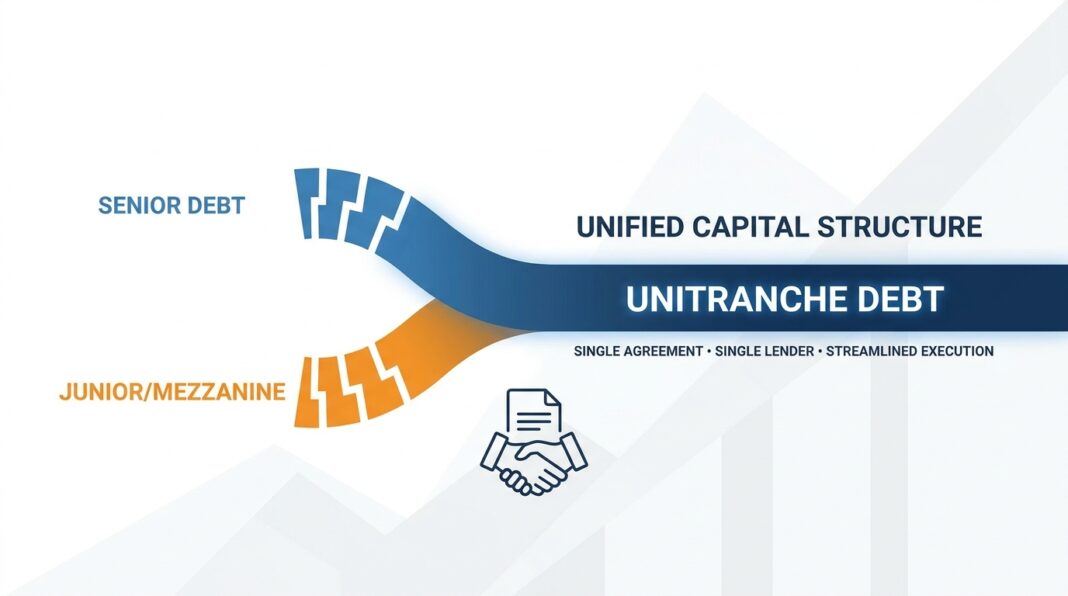
Why the Old Two-Lender Capital Stack Is Disappearing
Not long ago, a private equity sponsor financing a middle-market acquisition had to negotiate with at least two separate lenders: a bank providing senior secured debt and a mezzanine fund layering in subordinated capital below it. The result was a capital structure involving multiple credit agreements, competing intercreditor arrangements, and the ever-present risk of senior and junior lenders disagreeing at the worst possible moment, during a workout or restructuring.
Enter the unitranche loan: a single-tranche facility that collapses what was once a two-lender stack into one credit agreement, one lender relationship, and one blended interest rate. For business owners seeking acquisition financing and for investors evaluating private credit funds, understanding how unitranche works (and why it now dominates the lower and middle market) is foundational to understanding how private credit actually functions in 2026.
This concept sits at the intersection of structural innovation and practical capital allocation. It is not merely a product feature. It reflects a fundamental shift in who controls the middle-market lending ecosystem, and what that control is worth.
What a Unitranche Loan Actually Is
A unitranche facility is a hybrid debt instrument that combines senior secured and subordinated (mezzanine) debt components into a single loan with one interest rate, one set of covenants, and one lender, typically a direct lending fund rather than a bank.
The classic capital stack, oriented from lowest to highest risk, runs: senior secured debt → unitranche debt → subordinated/mezzanine debt → preferred equity → common equity. In a traditional structure, a company would separately negotiate senior debt (the lowest-cost, first-lien tranche) and mezzanine debt (higher-cost, subordinated capital sitting beneath the senior lender but above equity). Each layer came with its own documents, fees, and stakeholder dynamics.
A unitranche loan eliminates that layering for the borrower. The single direct lender (or a small club of two to three direct lenders) absorbs the full credit risk across what would have been multiple tranches, then charges a blended rate that reflects the weighted-average cost of those combined risks. Behind the scenes, when multiple lenders participate, they govern their respective risk and return allocations through an Agreement Among Lenders (AAL), which is invisible to the borrower.
The mechanics are straightforward: more leverage means a higher blended spread; higher-quality recurring-revenue businesses compress that spread; and repeat sponsor relationships can tighten pricing by 25–50 basis points versus one-time borrowers, reflecting the relationship premium that defines private credit markets.
A Concrete Example: The Numbers Behind a $60M Unitranche Deal
Consider a hypothetical private equity sponsor acquiring a software-enabled services company with $12 million in EBITDA at a 7x purchase multiple, a $84 million enterprise value. The sponsor contributes $30 million in equity (approximately 36% of the capital structure) and finances the remaining $54 million through a unitranche facility at 4.5x EBITDA.
Under the old two-lender model, the structure might have looked like this:
- Senior secured debt: $36M at 3.0x EBITDA, priced at SOFR + 375 bps (approximately 7.7% all-in)
- Mezzanine debt: $18M at 1.5x EBITDA, priced at 13–15% (cash + PIK)
- Two credit agreements, two sets of legal fees, intercreditor negotiations
Under the unitranche model:
- Single unitranche facility: $54M at 4.5x EBITDA, priced at SOFR + 550 bps
- At a 3-month term SOFR of approximately 4.3% (Q2 2026), that equates to roughly 9.8% all-in
- One credit agreement, one closing, one lender to manage post-close
The all-in cost of the unitranche is higher than senior debt alone; that is the trade-off. But relative to blending senior debt at ~7.7% with mezzanine at ~14%, the unitranche blended rate is often comparable or modestly cheaper in total, while eliminating the structural and legal complexity of two separate facilities. For operators, the primary benefit is execution certainty and simplicity. For direct lenders, it is the ability to capture yield across the full debt quantum rather than competing only for the senior-most piece.
Current Market Reality: Where Unitranche Stands in 2026
The unitranche structure has moved from innovation to institution. According to CT Acquisitions (June 2026), the unitranche market grew from roughly $20 billion in annual issuance in 2015 to over $200 billion in 2025 as direct lenders displaced traditional bank syndication for sub-$1 billion EBITDA borrowers.
Pricing in mid-2026 reflects the post-tariff repricing environment. According to CT Acquisitions (June 2026), a typical lower-middle-market unitranche carries a credit spread of 500–700 basis points over SOFR, with 3-month term SOFR running approximately 4.3% as of Q2 2026. That implies blended all-in rates in the 8–11% range depending on deal quality and leverage level.
The bank lending backdrop reinforces why private credit has room to grow. The Federal Reserve’s April 2026 SLOOS reported that banks tightened standards across all categories of non-depository financial institution (NDFI) loans over the prior year, with higher premiums on riskier loans, stricter covenants, and shorter maturities cited as the most common changes. For middle-market borrowers who do not qualify for investment-grade bank pricing, this tightening accelerates the shift toward direct lenders.
On the execution side, private credit maintains a structural advantage: Private Capital Global (September 2025) notes that private credit transactions can close within approximately four weeks, while bank deals may require six to eight weeks for syndication, a meaningful competitive edge in time-sensitive M&A processes.
Spread dynamics shifted notably in early 2025. According to the PitchBook LCD US Private Credit Monitor (April 2025), an LCD poll conducted on April 9, 2025 found that only 8% of market participants expected a unitranche to a $50M EBITDA non-cyclical business to price below SOFR + 500, compared to 45% of respondents saying the same just two months earlier in February, a dramatic repricing in response to tariff-driven volatility.
According to data cited by Angel Investors Network (August 2026), referencing KBRA data via Brinley Partners, the average private unitranche coupon was approximately 9.00% at year-end 2025, running roughly 160 basis points above comparable broadly syndicated loans, a persistent premium that compensates direct lenders for illiquidity and hold-to-maturity commitment.
| Metric | Data Point | Source |
|---|---|---|
| Annual unitranche issuance (2025) | ~$200B+ | CT Acquisitions, Jun 2026 |
| Typical LMM spread (Q2 2026) | SOFR + 500–700 bps | CT Acquisitions, Jun 2026 |
| Average unitranche coupon (year-end 2025) | ~9.00% | Angel Investors Network / KBRA, Aug 2026 |
| Spread premium vs. broadly syndicated loans | ~160 bps | Angel Investors Network / KBRA, Aug 2026 |
| US private credit AUM (2025) | $2T+ | CT Acquisitions / Preqin, Jul 2026 |
Decision Framework: Evaluating Unitranche From Both Sides of the Table
For Investors Evaluating Private Credit Funds:
When assessing a direct lending fund that predominantly deploys via unitranche structures, investors may consider the following criteria:
- Leverage attachment points: What is the maximum leverage (expressed as a multiple of EBITDA) at which the fund will lend? Funds that consistently hold discipline at 4–5x senior leverage on strong cash-flow businesses carry a materially different risk profile than those stretching to 6–7x to win deals.
- Covenant architecture: A unitranche with a single maintenance financial covenant (typically a maximum net leverage ratio tested quarterly) provides lenders with early-warning signals and intervention rights well before a default. Investors may evaluate how many of a fund’s unitranche loans carry maintenance covenants versus covenant-lite structures, which offer fewer protections.
- Spread premium sustainability: According to Goldman Sachs Research (April 2026), a notable spread differential between direct lending and the broadly syndicated loan market has persisted in both the US and Europe, driven by the illiquidity premium and customization value that private credit provides. Investors may assess how durable that premium appears as more capital enters the space.
- Manager concentration: According to McKinsey (June 2026), the top 25 managers accounted for approximately 72% of total private credit fundraising in 2025. Scale confers origination volume, diversification, and workout capability, factors that matter when evaluating managers.
For Operators and Business Owners Considering a Unitranche:
Operators evaluating whether a unitranche is the right structure for an acquisition or recapitalization typically weigh these factors:
- Speed and certainty: If a deal timeline is compressed, the ability to close in roughly four weeks versus six to eight weeks for a syndicated bank facility can be decisive.
- Single-lender relationship: A unitranche eliminates the risk of senior and mezzanine lenders disagreeing during a restructuring. As Angel Investors Network (August 2026) notes, the borrower also benefits from a single point of contact for the life of the loan.
- All-in cost vs. complexity trade-off: Operators should model the total cost of a unitranche (including original issue discount (OID) and prepayment fees) against the blended cost of a senior-plus-mezzanine stack. For deals under $150M in enterprise value, the simplicity premium often justifies a modest rate differential.
- Covenant sensitivity: Unlike many broadly syndicated loans, most middle-market unitranche facilities include at least one maintenance covenant. Operators with cyclical revenue or seasonal cash flow should stress-test whether their projected metrics provide adequate headroom above those covenant thresholds.
Key Takeaways
- Unitranche is now the dominant structure in middle-market direct lending, having grown from roughly $20 billion in annual issuance in 2015 to over $200 billion in 2025, reflecting a wholesale displacement of traditional bank-plus-mezzanine stacks in sub-$1B EBITDA transactions.
- The blended rate is the core trade-off: Borrowers pay a higher all-in cost than senior debt alone in exchange for structural simplicity, execution speed, and a single lender relationship, benefits that carry real economic value in competitive M&A processes.
- Bank tightening is a structural tailwind for unitranche lenders: The Federal Reserve’s April 2026 SLOOS confirmed ongoing tightening of bank lending standards for NDFI loans, reinforcing the displacement dynamic that has defined private credit’s growth.
- Pricing discipline matters: With LMM unitranche spreads ranging from SOFR + 500 to SOFR + 700 bps in mid-2026, the difference between a 500 and 700 bps spread on a $50M facility represents $1 million in annual interest cost, making lender selection and negotiation material for operators.
- Investors should look past headline yield to covenant architecture: The presence or absence of a maintenance financial covenant in a unitranche agreement is one of the most important structural distinctions separating conservative and aggressive direct lending mandates.


