
The Growth-Stage Capital Gap: Where Most Deals Break Down
You have $4M of EBITDA, a clean balance sheet, three years of audited financials, and a bolt-on acquisition at a 6.0x multiple. The purchase price is $24M. Your bank will lend 3.0x , $12M. Your equity capacity is $5M without diluting your position below the point where you’d take the deal. That leaves a $7M hole in the middle of the capital stack. Welcome to the growth-stage capital gap: the most common, most misunderstood financing problem in the lower middle market.
The companies that fill this gap efficiently compound faster, dilute less, and keep better governance. The companies that stumble fill it with expensive equity, loose seller notes, or walk away from accretive acquisitions entirely. In 2026, the capital stack offers more structured options to bridge this gap than at any point in the past two decades : but navigating them requires understanding what each layer actually costs, when each instrument belongs, and how to run the process to get competitive terms.
This article is for the growth-stage operator, MBO team, or independent sponsor financing a platform or add-on acquisition in the $10M–$75M enterprise value range. It maps every layer of the capital stack to your specific use case, provides a worked example with market-current pricing, and delivers a step-by-step Gap Capital Playbook for running the raise.
The Capital Stack Map: From Banks to Equity
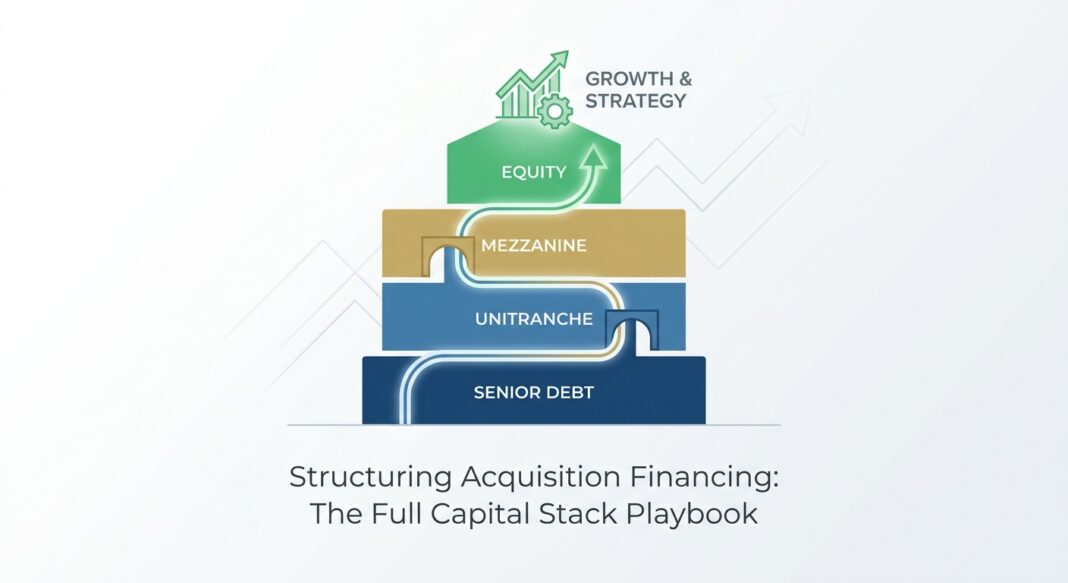
Every acquisition capital structure is a layered hierarchy of cost, priority, and flexibility. Understanding where each instrument sits , and what it demands in return , is the first act of disciplined structuring.
Layer 1: Senior Bank Debt (Lowest Cost, Highest Constraint)
Traditional commercial banks remain the lowest-cost source of acquisition debt, typically pricing at SOFR + 250–350 bps for a well-secured, first-lien term loan. The constraint is leverage: banks generally cap senior debt at 3.0x–3.5x EBITDA on cash-flow-based credits, with asset coverage requirements tightening further as you move into service or IP-heavy businesses. For working capital, asset-based lines (ABL) from institutions such as PNC Business Credit or Wells Fargo Capital Finance can extend availability beyond cash-flow limits when accounts receivable and inventory provide a formulaic borrowing base. Bank debt is the right first fill for any acquisition capital structure , maximize it before touching the more expensive layers above.
Layer 2: Unitranche / Direct Lending (Speed & Leverage, Moderate Cost Premium)
Unitranche is a single-tranche facility that blends senior and subordinated debt into one instrument with one interest rate, one lender group, and one set of documents. Borrowers deal with a single credit agreement and no intercreditor negotiation. In the $50M–$200M enterprise value band, unitranche dominates: direct lenders compete aggressively for these deals, and pricing and leverage are at their most favorable in this size range. Today, unitranche pricing runs approximately SOFR + 450–650 bps : a meaningful premium over plain first-lien bank debt, but the trade-off is leverage capacity (4.0x–5.0x EBITDA), speed (45–90-day close versus 90–150 days for traditional senior/mezz syndication), and certainty of execution.
For growth-stage operators, unitranche is frequently the correct single-instrument answer when the deal is too large for bank-only debt but too small or time-sensitive for a full syndication. The key lenders in this band ( Ares Capital, Blue Owl, Golub Capital, Monroe Capital, Twin Brook ) run efficient processes and prize relationship continuity, which matters for operators planning add-on acquisitions.
Layer 3: Mezzanine / Subordinated Debt (Highest Debt Cost, Maximum Flexibility)
Mezzanine capital sits between senior debt and equity in the capital stack. It is explicitly subordinated, accepts a second-lien or unsecured position, and compensates for that risk through a layered return structure: cash interest, PIK (paid-in-kind) interest that accrues to principal rather than paying current, and equity participation through warrants or co-investment rights. In 2026, growth-stage mezz for business acquisitions carries approximately 8–12% cash interest plus 2–4% PIK, with warrant or equity co-investment of 1–5%, targeting an all-in provider IRR of 16–22%.
Mezz extends total leverage to 5.0x–6.0x EBITDA and is most appropriate when senior or unitranche debt has been maximized and the remaining gap is too large for seller paper or equity alone. It is interest-only during the hold period, with a balloon at exit , a cash-flow-friendly structure for operators investing through a growth phase. PIK mechanics deserve close attention: accruing interest compounds the outstanding principal balance, increasing the exit payoff to the mezz provider and reducing the owner’s residual equity value. Model the PIK compounding effect across your full hold period before accepting any PIK rate.
Layer 4: Growth Equity / Sponsor Capital (Most Expensive, Most Governance-Intensive)
Equity is the residual claimant: it is the last to be repaid and demands the highest return. For growth-stage operators, diluting equity is the most expensive form of capital if the business succeeds. At current market conditions, median dilution in growth-stage priced equity rounds runs approximately 18–20% per round, and the fully-loaded dilution cost of a single growth-stage round at exit can reduce the pre-money founder position by 30–35%. Equity investors also receive governance rights ( board seats, voting thresholds, and protective provisions ) that constrain operational autonomy. Equity belongs in the capital structure when leverage capacity is genuinely exhausted, the growth thesis requires a strategic partner, or the deal economics absorb the dilution while still producing an acceptable founder return.
Worked Example: $24M Acquisition for a Growth-Stage Services Business
The scenario: A founder-owned professional services business with $4M of run-rate EBITDA acquires a bolt-on competitor at a 6.0x EBITDA multiple ($24M purchase price). The combined entity will generate $7M of pro-forma EBITDA. The founder wants to retain majority control and minimize dilution.
| Capital Layer | Amount | Leverage Multiple | Pricing / Cost | Key Terms |
|---|---|---|---|---|
| Senior Bank Revolver | $3M (availability) | Working capital | SOFR + 275 bps | Asset-based; maintenance covenants |
| Senior Term Loan (Bank) | $12M | 3.0x pro-forma | SOFR + 300 bps (~8.0% all-in) | 5-year term; 10% annual amortization; 1x DSCR maintenance |
| Mezzanine / Sub Debt | $7M | 4.75x pro-forma | 10% cash pay + 3% PIK + 2% warrant coverage | 5-year bullet; interest only; no maintenance covenants; incurrence triggers |
| Seller Note | $2M | 5.25x pro-forma | 6% , 7% fixed; subordinated to mezz | 5-year bullet; lender consent required for modifications |
| Founder Equity | $3M | – | Residual upside | Majority control retained (>70%); no external equity dilution |
| Total | $24M | Blended cost ~10.5% | No external equity; founder control intact |
Result: The founder acquires a $24M target at 6.0x, retains majority control, and avoids a dilutive equity raise entirely. The mezz provider earns a blended return of approximately 17–19% IRR through the cash/PIK/warrant stack. Annual debt service on the senior term loan runs approximately $1.56M, leaving $5.44M of EBITDA for growth investment, mezz PIK accrual, and eventual refinancing optionality.
Structure Comparison: Unitranche vs. Senior + Mezz vs. Equity Recap
Three primary structures compete for this scenario. Each has a distinct trade-off profile:
Option A: Unitranche (Single-Lender Direct Loan)
A $17M–$20M unitranche from a direct lender replaces both the bank term loan and mezz layer with a single instrument. Pricing runs SOFR + 500–575 bps (approximately 10.5–11.0% all-in at current SOFR). Leverage capacity reaches 4.5x–5.0x EBITDA. The advantages are structural simplicity ( one document, one lender, no intercreditor negotiation ) and execution speed: unitranche deals typically close in 45–90 days versus 90–150 days for a split senior/mezz syndication. The trade-off is an all-in cost that can run 100–150 bps above the blended rate on a well-structured senior/mezz split when mezz carries equity kickers.
Option B: Split Senior + Mezz (Used in the Worked Example Above)
The split stack preserves bank pricing on the senior portion (SOFR + 275–300 bps) and limits the mezz tranche to the true gap quantum. When the mezz provider accepts equity kickers (warrants, co-investment rights) in lieu of higher cash interest, the blended cost of the total debt stack can fall below a comparable unitranche. The cost is complexity: an intercreditor agreement between the bank and mezz provider, separate reporting obligations, and a longer close timeline. This structure works best when the borrower has strong bank relationships, is not in a time-compressed competitive auction, and can negotiate the mezz warrant coverage below 3%.
Option C: Growth Equity + Senior Debt (Dilutive Recap)
Replacing the mezz gap with growth equity eliminates subordinated debt risk and preserves covenant flexibility, but at the highest long-run cost. If the business scales from $7M to $14M of EBITDA over five years and exits at 7.0x, a $7M equity injection at a $28M post-money valuation (25% dilution) costs the founder approximately $14M–$15M in exit proceeds versus the mezz path. Equity is appropriate when leverage capacity is genuinely exhausted, when the business is EBITDA-negative during a growth investment phase, or when the equity partner brings strategic value that more than compensates for the dilution economics.
Current Market Terms: What Is Standard in 2026
The 2026 market for growth-stage acquisition financing has been shaped by three converging forces: spread compression as private credit AUM has scaled, a resurgent M&A backdrop driving competitive deal flow, and a mid-cycle reset toward lender-friendly documentation as credit quality dispersion has widened. Key benchmarks and structural standards as of Q3 2026:
- Unitranche pricing: SOFR + 450–650 bps for sponsored middle-market deals, with the lower end of that band reserved for high-quality credits in the $50M–$200M EV range where direct lender competition is most intense. By comparison, plain first-lien bank term loans price at SOFR + 250–350 bps.
- Leverage multiples: Average total leverage in sponsored middle-market unitranche deals ran approximately 5.0x EBITDA in mid-2024 and has held in that range through mid-2026, with lenders emphasizing free cash flow conversion and covenant headroom over headline multiple.
- Mezzanine all-in cost: 2026 acquisition mezz targets 10–14% all-in cost at the deal level (8–12% cash interest, 2–4% PIK, 1–5% warrant/equity co-invest) for a provider IRR of 16–22%.
- Covenant trends: Covenant-lite structures (incurrence-only, no maintenance tests) rose to 21% of direct lending deals in 2025, up from just 4% in 2023. However, lower-middle-market direct lending , sub-$100M ticket sizes , continues to retain maintenance covenants at significantly higher rates. Borrowers in this band should expect a leverage maintenance test (typically 5.5x–6.0x) and a minimum liquidity covenant rather than a fully cov-lite package.
- PIK usage: PIK features are increasingly appearing beyond traditional mezz positions. Public BDCs now receive an average of approximately 8% of investment income via PIK, a material increase that reflects both portfolio stress management and deliberate structuring to preserve borrower cash in growth-phase companies.
- Market scale: Global private credit AUM reached approximately $2.1 trillion in 2025. Private lenders provided roughly 80% of North American buyout financing by deal count in 2023, a figure that has remained elevated through 2026 as the syndicated market remains selective below $200M EV.
The Gap Capital Playbook: Quantify, Prepare, Run the Process, Negotiate
The difference between operators who close on optimal terms and those who overpay for capital , or fail to close at all , is almost always process quality. Here is the step-by-step framework.
Step 1: Quantify the Gap Precisely
Before approaching any capital provider, build a sources-and-uses model that defines the exact quantum of capital needed at each layer. Start from the purchase price, subtract maximum senior debt capacity (test at 3.0x, 3.5x, and bank-ceiling leverage), subtract available equity, and the residual is your true gap. Do not conflate total capital needed with gap capital needed. Lenders see over-equitized deals and under-equitized deals every day; the operator who arrives with a clean, layered model that shows precise gap sizing signals process maturity and commands better terms.
Step 2: Build the Materials Package
A credible process requires a Confidential Information Memorandum (CIM), a financial model with three operating scenarios (base, upside, downside), a management presentation, and a data room that includes three years of audited financials, trailing-twelve-month management accounts, and a customer concentration analysis. Lenders underwriting acquisition credits also require a quality-of-earnings (QoE) report on the target , budget for this as a day-one cost. Without a QoE, institutional mezz and direct lenders will either decline or price in the diligence uncertainty.
Step 3: Run a Competitive Process
The borrower’s primary negotiating lever is competitive tension. For the $10M–$75M EV range, approach three to five unitranche lenders and two to three mezz providers simultaneously. Set a first-round indication deadline. Compare term sheets not only on headline spread but on: leverage ceiling, PIK percentage, warrant coverage, call protection (prepayment premium schedule), equity cure rights, permitted acquisition basket size, and reporting burden. The operator who receives four term sheets is not choosing the cheapest rate , they are choosing the best total structure, because covenant flexibility and basket headroom will determine their ability to execute add-ons over the next three to five years.
Step 4: Negotiate the Structure (Not Just the Rate)
The negotiation points that matter most for growth-stage operators are frequently not the ones that dominate the term sheet headline. The five highest-leverage negotiation points are:
- Equity cure rights: The right to cure a maintenance covenant breach by injecting equity within a defined window , negotiate for this in every deal. Without it, a single quarter of underperformance can trigger technical default and lender control rights.
- Permitted acquisition basket: The dollar or ratio-based threshold below which you can complete add-on acquisitions without lender consent. Negotiate this to at least 1.0x LTM EBITDA of the target at closing.
- PIK election vs. PIK obligation: Distinguish between PIK-toggle (borrower elects to PIK, typically at a spread premium) and mandatory PIK (lender-imposed). Prefer the toggle; avoid mandatory PIK on the full balance.
- Call protection schedule: Standard market call protection is 103-102-101-par over four years. Negotiate for a 12–18-month soft call at 101 rather than a hard no-call period, preserving refinancing optionality if spreads compress further.
- Warrant coverage: If mezz providers request warrants, negotiate coverage (as a % of fully diluted equity), strike price (push for fair market value at closing, not nominal), and a sunset (automatic expiry if the loan is repaid within 36 months).
Key Takeaways
- Map the gap before approaching any lender. Precisely quantify the shortfall between maximum senior debt and available equity before selecting an instrument. The gap quantum determines whether unitranche, mezz, or a split stack is structurally appropriate.
- Unitranche wins on speed and simplicity; split senior/mezz wins on blended cost. In the $50M–$200M EV band, unitranche pricing runs SOFR + 450–650 bps. A well-structured senior/mezz split with equity kickers on the mezz tranche can run 100–150 bps cheaper in blended cost but requires a longer, more complex process.
- PIK accrues silently and compounds materially. Model PIK interest at 3–4% across a 5-year hold and you will find it represents a substantial increase in the mezz payoff at exit. Negotiate for PIK-toggle optionality rather than mandatory PIK where possible.
- Covenant design is a long-term governance question, not just a closing-day term. Maintenance covenants with equity cure rights give operators flexibility during growth-phase volatility. Incurrence-only covenants offer fewer intervention triggers but provide less early-warning protection and weaker lender engagement when problems emerge.
- The operators who net the most from a raise run a competitive process. Approaching three to five lenders simultaneously with a complete materials package is the single most effective lever for improving structure, reducing pricing, and securing the basket and cure-right provisions that enable future add-on acquisitions.


