
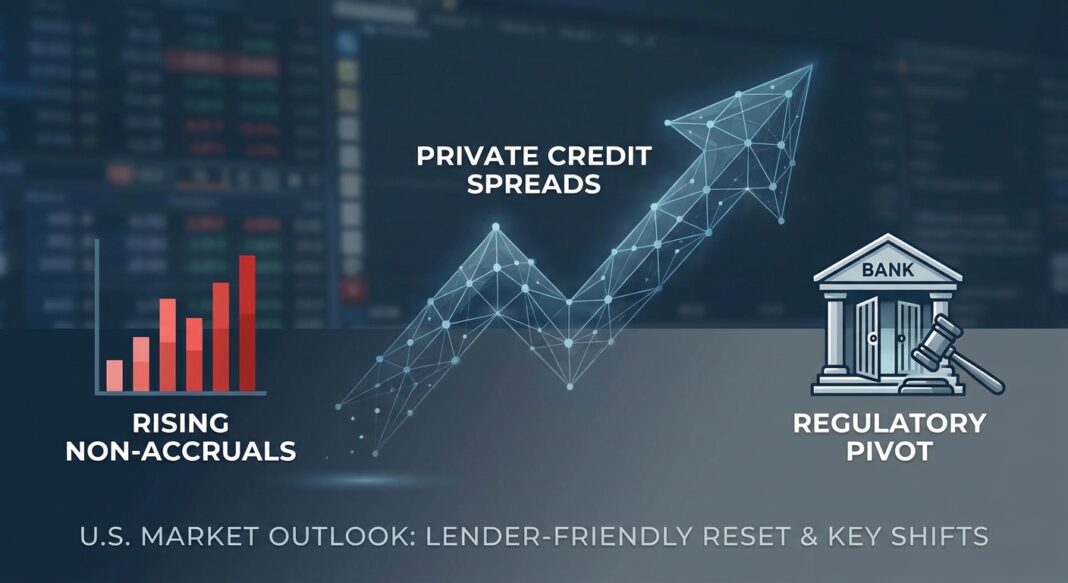
Market Headline: A Structural Inflection Point
As of August 30, 2026, the U.S. private credit market, now valued at an estimated $1.7–$1.8 trillion: is navigating its most consequential reset since the post-GFC era. Three converging forces have fundamentally altered the credit cycle’s character in 2026: a geopolitically driven spread repricing, a measurable rise in borrower distress across Business Development Companies (BDCs), and a landmark regulatory deregulation in leveraged lending that is pulling banks back into the competitive arena.
Private credit spreads, which had compressed to the mid-400 basis points (bps) over SOFR during 2025’s tight-lending environment, have widened back toward the S+500 context in 2026: driven by geopolitical shocks (the U.S.-Iran military conflict in February 2026), AI-related disruption fears across software credits, and a wave of BDC redemption requests that stressed certain semi-liquid fund structures. According to Hamilton Lane’s 2026 Private Credit Focus, spreads are now back in the S+500 range, up from the mid-400 bps level, a meaningful yield-enhancing reset for disciplined lenders with dry powder. Meanwhile, the July 2026 Federal Reserve Senior Loan Officer Opinion Survey (SLOOS) confirms that bank lending standards for C&I loans have stabilized at easier-than-historical-midpoint levels, signaling that the bank-versus-private credit competitive dynamic is about to intensify heading into H2 2026.
For institutional investors, operators, and borrowers, the operative question is no longer whether private credit will continue to grow; it is where, at what price, and under what covenant structure that capital will be deployed over the next 12 months.
Quantitative Market Snapshot
The table below synthesizes the most current publicly available market metrics across both public and private credit markets as of Q2/Q3 2026.
| Metric | Current Level (Q2–Q3 2026) | Prior Period (Late 2025 / Q1 2026) | Direction | Source |
|---|---|---|---|---|
| Private Credit (Middle Market) Spread | ~S+500 bps | Mid-S+400 bps (late 2025) | ↑ Wider by ~50–100 bps | Hamilton Lane 2026; Lord Abbett Midyear 2026 |
| Middle Market Unitranche All-In Yield (SOFR component) | 3-mo Term SOFR: ~3.68–3.69% (Q2 2026) | ~3.67% (Q1 2026); 5-yr UST: 4.23% (Jun 2026) vs. 3.92% (Mar 2026) | ↑ Higher-for-longer rate environment | Valuation Research Corp. Q2 2026 |
| Private Credit vs. High Yield Bond Spread Premium | ~150–200 bps over public HY (compressed from ~350 bps in 2019) | ~350 bps (2019 baseline); ~300 bps (early 2025) | ↓ Compressed; illiquidity premium narrowing | Owners.pe, Apr 2026 |
| Software Sector Secondary Spreads (vs. B-rated loan index) | ~+229 bps above broader B-rated loan index; ~+245 bps vs. year-end 2025 | Broadly in-line with B-rated cohort at year-end 2025 | ↑ Significantly wider; AI disruption discount | VRC / PitchBook LCD, Jun 19, 2026 |
| BDC Non-Accrual Rate (Top 20 BDCs, Median) | 2.8% of total debt at cost (Q2 2026), highest since 2017 | 2.0% (Q1 2026); ~1.3–1.4% baseline (year-end 2023) | ↑ Rising; borrower distress increasing | Angel Investors Network / Solve / FT, Aug 2026; PitchBook LCD, Aug 2026 |
| Middle Market PE Deal Value Growth (YoY) | +10.7% YoY deal value; exit activity +14% YoY | FY 2025: large-cap direct lending +37%, mid-market +14% vs. 2024 | ↑ Gradual normalization | VRC / PitchBook Q2 2026; Octus Direct Lending Analytics FY2025 |
| Bank C&I Lending Standards (Fed SLOOS, July 2026) | Basically unchanged (Q2 2026); easier than historical midpoints for large/mid-market non-syndicated loans | Tighter (Q1 2026, April SLOOS); tighter in Q4 2025 (Jan SLOOS) | ↓ Easing from prior tightening cycle; bank re-entry underway | Federal Reserve SLOOS, July 2026 |
Note: All spread data is presented as indicative market ranges drawn from cited institutional sources. Data reflects Q2–Q3 2026 conditions as of the article date. Individual deal economics will vary by sector, credit quality, sponsor affiliation, and deal size.
Sector Analysis: Lender Appetite and Structural Shifts
▲ High-Conviction Sectors: Infrastructure, Digital, Defense & Healthcare
The clearest structural shift in private credit in 2026 is the acceleration of sector specialization. According to Paul Weiss’s 2026 Private Credit Outlook, priority capital deployment sectors include energy infrastructure, digital infrastructure, defense and national security, and next-generation manufacturing: all domains requiring patient, long-duration institutional capital. This reflects a deliberate rotation away from the software-heavy vintage credit portfolios that generated most of the stress seen in Q1–Q2 2026.
Infrastructure is attracting substantial institutional lender appetite. Fitch Ratings (July 2026) notes that insurers, pension funds, sovereign wealth funds, and family offices are all increasing their focus on infrastructure debt, driven by liability-matching needs and capital efficiency under risk-based capital regimes. The data center and AI build-out theme is central: Morgan Stanley estimates that private credit could supply more than half of the $1.5 trillion needed for global data center buildouts through 2028. Asset-backed finance is another identified growth node, with BlackRock (2026 Private Markets Outlook) flagging ABF as an area expecting a profound increase in opportunity.
Healthcare, historically the largest sector in private credit by deal count, accounting for 19% of all 2025 direct lending deals according to Octus Direct Lending Analytics, remains a favored target for its non-cyclical cash flow characteristics. However, Morgan Stanley flags a notable countercurrent: healthcare has led all sectors in loans placed on non-accrual status over the past year, warranting careful borrower-level diligence within the sector.
▼ Under Pressure: Software, AI-Exposed Credits & Energy-Intensive Industrials
The most consequential sector-level dislocation in 2026 is in software and technology services. Secondary spreads for software credits are approximately 245 bps wider than year-end 2025 levels and roughly 229 bps above the broader B-rated loan index, according to Valuation Research Corp. citing PitchBook LCD data (June 19, 2026). This reflects a market-wide reassessment of AI disruption risk on existing SaaS and software-services business models, a dynamic that Capstone Partners (Q1 2026 Leveraged Finance Report) describes as the most consequential new variable in leveraged credit markets.
Energy-intensive industrials and manufacturing businesses with leverage structures predicated on stable input costs have also faced tighter underwriting, as lenders respond to elevated and volatile energy costs stemming from the geopolitical environment. Capstone Partners notes that lenders have specifically responded by tightening underwriting standards for energy-intensive industries, with oil prices expected to remain a deal-level variable for several quarters ahead.
Structural Market Shift: Banks Re-Entering & Documentation Improving
After a prolonged period of private credit market dominance, banks have gradually returned to the upper middle market in Q2 2026, increasing competition and alleviating some upward spread pressure, according to Valuation Research Corp.. This bank re-entry is structurally encouraged by the December 5, 2025 rescission of the OCC and FDIC’s 2013 Interagency Leveraged Lending Guidance: a deregulatory action that, according to Lexology / Mayer Brown, allows banks to apply enterprise-wide risk management programs to leveraged lending, potentially creating additional competition in the private credit loan market. The Federal Reserve has not yet followed the OCC and FDIC, leaving some regulatory asymmetry that market participants continue to monitor. On the lender-protective side, Lord Abbett’s Midyear 2026 Outlook confirms that covenants and documentation have improved meaningfully, a structural positive for the asset class heading into potential late-cycle credit stress.
Implications for Institutional Investors and Operators
For Institutional Investors and Lenders
The repricing environment is creating a genuine window of opportunity for disciplined direct lenders with available dry powder. Lord Abbett characterizes this as a “lender-friendly reset”: with spreads 50–100 bps wider than late 2025, covenants tightening, and documentation improving. The risk-adjusted opportunity is most compelling in senior secured direct lending to non-cyclical, sponsor-backed companies with demonstrated free cash flow generation.
However, rising non-accruals are a genuine portfolio risk indicator. The median non-accrual ratio across the 20 largest BDCs reached 2.8% of total debt at cost in Q2 2026: roughly double the 2023 baseline and the highest level since 2017, according to Angel Investors Network citing Solve / FT data. PitchBook LCD further reports that adjusted non-accrual exposure (counting all debt owed by borrowers with at least one non-accrual tranche) rose to 3.3% of total BDC debt at cost in Q1 2026, up 116 bps from the prior quarter. Investors should scrutinize portfolio vintage exposure (particularly 2021–2022 originations), PIK utilization rates, and software sector concentration when conducting manager due diligence.
On the public-versus-private relative value debate: the illiquidity premium commanded by private credit over public high yield has compressed from approximately 350 bps in 2019 to ~150–200 bps today, per Owners.pe analysis (April 2026). This narrowing demands a more precise analysis of the risk-adjusted return case for illiquid capital commitment. The recent spread widening in private credit has improved this calculus at the margin, but the structural compression from the asset class’s near-quadrupling in size over the past decade is not reversible.
For Borrowers and Operators
The financing environment has bifurcated sharply by borrower quality and sector. High-quality, sponsor-backed companies in non-cyclical sectors (particularly infrastructure, healthcare services, and industrial technology) continue to access competitive terms. VRC notes that direct lending market conditions stabilized in Q2 following Q1 volatility, with lending activity remaining competitive for higher-quality deals despite elevated redemption activity. However, borrowers in software, energy-intensive manufacturing, and AI-adjacent business models face materially higher spread requirements, stricter covenant packages, and more intensive underwriting scrutiny around AI disruption risk.
CFOs should note that the regulatory deregulation of leveraged lending standards opens a meaningful new negotiating lever: Chambers & Partners’ 2026 Private Credit Guide notes that the OCC/FDIC rescission allows private credit lenders to underwrite a broader range of loans under institution-specific risk definitions, while simultaneously introducing bank competition, particularly in the upper middle market. Borrowers with EBITDA above $50M should actively test both bank and private credit markets simultaneously to ensure competitive tension on spread, leverage covenant (debt/EBITDA), and FCCR thresholds.
Forward-Looking View: Liquidity and Lending Dynamics, H2 2026
Lord Abbett and Hamilton Lane both frame H2 2026 as a period of dispersion, where the gap between stronger and weaker portfolios, borrowers, and managers becomes increasingly visible. Non-accruals, PIK activity, and 2021–2022 vintage exposure are expected to remain leading stress indicators. The direct lending market’s stabilization in Q2 (with unitranche yields broadly flat quarter-over-quarter and 3-month Term SOFR at approximately 3.68%) reflects a market that has absorbed H1’s volatility without systemic rupture, though not without localized credit deterioration.
The structural demand case for private credit remains intact. Cleary M&A Watch notes that direct lending now matches the broadly syndicated loan market at $1.5–2 trillion in size and is forecast to reach $3 trillion by 2028. Morgan Stanley Investment Management expects new deal demand and a large refinancing wave to gradually overtake private credit supply over time, a dynamic that would support lender discipline and preserve the illiquidity premium. The M&A recovery underway (corporate deal value up 71% YTD to $1.53 trillion in the Americas per LSEG, as cited by VRC) provides the transaction pipeline essential for fresh-money private credit deployment.
The primary risk to this constructive base case is a deeper-than-expected credit deterioration in software and AI-exposed middle market credits, a sustained higher-for-longer rate environment that compounds FCCR pressure on highly leveraged 2021–2022 vintage borrowers, and an acceleration of bank re-entry that compresses spread premiums before the market has fully worked through current non-accrual inventory.
Key Market Insights
- Spread Reset Creates Lender Alpha Window: Private credit spreads have repriced ~50–100 bps wider since late 2025 to the S+500 context, improving new-vintage risk-adjusted returns for managers with dry powder and underwriting discipline. This is not a uniform opportunity, selectivity by sector and borrower quality is the defining competitive variable in H2 2026.
- Non-Accrual Trajectory Demands Active Monitoring: The median BDC non-accrual rate hit 2.8% at cost in Q2 2026, double the 2023 baseline and the highest reading since 2017. Rising adjusted non-accrual exposure to 3.3% (all debt of impaired borrowers) signals that headline reported figures likely understate portfolio stress. Investors should weight manager-reported non-accruals against adjusted borrower-level exposure.
- Regulatory Deregulation Reshapes the Competitive Landscape: The December 2025 rescission of OCC/FDIC leveraged lending guidance removes a key structural barrier to bank participation in the leveraged loan market. Banks reporting stronger large and mid-market C&I loan demand in the July 2026 SLOOS confirms this re-entry is already underway, creating meaningful near-term spread competition, especially in the upper middle market.
- Sector Rotation Is the Dominant Underwriting Imperative: Capital is rotating firmly toward infrastructure (energy, digital, defense), non-cyclical healthcare services, and asset-backed finance, and away from software, AI-disrupted technology services, and energy-intensive industrials. Borrowers in the latter cohort should plan for materially wider required spreads, tighter leverage covenants, and enhanced diligence around AI business-model risk assessments.
- Illiquidity Premium Compression Requires Reframing the Private Credit Value Proposition: The private credit premium over public high yield has compressed from ~350 bps (2019) to ~150–200 bps today. While the market’s recent spread widening has partially restored the case, institutional allocators must rigorously assess whether remaining premiums adequately compensate for illiquidity, valuation uncertainty, concentration risk, and rising manager dispersion, particularly as the asset class scales toward $3 trillion by 2028.


