
Why One Loan Can Hide Two Very Different Risk Profiles
If you have read anything about private credit in the past two years, you have almost certainly encountered the word unitranche. It appears in earnings calls, LP letters, and sponsor term sheets alike, usually described as the defining innovation of modern private credit. But the word obscures as much as it reveals. A unitranche loan looks like a single, clean financing to the borrower. Behind the scenes, it can carry the risk profile of a subordinated instrument dressed in a first-lien wrapper.
Understanding how unitranche loans actually work (mechanically, economically, and structurally) is essential for any investor allocating to private credit funds and for any business owner evaluating whether this financing suits their company. The structure has genuine advantages: speed, simplicity, and certainty of close. But its pricing reflects real junior risk, and knowing where that risk lives separates an informed decision from a marketed one.
This article teaches the mechanics of unitranche debt, walks through a concrete numerical example, and anchors the discussion in current 2026 market conditions so both investors and operators can apply the framework immediately.
What a Unitranche Loan Actually Is
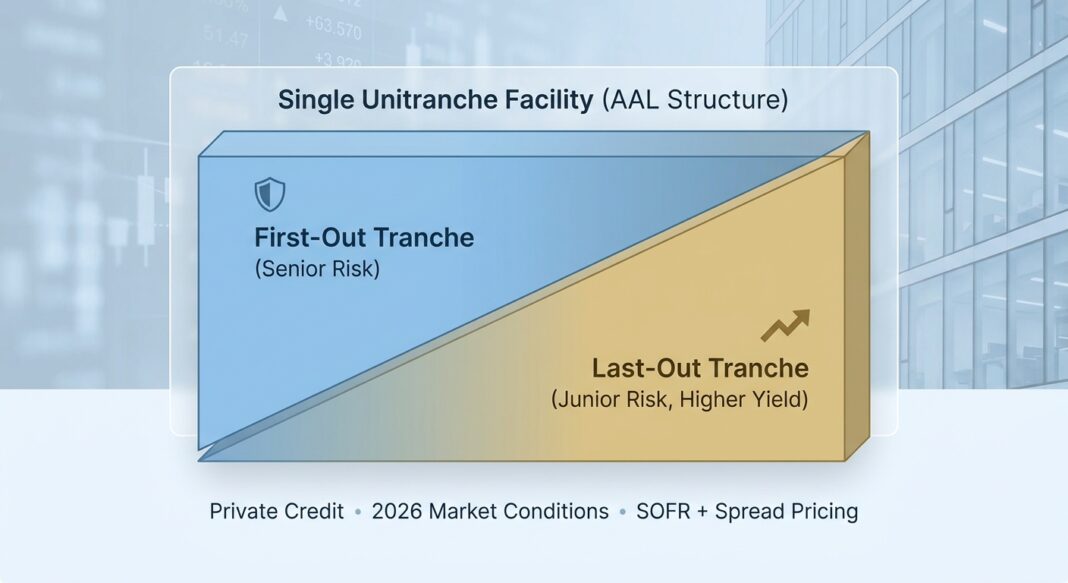
Unitranche financing is a single secured credit facility in which two or more groups of lenders share the same security interest on the borrower’s collateral, but agree among themselves, in a private document called an Agreement Among Lenders (AAL): on a payment priority and risk-sharing arrangement. The borrower sees and signs one loan document, pays one blended interest rate, and deals with one agent. The internal subordination is invisible to them.
The AAL typically divides the facility into two economic positions. The first-out tranche: often a revolving credit facility or a smaller term loan, receives priority on cash flows and recoveries in a default scenario. The last-out tranche: usually the larger term loan portion held by private credit funds, absorbs losses first while earning a higher spread to compensate. As Mayer Brown explains, the structure is intended to provide the first-out lender reduced risk and return, while providing the last-out lender increased risk and return, all within one streamlined facility for the borrower.
This internal split means a unitranche is not the same as a traditional first-lien / second-lien structure. In a first/second lien deal, two separate liens exist on the collateral, governed by a public intercreditor agreement. In a unitranche, both positions share a single first lien, and the subordination is governed entirely by the private AAL, a document the borrower typically never reviews.
How the Pricing and Numbers Work: A Concrete Example
Consider a private equity sponsor acquiring a software business for $100 million at 5.0x EBITDA (implying $20 million of annual EBITDA). The sponsor wants to minimize equity dilution and maximize leverage. A traditional bank might lend $40–50 million at conservative senior leverage. A unitranche lender, by contrast, can stretch to fund the full debt stack (senior and junior risk combined) in one facility.
Here is how the economics look in 2026 market conditions:
- Unitranche facility size: $60 million (3.0x EBITDA)
- Base rate (3-month Term SOFR): approximately 3.69% as of Q2 2026, per Valuation Research Corporation’s Q2 2026 Private Markets Trends report
- Credit spread (middle market unitranche): 4.75%–5.50% over SOFR, per the same report
- All-in yield range: approximately 9.00%–9.75%
- OID (Original Issue Discount): 1%–2% upfront (borrower receives $58.8–$59.4M, owes $60M)
- Prepayment schedule: 102 / 101 / par in years 1, 2, and 3
Underneath the blended rate, the first-out revolving lender might price at SOFR + 200–250 bps while the last-out term lender earns SOFR + 850 bps or more to compensate for absorbing losses ahead of the first-out position. The blended rate hides a real split: last-out lenders can price at SOFR + 850 bps or more and recover far less than first-out lenders in a default.
For the borrower, the annual interest cost on a $60 million facility at a 9.5% blended yield is approximately $5.7 million per year, a real but manageable cost on $20 million of EBITDA, especially compared to selling 20–30% equity to a growth investor.
Current Market Relevance: The Unitranche in 2026
Unitranche is not a niche innovation; it has become the default financing structure for sponsor-backed middle-market buyouts. The large-cap unitranche market roughly doubled to $210 billion of activity in 2024, up from $94 billion in 2023. The asset class supporting this volume has grown rapidly: global private credit assets under management reached approximately $2.1 trillion in 2025. Preqin projects that figure could reach $4.5 trillion by 2030.
The bank lending environment continues to create structural demand for these instruments. The Federal Reserve’s July 2026 SLOOS reported that C&I lending standards remained basically unchanged in Q2, while the April 2026 SLOOS found that banks reported tighter standards across all categories of non-depository financial institution (NDFI) loans over the prior year, with stricter covenants and higher risk premiums cited. This dynamic continues to push middle-market borrowers (particularly those that are service- or technology-oriented and lack hard collateral) toward private credit solutions.
On pricing, Lord Abbett’s 2026 Midyear Outlook notes that spreads have widened by roughly 50 to 100 basis points since late 2025, while credit structures on new loans have also improved, including tighter covenants and better documentation, a potentially favorable shift for investors deploying into the current vintage.
| Metric | Value | Source |
|---|---|---|
| Middle market unitranche all-in yield | ~9.00%–9.75% | VRC Q2 2026 |
| Unitranche coupon spread (over SOFR) | 4.75%–5.50% | VRC Q2 2026 |
| 3-month Term SOFR (June 2026) | ~3.69% | VRC Q2 2026 |
| Middle market direct loan spread (Octus, Q4 2025) | ~SOFR + 500 bps | Octus 2026 Outlook |
| Global private credit AUM (2025) | ~$2.1 trillion | Private Equity Bro |
| Preqin forecast: private credit AUM by 2030 | $4.5 trillion | IQ-EQ / Preqin 2026 |
Decision Framework: Investors and Operators
For investors evaluating private credit funds with unitranche exposure:
- Ask about first-out vs. last-out composition. A fund reporting “100% first-lien” exposure may still hold significant last-out risk. Investors consider requesting a breakdown of unitranche positions by tranche type before drawing conclusions about loss-given-default profiles.
- Evaluate the spread relative to the risk taken. At SOFR + 475–550 bps for last-out positions, investors weigh whether that premium adequately compensates for subordinated recovery rates in a stress scenario compared to true senior secured debt at SOFR + 250–350 bps.
- Assess vintage and covenant quality. Loans originated in the current environment (where, per Lord Abbett, credit structures are improving) may offer better terms than those originated during the 2022–2024 covenant-lite compression period.
For business operators evaluating unitranche financing:
- Value the certainty premium correctly. Unitranche financing can close 30 to 45 days faster than a syndicated alternative, which can justify 50–100 bps of additional spread when deal timing or purchase agreement certainty is critical.
- Model the all-in cost including OID and prepayment fees. A 2% OID on a $50 million loan means receiving $49 million while owing $50 million; the standard 2026 prepayment schedule (102/101/par) can offset much of the savings from refinancing into a lower-spread facility in years one or two.
- Match the structure to your business profile. Companies with niche operations, limited syndicated market demand, or complex buy-and-build strategies tend to benefit most. Companies with stable cash flows and hard collateral may access cheaper capital through bank revolvers or asset-based lending facilities.
Key Takeaways
- One loan, two risk profiles: A unitranche presents a single rate and single agent to the borrower, but the Agreement Among Lenders (AAL) creates a hidden first-out / last-out priority split that investors must understand before assessing a fund’s true risk exposure.
- Pricing reflects junior risk: Middle market unitranche loans currently price at SOFR + 475–550 bps, 100–200 bps above plain senior loans, because last-out lenders absorb first losses. The higher yield is compensation for subordination, not a free upgrade from traditional lending.
- Dominance is driven by speed, not cheapness: Unitranche structures dominate sponsor-backed mid-market M&A because they close faster and offer greater certainty than syndicated alternatives. Borrowers pay a spread premium for execution reliability, not a lower cost of capital.
- The 2026 environment is improving for new investors: Spreads have widened and covenant quality has strengthened since late 2025, meaning new vintage loans may offer a better structural setup than loans originated during the peak competition of 2022–2024.
- Ask the right diagnostic questions: For investors, the two essential questions are: what percentage of the fund’s unitranche book is last-out, and at what spread are new loans currently being written? For operators, the question is whether the certainty premium (in time, counterparty simplicity, and execution risk) is worth 50–100 bps of additional annual interest cost.


