
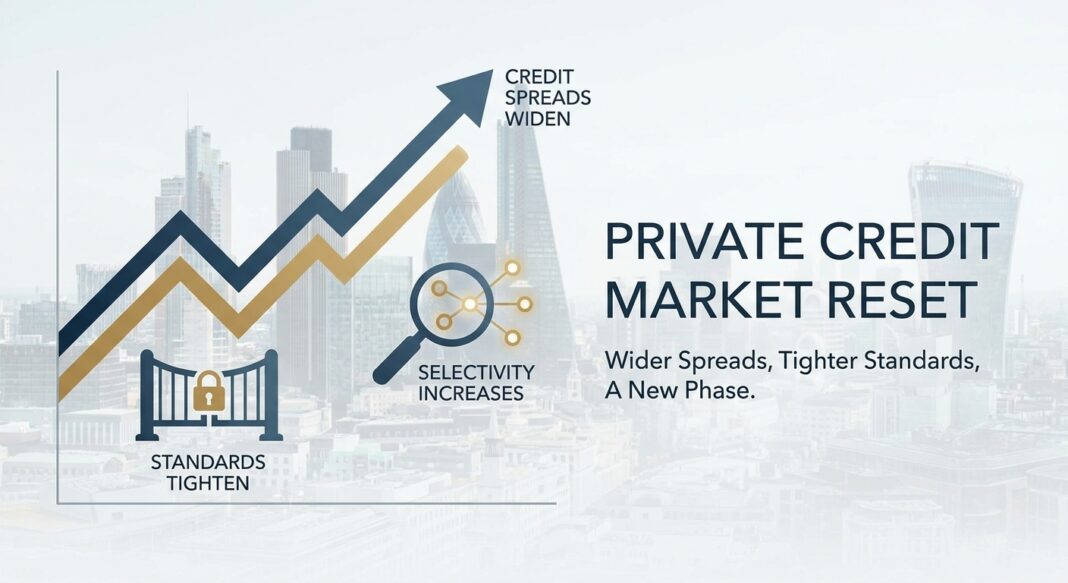
Market Headline: From Borrower’s Market to Lender’s Reset
As of late August 2026, the private credit market is navigating what many practitioners are calling a “lender-friendly reset”, a structural repricing away from the aggressive, borrower-accommodating environment of 2024 and early 2025. The catalyst is a convergence of macro headwinds: a higher-for-longer rate environment anchored by geopolitical instability, AI-driven sector disruptions, rising default rates in middle-market borrowers, and mounting regulatory scrutiny from the SEC and the Financial Stability Board. The result is a market in which capital is still abundant but increasingly selective, documentation is tightening, and the premium for credit quality has never been more pronounced.
Private credit spreads have widened by roughly 50 to 100 basis points since late 2025, according to PitchBook, with defensive loan terms also improving alongside that spread movement. Crucially, that repricing was not linear. Heightened volatility in early 2026 (driven by AI-related disruption concerns and geopolitical developments) pushed credit markets back into price discovery mode, slowing primary market activity late in Q1 while secondary spreads widened, particularly for technology and software-exposed credits. By Q2, conditions stabilized, but the bifurcation between strong and weak borrowers deepened sharply.
What stood out most during the second quarter was how selective markets became: strong borrowers continued to find financing, strong businesses continued to attract investors, and strong managers continued to separate themselves from the pack. For institutional investors and operators, this dispersion is now the defining feature of the credit cycle.
Quantitative Market Snapshot
The following data box summarizes key market metrics as of Q2/Q3 2026:
| Metric | Current Level (Q2/Q3 2026) | Prior Period | Source |
|---|---|---|---|
| Middle Market Private Credit Spreads (SOFR+) | ~S+500 bps | Mid-400 bps (mid-2025) | Hamilton Lane |
| Investment-Grade Credit Spreads | ~70 bps | ~55–60 bps (late 2025 est.) | Chicago Atlantic |
| High-Yield Bond Spreads | ~250 bps | ~300–350 bps (Q1 2026 peak) | Chicago Atlantic |
| Direct Lending Origination Volume (Q2 2026) | $33.6B (154 deals) | $74.7B / 217 deals (Q1 2026) | PitchBook/LCD via Angel Investors Network |
| Private Credit Default Rate (Proskauer Index, Q1 2026) | 2.73% (697 loans, $189.2B) | 1.84% (Q3 2025) | Forbes / Proskauer |
| Software Sector Secondary Spreads vs. B-Rated Loan Index | ~229 bps wider than B-rated loan index | Approx. at par (year-end 2025) | PitchBook LCD via VRC |
| 3-Month Term SOFR | 3.68% | 3.67% (Q1 2026) | VRC Q2 2026 |
| 5-Year U.S. Treasury Yield | ~4.23% | 3.92% (March 2026) | VRC Q2 2026 |
On the KPI front, underwriting standards are measurably shifting. Lenders are now underwriting to a forward-looking Fixed Charge Coverage Ratio (FCCR) that incorporates expectations for interest rates, which is constraining the amount of debt a company can support and, by extension, depressing leverage multiples. A study of middle-market CLO borrowers found that 10% lacked sufficient cash flow to cover interest payments, with many carrying high debt-to-EBITDA ratios and rated B-minus. The median implied EV/EBITDA acquisition multiple also declined: median implied EV/EBITDA multiples averaged 13.4x through the first half of 2026, lower than the 14.6x average recorded during 2025.
On the bank lending side, the July 2026 SLOOS delivered a mixed signal. The Federal Reserve’s July 2026 SLOOS reported basically unchanged standards for C&I loans to firms of all sizes over Q2, while banks reported stronger demand for C&I loans from large and middle-market firms and easier standards for commercial real estate loans. However, banks applied tighter conditions to non-depository financial institution (NDFI) loans: banks reported, on net, tighter standards for all categories of NDFI loans over the past year, with significant net shares of banks tightening standards for business credit intermediaries, consumer credit intermediaries, and private equity funds.
Sector Analysis: Winners, Losers, and Structural Shifts
Healthcare, Defensive but Cautioned
Healthcare led the way for private credit in 2025, accounting for 19% of all direct lending deals according to Octus Data. In healthcare, demographic shifts and non-cyclical service models continue to attract lenders seeking stable cash flows. However, not all healthcare subsectors are equal: Morgan Stanley’s direct lending team maintains a significant underweight to healthcare, which has led all sectors in loans placed on non-accrual status over the last year.
Technology & Software, Sharply Bifurcated
Performance in the software sector has been notably weak, where secondary spreads are approximately 245 basis points wider than year-end levels and roughly 229 basis points above the broader B-rated loan index, based on PitchBook LCD data as of June 19, 2026, reflecting continued uncertainty related to AI-driven disruption. At the same time, AI infrastructure represents a structural opportunity: Morgan Stanley estimates private credit could supply more than half the $1.5 trillion needed for global data center buildouts through 2028, according to a Reuters analysis of the AI-driven data center boom. There is also a rise in private credit financing in the technology space, where borrowers are tapping private credit to support companies with scalable business models, and private credit has been leading the development of financing structures for large-scale AI-related infrastructure.
Infrastructure, Expanding Structural Opportunity
In infrastructure, private credit is being used to fund large-scale projects, such as renewable energy developments, that require significant capital investment. By Q1 2026, direct lending’s share of private credit fundraising had fallen to 31%, while fundraising activity expanded across strategies including infrastructure debt, real estate credit, special situations, and other asset-backed opportunities. This reflects a deliberate rotation by institutional allocators toward more diversified and asset-backed strategies.
Lower Middle Market, Structural Advantage in Covenants
As more capital becomes concentrated in larger transactions, lenders in the lower-middle market often retain the ability to negotiate stronger covenant packages, tighter documentation, and more meaningful lender protections. This covenant premium is increasingly recognized as a return driver in its own right, particularly as BDC non-accrual rates trend upward in the upper-middle market.
Regulatory Overlay, A Structural Market Shift
Two regulatory developments are reshaping the competitive landscape. First, in December 2025, the OCC and FDIC issued a joint statement rescinding the 2013 Interagency Guidance on Leveraged Lending, expecting institutions to manage leveraged lending exposures consistent with general principles of safe and sound lending, a move that gives private credit lenders greater flexibility to underwrite a broader range of loans and develop institution-specific definitions of leveraged loans. Second, the SEC’s 2026 examination priorities reflect growing regulatory focus on private markets, including investment advisers’ adherence to fiduciary duties for products like private credit and private funds with investment lock-up for extended periods. On March 30, 2026, following an Executive Order calling for access to private credit for 401(k) investors, the Department of Labor unveiled a proposed rule to broaden access to alternative investments in private markets through workplace retirement plans.
Implications for Institutional Investors and Business Operators
For Institutional Investors / Lenders:
The widening spread environment is a signal of genuine opportunity, but only with discipline. Managers with dry powder can be more selective about the credits they choose to finance, and the second half of 2026 is likely to be defined by dispersion. The critical risk to monitor is the deployment gap: with so much capital competing for a shrinking pool of quality deals, GPs face real pressure to cut pricing, loosen covenants, or stretch on leverage multiples just to win a deal: though Q2 data suggests that, on balance, direct lenders chose to allow origination volume to fall rather than weaken credit standards.
Valuation and litigation risk have also moved to front of mind. Lawsuits filed in 2026 against several BDCs allege that fund managers misstated net asset values, delayed recognition of losses, and employed inadequate valuation processes. In Q1 2026 alone, investors sought to pull $20 billion from private credit funds, and facing sustained redemption pressure that approached structural liquidity limits, funds invoked gating provisions to limit the redemption amounts.
For Business Operators / Borrowers:
The borrower-friendly conditions of 2023–2025 are definitively over for lower-quality credits. Lender demand remains strong, and the market backdrop continues to favor high-quality borrowers, with higher risk premiums for AI-, tariff-, and cycle-exposed assets. Banks have gradually returned to the market in June 2026, contributing to increased competition in the upper middle market and alleviating some of the upward pressure on credit spreads. Operators should expect lenders to scrutinize forward-looking FCCR projections, cash interest coverage (not just EBITDA leverage), and the resilience of revenue streams to AI disruption and macro volatility.
Forward-Looking View: Liquidity and Lending Dynamics (Next 3–6 Months)
Market expectations continue to reflect a higher-for-longer rate environment, with the forward curve broadly flat as of June 2026. With SOFR unlikely to move materially in either direction before year-end, all-in yields will be driven primarily by spread dynamics. Private credit corporate lending assets under management are expected to exceed $2 trillion in 2026 and grow toward $4 trillion by the end of the decade. Capital is increasingly shifting toward specialist strategies, including asset-backed finance, non-sponsor lending, and the selective use of leverage.
The maturity wall, which dominated 2025 concerns, has been substantially addressed: as of June 30, just 15% of debt investments held by BDCs were due in 2026 and 2027, down from 20% at year-end 2024, representing $68.1 billion at cost currently versus $75.7 billion at year-end 2024. The refinancing overhang is clearing. What replaces it, M&A-driven new issuance, is picking up but remains below prior cycle volumes: middle market private equity deal value has increased approximately 10.7% year-over-year and exit activity has risen 14% over the same period, according to PitchBook data.
The regulatory environment will intensify, not moderate. The rapid growth of private credit and increased participation of retail and insurance capital is raising the level of regulatory oversight globally, with recent market developments including high-profile failures and redemption limits at semi-liquid funds intensifying the scrutiny. Managers that invest in compliance infrastructure, independent valuation processes, and transparent disclosure now are building a structural competitive advantage heading into an environment where regulatory friction will increasingly separate institutional-grade platforms from smaller players.
Key Market Insights
- Spread Reset is Real, Not Temporary: Middle market private credit spreads have re-widened to the S+500 bps range from mid-400 bps, driven by geopolitical uncertainty, AI disruption, and rising default rates. This represents a genuine risk-adjusted repricing, not technical noise.
- FCCR and Cash Coverage Are the New Underwriting Anchors: Lenders are stress-testing forward-looking FCCR under rate-shock scenarios. Borrowers with all-in interest coverage ratios below 1.1x face materially constrained access to capital regardless of EBITDA leverage metrics.
- Software Sector Remains a Structural Outlier: Secondary spreads in software credits are running approximately 229 bps wider than the broader B-rated loan index. Lenders are differentiating sharply between AI-enabled platforms and legacy software models facing displacement risk.
- The Deployment Gap is a Systemic Pressure Point: With Q2 2026 origination falling 55% quarter-on-quarter to $33.6 billion, GPs face mounting pressure to deploy dry powder. The discipline shown so far, accepting lower volumes rather than weaker standards, is the key metric to watch in H2 2026.
- Regulatory and Litigation Risk is Now a Core Return Variable: SEC examination priorities, FSB reporting, DOL 401(k) access rules, and BDC securities fraud litigation are converging to create meaningful operational risk for private credit platforms. Institutional-grade valuation governance and redemption structure design are no longer optional.


