
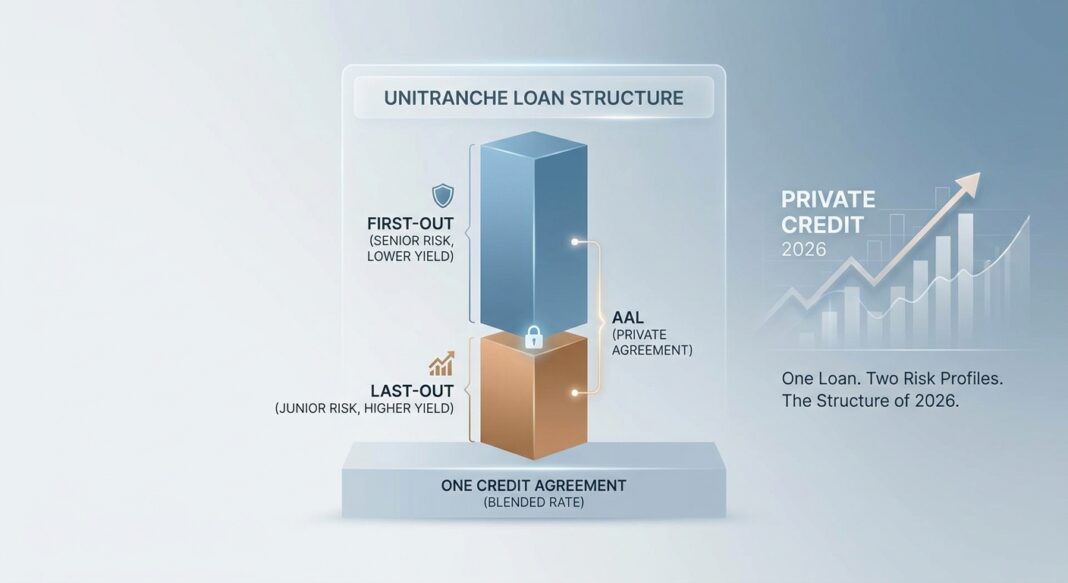
One Loan. Two Risk Profiles. The Structure Running Private Credit in 2026.
Walk into almost any private-equity-backed middle-market acquisition today and you will find a unitranche loan at the center of the capital structure. On the surface it looks like a single, senior-secured term loan with one interest rate and one credit agreement. Underneath, it is something more sophisticated: a carefully engineered blend of senior and junior risk, divided between lenders through a confidential side agreement the borrower never signs and rarely sees.
Understanding how unitranche financing actually works, not just what it is called, is one of the most important analytical skills in private credit today. For investors evaluating direct lending funds, it determines whether a stated yield is truly senior-secured income or something closer to mezzanine risk priced at a senior-sounding spread. For business owners and operators raising capital, it determines whether one-stop financing will genuinely simplify a transaction or carry hidden structural complexity.
This article unpacks the mechanics, the economics, and the decision framework behind the structure that now dominates new private credit issuance.
What Is a Unitranche Loan?
A unitranche loan merges what would traditionally be two separate debt instruments (a senior secured term loan and a subordinated or mezzanine piece) into one credit agreement with a single blended interest rate. The borrower sees one lender group, signs one set of documents, and services one interest obligation. The structural complexity is resolved entirely between the lenders in a private contract called an Agreement Among Lenders (AAL).
Inside the AAL, the loan is divided into two economic positions. The first-out (FO) tranche receives principal and interest payments first in any distribution; it carries the lowest credit risk and commands a lower internal spread. The last-out (LO) tranche absorbs losses first, is repaid after the first-out lender is made whole, and receives a higher internal spread to compensate for that subordinated risk profile.
As Mayer Brown explained in a July 2026 analysis of these structures, the first-out/last-out arrangement achieves a form of internal subordination within a single credit facility, without requiring a separate intercreditor agreement or a second lien. The AAL governs the payment waterfall, voting rights on amendments, enforcement control, and how fees are split, all invisible to the borrower at closing.
How the Economics Work: A Concrete Example
Suppose a private equity sponsor is acquiring a software business for $100 million and wants to finance $60 million of that with debt. A direct lender arranges a $60 million unitranche priced at SOFR + 550 bps (approximately 9.25% all-in at mid-2026 rates). The borrower signs one loan agreement and pays that single blended rate.
Behind the scenes, the AAL divides the loan as follows:
- First-Out Tranche, $20 million held by a bank partner. Internal AAL spread: SOFR + 300 bps. This lender gets paid first in any enforcement scenario and assumes the lowest risk.
- Last-Out Tranche, $40 million held by the private credit fund. Internal AAL spread: SOFR + 675 bps. This lender absorbs first-dollar losses and is compensated with a materially higher effective yield.
The borrower’s experience is simple: one closing, one set of covenants, one wire. The lenders’ experience is more complex: they have negotiated a detailed AAL governing who controls enforcement if the company misses a payment, who can block amendments, and under what conditions the first-out lender can buy out the last-out lender (or vice versa).
This is precisely the dynamic described by legal practitioners: the blended rate visible to the borrower is re-allocated through an interest skim mechanism in the AAL, with last-out lenders receiving additional economics to compensate for their subordinated position in the capital structure.
The AAL is also kept confidential from the borrower, a feature noted by McDermott Will & Emery: the side agreement between lenders is a separate document not shared with borrowers, which is a meaningful asymmetry that operators and their counsel should account for in diligence.
Current Market Reality: Unitranche by the Numbers
The unitranche structure is not a niche instrument; it is the dominant format for private credit deal execution today. According to Alternative Fortune (March 2026), the large-cap unitranche market roughly doubled to $210 billion of activity in 2024, up from $94 billion in 2023.
Pricing data from Q2 2026 illustrates where the market sits today:
| Metric | Current Level (Q2 2026) | Source |
|---|---|---|
| Unitranche all-in yield range | ~9.00% – 9.75% | VRC Q2 2026 |
| Unitranche coupon spreads (new issuance) | SOFR + 475–550 bps | VRC Q2 2026 |
| LMM direct lending spreads (vs. BSL premium) | ~100–150 bps above syndicated market | Alternative Fortune / Chicago Atlantic, 2026 |
| 3-month Term SOFR (June 2026) | 3.69% | VRC Q2 2026 |
| Cliffwater Direct Lending Index (CDLI), 2025 full-year return | 9.3% (interest income: 10.4%) | Cliffwater / Morningstar, March 2026 |
| CDLI trailing year return (ending June 30, 2026) | 7.7% | Cliffwater / PR Newswire, August 2026 |
| U.S. private credit market AUM | ~$1.3 trillion | Creative Planning / Preqin, March 2026 |
It is also worth noting the broader macro backdrop shaping demand for unitranche structures. According to the Federal Reserve’s July 2026 SLOOS, bank lending standards for C&I loans held broadly unchanged in Q2 2026, but banks reported tighter standards across all categories of non-depository financial institution (NDFI) loans over the prior year: including stricter covenants, higher risk premiums, and shorter maturities. This environment continues to push middle-market borrowers toward private credit solutions that offer certainty of execution and structural flexibility that banks are pulling back from.
Lord Abbett’s 2026 midyear outlook noted a lender-friendly shift underway: spreads widened roughly 50 to 100 basis points from late 2025 levels, while new loans are increasingly carrying better credit structures, according to PitchBook data, a meaningful structural improvement for incoming capital.
Decision Framework: What Investors and Operators Should Ask
For Investors Evaluating Direct Lending Funds:
- Ask about last-out concentration. A fund advertising a 9%+ yield may hold a large proportion of last-out positions. Last-out lenders price at SOFR + 850 bps or higher internally, but they also absorb first-dollar losses in default. Understand the actual loss-absorption profile, not just the stated yield.
- Read the vintage vs. forward yield distinction. The Cliffwater CDLI’s 20-year average return of 9.5% was earned on loans written at older, wider spreads. New loans being written at SOFR + 450–500 bps will generate lower forward income than historical benchmarks imply. Treat stated yields as forward estimates, not historical guarantees.
- Examine AAL control rights. In a stress scenario, who controls enforcement, first-out or last-out lenders? Some AALs give last-out lenders broad blocking rights; others give first-out lenders rapid step-in rights after a short standstill. This affects recovery timing and outcome for all capital in the structure.
- Evaluate covenant quality. The lender-friendly reset underway in mid-2026 has improved documentation terms. Investors considering new allocations may find better structural protection now than in the looser 2024–2025 vintage window.
For Business Owners and Operators Evaluating Unitranche Financing:
- Unitranche is not always cheaper; it is simpler. Borrowers pay a spread premium over a plain bank senior loan in exchange for execution speed, covenant flexibility, and a single point of contact. Evaluate whether that simplicity premium is worth it relative to your deal timeline and complexity.
- Negotiate equity cure rights carefully. Standard 2026 unitranche terms include equity cure rights, typically allowing 4 cures over the loan life, with no more than 2 in any consecutive 4-quarter window. How cure proceeds are calculated and applied can meaningfully affect covenant headroom.
- Understand prepayment economics before signing. Standard 2026 prepayment schedules run 102/101/par over years 1–3. If your business plan involves a refinancing or sale event in year 1 or 2, prepayment fees should be modeled as a direct cost.
- Request clarity on the AAL’s enforcement provisions. While the AAL is confidential, operators and their legal counsel can ask direct questions about standstill periods, who controls workout decisions, and whether the first-out lender can accelerate independently.
Key Takeaways
- A unitranche is one loan with two hidden risk profiles. The borrower sees a single blended rate; the lenders divide that rate into first-out and last-out economics through a confidential Agreement Among Lenders.
- Last-out risk is junior risk inside a first-lien wrapper. The last-out tranche absorbs losses first and prices significantly higher internally, investors must understand how much of any fund’s book sits in last-out positions.
- Unitranche yields of 9–9.75% in mid-2026 are 250 bps below 2023 peak levels but remain above pre-2022 historical ranges. Forward income will differ from historical CDLI benchmarks for new capital deployed today.
- Bank credit tightening for NDFIs and middle-market firms continues to drive deal flow into private credit, keeping the unitranche structure central to leveraged buyout and growth financing activity.
- A lender-friendly structural reset is underway in H2 2026. Wider spreads and improved covenant terms since late 2025 represent better entry conditions for new private credit allocations relative to the prior two years.


