
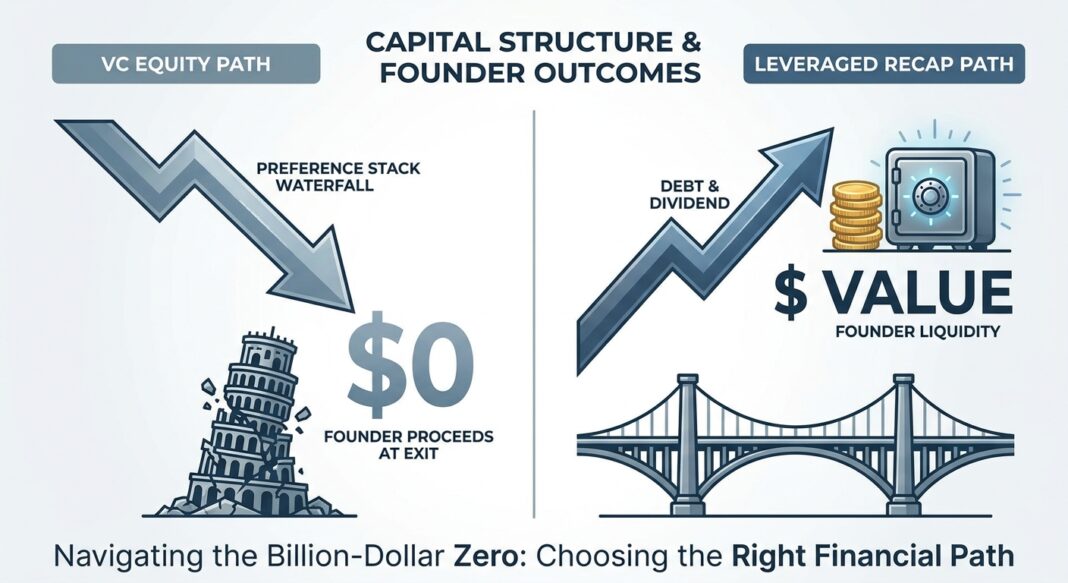
The Story: A Billion Dollars. Zero for the Founders.
In January 2025, Divvy Homes, a rent-to-own proptech platform that had once been the darling of Silicon Valley, was acquired by Brookfield Properties for approximately $1 billion. On the surface, a unicorn exit. The kind of outcome founders dream about. Except it wasn’t.
CEO and co-founder Adena Hefets wrote a letter to shareholders confirming the unthinkable: after paying down outstanding debt and fulfilling the liquidation preferences of preferred shareholders from multiple VC rounds, neither common shareholders, employees, nor founders would receive any proceeds from the sale. A billion-dollar exit. Zero dollars to the people who built it.
This was not a fraud story. It was not a mismanagement story. It was, at its core, a capital structure story.
Divvy had launched in 2017 with a genuinely transformative model, purchasing homes for renters, leasing them back while those renters built savings toward a down payment. By 2021, the company carried a $2.3 billion valuation. By the end of 2018, they had raised $45.5 million. By 2019, they had hit unicorn status. The momentum was undeniable.
Then interest rates surged in 2022, and the model fractured. Three rounds of layoffs followed. New home acquisitions were paused entirely in 2023. When Brookfield swept in with a $1 billion offer in early 2025, it looked like a lifeline. From the inside, it was a financial devastation, the waterfall consumed everything before a single dollar reached the founders or their team.
The real question isn’t why Divvy failed to return value at exit. The question is: was there a different capital path that could have allowed the founders to de-risk earlier, preserve more ownership, and protect against exactly this kind of outcome? There was. And thousands of mid-market operators are choosing it right now.
The Decision: What the Waterfall Actually Looks Like
To understand why Divvy’s founders received nothing, you need to understand how venture capital is structured to win first. Every VC round comes with liquidation preferences, legal rights that guarantee preferred shareholders get paid back before any common shareholder sees a cent. Those preferences stack with each round.
Common shareholders and holders of Series FF preferred stock, typically awarded to founders, are structurally last in line. Debtholders and preferred shareholders move first. Transaction costs move first. By the time the waterfall reached those who built the business, the billion dollars had been distributed entirely upstream.
This is not a bug in the VC system. It is the feature. Equity investors invest based on the goal of companies being acquired or going public within a relatively short time period, and they engineer their returns into the capital structure from day one. Founders are subject to forced liquidity timelines and preference stacks that quietly erode everything they built.
Now consider the alternative, one thousands of profitable mid-market operators are executing today.
⚠️ Hypothetical Scenario, Clearly Labeled
The following is a constructed illustration using real market benchmarks, not a real company. It is presented to show how a leveraged recapitalization would have mechanically altered the outcome for a founder in a similar position.
Imagine a founder-owned home services platform, call it ClearPath Services: generating $8 million in EBITDA by Year 5, with stable recurring contract revenue and strong cash conversion. The founder is considering two paths:
| Decision Point | Path A: VC Equity Round | Path B: Leveraged Recapitalization |
|---|---|---|
| Capital raised | $20M Series A at $70M pre-money valuation | $20M unitranche debt at 4x EBITDA |
| Founder dilution | ~22% ownership surrendered immediately | 0%, founder retains 100% equity |
| Immediate founder liquidity | $0 (secondary not offered at Series A) | $18M cash dividend to founder (after fees) |
| Board control | Investor board seat + protective provisions | Founder retains full operational control |
| Exit timeline pressure | Forced: VC fund life demands exit in 5–7 years | None: founder chooses timing and buyer |
| All-in cost of capital (2025 market) | Equity cost: 25–35% IRR demanded by VC | Debt cost: ~9.3% all-in yield (2025 average) |
Using real 2025 market benchmarks (where average all-in yields on mid-market direct lending ran approximately 9.3%, and lower middle-market recaps typically close at 3x to 5x EBITDA in total debt) ClearPath would have had full access to this structure if its cash flows were predictable and covenants serviceable. The debt is serviced from operating cash flow. The founder keeps the upside. There is no preference waterfall waiting to consume the exit proceeds.
The Outcome: What the Numbers Actually Mean at Exit
Return to Divvy. The company sold for $1 billion in January 2025, a 57% discount to its 2021 peak valuation of $2.3 billion. But the discount to headline valuation wasn’t the fatal issue. The fatal issue was that hundreds of millions of dollars in debt repayment moved first, followed by a layered preference stack from Series A through Series D investors. What remained for common shareholders and founders was, in Hefets’ own words, nothing.
Now replay the ClearPath hypothetical under the recapitalization path. If ClearPath grows its EBITDA from $8M to $14M over the following four years, a reasonable 15% annual growth rate for a well-run services business, and exits at a 7x EBITDA multiple, the enterprise value at exit is approximately $98 million. Remaining debt balance (after four years of amortization on a $20M facility) might be $12–14M. The founder takes home roughly $84–86 million at exit. All of it.
Under the VC equity path, with a 22% first-round dilution, two additional rounds of funding (each diluting further), and a liquidation preference waterfall, the founder’s effective share of that same $98M exit could drop to 30–40% of the net proceeds after preferences, or, in a scenario where valuations compressed, potentially far less. The ClearPath founder would have pocketed $18M in immediate liquidity from the recap and captured the majority of the exit value years later. Under the VC path, the same founder might have received nothing if the market shifted mid-cycle.
The math isn’t abstract. The Divvy story makes it concrete. And it is happening at scale: PE-owned companies borrowed roughly $94 billion in leveraged loans and high-yield bonds in 2025 to fund dividend recapitalizations, a post-financial-crisis record, according to Moody’s data. Sponsors returned approximately $50 billion directly to private equity owners through these structures in 2025 alone, up from $33 billion in 2024. These are not exotic transactions. They are the mainstream mechanism by which sophisticated owners extract liquidity without surrendering control.
The Lessons: A Framework for Founder-Owners Facing This Decision
The Divvy story is not an argument against ambition, or against raising capital. Divvy helped over 15,000 residents start a path to homeownership. That mission was real. But the capital structure choices made at the height of the market created a waterfall that eliminated founder value entirely when conditions deteriorated.
Here is a framework for any founder or operator facing a similar decision:
1. Separate liquidity from growth capital
A leveraged recapitalization is not growth capital; it is personal liquidity engineered into the business’s balance sheet. If your business generates reliable free cash flow, you do not need to sell equity to de-risk personally. You can borrow against the cash flows of the business you built, pay yourself a dividend, and keep your ownership intact. This is what a leveraged recap does.
2. Know where you sit in the waterfall: before you sign
Every VC term sheet carries liquidation preferences. Every new round adds a new layer above you. Founders are structurally last. By contrast, in a recapitalization structure, the debt is a fixed obligation with a defined repayment schedule; there is no preference stack eroding your exit proceeds. Your equity is your equity, senior to no one.
3. Assess fit: cash flow is the qualifying criterion
A leveraged recap is appropriate when: the business generates stable, recurring cash flows sufficient to service debt; EBITDA margins are defensible; the founder seeks liquidity without loss of control; and there is no immediate appetite to sell the entire company. Debt providers focus on your ability to repay, examining cash flow predictability, burn rates, and downside scenarios. If those metrics are strong, you likely qualify, and you may not need to sell a single share.
4. Understand the real cost of equity
Equity capital is not free. A VC demanding 25–35% IRR is an extraordinarily expensive partner: one who also controls your exit timeline, sits on your board, and holds preferences that dominate the waterfall. In 2025, average all-in yields on mid-market direct lending ran approximately 9.3%, down from 10.5% in 2024, as base rates declined. The cost of structured debt capital has rarely been more competitive against the implicit cost of equity.
5. Timing matters: de-risk before the cycle turns
Divvy’s founders built real value. Their mistake was not one of execution; it was one of timing. The capital structure that worked at zero interest rates became lethal when rates surged in 2022. A leveraged recap completed at peak earnings, at a defensible leverage multiple, would have extracted personal liquidity before the cycle turned. That liquidity is permanent, regardless of what happens to valuations subsequently.
Key Insights
- 💥 The billion-dollar zero is real: Divvy Homes sold for $1 billion in January 2025, and its founders, employees, and most investors received nothing, consumed entirely by debt repayment obligations and layered VC liquidation preferences.
- 📊 The market is validating the recap: Leveraged loan issuance for dividend recapitalizations grew to $74.3 billion in 2025, the highest recorded level, as owners across every sector used structured debt to extract liquidity without triggering a full exit.
- 🏦 Private credit has made this accessible to the mid-market: With average all-in yields declining to approximately 9.3% in 2025 and typical mid-market leverage multiples of 4–5x EBITDA, the leveraged recap is no longer a large-cap-only tool; it is available to operators with $5M+ EBITDA and predictable cash flows.
- ⚖️ The real cost of VC equity is 25–35% IRR plus control: Every equity round dilutes founders, introduces liquidation preferences, imposes board governance, and creates exit timeline pressure. Structured debt costs a fraction of that and does none of those things, if the business can service it.
- 🔑 The qualifying criterion is cash flow, not growth rate: A leveraged recapitalization is right for stable, cash-generative businesses, not hyper-growth, pre-revenue startups. Founders who understand this distinction can design a capital strategy that delivers personal liquidity, preserves equity ownership, and keeps every exit option open.


