
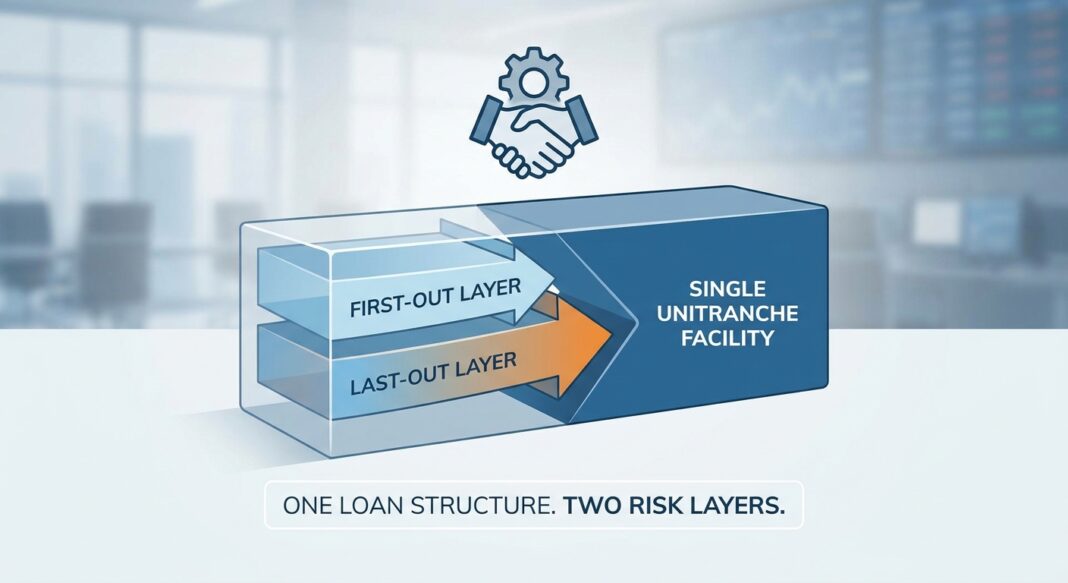
Why One Loan Is Often Two in Disguise
When a private equity sponsor closes a $75 million acquisition today, there is a good chance the debt package looks deceptively simple on the term sheet: one lender, one credit agreement, one blended interest rate. But that apparent simplicity conceals a sophisticated structure that has quietly reshaped how middle-market companies access capital. That structure is the unitranche loan, and understanding how it works (and how it prices) is foundational knowledge for anyone participating in private credit markets, whether as a capital provider or a borrower.
Unitranche has become the default financing instrument in the lower and core middle market. According to CT Acquisitions (June 2026), the unitranche market grew from roughly $20 billion in annual issuance in 2015 to over $200 billion by 2025, as direct lenders steadily displaced traditional bank syndication for sub-$1 billion EBITDA borrowers. Understanding what you are actually buying (or borrowing) requires looking beneath the single credit agreement.
The Core Concept: One Loan, Two Risk Layers
A unitranche loan merges what were traditionally two separate financing instruments (a senior secured loan and a subordinated or mezzanine loan) into a single credit facility with one blended interest rate. As explained by Mayer Brown (July 2026), the structure involves a single secured credit facility in which two or more groups of lenders share the same security interest on the borrower’s collateral, while privately agreeing among themselves on payment priority.
That private agreement is called the Agreement Among Lenders (AAL). The AAL carves the single facility into a “first-out” piece and a “last-out” piece, a structure the market calls FOLO (first-out/last-out). As Alternative Fortune (March 2026) describes it, the first-out lenders get repaid first and take the lower return, while last-out lenders absorb more risk and earn a higher spread. The borrower, however, sees only one loan and makes one interest payment.
Critically, this is not the same as a traditional first lien / second lien arrangement. In a first/second lien deal, two separate liens exist on collateral, governed by an intercreditor agreement between competing secured parties. In a unitranche, per Mayer Brown (July 2026), there is only one lien, the internal payment subordination lives entirely within the AAL, invisible to the borrower and to courts in a standard enforcement scenario.
According to PipelineRoad (March 2026), a unitranche typically provides total leverage reaching 5–6x EBITDA in a single facility, compared to the 3–4x a senior-only lender would typically provide, effectively stretching the debt capacity without requiring the borrower to negotiate with multiple creditor groups.
How It Works in Practice: A Worked Example
Consider a private equity sponsor acquiring a specialty distribution business at a $100 million enterprise value. The business generates $14 million in EBITDA. The sponsor contributes $45 million in equity (45% equity cushion) and finances the remaining $55 million through a unitranche facility at approximately 4.0x leverage.
The term sheet the borrower signs:
- Facility: $55 million unitranche term loan
- Rate: SOFR + 575 basis points (blended)
- Original Issue Discount (OID): 2%
- Prepayment schedule: 102 / 101 / par (years 1, 2, 3+)
- Maintenance covenant: Maximum leverage of 5.5x; minimum fixed charge coverage of 1.15x
What the lender club sees internally (the AAL):
- First-out lender (e.g., a bank or senior-focused BDC): holds $20 million at approximately SOFR + 350 bps, senior-equivalent risk and return
- Last-out lender (e.g., a direct lending fund): holds $35 million at approximately SOFR + 725 bps, subordinated-equivalent risk and return
The blended rate of roughly SOFR + 575 bps is what the borrower pays. Based on current SOFR levels, CT Acquisitions (June 2026) pegs typical all-in unitranche pricing in 2026 at SOFR + 500–700 bps, with all-in yields of approximately 9.5–11% for a standard 5x leverage deal. Separately, the OID means the borrower receives $53.9 million at funding but owes $55 million in principal, the $1.1 million difference accretes as additional yield to the lender over the loan’s life.
For the operator, the entire $55 million is negotiated in one process, documented in one agreement, and managed with one relationship post-close. According to CT Acquisitions (June 2026), a unitranche typically closes in 45–90 days versus 90–150 days for a traditional senior-plus-mezzanine syndication, a material advantage for roll-up platforms executing frequent add-on acquisitions.
Current Market Relevance
The unitranche structure has never been more dominant, or more closely scrutinized. Here is where the market stands as of mid-2026:
| Metric | Current Level | Source |
|---|---|---|
| Unitranche coupon spread (new issuance) | SOFR + 475–550 bps | VRC Q2 2026 |
| Unitranche all-in yield range | ~9.00% – 9.75% | VRC Q2 2026 |
| Typical total leverage (LMM unitranche) | 4–6x EBITDA | CT Acquisitions June 2026 |
| Global private credit market size | ~$1.7 trillion AUM | CT Acquisitions / Preqin 2025 |
| H1 2026 private credit fundraising | $262 billion (record H1) | Credit Crunch / Preqin June 2026 |
| Bank C&I lending standards (Q2 2026) | Basically unchanged | Federal Reserve SLOOS July 2026 |
| Unitranche yield vs. 2023 peak | ~250 bps below 2023 peak of 11.5–12.5% | VRC Q2 2026 |
A critical backdrop: the Federal Reserve’s July 2026 SLOOS reports that bank lending standards for commercial and industrial loans were basically unchanged in Q2 2026, with banks noting that current standards are easier than the midpoint of their historic ranges since 2005. This matters for unitranche because it signals that, for now, the acute bank retrenchment that drove middle-market borrowers toward private credit in 2022–2023 has moderated. Yet the private credit ecosystem has permanently expanded, The Credit Crunch (June 2026) reports that private credit managers raised $262 billion in H1 2026, 30% above the prior year’s pace, setting a new record for first-half fundraising.
Meanwhile, PitchBook’s 2026 US Private Credit Outlook notes that with private credit loan supply expected to increase, spreads will stabilize or widen, a caution for investors underwriting new commitments at today’s compressed yields. Current unitranche all-in yields of roughly 9.00–9.75%, per Valuation Research Corp. (Q2 2026), represent a decline of approximately 250 basis points from peak 2023 levels, though they remain above the pre-2022 historical range of 7–8%.
Decision Framework: Investors and Operators
For Investors Evaluating a Unitranche Allocation
Not all unitranche positions carry the same risk. Investors should evaluate three structural questions before committing capital:
- First-out or last-out exposure? A fund marketing itself as a unitranche strategy may hold predominantly last-out positions, which carry subordinated economics despite appearing in a first-lien credit agreement. Investors consider asking managers to disclose what percentage of their book is last-out and at what average spread those positions were originated. As Alternative Fortune (March 2026) notes, a unitranche prices above a plain senior loan precisely because it is carrying junior risk inside the same wrapper.
- Covenant quality: According to PipelineRoad (March 2026), unitranche facilities typically include maintenance covenants, a meaningful lender protection compared to the broadly syndicated market where covenant-lite has become standard. Common covenants include a maximum total leverage ratio and a minimum fixed charge coverage ratio. Investors evaluate whether those levels provide adequate early-warning headroom.
- Spread vs. vintage risk: Loans being written today at SOFR + 475–550 bps lock in thinner economics for years ahead. Investors in newer vintage funds should consider whether current spread levels adequately compensate for last-out risk relative to older vintages originated at wider spreads.
For Operators Deciding Whether to Use a Unitranche
The unitranche trade-off is straightforward: operators pay a spread premium of roughly 50–100 basis points above a comparable senior-only structure, in exchange for speed, certainty of execution, and a single lender relationship. According to CT Acquisitions (June 2026), the optimal use case is transactions with enterprise values between $25 million and $200 million: below that range, SBA or senior bank financing wins on cost; above $300 million, the broadly syndicated loan market typically wins on pricing. Operators evaluate this structure when timeline certainty matters more than minimizing the last basis point of coupon.
Key Takeaways
- One loan, two risk layers: A unitranche combines senior and subordinated debt into a single credit agreement with a blended rate. The internal FOLO split lives in the Agreement Among Lenders (AAL), invisible to the borrower, but fundamental to investor risk assessment.
- The borrower pays a speed premium: Unitranche pricing at SOFR + 475–700 bps is higher than a pure senior loan. What operators are buying is not the lowest coupon; it is a faster, simpler, more certain financing process with a single point of contact post-close.
- Current yields are compressed but still above pre-2022 norms: All-in unitranche yields of 9.00–9.75% in mid-2026 are approximately 250 bps below peak 2023 levels, according to Valuation Research Corp., but remain above the pre-2022 range of 7–8%, offering investors a meaningful spread over public credit benchmarks.
- Investor due diligence must look through the label: A “first-lien private credit” fund may hold significant last-out exposure. Investors consider requesting transparency on first-out vs. last-out composition and the spread earned on each layer before committing capital.
- Market context matters: Record H1 2026 private credit fundraising of $262 billion, per Preqin data, means more capital is competing for a relatively stable deal pipeline, a dynamic that pressures spreads and rewards disciplined underwriters over scale deployers.


