
The Credit Cycle Has Turned: Private Credit Enters a Lender-Friendly Regime
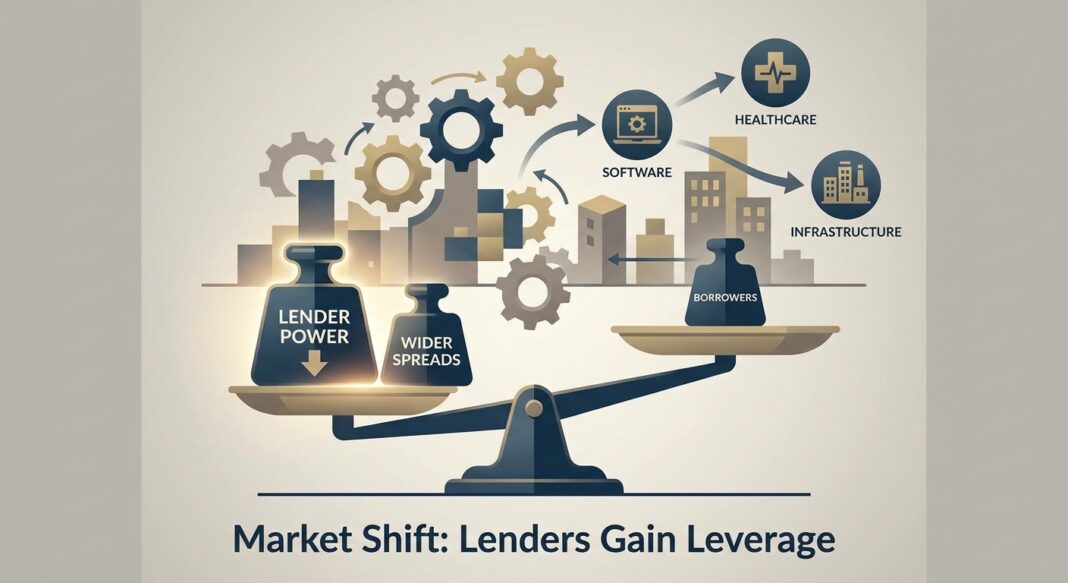
For the first time since the zero-rate era, the architecture of private credit is shifting decisively in favor of lenders. After years in which abundant fundraising capital chased a constrained deal pipeline (compressing spreads, elevating leverage, and loosening documentation) the market has corrected. Spreads in the middle market have widened by roughly 50 to 100 basis points since late 2025, covenants are tightening, and managers with dry powder are gaining the structural leverage to dictate terms rather than accept them.
This reset did not arrive gently. A confluence of forces in early 2026, geopolitical shock from a renewed Middle East conflict involving Iran, a sharp AI-driven selloff in software and technology credit, investor redemption pressure at select private credit vehicles, and persistent higher-for-longer base rates, simultaneously reduced capital supply and forced rigorous price discovery. The result is a market recalibration that is textbook late-cycle, but structurally more nuanced than a simple tightening.
Critically, the Fed’s July 2026 SLOOS survey adds an important macro counterweight: bank C&I lending standards have stabilized and are now easier than the historical midpoint of standards since 2005, and demand from large and middle-market firms is strengthening. This means private credit lenders face a two-sided dynamic, improved deal terms and spreads on one side, but renewed bank competition on the other. The second half of 2026 will be defined by disciplined capital deployment, sector selectivity, and the performance divergence between vintages underwritten before and after the 2026 repricing.
Quantitative Market Snapshot: August 25, 2026
The following table synthesizes the most current publicly available market data across spreads, yields, deal metrics, and credit quality indicators. All figures are sourced and dated.
| Metric | Current Value (Q2/Q3 2026) | Prior Period | Change | Source |
|---|---|---|---|---|
| Middle Market Unitranche Spread | S+475–550 bps | S+450–500 bps (YE 2025) | +25–50 bps wider | VRC Q2 2026 |
| Direct Lending All-In Yield (New Issues) | ~9.0% (3.9% base + 5.1% spread/fees) | <10% first seen in three years (late 2025) | Repricing upward in 2026 | Blackstone BCRED 8-K, Q2 2026 |
| Spread vs. High Yield Bonds (Private Credit Premium) | ~150–200 bps over public HY | ~350 bps (2019) | Significant compression over cycle | Owners.pe, Apr 2026 |
| Middle Market Leverage (LBO Transactions) | 5.0x–6.0x total debt / EBITDA (high-quality deals) | Trending higher in 2025; now conservative since March 2026 | Standards tightening post-March 2026 | VRC Q2 2026 |
| Private Credit Default Rate (Fitch, TTM) | 6.0% (Fitch, April 2026); KBRA DLD: 1.5% by volume (May 2026) | 5.7% TTM (Fitch, Nov 2025) | Rising; KBRA forecast 2.5%–3.5% for full-year 2026 | Forbes / Fitch, May 2026 |
| Bank C&I Lending Standards (SLOOS, Large & Mid-Market Firms) | Basically unchanged / easing vs. historical midpoint | Tighter (Q1 2026, April SLOOS) | Eased Q2 2026; C&I demand strengthening | Federal Reserve SLOOS, July 2026 |
| 3-Month Term SOFR | 3.69% (June 2026) | 3.68% (March 2026) | Broadly flat; forward curve elevated ~50 bps vs. YE 2025 | VRC Q2 2026 / Chatham Financial |
| Public High-Yield Spreads | ~270–305 bps (compressed; near 20-year lows in July) | 316 bps (early 2026 high) | Tightened sharply; near historic lows | Bankers Edge Advisory, Aug 4, 2026 |
Data Box Note: Spread figures reflect senior secured, first-lien or unitranche structures. Default rates vary by methodology; Fitch includes selective defaults/distressed exchanges. KBRA DLD figures are payment-default based. All figures current as of the most recent publicly available reporting period.
Key Macro Context: The SOFR Floor and Higher-for-Longer Reality
The forward rate environment is a critical input for every leveraged credit underwrite in 2026. Three-month Term SOFR stands at approximately 3.69% as of June 2026, while the 5-year Treasury rose to roughly 4.23% in June, up from 3.92% in March. Market expectations continue to reflect a higher-for-longer rate environment, with the forward curve broadly flat as of June 2026. Meanwhile, Nuveen’s most recent fixed income commentary forecasts the 10-year Treasury yield ending 2026 between 4.25% and 4.50%, with the Fed remaining on hold through year-end. For floating-rate private credit borrowers, this sustained base rate environment continues to test interest coverage ratios, a point with direct implications for FCCR covenants and lender underwriting models.
The structural consequence is stark: by early 2026, interest coverage ratios for many mid-market firms had plummeted below 1.0x, the result of 2021–2022 vintage loans underwritten at near-zero base rates now serviced at SOFR-plus in a 3.5–4%+ base rate environment. For lenders, requiring minimum FCCR covenants of 1.10x–1.25x on new originations is no longer conservative best practice; it is table stakes.
Sector Analysis: Capital Rotating Hard, Hot Sectors, Cold Sectors
🔴 Under Pressure: Software & Technology Services
The most significant structural credit story of 2026 is the collapse in lender appetite for software and SaaS. Performance in the software sector remains notably weaker, with secondary spreads approximately 245 basis points wider than year-end levels and roughly 229 basis points above the broader B-rated loan index, per PitchBook LCD data as of June 2026. The AI disruption narrative, crystallized by the AI-driven software selloff earlier in 2026, has fundamentally challenged the recurring revenue and EBITDA growth assumptions embedded in SaaS underwriting models.
The practical consequence: since the year began, the healthcare sector surpassed technology as the dominant private credit deal sector. Borrowers like cybersecurity company Sophos, which had marketed a $2.6 billion refinancing to private credit at pricing of approximately SOFR+575 bps, pivoted to the broadly syndicated loan market instead, a concrete signal of pricing dysfunction in private credit software lending.
🟢 In Favor: Healthcare & Life Sciences
Healthcare led all sectors for private credit in 2025, accounting for 19% of all direct lending deals, according to Octus Data. That momentum is accelerating. Demographic shifts and non-cyclical service models continue to attract lenders seeking stable cash flows, precisely the kind of predictable EBITDA and FCCR profile that disciplined underwriters demand in a higher-rate environment. Refinancing deals like HPS’s more than $500 million package for healthcare company Cordis at approximately SOFR+450–500 bps demonstrate sustained lender appetite at competitive pricing.
The caveat: Morgan Stanley notes a meaningful underweight to healthcare in some portfolios, citing that healthcare has led all sectors in loans placed on non-accrual status over the last year. Lenders must distinguish between diversified, fee-based healthcare services businesses, which remain highly attractive, and capital-intensive healthcare technology or device companies, where revenue models are facing AI disruption analogues.
🟢 Emerging: Infrastructure, Data Centers & Asset-Backed Finance (ABF)
The AI infrastructure buildout is creating a new frontier for private credit. Morgan Stanley estimates private credit could supply more than half the $1.5 trillion needed for global data center buildouts through 2028, while UBS reports AI-related private credit loans nearly doubled in the 12 months through early 2025. BlackRock identifies asset-based financing as an area where they expect a profound increase in opportunities in 2026. Capital is increasingly shifting towards specialist strategies, including asset-backed finance, non-sponsor lending, and the selective use of leverage, per PwC’s 2026 Private Credit Survey.
🟡 Mixed: Commercial Real Estate (CRE)
The July 2026 SLOOS delivered a meaningful signal for CRE: banks eased CRE lending standards the most since early 2022, suggesting a tentative return of risk appetite in this long-depressed sector. However, residential real estate standards remain tight, and the CRE recovery is uneven by property type and geography. Private lenders re-entering CRE should model stress scenarios at current SOFR floors, as the interest coverage math on transitional properties remains challenged.
Strategic & Operational Implications
For Borrowers
The borrower-friendly regime of 2023–2025 is over. Spreads are wider, covenants and documentation are improving, and managers with dry powder can be more selective about the credits they choose to finance. Middle-market borrowers across software, consumer services, and cyclical industrials should expect: (1) FCCR covenant floors at or above 1.10x–1.20x on new facilities; (2) leverage caps trending toward 5.0x for quality credits, lower for stressed sectors; (3) tighter PIK provisions and more lender-controlled amendment processes; and (4) higher origination fees and OIDs as lenders recapture negotiating leverage. Operators with EBITDA under $25M should be particularly proactive, SLOOS data confirms that better credit opportunities remain concentrated with large firms, while small firm owners face more difficulty accessing capital.
The positive development for creditworthy borrowers: high-yield credit spreads have compressed sharply, falling from a 3.16% high to near 2.70% in early July, about as low as high-yield credit risk has been priced in nearly two decades. Upper-middle-market borrowers with public market access or strong sponsor relationships can leverage the BSL/private credit dynamic to negotiate competitively. Borrowers are increasingly shopping between BSL and private credit markets, leveraging competitive pricing and flexible terms.
For Lenders & Institutional Investors
Within private credit, a pullback in supply contributed to wider credit spreads and improved lender terms; combined with elevated base rates, these conditions created an attractive environment for investors, supporting strong all-in yields and attractive risk-adjusted returns. The current environment structurally favors lenders with dry powder, strong origination networks, and the operational discipline to say no to marginal credits.
The critical risk to manage is the “shadow default” phenomenon. Margin compression and elevated leverage are testing assumptions held during the last cycle, and the combination of rapid growth and rising stress creates a hazard: new capital flowing in based on backward-looking metrics that do not capture forward-looking deterioration. Portfolio monitoring tools (specifically real-time FCCR tracking, covenant waiver analysis, and PIK income as a percentage of total return) should be elevated in every lender’s risk framework. Managers who emphasize disciplined underwriting, conservative leverage, and transparency around stress will be better positioned than those who rely on documentation flexibility alone.
Forward View: Liquidity & Lending Dynamics, H2 2026 and Into 2027
The second half of 2026 is likely to be defined by dispersion. The aggregate asset class headline will mask significant variation across managers, vintages, and sectors. The key structural dynamic to watch: over time, new deal demand together with a large refinancing wave is expected to gradually overtake private credit supply, creating an imbalance that allows lenders to preserve discipline, strengthen terms, and capture the illiquidity premium to public markets.
The market size trajectory is unambiguous: direct lending now matches the broadly syndicated loan market at $1.5–2 trillion in size and is forecast to reach $3 trillion by 2028. Meanwhile, the bank re-entry dynamic introduced by the withdrawal of leveraged lending guidelines in December 2025 will continue to intensify competition in the upper middle market, while the core middle market (EBITDA $10M–$75M) remains the most structurally protected segment for private credit lenders. Lenders report that sourcing good deals remains a challenge, and there is concern that without a meaningful pickup in deal volume, many firms will fall short of deployment budgets for the year.
From a credit cycle perspective, the market appears to be traversing the transition from mid to late cycle. Geopolitical and energy shocks raise late-cycle risks, but strong banks and senior exposure suggest volatility rather than systemic stress. The base case for H2 2026 is a selective, higher-quality deal environment with structurally improved terms, but with elevated dispersion risk in software, healthcare technology, and consumer-cyclical credits where 2021–2022 vintage leverage is meeting 2026 coverage ratios.
Key Market Insights: Bond Capital Intelligence Desk
- Spread Repricing is Real, But Watch the Floor: Middle market unitranche spreads have widened to S+475–550 bps, with SOFR holding near 3.69%. All-in yields on new issues are running approximately 9.0% (Blackstone BCRED Q2 2026). Lenders entering new deals today are being compensated materially better than the compressed 2024–2025 vintage, but only if base rates hold near current levels.
- Sector Rotation is the Defining Trade: Healthcare has overtaken software as the dominant private credit sector by deal count in 2026. Infrastructure, data centers, and asset-backed finance are the fastest-growing sub-strategies. Lenders maintaining material software concentration in portfolios should model scenario stress at spreads 200+ bps wide of current market.
- The “True” Default Rate is Higher Than Headlines Suggest: Fitch’s reported 6.0% rate and the “shadow default” dynamic (where PIK toggles, distressed exchanges, and amend-and-extend structures defer but do not eliminate credit deterioration) mean FCCR covenant tracking and non-accrual monitoring are now mission-critical portfolio management functions, not just compliance exercises.
- Bank Re-Entry is a Structural Pressure for Upper-Market Lenders: The Fed SLOOS confirms C&I standards are easier than the historical midpoint, and demand from large and middle-market firms is strengthening. Private credit managers competing in the $100M+ loan market are facing re-engaged bank balance sheets. True competitive advantage remains concentrated in the core middle market, complex structures, and sectors requiring speed and relationship certainty over price.
- The Lender-Friendly Reset Creates Vintage Opportunity, With Discipline: Managers with undeployed capital are entering a structurally improved environment: wider spreads, stronger covenant packages, higher equity contributions (average LBO equity at origination now approximately 50%, up from 35% in 2013), and improved OID economics. The opportunity is real, but the asymmetric returns will accrue to managers who combine patient capital with rigorous sector selection and proactive portfolio monitoring.


