
The Growth-Stage Financing Problem Nobody Talks About Clearly
You have passed product-market fit. Revenue is growing. The business is operationally credible. And you need capital, not to survive, but to accelerate. This is the moment the capital stack becomes genuinely difficult to navigate, because you have outgrown the instruments that got you here and you are not yet large enough to access the cheapest institutionalised debt markets at scale.
The gap between what a bank will comfortably lend and what the equity markets will value you at is exactly where most growth-stage operators make expensive, structural mistakes. They either take equity too early, at a valuation that punishes them at exit, or they take on bank debt with covenant packages that constrain the very operating decisions needed to hit plan. The resolution is rarely one instrument. It is a deliberately sequenced capital stack, matched precisely to the use of proceeds and the stage of the business.
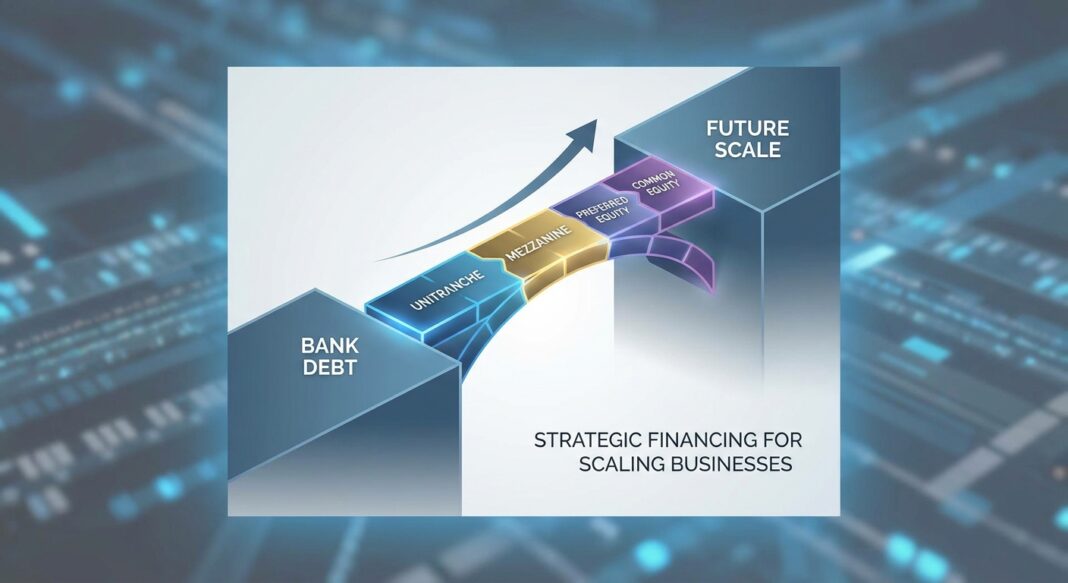
This article maps that capital stack in granular detail. It explains the cost-of-capital spectrum from bank facilities through private credit and mezzanine to preferred and common equity. It provides a tactical playbook for quantifying the gap, preparing materials, running the process, and negotiating the structure, with current market terms drawn from active deal data.
Mapping the Cost-of-Capital Spectrum: Banks to Equity
Every capital raise decision is, at its core, a cost-versus-control trade-off measured against your use of proceeds. The spectrum runs from lowest-cost and most constrained at the bank end, to highest-cost and most flexible at the equity end. Understanding where each instrument sits (and why) is the foundational analytical skill for a growth-stage operator or CFO.
Senior Bank Debt (Cost: Base Rate + 200–350 bps)
Commercial bank facilities (revolving credit lines, term loan A structures, asset-based lending) sit at the cheapest end of the spectrum. They are priced conservatively because they carry the first claim on assets and typically require hard collateral, strict maintenance covenants, and quarterly financial testing. Banks lean toward strict quarterly maintenance tests and usually require standard amortization from year one, whereas direct lenders more often extend interest-only periods that free up cash for growth. For a growing business with EBITDA volatility or a heavy reinvestment cycle, those maintenance covenants are an operational constraint, not just a documentation issue.
Private Credit / Direct Lending / Unitranche (Cost: SOFR + 425–650 bps)
The dominant instrument in sponsored middle-market transactions today is the unitranche, a single facility that merges senior and subordinated risk into one loan with one blended rate. A unitranche merges senior and junior debt into one credit agreement with a single blended rate; the risk split lives in a private Agreement Among Lenders as a first-out/last-out structure the borrower never sees. The borrower’s experience is streamlined: one term sheet, one set of covenants, one relationship to manage. The middle market lending landscape has experienced a decisive shift toward simplified debt structures, with unitranche facilities increasingly becoming the financing solution of choice for transactions ranging from $10 million to $500 million in enterprise value.
On pricing, unitranche facilities typically price at SOFR + 425–475 basis points for sponsored upper middle market transactions, with core middle market credits commanding 50–100 basis points higher, according to Capstone Partners’ Winter 2025 Leveraged Finance Report. For context, this prices above a senior loan, approximately 450 to 650 bps over the floating benchmark versus approximately 250 to 350 bps for senior, precisely because it carries junior risk inside a first-lien wrapper. The borrower is paying a premium in spread, but buying certainty of execution. If unitranche financing can close 30 to 45 days faster than a syndicated alternative, sponsors often justify 50 to 100 basis points of extra spread by avoiding financing gaps, broken syndications, or delayed closings that jeopardize purchase agreements.
Mezzanine Debt (Cost: 12–20% all-in, Cash + PIK + Warrants)
Mezzanine sits subordinated to all senior debt, priced to reflect that risk. Mezzanine debt has three defining structural features that distinguish it from senior debt: its subordinated and unsecured position, its option for Payment-in-Kind (PIK) interest, and its equity kicker, almost always in the form of stock warrants.
On current market terms: the cost structure runs 8–12% cash interest plus 2–4% PIK accruing to principal, plus warrants or equity co-investment of 1–5% equity, creating a 16–22% all-in IRR for the lender. Mezzanine lenders often want more than a coupon: lender return can include an equity kicker such as warrants or a conversion feature, in addition to current cash coupon and possible PIK interest. PIK is the critical variable for cash-constrained growth businesses; it defers cash outflow, but compounds the debt balance. When borrowers elect PIK interest, the outstanding balance compounds, increasing total debt burden. If the anticipated liquidity event is delayed, the growing PIK balance creates a larger refinancing burden at bullet maturity.
Preferred Equity (Cost: 8–15% coupon or dividend + upside participation)
Preferred equity is structurally senior to common equity but junior to all debt. It is the instrument of choice when the company needs capital but the lender or investor wants downside protection without full debt covenants. Senior lenders have limits on how much risk they will accept, and PE sponsors have limits on how much equity they want to contribute, and it is the instruments that fill this gap, with their hybrid features of debt-like priority and equity-like upside participation, that create a more complete and flexible capital structure.
Common Equity / Venture Capital / Growth Equity (Cost: 20–35%+ IRR expectation)
Equity is the most expensive capital by return expectation, but carries no contractual repayment obligation. According to Carta’s State of Private Markets data, median dilution in 2025 sits at approximately 19.5% for seed rounds and 18% for Series A rounds. For growth-stage companies still pre-profitability, equity is often unavoidable, but the goal of good capital stack strategy is to minimise equity at the moments when valuation is lowest.
Structure Breakdown: The Growth-Stage Acquisition Financing Example
Consider a practical scenario: a B2B software company with $8M ARR, growing 35% year-over-year, EBITDA-negative on a GAAP basis but strongly cash-generative on an adjusted basis, looking to fund a $25M bolt-on acquisition of a complementary product that would accelerate ARR to $15M and create genuine scale economics.
The Capital Need: Quantifying the Gap
The company has three levers: existing equity (insufficient without a dilutive raise), bank debt (limited by adjusted EBITDA multiples and maintenance covenant restrictions), and gap capital, the structured instruments that sit between them. The acquisition is $25M. The bank will stretch to 3.0x adjusted EBITDA, which on $2M pro forma EBITDA means $6M of senior bank debt. Equity investors would fund the deal at a 6x ARR valuation ($90M), but that requires issuing equity at a price that punishes founders. The gap is $19M.
The Recommended Structure
A three-tranche structure resolves this cleanly:
- Senior Revolver ($4M, Bank, SOFR + 250 bps): Working capital facility, drawn as needed, minimal fees. Secured on receivables.
- Unitranche Term Loan ($15M, Direct Lender, SOFR + 500 bps): Five-year bullet with one year interest-only, single maintenance covenant (net leverage ratio, 6.5x initial, stepping to 5.5x in year three), 1% OID, 1% exit fee. The financial covenant is typically a single net first-lien or total net leverage covenant with an initial cushion of 25 to 35 percent over the base case plan, stepping down as cash flow grows.
- Mezzanine Tranche ($10M, Mezzanine Fund, 11% cash + 2% PIK + 2% warrant coverage): Six-year maturity, structured to sit behind the unitranche. Warrants struck at current equity valuation. Soft call at 103% in year two, par thereafter. Mezzanine loan maturity is usually longer than that of senior debt, often around 5 to 7 years, to give the borrower time to grow and increase cash flows.
Total debt raised: $29M. Equity contribution: zero. The acquisition closes. The founder retains full equity ownership and avoids dilution at a growth-stage valuation. The blended cost of debt is approximately 14.5% all-in, expensive relative to bank debt, but cheap relative to issuing equity at a $90M pre-money valuation to fund a $25M deal.
Sponsors use mezzanine to reduce equity contribution because even at 15–20% yields, mezzanine is cheaper than the 20%+ returns expected on equity.
Structure vs. Alternatives: When Each Option Wins
Unitranche-Only vs. Senior + Mezzanine Split
The pure unitranche simplifies documentation and closing logistics but provides a single blended rate that may overprice the senior risk component. Consolidation of senior and subordinated debt into a single facility has materially impacted deal execution timelines and documentation complexity across the ecosystem. The senior-plus-mezzanine split is more structurally complex but can lower overall blended cost when the senior component is genuinely investment-grade quality. Traditional mezzanine remains relevant in several contexts: very large transactions where unitranche lenders cannot provide the full quantum of debt needed, situations where the borrower wants to minimise total cost by maximising cheap senior debt separately, and deals where the sponsor or management team wants equity kickers to align lender incentives.
Mezzanine vs. Preferred Equity
Mezzanine debt carries contractual cash interest obligations and a defined maturity; it must be repaid. Preferred equity can be structured with dividends that accrue rather than pay, and without a hard maturity. For a business with genuine cash flow uncertainty, preferred equity offers more flexibility at the cost of more expensive overall economics and governance complexity. Mezzanine is the right call when the business has predictable free cash flow sufficient to service the coupon, and when a defined exit timeline (sale or recap) is credible within the maturity window.
Growth Equity vs. Structured Debt
A more flexible capital stack can reduce dilution and increase optionality. Debt can extend runway when equity markets are constrained. Structured equity can bridge valuation gaps. The decision turns on three variables: certainty of exit timeline, capacity for debt service, and current equity valuation. When valuation is below intrinsic value, as it often is for growth-stage businesses in flat venture markets, debt capital preserves equity value that would otherwise be surrendered at a discount.
Current Market Terms (As of Mid-2026)
The private credit landscape in mid-2026 reflects a market recalibrating after a period of aggressive lender competition. Key current data points:
- Direct Lending Spreads Widening: Lord Abbett’s 2026 Midyear Investment Outlook found direct lending spreads widening by roughly 50 to 100 basis points since late 2025, alongside a return to stronger lender protections, after a stretch where heavy fundraising had left too much capital chasing too few deals.
- Unitranche Market Share: Unitranche financings now represent approximately 30% of sponsored middle market transactions, reflecting both sponsor preference for execution certainty and the expanding capabilities of direct lenders to provide larger hold sizes.
- All-In Yields: Average all-in yields for new private credit deals ran 12 to 13% in the first half of 2024. Given the spread widening through 2025–2026, current all-in yields on core middle market unitranche are tracking closer to 13–14.5%.
- Covenant Posture by Size: Maintenance covenants continue to be more prevalent in the lower and core mid-market (EBITDA under $100M), while covenant-lite structures are more common for larger borrowers with EBITDA above $100M that operate in defensive industries.
- Covenant-Lite Creep into Direct Lending: Covenant-lite structures reached 21% of direct lending transactions in 2025, up from just 4% in 2023. Borrowers with strong sponsor relationships and defensive revenue profiles are extracting documentation concessions previously reserved for the broadly syndicated market.
- Mezzanine Rates: Mezzanine loan interest rates typically range from 12–20% annually. Lender return often includes a current cash coupon of 10–14%, plus possible PIK interest and an equity kicker such as warrants or a conversion feature.
- Venture Debt Market: Venture debt has moved from the margins to the mainstream. The global venture debt market reached roughly $49 billion in 2025, and Deloitte projects the asset class could grow to represent 20% of total venture funding by 2027.
The Gap Capital Playbook: Quantify, Prepare, Run the Process, Negotiate
Step 1: Quantify the Need
Start with a clean sources-and-uses table. Map the total capital requirement against what each layer of the stack can credibly provide: senior bank capacity (based on collateral or EBITDA multiples), unitranche or direct lending capacity (typically 4.0x–5.5x adjusted EBITDA for software or recurring-revenue businesses), and the residual gap that requires subordinated or equity capital. The gap number is not negotiable; it is the output of your financial model, not a starting position.
Business owners need clean financials, realistic forecasts, a clear use of funds, and a strong understanding of which funding options align with their business model, growth stage, and long-term goals.
Step 2: Prepare Materials
For debt capital processes, the package is: audited or reviewed financials (two to three years), a detailed management-prepared model with base and downside cases, a use-of-proceeds memorandum, customer concentration analysis, and a management presentation. For structured instruments with equity components (mezzanine with warrants, preferred equity) add a cap table, exit scenario waterfall, and a clear articulation of the exit timeline and path. Lenders underwriting subordinated capital are underwriting equity risk. They need to understand the equity story.
Step 3: Run the Process
Do not run a sequential process. Approach senior lenders, unitranche providers, and mezzanine funds simultaneously. The senior lender’s term sheet anchors the quantum of senior debt available; the mezzanine fund sizes off the residual gap and the equity cushion below them. Competitive tension between two or three mezzanine providers is your single most powerful pricing lever. The underwriting process runs 60 to 90 days from term sheet to close. Build that into your timeline and do not compress diligence to accelerate a closing, incomplete diligence surfaces in covenant packages later.
Step 4: Negotiate the Structure
The negotiation for growth-stage operators has four key battlegrounds:
- Covenant headroom: Push for 30–35% cushion over your base case on the leverage maintenance test. The financial covenant is typically sized with an initial cushion of 25 to 35% over the base case plan, stepping down as cash flow grows. Never accept a covenant set to your base case; that is a covenant breach waiting to happen.
- PIK toggle: Negotiate the right to elect PIK on a portion of the mezzanine coupon, typically 2–4% of the total rate, during periods of cash investment. This preserves liquidity for growth without technically breaching payment obligations.
- Warrant coverage and strike price: The true complexity in mezzanine comes from the warrants. These equity kickers can complicate the capital structure, add layers to future financing rounds, and create challenging negotiations in a potential exit scenario. Negotiate warrant coverage as a percentage of fully-diluted shares (not a fixed dollar amount), and negotiate a call right to buy out the warrants at a formula-based price prior to exit.
- Prepayment flexibility: Growth businesses refinance faster than their debt matures. Build in call protection that steps down (103% in year one, 102% in year two, par thereafter) so that a refinancing at lower cost is not economically prohibitive when the business achieves scale.
Key Takeaways
- Match instrument to use of proceeds, not to cost alone. The cheapest capital that comes with covenants you cannot live inside is more expensive than the headline rate suggests. Operational flexibility has a dollar value.
- The unitranche is a speed and simplicity premium, not a discount. What the borrower buys is not a lower coupon but a simpler, faster, more certain deal, and they pay a premium in spread for it. Understand what you are buying before accepting the blended rate.
- PIK interest defers cash pain but compounds the debt burden. When borrowers elect PIK interest, the outstanding balance compounds, increasing total debt burden. If the anticipated liquidity event is delayed, the growing PIK balance creates a larger refinancing burden at bullet maturity. Model the downside scenario before electing PIK.
- Maintenance covenants are lender value, not just borrower constraint. The existence of maintenance covenants allows the lender to engage early with a borrower in the event of weakening performance. For a growth-stage operator, an early conversation about a covenant trip is materially better than a payment default, negotiate the headroom, not the existence of the covenant.
- Sequence your capital raises; do not run them in parallel. Stack capital sequentially: close one facility, deploy it, hit milestones, then raise the next layer. Parallel raises create structural problems. Each round of capital should be sized to get you to a demonstrable milestone that improves your pricing on the next one.


