
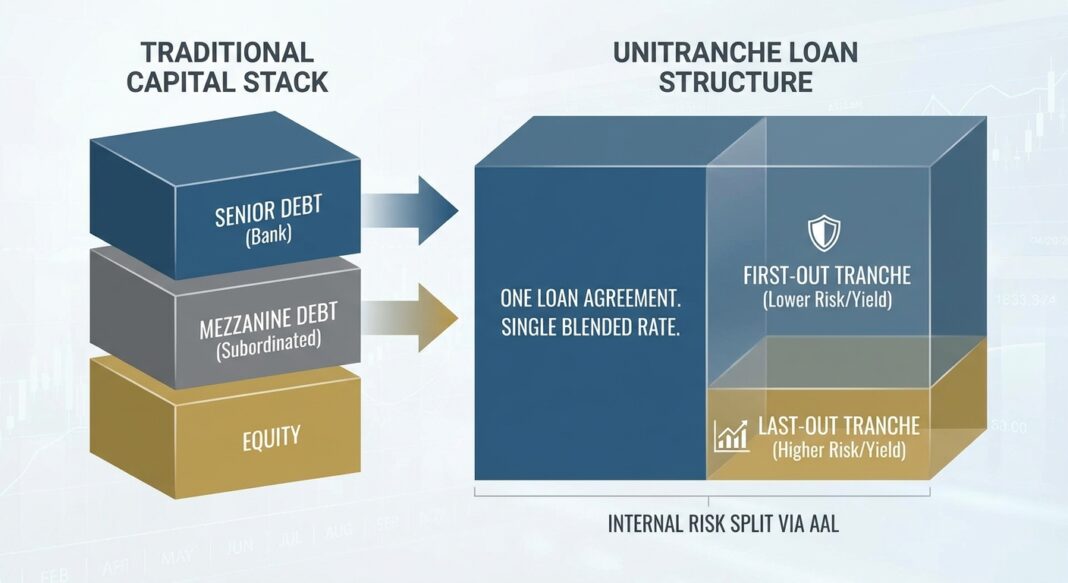
One Loan, Two Realities: The Unitranche Structure
If you have spent any time studying private credit over the last few years, you have almost certainly encountered the word unitranche: often followed by the word dominant. That pairing is not an exaggeration. The large-cap unitranche market roughly doubled to $210 billion of activity in 2024, up from $94 billion in 2023, and it has since become the default financing mechanism for private credit-backed leveraged buyouts, according to Alternative Fortune (March 2026). For business owners considering a sale and for investors evaluating direct lending funds, understanding what a unitranche loan actually is, beneath the single-loan surface, is essential to understanding where the risk and the return really live.
The concept sounds simple: one borrower, one lender, one loan document, one interest rate. But inside that clean exterior sits a sophisticated internal structure that quietly separates senior and junior risk between multiple lenders, invisible to the borrowing company, yet critical to the economics of every party involved. This article teaches that structure from the ground up.
What a Unitranche Loan Actually Is
Unitranche financing is a single secured loan that economically combines senior and subordinated (mezzanine) debt into one facility with a blended interest rate. As described by LexisNexis Banking & Finance (June 2026), key legal features include one facility agreement, one security package, one set of covenants and events of default, and a single ranking against the borrower group.
From the borrower’s perspective, this is a genuine simplification. Before unitranche became widespread, a middle-market leveraged buyout typically required two separate loan agreements: a senior secured term loan from a bank, plus a subordinated mezzanine loan from a separate lender: each with its own covenants, agents, and intercreditor negotiations. Unitranche collapses that complexity into a single relationship.
But within the lender group, the structure bifurcates. Most institutional unitranche deals are governed by an Agreement Among Lenders (AAL): a private document that divides the lenders into a first-out tranche and a last-out tranche. As explained by Mayer Brown (July 2026), the first out/last out structure achieves a form of internal subordination within a single credit facility, without creating two distinct tranches with separate credit agreements. The AAL governs the payment waterfall, fee and interest allocation, voting rights, and enforcement procedures.
The borrowing company sees one rate and one agent. The lenders, however, have agreed privately on who gets paid first in a distress scenario, and who bears the residual loss.
How the Economics Split: A Concrete Example
Consider a hypothetical acquisition: a private equity sponsor buys a software business for $100 million, contributing $40 million of equity and financing the remaining $60 million with a unitranche loan, a 5.0x leverage multiple on $12 million of EBITDA. The borrower signs one loan agreement with a blended coupon of, say, SOFR + 525 basis points. With three-month Term SOFR at approximately 3.69% as of Q2 2026 (per Valuation Research Corporation, July 2026), the all-in rate is roughly 9.2%, within the current market range of approximately 9.00% to 9.75% for unitranche yields cited by the same source.
Behind the scenes, the AAL may allocate the $60 million as follows:
- First-out lender: $35 million at SOFR + 400 bps (roughly 8.1% all-in). Lower return, but first priority on cash flows and collateral recovery in a default.
- Last-out lender: $25 million at SOFR + 700 bps or more (roughly 10.7%+ all-in). Higher return, but absorbs losses before the first-out lender recovers a dollar.
The borrower pays one blended rate. The AAL privately redistributes cash flows via a strip or fee flip, according to Private Equity Bro (October 2025). First-out economics may also arrive through higher upfront fees or back-ended exit fees paid by the last-out lender, not by the borrower. The last-out lender receives the residual coupon and bears the higher final-loss exposure.
Additionally, operators evaluating unitranche structures should factor in original issue discount (OID): unitranche loans typically carry 2–3% OID at funding, meaning a borrower receiving $50 million in proceeds owes $50 million in principal but receives approximately $48.5–$49 million upfront. On a six-year loan, a 2% OID adds roughly 33 basis points to the annualized cost of capital, per CT Acquisitions (May 2026).
Current Market Reality: Where Unitranche Stands in Mid-2026
The unitranche market in mid-2026 reflects a market that has repriced, widened modestly, and grown more lender-friendly since the tightest point of 2024–2025. Here is what the current data shows:
| Metric | Current Level | Source |
|---|---|---|
| Unitranche all-in yield range | ~9.00%–9.75% | VRC, Q2 2026 |
| Unitranche coupon spreads (new issuance) | SOFR + 475–550 bps | VRC, Q2 2026 |
| 3-month Term SOFR (June 2026) | 3.69% | VRC, Q2 2026 |
| Cliffwater Direct Lending Index (CDLI), 2025 return | 9.3% | Cliffwater / Morningstar, March 2026 |
| CDLI, trailing year return ending June 30, 2026 | 7.7% | Cliffwater / PR Newswire, August 2026 |
| Global private credit AUM (approx.) | ~$1.7 trillion | Preqin / Bloomberg via CT Acquisitions, Q1 2026 |
| Bank C&I lending standards, Q2 2026 | Basically unchanged | Federal Reserve SLOOS, July 2026 |
Spreads have widened by roughly 50 to 100 basis points since late 2025, while credit documentation and covenants have also improved, according to Lord Abbett’s 2026 Midyear Outlook (June 2026). Institutional competition among direct lenders remains intense: Octus (January 2026) reported that Blackstone Credit closed 225 deals in 2025, holding a 5.4% share of market deal volume.
On the banking side, the Federal Reserve’s July 2026 SLOOS showed basically unchanged C&I lending standards in Q2, with stronger demand from large and middle-market firms. While bank lending is stabilizing, the structural advantages of unitranche (speed, covenant flexibility, and certainty of close) continue to make private credit the preferred route for sponsor-backed mid-market transactions.
Decision Framework: For Investors and Operators
For Investors Evaluating a Private Credit Fund
When a manager markets a direct lending fund by quoting the Cliffwater CDLI’s 20-year average return of approximately 9.5%, sophisticated investors consider whether that historical performance was earned on loans priced in a different rate and spread environment. New unitranche loans being written at SOFR + 475–550 bps in 2026 lock in different economics than loans originated at SOFR + 650–725 bps in 2022–2023. Investors evaluate:
- First-out vs. last-out composition: What percentage of the fund’s book is last-out exposure? Last-out lenders can price at SOFR + 850 bps or more, but bear significantly higher loss severity in a default scenario.
- Vintage sensitivity: Funds with older, wider-spread loans in the portfolio will show higher yields than funds deploying capital at today’s compressed spreads.
- Covenant quality: The mid-2026 reset toward lender-friendly documentation means newer loans may carry better protections than 2023–2024 vintages originated under maximum borrower-friendly conditions.
- Default rates: The leveraged loan LTM default rate stood at 1.36% by issuer count as of February 2026, per Hamilton Lane’s 2026 Private Credit Focus, inside long-term averages, but with a distressed ratio worth monitoring.
For Business Operators Evaluating Unitranche Financing
Operators considering unitranche debt for an acquisition or recapitalization evaluate several structural points beyond the headline rate:
- All-in cost clarity: The coupon is only part of the cost. OID (2–3%), upfront fees, and prepayment penalties (typically 102/101/par in years 1–2–3+ for 2026 deals) must be modeled against the expected hold period.
- Equity cure rights: Standard 2026 unitranche terms typically allow four equity cures over the life of the loan, with no more than two in any consecutive four quarters. Negotiating for cure proceeds to count toward the breach quarter EBITDA calculation is a meaningful protection.
- MFN clauses: A most-favored-nation provision means that issuing incremental debt at a higher spread can reset the entire unitranche spread upward. Understanding the cushion threshold (typically 50 bps) and the sunset period (typically 12 months) is material to future financing flexibility.
- Deal size sweet spot: Unitranche dominates acquisitions valued between approximately $25 million and $200 million in enterprise value, with roughly 70–80% of deals in that range using at least partial unitranche funding, per CT Acquisitions (May 2026).
Key Takeaways
- Unitranche simplifies the borrower experience by replacing a senior loan plus mezzanine with one document, one agent, and one interest rate, but the internal AAL structure still creates senior and subordinated risk tiers among lenders.
- First-out lenders accept lower yields for priority in recovery; last-out lenders accept higher loss risk in exchange for higher coupons, sometimes SOFR + 850 bps or more. Investors in funds with last-out exposure are taking on economics that differ materially from a simple senior secured loan.
- Current all-in unitranche yields of 9.00%–9.75% represent a roughly 250 bps decline from the 2023 peak of 11.5%–12.5%, but remain above pre-2022 historical ranges, reflecting a still-elevated rate and spread environment.
- The market has shifted modestly lender-friendly in 2026, with spreads 50–100 bps wider since late 2025 and documentation improving, a meaningful shift from the borrower-friendly terms that prevailed during the competitive 2023–2024 period.
- Operators must model the total cost of capital, not just the coupon: OID, prepayment fees, and MFN clauses can meaningfully alter the effective financing cost depending on the hold period and future capital needs.


