
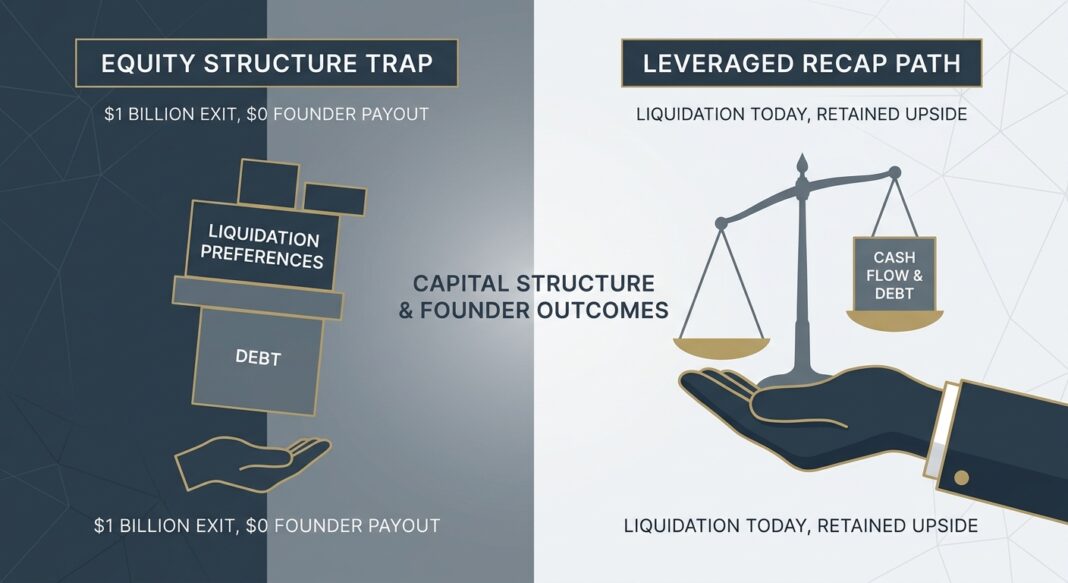
The Story: A Billion-Dollar Exit. Zero Dollars for Founders.
In January 2025, a headline crossed the wires that looked, on the surface, like a triumph. Divvy Homes: a San Francisco-based rent-to-own proptech startup, had been acquired by a division of Brookfield Properties for approximately $1 billion. For a company that had navigated one of the most brutal macro environments in recent memory, it seemed like a respectable landing.
Then the letter arrived.
CEO and co-founder Adena Hefets wrote to shareholders confirming what the deal math had always quietly implied: after repaying outstanding debt, covering transaction costs, and satisfying preferred shareholder liquidation preferences, neither common shareholders nor founders would receive any proceeds from the sale. A billion-dollar deal. Zero dollars for the people who built it.
Divvy had raised over $700 million in debt and equity from marquee investors including Tiger Global, Andreessen Horowitz, and GGV Capital. Its last known funding round, a $200 million Series D led by Tiger Global in August 2021, had valued the company at $2.3 billion. Eighteen months later, interest rates surged, the rent-to-own model fractured, and three rounds of layoffs followed. By 2023, new home acquisitions had been paused entirely.
The Brookfield deal wasn’t an exit. It was a waterfall, and by the time the water reached the founders, the pool was dry.
The Decision: What the Capital Structure Actually Said
Divvy’s capital model wasn’t irrational on its face. The business required purchasing physical homes at scale, so layering in debt to fund a capital-intensive asset base made operational sense, particularly during the zero-interest-rate era of 2020 and 2021, when cheap money made the math look clean. The equity rounds funded the platform; the debt funded the homes.
But the structure concealed a structural trap. Every round of venture equity carried liquidation preferences: contractual guarantees that investors get paid first, and often at a multiple, before founders and common shareholders see a dollar. With preferred equity stacked across a Series A through Series D, and hundreds of millions in debt sitting senior to all of it, the exit waterfall was always going to be merciless the moment the valuation came in below the fully-stacked preference threshold.
The critical question Divvy’s story forces every founder to ask isn’t “Should I raise equity?”, it’s “What does my capital structure do to my payout in a non-unicorn outcome?”
This is precisely the question that makes a leveraged recapitalization: a structurally different tool, worth understanding in contrast.
The Leveraged Recap Alternative: A Hypothetical Scenario
The following is a clearly labeled hypothetical scenario constructed to illustrate how leveraged recapitalization mechanics work in contrast to the Divvy Homes capital structure. It is not based on a specific real company.
Imagine a founder, call her Maria: who runs a B2B software-as-a-service business generating $6 million in annual EBITDA with recurring revenue, low churn, and no institutional investors on her cap table. She owns 100% of the equity. After a decade of building, she wants personal liquidity, but she doesn’t want to sell the company, and she doesn’t want to raise a VC round that would dilute her ownership and install a board with its own exit timeline.
She explores a leveraged recapitalization: the company takes on new debt (in this case, $18 million at 3x EBITDA) and distributes the proceeds to her as a dividend. Her ownership percentage doesn’t change. Her cap table stays clean. No preferred equity. No liquidation preferences. No investor veto rights over strategic hires or budget decisions.
The capital structure post-recap looks like this:
- New debt: $18M at approximately 9% interest (~$1.62M annual debt service)
- Maria’s equity: 100% (unchanged)
- Liquidation preferences against her: $0
- EBITDA coverage ratio: 3.7x (well above typical covenant thresholds)
She’s taken $18 million off the table, personal financial security achieved, while retaining full ownership of a growing business. If she sells in five years at 8x EBITDA with the business at $10M EBITDA, she collects the full $80 million exit less remaining debt. No waterfall. No preference stack. No investors ahead of her in line.
The Outcome: Two Founders, Two Structures, Two Realities
The contrast between these two paths (Divvy’s equity-heavy stack and Maria’s hypothetical recap) illuminates something fundamental about how capital structure determines outcome independence from business performance.
Divvy’s business wasn’t worthless. Brookfield paid $1 billion for it. It had helped create 2,000 homeowners across 20 cities. The product worked. The team executed. But the capital structure, not the business, determined who got paid. With over $735 million in debt layered on top of multi-round preferred equity carrying liquidation preferences, the exit waterfall consumed the entire $1 billion before founders saw a dollar.
In the hypothetical recap scenario, Maria’s outcome is structurally protected regardless of whether her eventual exit is spectacular or merely solid. Because she carries no liquidation preferences above her, every dollar of enterprise value above remaining debt flows directly to her. A $40 million exit, a $60 million exit, or a $100 million exit, all produce meaningful founder proceeds. The debt is fixed and repayable. The equity upside is fully hers.
This is the core asymmetry that founders consistently underestimate when evaluating venture equity versus structured debt:
- Venture equity optimizes for the enormous upside scenario, but extracts enormous structural cost in every other scenario via preference stacks, anti-dilution provisions, and investor-driven exit timelines.
- Leveraged recapitalization optimizes for retained ownership value, it delivers liquidity now, preserves the full exit upside, and imposes a fixed, manageable cost (debt service) rather than an open-ended structural claim on future proceeds.
The market data underscores how broadly this dynamic is being recognized. Leveraged loan issuance tied to sponsored dividend recapitalizations grew 11% year-over-year to $74.3 billion in 2025, after rising 326% in 2024, as founders and PE sponsors alike sought liquidity without forcing full exits into a constrained M&A market.
The Lessons: Principles Extracted from the Contrast
1. The Waterfall Is the Strategy
Most founders think about capital structure in terms of valuation: “At what price am I raising?” The more important question is: “In what order does my capital structure pay out, and at what exit size does that structure finally pay me?” Venture equity with liquidation preferences can require a company to exit at 2x–3x the total capital raised before founders see any proceeds above zero.
2. Leverage Works When Cash Flow Is Stable
Divvy’s model wasn’t disqualified from debt; it just used the wrong kind of debt at the wrong time, layered on top of an already preference-heavy equity structure. A leveraged recapitalization only makes sense when the underlying business generates predictable, covenant-safe cash flow. Typical debt multiples range from 3x to 6x EBITDA depending on industry and cash flow stability. For asset-light SaaS, services, or distribution businesses with recurring revenue, this threshold is often comfortably achievable.
3. Personal Liquidity and Business Ownership Are Not Mutually Exclusive
One of venture capital’s most effective recruiting pitches to founders is that equity rounds are the only path to personal liquidity before an exit. This is false. A leveraged recap allows owners to receive cash today, diversifying personal wealth, without ceding a single share of ownership or a single seat on their board. Many founders want liquidity but are unwilling to sell control unless they are cashing out entirely. The recap structure solves this precisely.
4. The Rate Environment Matters, But Less Than Structure
The private credit market remains active and well-capitalized heading into the second half of 2026, with private capital dominating refinancings and recapitalizations even as competition from traditional banks has increased in acquisition financing. Spreads have tightened from their 2023 peaks, and while the window is not as wide as it was in 2021, debt is still a structurally superior liquidity tool for cash-generative businesses compared to preference-laden equity. Founders who wait for a “perfect” rate environment often end up raising equity out of impatience, and paying for it structurally for years.
5. The Recap Is a Planning Tool, Not a Last Resort
The Divvy story is painful partly because the capital structure decisions that led to the zero-dollar outcome were made years before the exit, during rounds that felt celebratory at the time. The best time to think about exit waterfall math is at the first institutional financing, not the last. And for founders who have avoided institutional equity altogether, the leveraged recap is best executed proactively: when cash flow is growing, lenders are competing, and the founder is negotiating from strength rather than necessity.
Key Insights
- A billion-dollar exit can produce zero founder proceeds when venture equity liquidation preferences and senior debt consume the entire waterfall, as the Divvy Homes acquisition demonstrated in January 2025.
- A leveraged recapitalization delivers personal liquidity without dilution: the company borrows against its cash flow, distributes proceeds to the owner as a dividend, and the founder retains 100% of future equity upside with no new shareholders in the cap table.
- The structure of capital, not just the amount, determines founder outcomes. Fixed debt service is a known, manageable cost. Open-ended liquidation preferences are an invisible tax on every future dollar of enterprise value.
- The dividend recap market reached $74.3 billion in 2025, a reflection of how widely founders, PE sponsors, and operators are using structured debt as a liquidity tool in an environment where traditional exits remain constrained.
- The framework for choosing a recap over equity is straightforward: stable EBITDA above 3x proposed debt load, no asset-value dependency on macro rates, and a founder who wants liquidity today without surrendering ownership, board control, or exit timing to outside investors.


