
The Growth-Stage Financing Problem Nobody Maps Clearly
You’ve cleared product-market fit. Revenue is real, recurring, and growing. The business needs $15 million to $50 million, not to survive, but to accelerate. The use of proceeds is specific: hire a 12-person enterprise sales team, fund a tuck-in acquisition, or bridge to a recapitalization at a materially higher valuation.
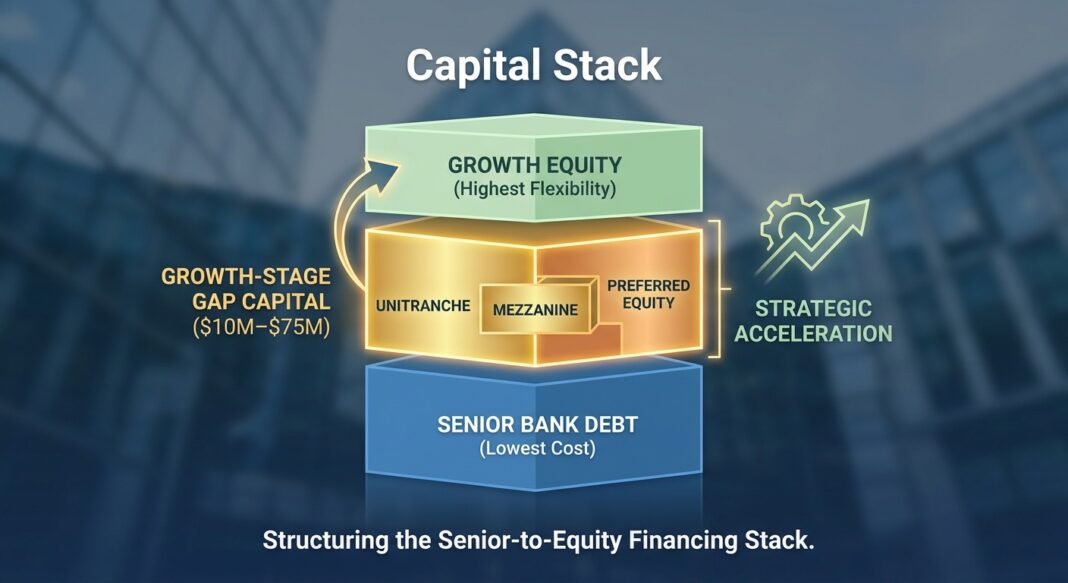
Here is where most operators get structurally wrong: they frame the capital decision as a binary, raise equity or don’t. But the capital stack between a senior bank revolver and a dilutive Series B is wider and more navigable than most founders, CFOs, or independent sponsors realize.
The growth stage (broadly defined as companies generating $3M to $25M in EBITDA or $5M to $40M in ARR with demonstrated operating leverage) sits at the most structurally interesting point in the capital lifecycle. Senior bank lenders will offer leverage, but typically cap out at 2.5x to 3.0x EBITDA, leaving a meaningful gap between what a bank will lend and what the business needs to fund its strategy. That gap doesn’t require equity. It requires structure.
This article maps the full cost-of-capital spectrum from banks to equity, explains which instruments belong at each layer of the stack, provides a detailed worked example, and delivers a practitioner’s playbook for running the growth-stage capital raise from quantification to close.
The Cost-of-Capital Spectrum: Mapping the Stack from Banks to Equity
Before selecting a structure, operators must understand the hierarchy of cost and access across the stack. Each layer has a defined role, a defined pricing band, and a defined set of conditions under which it makes sense. The following maps the relevant options for a growth-stage company with $5M–$20M of EBITDA:
Layer 1: Senior Bank Debt (Cheapest, Most Constrained)
Bank revolvers and term loans remain the lowest-cost debt available. A well-structured commercial bank facility for a profitable growth-stage company typically prices at SOFR + 150 to 250 basis points, roughly 6.5% to 8.5% all-in at mid-2026 base rates. The constraint is leverage: most banks cap at 2.5x to 3.0x senior leverage, require two to four financial maintenance covenants tested quarterly, and have limited appetite for acquisition-related draws or PIK features. Banks are the right anchor for working capital and revolving credit needs but routinely leave $10M to $30M of structural capacity unfilled for growth-stage operators.
Layer 2: Unitranche Direct Lending (One Stop, Mid-Stack)
The unitranche (which combines senior and subordinated debt into a single facility from one direct lender) has become the dominant financing tool for the $25M to $200M enterprise value market. Unitranche debt is a single-tranche acquisition loan that combines what would otherwise be senior debt and mezzanine or subordinated debt into one instrument with one lender and one credit agreement. For growth-stage companies, this matters because it removes the need for a senior lender and a mezzanine lender to agree on intercreditor terms before capital is deployed.
Unitranche pricing in 2026 runs SOFR + 500–700 basis points, plus a 2–3% original issue discount and a 2–3% prepayment fee declining over the first 24 months. The all-in cost of capital for a typical 5x leverage deal is 9.5% to 11% blended. The execution advantage is significant: if unitranche financing can close 30 to 45 days faster than a syndicated alternative, sponsors often justify 50 to 100 basis points of extra spread by avoiding financing gaps, broken syndications, or delayed closings that jeopardize purchase agreements.
Layer 3: Mezzanine / Subordinated Debt (Flex Layer, Equity-Optionality)
Mezzanine financing represents a critical component of leveraged buyout and growth capital structures, typically filling the gap between what senior lenders will provide and what equity investors wish to contribute. In a traditional split-stack structure, a mezzanine tranche sits beneath senior debt, picks up leverage from 3.5x to 5.5x EBITDA, and carries a blended cash-plus-PIK coupon. The typical cost structure is 8–12% cash interest plus 2–4% PIK (paid-in-kind, accruing to principal) plus warrants or equity co-investment of 1–5% equity, creating a 16–22% all-in IRR for the lender. Interest payments are tax-deductible for borrowers, unlike equity dividends.
Layer 4: Preferred Equity (Structural Hybrid, Pre-Equity)
Preferred equity sits above common equity but below all debt in the liquidation waterfall. It carries no mandatory repayment date but typically accretes at 10–14% per annum, often with PIK toggle features. For growth-stage companies where debt service capacity is constrained but dilution from common equity is unacceptable, preferred equity provides a non-amortizing capital solution. It is commonly used in recapitalizations, management buyouts, and minority stake acquisitions where the operator wants to monetize partial equity while retaining operating control.
Layer 5: Growth Equity (Most Dilutive, Longest Duration)
Growth equity (minority or majority institutional equity investment) represents the highest-cost and most dilutive form of growth capital. Median Series A pre-money valuations hit $48 million in Q1 2025, and median founder ownership falls from about 56% after seed to 36% after Series A and 23% by Series B. Equity is more expensive long-term but has no repayment obligation; debt preserves ownership but requires cash flow to service payments. Growth equity is the right instrument when capital needs exceed what any debt structure can safely support, when the business is pre-EBITDA, or when the strategic value of a specific investor’s network and governance contribution justifies the ownership cost.
Worked Example: Structuring a $45M Growth Capital Package for a $120M EV Enterprise Software Company
Consider a B2B SaaS company with $12M of ARR growing at 35% year-over-year, $4M of adjusted EBITDA, and a clean balance sheet with no existing debt. The business wants to fund two strategic priorities simultaneously: a $20M tuck-in acquisition of a complementary product and $25M for go-to-market expansion (hiring, infrastructure, and international launch). Total need: $45M.
Option A: Unitranche (Preferred)
- Structure: $45M unitranche facility (first-lien, all-senior wrapper) from a single direct lender
- Leverage: ~4.0x LTM EBITDA on a $45M draw, with a $10M undrawn revolver for liquidity
- Pricing: SOFR + 575bps (approximately 10.0% all-in at current base rates), 2% OID, 18-month soft call at 102
- Covenant: Single financial maintenance covenant, total net leverage not to exceed 5.5x tested quarterly
- Maturity: 5-year bullet; interest-only for first 24 months, then 1% annual amortization
- Equity Feature: None (clean debt, no warrants)
- All-in Cost: ~10.0–10.5% cash pay, no dilution
This structure works because the unitranche lender’s single covenant package replaces the complexity of a senior/mezz intercreditor, the 5-year bullet matches the operator’s growth plan timeline, and the absence of equity features means zero dilution to existing shareholders. The ability to work with a single lending group simplifies ongoing portfolio management, particularly during covenant modifications or add-on acquisitions.
Option B: Senior + Mezzanine Split (Alternative)
- Senior Tranche: $28M at SOFR + 250bps (~7.0% all-in); four financial maintenance covenants
- Mezzanine Tranche: $17M at 10% cash + 2% PIK + 2% warrant coverage (penny warrants on ~2% of fully diluted equity)
- Blended Cost: ~9.8% cash pay plus warrant dilution
- Complexity: Intercreditor agreement required; two lender groups to manage; longer execution timeline (60–90 days vs. 30–45 days for unitranche)
Warrants in mezzanine structures are typically penny warrants for 1% to 5% of fully diluted equity. The blended cost of Option B is nominally cheaper on a cash-pay basis, but the warrant dilution, intercreditor complexity, and slower execution make the unitranche the structurally superior choice for this company’s specific use case.
Covenant Design: The Maintenance vs. Incurrence Decision
Covenant structure is one of the most consequential and least-discussed elements of growth-stage capital negotiation. The choice between maintenance covenants and incurrence covenants is not administrative; it fundamentally determines how much operating flexibility a borrower retains and how early a lender can intervene.
In private credit, covenants serve as functional tools for risk management: maintenance covenants provide early warning signals, and incurrence covenants prevent actions that increase lender risk. Covenant use shifts with borrower size, maintenance covenants are more prevalent with smaller borrowers, while incurrence covenants are the primary guardrails as companies grow.
A cov-lite structure replaces maintenance covenants with incurrence covenants, which only test the ratio when the borrower takes an affirmative action such as issuing new debt, making an acquisition, or paying a dividend, meaning a borrower can sit on deteriorating financials for quarters without ever triggering lender intervention rights. This is strategically valuable for borrowers navigating investment cycles (where EBITDA temporarily compresses due to growth spend) but creates genuine risk for lenders if the business deteriorates without a trigger.
For growth-stage companies where EBITDA is expected to expand meaningfully over the loan term, negotiating a single maintenance covenant with a generous headroom cushion, typically 30–35% above the closing leverage ratio, is the optimal borrower outcome. Roughly 65% of lower-middle-market deals in 2025, per PitchBook, used a single financial covenant rather than the traditional four-covenant package. Borrowers who can credibly demonstrate EBITDA growth visibility should push hard for incurrence-only covenants or a single-covenant maintenance package with a step-up schedule that tracks the business plan.
The Gap Capital Playbook: Quantify, Package, Process, Negotiate
Step 1: Quantify the Gap With Precision
Before approaching any lender, the borrower must produce a bottoms-up uses-of-proceeds analysis that maps each dollar of the raise to a specific operational output. Lenders fund uses, not stories. A $45M raise broken into “$20M acquisition + $15M GTM + $10M balance sheet cushion” is fundable. “$45M for growth” is not. The quantification exercise should produce: (a) a detailed sources-and-uses table, (b) a 5-year base-case model with a conservative downside scenario showing debt service coverage, and (c) a leverage sensitivity table showing the net leverage ratio at each year-end under both scenarios.
Step 2: Build Institutional-Grade Materials
Growth-stage companies frequently underestimate the documentation standards required by direct lenders and mezzanine funds. The core package should include: a 15–20 page confidential information memorandum (CIM) oriented around credit (not equity) metrics; three years of audited or reviewed financials; trailing-12-month management accounts; a capitalization table with all instruments, conversion features, and liquidation preferences clearly mapped; and customer concentration and cohort retention data. According to Carta, the median company raising a Series B in Q1 2025 had waited 2.8 years since its Series A, the longest median interval on record, a sign that companies that reach institutional capital processes underprepared face increasingly extended timelines.
Step 3: Run a Focused, Competitive Process
The growth-stage debt market is populated by direct lenders who specialize by check size, sector, and leverage tier. Ares Capital, Blue Owl Capital, Antares Capital, Twin Brook Capital Partners, Apollo Global Management direct lending, Carlyle Direct Lending, KKR Capital Markets, Golub Capital, and Monroe Capital lead the unitranche market for $25M to $200M EV deals. A targeted process should engage 4–6 direct lenders simultaneously to generate competitive tension without creating process fatigue. The goal of the initial outreach is a term sheet within 15 business days of CIM distribution, not a mandate letter. Maintain leverage by running debt and equity processes in parallel, even if debt is the preferred outcome, the optionality disciplines pricing.
Step 4: Negotiate the Structure, Not Just the Rate
Most borrowers spend 80% of their negotiating energy on spread and almost none on the covenant package, the equity feature, or the prepayment structure. The highest-leverage negotiating points for a growth-stage borrower are:
- Covenant headroom: Push for 30–35% headroom to the maintenance test at closing, with a step-up schedule tied to the business plan.
- Equity features: Resist warrant coverage on unitranche structures entirely. If mezz is required, cap warrants at 1–2% fully diluted and negotiate a fixed-price buyout option (call right) at a predetermined IRR threshold.
- Prepayment flexibility: Negotiate a 12–18 month no-call period rather than 24 months, with a declining prepayment premium of 2–1–0 thereafter, to preserve optionality for refinancing at a lower spread as the business scales.
- PIK toggle: If cash flow is constrained in the first 12–18 months, negotiate a PIK toggle option on a portion of the coupon, typically 1–2%, rather than a fully cash-pay structure that pressures liquidity during the investment phase.
- Incremental capacity: Negotiate an incremental accordion facility at closing (typically 0.5x EBITDA or $10–15M) to fund add-on acquisitions without returning to market.
Current Market Terms: What Lenders Are Putting in Term Sheets Right Now (August 2026)
The following reflects current market conditions across the growth-stage financing landscape as of mid-2026:
- Unitranche pricing (upper middle market): SOFR + 425–475 basis points for sponsored upper middle market transactions, with core middle market credits commanding 50–100 basis points higher, per Capstone Partners’ Winter 2025 Leveraged Finance Report.
- Unitranche pricing (lower middle market): SOFR + 500–700 basis points plus a 2–3% OID and a 2–3% prepayment fee declining over the first 24 months.
- OID: Average OID on private credit deals in the first half of 2024 ran around 2 to 3 percent of funded principal.
- Leverage: Total leverage typically 4–6x EBITDA with a single covenant package and single intercreditor relationship.
- Mezzanine coupon (corporate): SOFR sat above 5.0% through most of 2024 before drifting to roughly 4.25% by mid-2026, which mechanically pulled the all-in mezzanine coupon down by 75 to 100 basis points from the 2023 peak.
- PIK prevalence: PIK is increasingly appearing in senior secured loan documentation, and while many managers argue for a distinction between ‘good’ and ‘bad’ PIK, this broad-based increase suggests that borrowers are increasingly struggling under higher interest burdens.
- Private credit AUM: Global private credit assets under management reached about $2.1 trillion in 2025, up from $1.5 trillion a year earlier.
The broad directional trend for 2026 is spread compression at the upper end of the market, where large-cap direct lenders compete aggressively for quality credits, and persistent spread premiums of 50–100 basis points in the lower middle market, where lender coverage is thinner and credit quality is more variable. The private credit market now extends beyond senior loans to include junior lending (often with equity upside), mezzanine financing, infrastructure debt, real estate lending, and asset-backed finance, meaning the structural menu available to growth-stage borrowers has never been wider.
Key Takeaways
- Map use-of-proceeds first, then select the structure. The capital instrument should be selected as a function of what the money does operationally: acquisition capital, growth investment, and working capital have different risk profiles and belong at different layers of the stack.
- Unitranche is the default growth-stage tool for $25M–$75M needs. Unitranche has become the financing standard for acquisitions valued between $25M and $200M enterprise value, with roughly 70 to 80 percent of deals in that range using at least partial unitranche funding. Its execution speed and single-lender simplicity justify the spread premium over a split senior/mezz structure in most growth-stage scenarios.
- Negotiate structure over spread. Covenant headroom, accordion capacity, PIK toggle rights, and prepayment flexibility have greater long-term value than 25–50 basis points of coupon savings. Operators who trade structural flexibility for a tighter rate typically regret it within 18 months.
- Covenants are a risk management tool, not just a constraint. In private credit, covenants serve as functional tools for risk management, maintenance covenants provide early warning signals, and incurrence covenants prevent actions that increase lender risk. Borrowers should understand what they are trading away when they accept a cov-lite structure on a growth-stage credit.
- The growth-stage financing window is structurally wide in 2026. As private credit matures, it is expanding to new areas of the financing economy, meeting the needs of investors who seek greater diversification and providing solutions for new classes of borrowers. For growth-stage operators who prepare institutional-grade materials and run a competitive, well-structured process, the access-to-capital constraint is largely self-imposed.


