
The Single Loan That Contains a Capital Stack
Walk into a middle-market financing in 2026 and there is a strong chance the deal closes under a single loan agreement, priced at one blended interest rate, secured by one lien, yet simultaneously accommodating lenders with meaningfully different risk appetites. That instrument is the unitranche loan, and it has quietly become the dominant debt structure in sponsor-backed middle-market transactions.
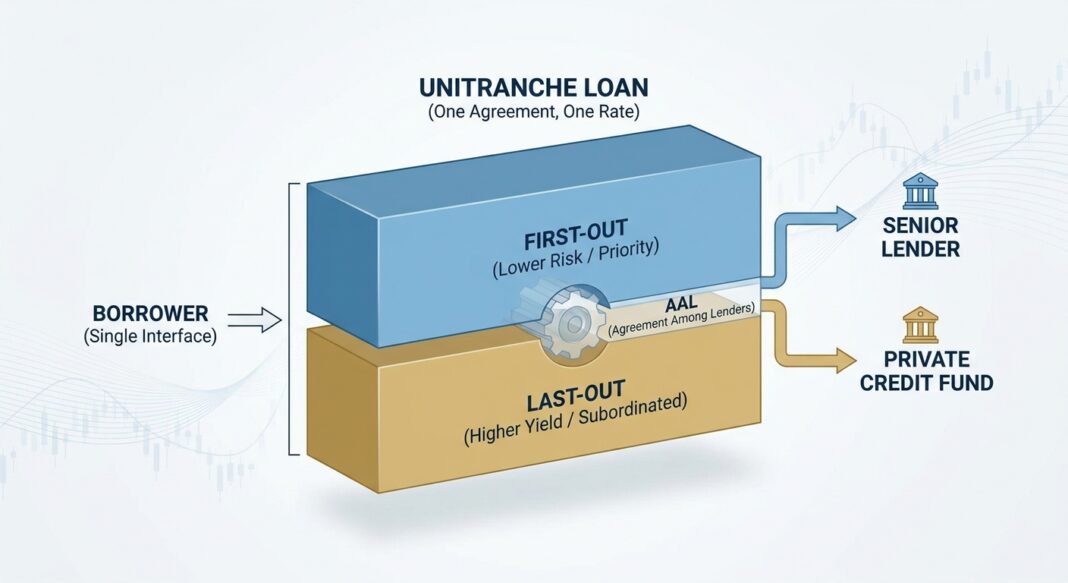
The concept is deceptively simple: instead of stacking separate first-lien and second-lien facilities, each with its own documentation, intercreditor negotiation, and closing timeline, a unitranche facility rolls those layers into a single credit agreement at a blended price. The borrower sees one rate, one agent, and one set of covenants. The lenders, however, see something more nuanced, an internal payment waterfall governed by a private contract called an Agreement Among Lenders (AAL).
Understanding how that internal waterfall works (and what it means for the risk and return each lender actually bears) is foundational knowledge for anyone evaluating private credit investments or seeking growth capital in today’s market. Unitranche structures now dominate new direct-lending issuance, making this one of the most practically useful concepts in modern private finance.
The Mechanism: One Loan, Two Hidden Tranches
At its core, a unitranche facility is a single secured credit facility in which two or more groups of lenders share the same security interest on the borrower’s collateral but agree among themselves to a payment priority. The borrower negotiates one loan; the lenders privately divide it.
That division produces two positions:
- First-Out (FO) Tranche: Receives priority in the payment waterfall. Lower risk, lower effective yield. Often structured as a revolving credit facility or senior term loan, typically provided by a bank or a more senior-oriented lender.
- Last-Out (LO) Tranche: Absorbs losses first if the borrower defaults. Higher risk, higher effective yield. Typically held by a private credit fund or Business Development Company (BDC). According to Crescent Capital BDC’s 2026 SEC filings, the last-out portion earns a higher interest rate specifically in exchange for this greater risk of loss.
Crucially, the borrower is not party to the AAL. From the borrower’s perspective, there is one loan, one rate, and one agent. The internal economics between first-out and last-out lenders remain opaque to the company being financed. Mayer Brown’s July 2026 analysis of unitranche mechanics confirms that the blended rate visible to the borrower reflects one interest rate applicable to all obligations, with the first-out/last-out features set forth entirely within the AAL.
The AAL governs four critical arrangements: interest and fee allocation between the tranches, voting rights on amendments, enforcement of remedies in a default scenario, and the payment waterfall itself.
A Concrete Example with Real Numbers
Consider a mid-market manufacturing company with $12 million in EBITDA seeking acquisition financing. A private equity sponsor structures a buyout at 5.5x EBITDA ($66 million enterprise value), contributing $26 million in equity (roughly 40%) and borrowing $40 million in unitranche debt.
The unitranche is structured as follows:
- Total Unitranche Facility: $40 million, priced at SOFR + 5.00% (blended), consistent with Valuation Research Corporation’s Q2 2026 report, which found unitranche coupon spreads generally ranging from 4.75% to 5.50% over SOFR in mid-2026.
- First-Out Revolving Credit Facility: $8 million at SOFR + 3.50%, lower risk, first dollars out the door in a wind-down.
- Last-Out Term Loan: $32 million at SOFR + 5.50%, reflecting the subordinated economic position despite the single first-lien documentation.
With three-month Term SOFR running near 3.68% as of June 2026, the all-in yield on the last-out tranche approaches approximately 9.2%, in line with the broader market. The borrower, however, simply sees a single loan at the blended rate of approximately 8.68% all-in.
The equity cushion of $26 million (40% of enterprise value) must erode entirely before the last-out lender loses a single dollar of principal, a structural protection that anchors the risk underwriting for both tranches.
Current Market Relevance
Unitranche structures did not achieve dominance by accident. A confluence of structural and cyclical forces has made them the instrument of choice in 2026’s middle-market lending environment.
Bank retreat creates the opening. The Federal Reserve’s July 2026 SLOOS reported that lending standards for C&I loans to businesses of all sizes remained essentially unchanged in Q2, yet the April 2026 SLOOS revealed banks tightened all terms surveyed on loans to non-depository financial institutions, including stricter covenants, higher risk premiums, and shorter maturities. Middle-market borrowers, particularly those without hard collateral, have found bank channels increasingly constrained.
Private credit fills the vacuum at scale. Preqin projects global private credit AUM to more than double to $4.5 trillion by 2030, and the U.S. private credit market has already expanded from $500 billion to $1.3 trillion over the last five years. PitchBook data shows direct lending accounted for close to 60% of all private debt raised in 2024, with unitranche as its dominant instrument.
Spreads remain elevated but are stabilizing. VRC’s Q2 2026 update confirmed unitranche spreads are approximately 25 basis points higher than year-end 2025 levels, with original issue discounts holding steady between 98.75 and 99.25. Northleaf Capital’s Q1 2026 report noted that direct lending continues to generate high single-digit unlevered asset returns, an attractive premium relative to public credit markets.
Performance data supports the structure’s durability. Cliffwater’s March 2026 release of its Direct Lending Index (CDLI) showed the benchmark returned 9.3% for full-year 2025, with interest income of 10.4%, and the index has now delivered a 20-year return average of 9.5% with only one negative year. The CDLI currently covers approximately 21,000 directly originated U.S. middle-market loan holdings totaling $549 billion in assets.
| Metric | Value | Source |
|---|---|---|
| Unitranche spread range (mid-2026) | SOFR + 4.75% – 5.50% | VRC Q2 2026 |
| 3-Month Term SOFR (June 2026) | ~3.68% | VRC Q2 2026 |
| CDLI 2025 full-year return | 9.3% | Cliffwater / Morningstar Mar 2026 |
| CDLI 20-year average annual return | 9.5% | Cliffwater / Morningstar Mar 2026 |
| U.S. private credit market AUM | ~$1.3 trillion | Creative Planning / Preqin, Mar 2026 |
Decision Framework
For Investors Evaluating Private Credit Funds
When reviewing a fund or BDC’s portfolio, investors consider several questions specific to unitranche exposure:
- What tranche position does the fund hold? A fund holding last-out positions earns more yield but absorbs first-dollar losses after the equity cushion is exhausted. A fund holding first-out positions has greater payment priority but lower return. Most private credit funds disclose their tranche composition in quarterly filings.
- How are unitranche assets valued? Unlike publicly traded bonds, unitranche loans are marked to model. Investors evaluate the consistency and independence of a manager’s valuation methodology, particularly given that Q1 2026 saw significant investor redemptions from private funds following reports of valuation concerns.
- What is the underlying equity cushion? The equity contribution by the sponsor, typically 35%–50% of enterprise value in current middle-market LBOs, is the first line of defense. Larger equity cushions reduce expected loss severity on the debt even in downside scenarios.
- Does the AAL provide adequate control rights? Last-out lenders with majority hold sizes typically negotiate meaningful amendment and enforcement control rights within the AAL, an important structural protection investors evaluate during due diligence.
For Business Owners and CFOs Considering Unitranche Financing
- The simplicity premium is real. Mayer Brown notes that unitranche structures offer quicker execution and in some cases a lower total cost of capital than equivalent first/second lien structures: the savings from one legal process, one set of documents, and one closing timeline can be meaningful in competitive M&A processes.
- Understand who controls the loan in a stress scenario. Because the AAL is not visible to the borrower, the identity and philosophy of the last-out lender matters. A distressed-debt-oriented last-out holder may have different workout objectives than a relationship-focused direct lender.
- Covenant structure is negotiable. Unlike broadly syndicated loans, unitranche facilities in the private market typically include maintenance financial covenants, providing early warning but also creating amendment negotiation events. Operators evaluate covenant headroom carefully at origination.
Key Takeaways
- One loan, two economic positions: The unitranche facility presents a single loan to the borrower but contains internally divided first-out and last-out tranches, each carrying different risk and return profiles governed by the Agreement Among Lenders (AAL).
- Last-out lenders earn more by absorbing first losses: The last-out tranche compensates for its subordinated payment position with a higher effective interest rate, a direct application of the risk/return trade-off at the heart of capital stack theory.
- Spreads are SOFR + 4.75% to 5.50% in mid-2026: With three-month Term SOFR near 3.68%, unitranche all-in yields for middle-market borrowers are running approximately 8.4%–9.2%, reflecting both the base rate environment and credit-specific premiums.
- Bank retrenchment is structural, not cyclical: Federal Reserve SLOOS data and long-term market share trends confirm that banks have ceded significant ground in middle-market cash-flow lending, a gap that direct lenders deploying unitranche structures have systematically filled.
- Performance data supports the structure’s track record: The Cliffwater Direct Lending Index (covering over 21,000 middle-market loans) has averaged 9.5% annually over 20 years, with interest income as the dominant return driver, validating the fundamental premise that senior secured private credit can deliver equity-like returns with structural debt protections.


