
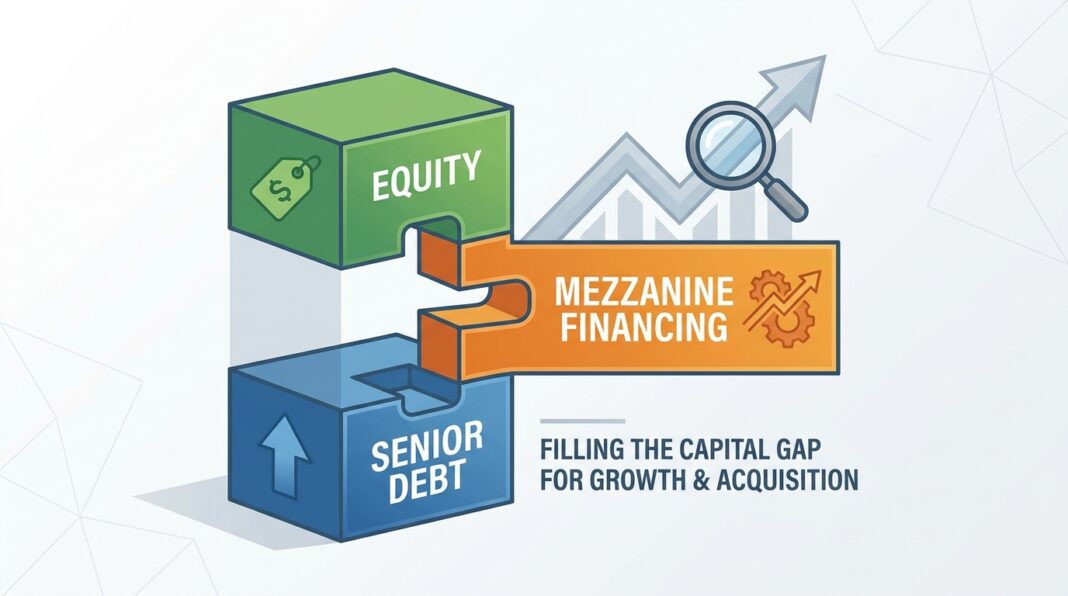
The Growth-Stage Acquisition Problem: Senior Debt Has a Ceiling, Equity Has a Price
Picture a $25M-revenue vertical SaaS business with $6M of trailing EBITDA. The founders have identified a $15M bolt-on acquisition that would add a complementary customer base, accelerate ARR, and justify a step-up in enterprise value ahead of a planned exit in 36 months. The bank will lend to 3.0x EBITDA, roughly $18M, which funds the platform but leaves the acquisition $8M short. A new equity round would cover the gap, but at current market pricing, it would cost 20–30% of the remaining founder position at a moment when enterprise value is about to inflect upward.
This is the canonical growth-stage acquisition problem: a defined, time-sensitive capital need that falls in the dead zone between what senior lenders will stretch to and what equity sponsors are willing to put in without majority control. It is the exact gap that mezzanine debt was architected to fill.
The stakes are not abstract. The growth-stage financing decision made today (structure, cost, dilution, covenant) shapes the exit waterfall, management incentive alignment, and future refinancing optionality. Getting the capital stack wrong at this stage is among the most consequential financial errors an operator can make.
Mapping the Cost-of-Capital Spectrum: From Bank to Equity
Before selecting a structure, operators must understand where each instrument sits on the cost-of-capital continuum, because every incremental dollar of financing carries both a price and a set of control implications.
| Layer | Typical Provider | All-In Cost (2026) | Leverage Ceiling | Control Impact |
|---|---|---|---|---|
| Senior Secured (Bank) | Commercial banks | 7–9% (floating) | 2.5–3.5x EBITDA | Low, maintenance covenants, no dilution |
| Unitranche (Direct Lending) | BDCs, direct lenders | SOFR + 450–650 bps (~10–12%) | 4.0–5.5x EBITDA | Moderate, single-document, covenant package |
| Mezzanine | Mezz funds, BDCs | 13–18% all-in (cash + PIK + warrants) | Fills to 5.5–6.5x combined | Moderate-High, subordinated, equity kicker dilution |
| Preferred Equity | Growth equity, family offices | 15–20%+ (liquidation preference) | N/A, equity layer | High, board rights, participation rights |
| Common Equity | PE sponsors, VCs | 20–35% expected IRR | N/A | Highest, ownership dilution, governance transfer |
The progression is not merely about cost; it is about where control rights shift. Mezzanine is the last layer of the capital stack that is unambiguously debt in character, yet it carries quasi-equity economics through its PIK and warrant features. That duality is both its value proposition and its structural complexity.
The private credit market provides important backdrop here. Direct lending now matches the broadly syndicated loan market at $1.5–2 trillion in size, with the asset class forecast to reach $3 trillion by 2028, according to Cleary Gottlieb’s 2026 outlook. Within that universe, mezzanine occupies a distinct niche. J.P. Morgan data shows annualized mezzanine debt returns have historically run at approximately 11.4%, versus 9.0% for direct lending and 5.5% for leveraged loans, a premium that reflects the subordinated position and equity optionality baked into the instrument.
Mezzanine: Component Breakdown and a Live Term-Sheet Example
Mezzanine debt is a hybrid financing instrument that combines characteristics of both debt and equity. Structurally, it sits junior to senior debt but senior to common equity in a company's capital stack. Its three core components each serve a distinct economic function:
- Cash Interest: Regular coupon paid quarterly or semi-annually, typically ranging from 8–12% of the outstanding principal. This provides the lender with current income and signals borrower cash flow health.
- PIK Interest (Payment-in-Kind): An additional interest tranche, commonly 1–4%, that accrues to the principal balance rather than being paid in cash. PIK preserves borrower liquidity during the growth phase but compounds the balance, creating a larger obligation at bullet maturity.
- Equity Kicker: Warrants or conversion rights granting the mezzanine lender participation in equity upside, typically representing 3–8% of the post-close capitalization. This is the mechanism by which lenders target total returns of 16–22% IRR despite a stated interest rate well below that level.
Illustrative Term Sheet, $8M Mezzanine Tranche for a SaaS Acquisition:
| Term | Detail |
|---|---|
| Facility Size | $8,000,000 subordinated note |
| Senior Tranche | $18M first-lien term loan @ SOFR + 500 bps (bank / direct lender) |
| Combined Leverage | $26M total debt on $6M EBITDA = 4.3x (within lender norms) |
| Cash Interest | 10% per annum, quarterly |
| PIK Toggle | +2% PIK (borrower may elect in years 1–2) |
| All-In Cash Rate | 12% cash-pay; 14% if PIK elected |
| Equity Kicker | Warrants for 5% fully-diluted equity, strike at closing valuation |
| Maturity | 5-year bullet; no amortization |
| Prepayment | 102% in year 1; 101% in year 2; par thereafter |
| Origination Fee | 2.0% upfront (OID) |
| Covenants | Maintenance leverage test (Total Debt / EBITDA ≤ 5.5x), quarterly; minimum liquidity $1.5M |
| Intercreditor | Subordination agreement with senior lender; 180-day standstill on enforcement |
The all-in cost to the borrower (inclusive of cash interest, accrued PIK, warrant dilution, and origination fee) translates to approximately 17–19% on an IRR basis, consistent with market data showing mezzanine structures targeting 16–22% all-in returns for the lender.
Mezzanine vs. Alternatives: When Does Each Structure Win?
Choosing between a mezz layer, a unitranche stretch, and an equity round is not a theoretical exercise; it is an access-vs-cost trade-off governed by the company's EBITDA trajectory, ownership priorities, and exit horizon.
Mezzanine vs. Unitranche
A unitranche blends senior and junior debt into a single instrument, priced at roughly SOFR + 450–650 bps, cheaper than dedicated mezzanine, but constrained in total leverage capacity. Unitranche typically dominates the $50M–$200M EV market, where direct lenders compete aggressively and terms are most flexible. However, when a company's senior lender cannot extend to the required leverage multiple (or where an existing credit agreement restricts additional senior debt) a mezzanine tranche can stack on top without requiring a full refinancing of the senior facility. As one market framework notes, traditional senior-plus-mezzanine can achieve a lower weighted cost of capital if mezz carries equity kickers, though intercreditor complexity slows execution and reduces flexibility relative to a single-document unitranche.
Mezzanine vs. Preferred Equity
Preferred equity sits above common equity in the waterfall but below debt, making it structurally junior to mezzanine. Its cost in governance terms is typically higher: preferred investors frequently demand board representation, information rights, and anti-dilution protections that constrain future financing flexibility. Mezzanine is more expensive in cash terms but preserves more founder control, provided the leverage capacity exists to service it. The interest deductibility of mezzanine debt versus the non-deductible dividend or return on preferred equity also favors the mezz structure from an after-tax cost perspective.
When to Avoid Mezzanine
Mezzanine debt is structurally unsuited to cyclical or capital-intensive businesses. Conditions that disqualify the structure include: customer concentration above 30% of revenue, CapEx requirements exceeding 8% of EBITDA, EBITDA growth historically below 5% organic, and volatile or seasonal cash flows. In these scenarios, the compounding PIK balance and bullet maturity create a refinancing risk that amplifies rather than absorbs operational stress.
Current Market Terms: What Is Standard in 2026
The 2026 mezzanine market reflects a higher-rate environment that has revived structural features that compressed during the 2020–2021 low-rate cycle. Key data points:
- All-In Pricing: Current-pay cash interest of 8–12% plus PIK of 1–4%, producing all-in yields of 13–18% depending on deal size and credit quality. Smaller deals ($1M–$10M) price at the wider end (14–18% all-in); institutional-scale facilities ($25M+) compress to 13–15%. (Source: PeerSense Capital Advisory, June 2026)
- Equity Kicker Coverage: Warrants representing 3–8% of post-close equity are standard, with lender IRR targets of 16–22% when blending cash interest, PIK accretion, and warrant upside. (Source: CTA Acquisitions / Ascendant Global Credit Group, 2026)
- Tenor and Structure: Mezzanine facilities typically run 5–7 years versus 3–5 years for senior debt, with bullet repayment: requiring a refinancing event, dividend recapitalization, or business sale to retire principal. (Source: Ascendant Global Credit Group, 2026)
- Covenant Architecture: Maintenance covenants remain standard in sub-$50M EBITDA deals, with quarterly leverage testing the norm in the lower middle market. Research from KBRA DLD and ABF Journal indicates that 98% of lower-middle-market loans with borrower EBITDA below $50M retain full financial maintenance covenant packages, in contrast to the broadly syndicated market where cov-lite incurrence-only structures dominate at 91.7% of large corporate issuance. (Source: Angel Investors Network / PitchBook LCD, 2026)
- Lender Universe: The primary mezzanine provider pool includes BDCs (Ares Capital, Blue Owl, FS KKR), specialty mezz funds (Audax Mezzanine, Madison Capital, Maranon, Babson), and family offices operating pooled mezzanine vehicles. The underwriting timeline from term sheet to close runs 60–90 days.
The renewed interest in mezzanine in 2025–2026 is partially structural: in a higher-rate environment, mezzanine's current-pay component becomes more attractive to investors, while the PIK toggle gives borrowers cash-flow management flexibility that pure cash-pay facilities do not afford.
The Gap Capital Playbook: Quantify, Prepare, Run the Process
The mechanics of accessing mezzanine capital follow a four-step process that separates well-prepared borrowers from those who lose time, optionality, or pricing leverage in the market.
Step 1: Quantify the Gap with Precision
Begin with a sources-and-uses model built around the specific acquisition. Map the maximum senior debt capacity (senior lender's leverage covenant, typically 3.0–3.5x for bank, up to 4.5–5.0x for unitranche). The gap between total deal capitalization and available senior debt, after sponsor equity contribution, defines the mezzanine quantum. For the illustrative SaaS example: $33M total acquisition cost, $18M senior debt, $7M sponsor equity = $8M mezzanine. Stress-test the combined debt service against a downside EBITDA case (typically 20–25% below base) to confirm the structure does not become self-defeating under realistic scenarios.
Step 2: Prepare the Lender Package
Mezzanine providers evaluate historical and projected cash flow, growth potential, and ability to service both existing senior debt and the new mezzanine layer. The package must include: three years of audited financials, a 5-year operating model with clearly bridged assumptions, a detailed use-of-proceeds analysis, an organizational chart showing the post-close capital stack, and a management presentation articulating the growth thesis. For acquisition mandates, the target company's financials, integration assumptions, and pro forma EBITDA bridge are essential. Lenders will independently stress the add-backs, which in 2024 clustered around 25–35% of EBITDA as market standard, and will push back on any projection that requires heroic cost savings to clear coverage ratios.
Step 3: Run a Competitive Process
Approach three to five mezzanine providers simultaneously, establishing a structured bid date. Competition disciplines pricing and terms. The differences between first and fourth bids on a well-run process typically span 150–200 bps on cash interest and 2–3 percentage points on warrant coverage. Lenders with existing BDC mandates in the same sector can move faster and may offer more flexible prepayment terms in exchange for relationship continuity. Do not conflate speed with cost, a faster close at 100 bps wider is usually the wrong trade.
Step 4: Negotiate the Structure, Not Just the Rate
The rate is the headline, but the terms determine the real cost. Key negotiation points for borrowers include:
- PIK Toggle vs. Mandatory PIK: Insist on an elective toggle, the right to choose PIK in early years, rather than a mandatory PIK structure. Mandatory PIK compounds faster and limits future refinancing flexibility.
- Warrant Strike and Anti-Dilution: Negotiate the warrant strike price at closing valuation with broad-based weighted-average anti-dilution protection. Avoid full-ratchet provisions that penalize future down-round financing if market conditions shift.
- Prepayment Premium Cliff: Push for a call schedule that reaches par within 24–30 months rather than 36. Given the 36-month exit horizon in this example, the ability to repay at par before exit materially affects the total return to lenders and the net proceeds to equity.
- Maintenance Covenant Cushion: Negotiate 25–30% headroom above the base-case EBITDA projection for the leverage maintenance test. Given that the covenant will be tested quarterly, covenant cushion is operational breathing room, not a technicality.
- PIK Compounding Risk Management: If PIK is elected in years 1–2, model the compounding effect on the bullet maturity balance. PIK does not provide current cash income; it accrues as additional principal and is only settled at exit or maturity. A two-year PIK election on an $8M facility at 2% PIK grows the balance to approximately $8.33M, a modest absolute impact, but one that increases the total warrant dilution base if warrants are calculated on outstanding principal at maturity.
Key Takeaways
- Mezzanine is a precision instrument: It is purpose-built for the gap between senior debt capacity and the capital requirement of a specific value-creation event (most commonly an acquisition, recapitalization, or growth infrastructure build) where equity dilution is disproportionate to the opportunity cost.
- The true all-in cost is not the stated rate: Cash interest, PIK accretion, warrant dilution, origination fees, and prepayment premiums collectively drive the all-in cost to 17–22% on an IRR basis. Model all components before comparing to the dilution cost of an equity alternative.
- Covenant architecture matters as much as pricing: In the lower middle market, maintenance covenants are nearly universal for sub-$50M EBITDA borrowers. Negotiate cushion at origination, not after the first miss.
- The market window is real: With private credit AUM exceeding $2 trillion globally and lenders actively competing for lower-middle-market deployment, borrowers with stable recurring revenue, low customer concentration, and credible management teams are in a structurally favorable negotiating position in 2026.
- Mezzanine is a bridge, not a destination: The bullet maturity, PIK compounding, and equity kicker dilution all assume a defined exit or refinancing event within the tenor. Operators should model the structure against the most likely liquidity path (sale, IPO, or dividend recapitalization) and ensure the mezzanine maturity does not become a forced-sale catalyst if that path is delayed.


