
The Story: A $1 Billion Exit That Paid Nobody
In January 2025, one of the most instructive capital structure lessons in recent memory played out in the proptech sector, not in the way that makes for a triumphant founder story, but in the way that makes experienced investors wince.
Divvy Homes, a San Francisco-based rent-to-own startup founded in 2016, had spent years building something genuinely ambitious: a platform to help working families who couldn’t afford a traditional mortgage transition into homeownership. By 2021, it was a Wall Street darling. Its Series D, led by Tiger Global Management and Caffeinated Capital, valued the company at over $2.3 billion. Andreessen Horowitz had been an early backer. The press called it a revolution in housing access.
Then, in January 2025, Brookfield Properties acquired the company for approximately $1 billion, and CEO and co-founder Adena Hefets wrote a letter to shareholders informing them that, after paying down obligations, shareholders would receive nothing.
Not a reduced return. Not a modest payout. Nothing.
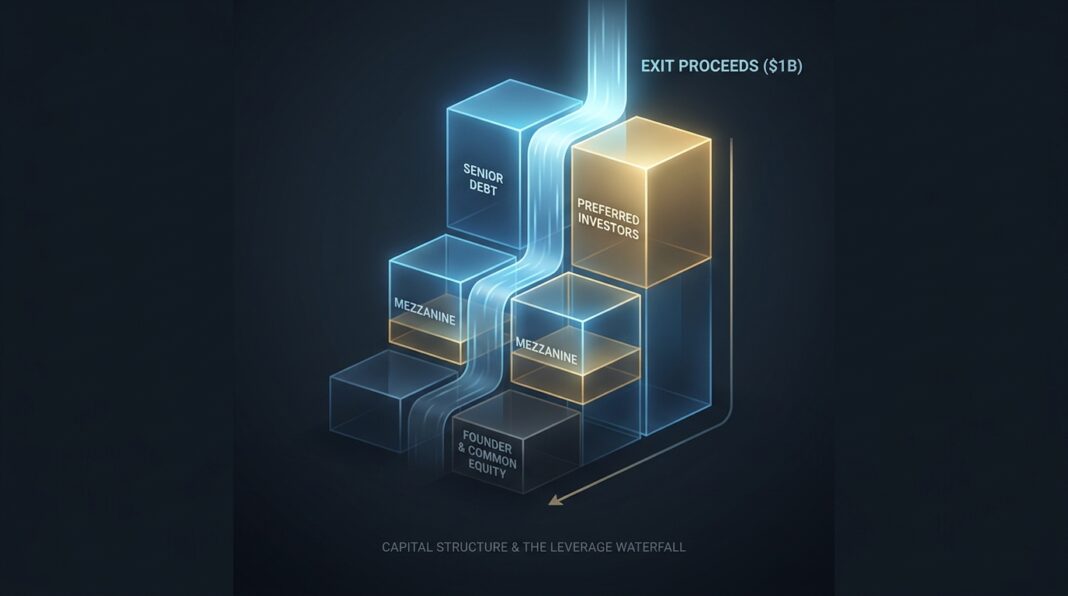
An industry insider described the situation bluntly: just about everyone at Divvy had been laid off, and it was described as “a bloodbath for investors and employee equity.” A $2.3 billion company sold for less than half its peak valuation, and a cap table stacked with preferred liquidation preferences and debt obligations consumed every dollar before common shareholders ever saw a penny.
The lesson wasn’t about the product. It wasn’t about the mission. It was about the structure. Specifically, what happens when you combine aggressive venture equity with a massive debt load in a rate-sensitive business, and then watch interest rates surge.
The Decision: How the Capital Stack Was Built
To understand how a $1 billion exit yields zero for founders and investors, you have to trace the capital decisions made at Divvy’s peak.
Over its life, Divvy raised more than $400 million in venture equity from top-tier firms including Andreessen Horowitz and Tiger Global. Then, in October 2021, at the height of the zero-interest-rate era, the company layered in approximately $735 million in debt financing. At the time, cheap money made the math look clean. Divvy’s model required purchasing homes at scale, and debt seemed like the logical instrument to finance a capital-intensive asset base.
The structure at its peak looked something like this:
- $400M+ in venture equity carrying multi-tier liquidation preferences
- ~$735M in debt financing secured against the home portfolio
- $2.3B implied valuation, built on an assumed interest rate environment that would evaporate within months
The problem wasn’t leverage per se. The problem was the nature of the leverage: balance-sheet debt taken on a rate-sensitive asset (residential property) during a period of historically suppressed rates, combined with a preferred equity stack that placed common shareholders (including founders and employees) at the very bottom of the waterfall. When rates surged in 2022, the model fractured. Three rounds of layoffs followed. New home acquisitions were paused entirely by 2023.
When Brookfield’s $1 billion offer arrived, it looked like a rescue from the outside. From the inside, the payment waterfall was devastating: debt holders collected first, no exceptions, and by the time preferred equity liquidation preferences were covered, nothing remained for the common cap table.
The venture capital structure, designed to give investors downside protection via preferred shares, performed exactly as written. It just didn’t leave anything for the people who built the company.
The Outcome: What the Other Side of the Market Looked Like
While Divvy’s story played out in public, a quieter set of capital decisions were producing very different outcomes across the middle market.
Hypothetical Scenario, for illustrative purposes: Consider a founder-owned industrial services company generating $8M in annual EBITDA with strong recurring cash flows from long-term maintenance contracts. In 2022, this founder faced a familiar fork in the road: bring in a PE sponsor (accepting dilution of 60–70% of equity and a fund-controlled exit timeline), or explore a dividend recapitalization through a private credit lender.
She chose the recap. Working with a direct lender, she structured a $24M term loan at 4.5x EBITDA, consistent with typical middle-market recap leverage, at a floating rate with a floor. The debt service was covered by existing cash flow with headroom. She distributed $20M to herself and her co-founder as a special dividend, retiring personal risk accumulated over a decade of building the business.
Ownership? Still 100%. Governance? Still hers. And when she eventually sold the business three years later at a 7x EBITDA multiple, a $56M enterprise value, she retained the full equity upside, less the remaining debt balance.
The contrast with Divvy’s founders is stark. Under the venture equity model, even a $56M outcome would have run through a preference stack that might have returned little to common holders depending on the round structures. Under the recap model, this founder’s liquidity was secured in two phases (the dividend and the eventual exit) and she controlled both timings.
This dynamic is playing out broadly. Leveraged loan issuance for sponsored dividend recaps grew 11% year-over-year to $74.3 billion in 2025, following a 326% surge in 2024, as sponsors and founders alike recognized recaps as a primary liquidity tool in a market where clean exits remained difficult to execute.
The Lessons: What Every Founder Needs to Know Before Signing a Term Sheet
1. Capital structure is destiny at exit.
The single most important sentence in any financing document is the one that describes what happens to proceeds in a liquidation event. Venture preferred equity is, at its core, a downside protection instrument for investors, not a wealth-creation instrument for founders. When the exit price falls below the total preference stack, common shareholders receive nothing. Divvy’s story is not unusual; it is the rule in compressed-multiple exits with multi-round VC structures.
2. Debt taken for the wrong reason, on the wrong asset, at the wrong time is as dangerous as equity dilution.
The lesson from Divvy isn’t that debt is bad. The $735M in debt financing made sense on a spreadsheet in 2021. The lesson is that balance-sheet debt secured against rate-sensitive assets, with no margin for a rate shock, is a structural vulnerability, not a feature. The venture equity and debt stacked together created a waterfall with almost no room for founder value to survive a down-cycle exit.
3. A dividend recap is one of the most powerful founder liquidity tools available, and it is still widely underutilized.
A dividend recapitalization allows a company to borrow against its enterprise value and distribute the proceeds as a special dividend to existing shareholders, without selling a share of equity. For founder-owned businesses with strong, recurring cash flows, it offers partial liquidity now with full equity upside preserved for a future exit. Market conditions increasingly support this structure: private credit’s ability to provide capital structure flexibility has made it dominant in recapitalizations and refinancings, even as traditional bank competition intensifies in other areas.
4. The framework: when does a recap work vs. when does it add dangerous leverage?
The recap model works when the business has durable, predictable cash flow, debt service coverage of 1.5x or above post-transaction, a management team committed to continuing operations, and no imminent macro risk to the core revenue model. It becomes dangerous when leverage is piled on a cyclical or rate-sensitive asset base, as Divvy’s $735M home portfolio demonstrated. The distinction is not between debt and equity; it is between leverage that matches the asset’s risk profile and leverage that amplifies it.
5. The exit environment in 2025–2026 makes this decision more urgent than ever.
Exit activity rebounded strongly in 2025, but 78% was concentrated in mega exits, leaving mid-market inventory effectively stagnant. For founders holding cash-flow businesses and waiting for the “right” exit moment, dividend recaps offer a way to monetize a portion of their value today, while retaining future upside potential. Instead of waiting for perfect exit conditions that may not arrive, the recap reframes the question: not “when do I sell?” but “how do I capture value in stages?”
Key Insights
- The waterfall decides everything: In a distressed or compressed-multiple exit, a cap table loaded with VC preferred equity and senior debt will exhaust proceeds before common shareholders, including founders, see a dollar. Divvy’s $1B sale is the textbook case.
- Debt type matters as much as debt amount: Divvy’s $735M wasn’t the problem in isolation; it was rate-sensitive balance-sheet debt on residential property taken at peak-ZIRP conditions. Disciplined leverage matched to cash-flowing, durable businesses is a completely different instrument.
- Dividend recaps offer a third path: Between “raise VC and give up control” and “sell the company,” a well-structured dividend recap allows founders with strong EBITDA businesses to take chips off the table while retaining full ownership and the option value of a future exit at a higher multiple.
- The market for recaps is deep and growing: Leveraged loan issuance for dividend recaps reached $74.3 billion in 2025, and private credit’s dominance in recapitalizations and refinancings continues to expand. Founders who assume this market is only for PE-backed companies are leaving a significant tool unused.
- The real cost of venture capital is revealed at the exit, not the term sheet: Liquidation preferences, anti-dilution provisions, and participating preferred structures are founder-risk instruments written in investor-friendly language. The moment of truth is when the proceeds are distributed, and by then, the terms are already signed.


