
The Growth-Stage Capital Challenge: Bridging the Acquisition Gap
Picture this: a founder-owned professional services business generating $6M in EBITDA wants to acquire a complementary platform at a $50M enterprise value, roughly 8.3x. The owner’s equity reserves cover $8M. Senior bank debt, conservatively underwritten at 3.0x EBITDA, contributes $18M. That leaves a $24M gap sitting between senior capacity and available equity. This is the precise scenario where mezzanine financing was built to live.
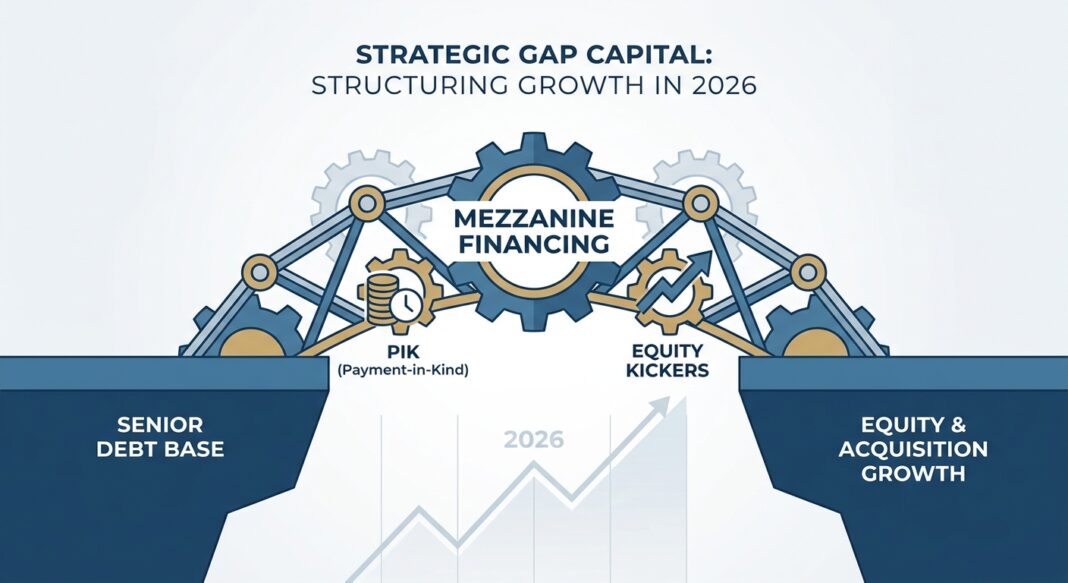
For growth-stage operators executing buy-and-build strategies, tuck-in acquisitions, or shareholder buyouts, the financing challenge is rarely about access to senior debt or equity in isolation. It is about filling the structural gap between the two: doing so without catastrophic dilution, without suffocating fixed cash charges, and without handing governance to a control equity investor years too early. Mezzanine financing, with its layered combination of cash interest, Payment-in-Kind (PIK) accruals, and warrant-based equity kickers, is the practitioner’s answer to that gap. This article maps the structure, prices it against current market terms, and walks through the deal process from credit box to closing.
Structure Breakdown: Components, Mechanics, and a Live Example
Mezzanine debt occupies the layer of the capital stack that sits directly below senior secured debt and above common equity. As a structural matter, it is subordinated and typically unsecured, meaning senior lenders get paid out in full before mezzanine holders see a dollar in a liquidation. That subordinated position drives everything: higher pricing, deferred cash-pay options, and equity participation rights that compensate lenders for bearing a risk profile closer to equity than to senior debt.
The instrument has three defining features that borrowers and advisors must understand before approaching a mezzanine fund:
- Cash Interest: The current-pay component of the coupon, paid quarterly or semi-annually. This is real cash out the door every period and must be modeled against post-close free cash flow.
- PIK Interest: With PIK (Payment-in-Kind) interest, the borrower does not pay cash immediately; instead, the interest amount is added to the total loan balance, causing the principal to grow over time. PIK is the structural release valve that preserves operating cash flow during high-investment phases, but it compounds leverage. When borrowers elect PIK interest, the outstanding balance compounds, increasing total debt burden. If the anticipated liquidity event is delayed, the growing PIK balance creates a larger refinancing burden at bullet maturity.
- Equity Kicker (Warrants): Warrants give the holder the right to purchase a company’s stock at a set price in the future. In mezzanine financing, warrants act as an equity kicker, letting lenders share in the company’s upside if it grows. This is the instrument’s equity-like return driver, and it is priced to make the lender’s total return competitive with the risk it is taking. Every warrant granted to a mezzanine lender dilutes existing common equity. In a successful exit, the mezzanine lender’s equity kicker reduces the return available to the PE sponsor and management team, a cost that must be weighed against the benefit of reduced upfront equity contribution.
Illustrative Example: $24M Mezzanine Tranche for a $50M Acquisition
Returning to our $50M platform acquisition with $6M of EBITDA:
| Layer | Amount | Multiple | Instrument | Pricing (2026) |
|---|---|---|---|---|
| Senior Secured Term Loan | $18M | 3.0x EBITDA | First-lien TL + Revolver | SOFR + 475–550 bps (~9.0–10.0% all-in) |
| Mezzanine Note | $24M | 4.0x EBITDA (incremental) | Sub. Note + Warrants | 11–14% cash + 2–4% PIK + 2–4% equity warrants |
| Buyer Equity | $8M | – | Common Equity | – |
| Total | $50M | ~8.3x EV | – | – |
Current mezzanine cost structure runs 8–12% cash interest plus 2–4% PIK (accruing to principal) plus warrants or equity co-investment of 1–5% of equity, creating an all-in lender IRR target of 16–22%. The intercreditor agreement between the senior lender and the mezzanine provider governs payment subordination, standstill periods, and the mezzanine holder’s right to cure senior defaults, a document that will directly shape the borrower’s operating flexibility post-close.
PIK triggers deserve particular attention during negotiation. Effective PIK structures include carefully tailored triggers that constrain or condition PIK elections. Performance-based triggers might require a minimum liquidity threshold, a maximum leverage ratio, or positive free cash flow before permitting cash-pay toggling. Alternatively, time-based triggers may allow PIK for an initial period, with a step-down to partial cash-pay thereafter.
Mezzanine vs. Alternatives: Unitranche, Second Lien, and Growth Equity
The growth-stage operator evaluating a capital structure has at least three credible alternatives to a split senior/mezz stack. Understanding the structural and economic trade-offs is the practitioner’s core skill.
Mezzanine vs. Unitranche
Unitranche debt is a single-tranche acquisition loan that combines what would otherwise be senior debt and mezzanine into one instrument with one lender and one credit agreement. Unitranche closes faster and simplifies intercreditor questions. It usually prices 25 to 75 basis points inside a split senior plus mezz structure. For the borrower who values speed and documentation simplicity above all else, unitranche wins, but the operator cedes the ability to negotiate senior and junior tranches separately. Despite the unitranche’s rise, traditional mezzanine debt has not disappeared. It remains relevant in very large transactions where unitranche lenders cannot provide the full quantum of debt needed, situations where the borrower wants to minimize total cost by maximizing cheap senior debt separately, and deals where the sponsor or management team wants equity kickers to align lender incentives.
Mezzanine vs. Second Lien
Second lien debt carries second-priority security on assets and cash flow. It sits between senior and mezzanine in the stack, features cash interest only (no PIK typical), and no warrants, at a cost of approximately 9–12%. Second lien is cheaper than mezzanine on a headline basis but delivers no PIK optionality and requires full current-pay cash service. For a capital-intensive growth business managing tight post-acquisition free cash flow, the PIK feature in mezzanine can be the structural difference between making debt service and breaching covenants.
Mezzanine vs. Growth Equity
Compared to senior debt or unitranche, growth capital does not require monthly amortization, does not put personal guarantees at risk, and does not have covenants that trigger in a downturn. The tradeoff is dilution and governance sharing rather than leverage risk. Mezzanine protects ownership percentage and control while adding leverage, the right trade-off when the operator has high conviction in a near-term liquidity event within the mezzanine’s typical 5–7 year bullet maturity window.
Current Market Terms: What the 2026 Market Is Actually Pricing
Market conditions as of mid-2026 reflect a private credit complex that has expanded aggressively, and is now sorting deals with greater precision on credit quality, sector, and leverage quantum. Here are five data-anchored benchmarks operators should carry into any term sheet conversation:
- Mezzanine All-In Pricing: Mezzanine debt prices at an all-in yield of 13–17% in 2026 (11–14% cash coupon plus 2–4% PIK) and typically includes 1–5% equity warrants.
- Senior Debt Baseline: As of Q2 2026, senior secured lending for lower middle market businesses runs SOFR plus 400 to 550 basis points per S&P Global LCD, putting all-in coupons in the 9–10% range.
- Unitranche Pricing Spread: Unitranche pricing in 2026 runs SOFR plus 500–700 bps, plus a 2–3% original issue discount (OID) and a 2–3% prepayment fee declining over the first 24 months.
- PIK Prevalence: In 2025, public BDCs received an average of 8% of their investment income through PIK interest, reflecting the growing prevalence of PIK structures across the private credit market.
- Covenant Environment: In the broadly syndicated loan market, approximately 90% of new loans in 2024 remained covenant-lite, continuing borrower-friendly documentation trends. However, private credit lenders have maintained firmer positions on covenant inclusion, particularly for mid-market transactions. The IMF noted in its April 2024 Global Financial Stability Report that private credit often carries tighter covenant packages and stronger lender control than broadly syndicated leveraged loans.
On covenant design, growth-stage borrowers face a critical structural choice. While both maintenance and incurrence covenants require borrowers to meet specified financial metrics, the consequence of not meeting them differs. Longstanding maintenance covenants require transfer of control to lenders, while incurrence covenants only restrict certain predetermined actions by corporate managers, such as dividend payments or new debt issuance. Middle market mezzanine providers almost universally insist on at least one quarterly maintenance covenant (typically a maximum leverage ratio or minimum fixed charge coverage ratio) giving them an early intervention right that protects the subordinated position before enterprise value erodes to the point of loss.
The Gap Capital Playbook: From Quantifying the Need to Closing the Structure
Raising mezzanine capital is a process, not a conversation. Operators who approach it without a structured playbook typically face extended timelines, repriced terms, or failed processes. The four-step playbook below is built for the growth-stage borrower executing an acquisition or recapitalization.
Step 1: Quantify the Gap Before Approaching Any Lender
Build a sources-and-uses table at multiple purchase price scenarios. Map maximum senior debt capacity at 3.0x and 3.5x EBITDA. Determine committed equity. The residual (net of any seller rollover or earnout) is the mezzanine quantum. This number drives every subsequent conversation. A borrower who cannot articulate the gap precisely signals to a mezzanine fund that the capital structure has not been fully modeled.
Step 2: Prepare the Lender Package
Mezzanine lenders underwrite subordinated risk and need to see a credible path to a liquidity event that retires the bullet. The package should include: (1) trailing twelve-month and three-year historical EBITDA with clear add-back documentation; (2) a detailed acquisition thesis and integration timeline; (3) a five-year cash flow model showing debt service coverage under base, downside, and stress scenarios; (4) a cap table pre- and post-transaction; and (5) a warrant coverage negotiation range the borrower can accept without triggering dilution that undermines the deal logic. Lenders consider financial health, creditworthiness, operational stability, industry outlook, use of funds, collateral availability, management team, and debt-service capacity. They typically request financial statements, the current cap table, financial projections, details on the use of funds, and legal and regulatory compliance information.
Step 3: Run a Parallel Process
Buyers who lock in an equity sponsor before pricing senior debt routinely give up 300 to 500 bps of blended cost and 8 to 12 points of equity that a competitive process would have preserved. The winners run senior debt, unitranche, and mezz quotes in parallel, then use the tightest term sheet as leverage on the equity conversation. Target five to seven mezzanine providers simultaneously. Top mezzanine providers include BDCs such as Ares Capital, Blue Owl, Main Street, Owl Rock, and FS KKR, as well as specialty mezz funds including Audax Mezzanine, Madison Capital, Twin Brook, Babson, Brookfield, NXT, GoldenTree, Maranon, and Antares.
Step 4: Negotiate the Structure, Not Just the Rate
Headline cash coupon is the least important term to negotiate first. The high-value negotiation points for growth-stage borrowers are: (i) warrant coverage percentage, fight to keep this below 3% dilution; (ii) PIK toggle mechanics, push for borrower-elected PIK rather than mandatory PIK, which signals lender distress management; (iii) prepayment premiums, negotiate step-downs that allow refinancing into cheaper senior debt if the business outperforms; and (iv) the intercreditor standstill period, a longer standstill window gives the mezzanine holder more time to cure a senior default before enforcement. The interaction between PIK compounding and equity kicker valuation influences redemption mechanics, prepayment premiums, and change-of-control provisions. If the borrower elects to prepay, the agreement should clarify whether make-whole or call protection applies to both the debt and the warrant value, and how capitalized PIK is factored into any premium calculation. Failure to define these aspects with specificity is a frequent source of post-closing disputes, especially when the company outperforms and the equity kicker becomes valuable.
Key Takeaways
- Mezzanine fills the structural gap: For growth-stage acquisitions where senior debt capacity is exhausted and equity dilution is unacceptable, mezzanine bridges the financing gap without transferring control.
- PIK is a cash flow tool, not a free lunch: PIK interest preserves operating liquidity during high-investment periods but compounds principal, a growing bullet maturity that demands a credible exit or refinancing path within the instrument’s 5–7 year window.
- Warrant dilution is a real cost: Equity kickers priced at 1–5% of equity look manageable at origination but can represent significant value transfer at exit. Model the warrant cost at multiple exit multiples before accepting a term sheet.
- Covenant design is venue-specific: Middle market mezzanine providers almost always require at least one financial maintenance covenant tested quarterly. Understanding the difference between maintenance and incurrence tests (and their enforcement consequences) is non-negotiable competence for any growth-stage borrower.
- Process discipline creates pricing leverage: Running senior debt, unitranche, and mezzanine quotes in parallel before anchoring to any single lender is the single highest-return activity in a capital raise. The tightest term sheet becomes the negotiating floor for every other conversation in the stack.


