
The Story: A Billion Dollars That Belonged to Everyone Except the People Who Built It
In January 2025, Adena Hefets (co-founder and CEO of Divvy Homes) sent a letter to her shareholders. The news was not what any of them had hoped for. TechCrunch reported that the letter stated that after repaying outstanding indebtedness, transaction costs, and liquidation preferences to preferred shareholders, “neither common shareholders nor holders of the Series FF preferred stock will receive any consideration.” Series FF preferred stock is, by convention, the share class issued to founders.
Read that again slowly. A billion-dollar exit. Zero for the founder.
Divvy Homes was a San Francisco-based rent-to-own startup founded in 2016 with a genuinely elegant social mission: buy a home, rent it back to the customer, and set aside a portion of each monthly payment toward a future down payment. By 2021, the model had won over some of the most sophisticated investors in venture capital. Divvy had raised over $700 million from investors including Tiger Global Management and Andreessen Horowitz, and its valuation had climbed to $2.3 billion off a $200 million Series D.
Then came the debt, and the rate cycle that broke everything. In October 2021, Divvy took on approximately $735 million in debt financing, layered on top of hundreds of millions in preferred equity that each carried its own liquidation preferences. When interest rates surged in 2022, the model that required Divvy to buy homes at scale (and finance them at low rates) snapped under the pressure. Three rounds of layoffs followed. By 2023, new home acquisitions had stopped entirely.
Brookfield Properties acquired the company for approximately $1 billion in January 2025, less than half of Divvy’s peak valuation, and when the waterfall was paid out, there was simply nothing left for the people who had built it.
The Decision: What the Capital Stack Actually Said
Divvy’s story is often told as a rate-cycle casualty. That framing is too forgiving. It was a capital structure story from the beginning, and the structure was always weighted against the founder.
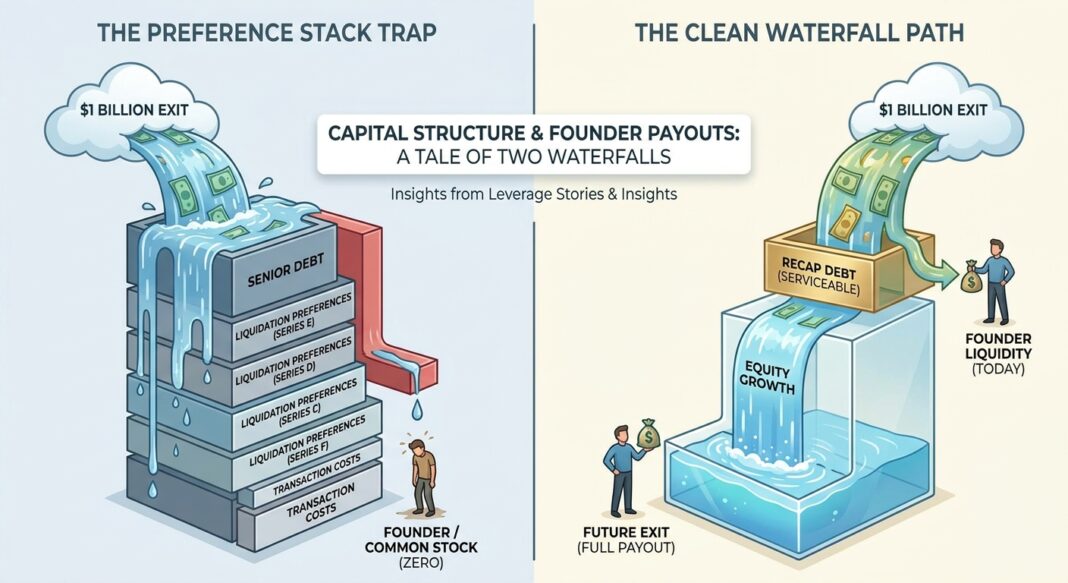
Here is how the waterfall worked. When Divvy was acquired, the cap table included investors, employees, and founders across multiple share classes. Investors negotiate a liquidation preference during funding rounds, a guarantee of a minimum return before other stakeholders get paid. Layered across multiple rounds of preferred equity, each carrying its own preference, the stack consumed the entire $1 billion before a single dollar reached a common shareholder. The $735 million in asset-backed debt came first. Transaction costs came next. Then the preferred equity liquidation preferences. By the time the waterfall was exhausted, the common stack (founders, employees, early supporters) received nothing.
This is not an anomaly. Venture equity dilutes founder ownership by 15–25% per round on average and typically comes with board seats, protective provisions, and liquidation preferences. Stack enough rounds together at a peak valuation (and then watch the exit price compress) and the preference overhang can swallow the entire company. The entrepreneur who raised at $2.3 billion and sold at $1 billion did not just take a haircut on valuation. She was zeroed out entirely.
The first quarter of 2025 alone produced $31 billion in dividend recap issuance, suggesting that a substantial cohort of founders and PE sponsors had already absorbed this lesson and were finding alternative ways to generate liquidity, without handing that waterfall priority to a preferred equity stack.
⚠️ HYPOTHETICAL SCENARIO, Case Study Example
The following is a constructed illustrative example based on real 2025–2026 market structures, deal terms, and EBITDA multiples sourced from public deal databases and advisory benchmarks. It does not represent a real company or transaction. It is designed to contrast the Divvy Homes outcome with what a different capital strategy could have produced.
The Outcome: What the Other Path Looks Like
Consider a hypothetical founder, call her Marina, who owns a field services software company doing $5.2 million in EBITDA, growing at 18% annually, with 80% recurring revenue and minimal capex requirements. In early 2024, Marina is 51 years old and facing the same question thousands of founder-operators face every year: she has built real wealth on paper, but not a dollar of it is in her bank account. She needs personal liquidity, but she is not ready to sell the company she has spent twelve years building.
Marina’s investment banker presents her with two options:
- Option A, Minority Equity Sale: Sell a 40% stake to a growth equity fund at an 8x EBITDA multiple ($41.6M company value), netting approximately $16.6M in pre-tax proceeds. The fund takes a board seat, co-investor rights, and a 3x liquidation preference on its preferred shares. Marina retains 60%, but her upside is now subordinated to the preference stack on any future exit.
- Option B, Leveraged Dividend Recapitalization: Retain 100% of the equity. Use a private credit unitranche facility at 4.5x EBITDA ($23.4M) to fund a special dividend to herself. After transaction costs, Marina pockets approximately $14 million in cash, today, while remaining the sole owner of 100% of her company. Annual debt service of approximately $1.9M on the facility is covered at 2.7x by current free cash flow, with headroom remaining.
Marina chooses Option B. Typical debt multiples for a leveraged recap range from 3x to 6x EBITDA depending on industry, cash flow stability, and lender risk appetite. At 4.5x on a business with predictable SaaS-like cash flows, the structure is conservative and serviceable. No preferred shares are issued. No liquidation preference is created. No investor joins the board. The waterfall on a future exit remains entirely clean.
Three years later, Marina sells the company for $62 million, a 10x multiple on a business that has grown EBITDA to $6.2 million. She takes home approximately $55 million net of debt repayment. Her total liquidity: the $14 million dividend recap plus the $55 million exit, $69 million over four years, from 100% of her equity stake. Under Option A, at the same exit price, her 60% stake would have produced approximately $37 million, with the fund’s liquidation preference consuming the first slice and cap table dynamics compressed further if the exit occurred at less-than-expected multiples.
The Lessons: Frameworks for Founders Facing the Same Decision
The Divvy Homes story and Marina’s hypothetical are not really about good founders versus bad founders, or good companies versus bad ones. Divvy helped over 2,000 renters become homeowners and sold for a billion dollars. That is a meaningful business. But what happened was a capital structure story, and specifically a debt and preference stack story.
These are the principles that separate the two outcomes:
1. Liquidation Preferences Are Hidden Risk, Not Just Investor Protection
Every time a founder signs a term sheet with a participating preferred liquidation preference, they are agreeing to get paid last. In a blowout exit, this rarely matters. In a compressed or rate-cycle-challenged exit, it can mean the founder receives nothing. During tough economic times, preference stacks can become more aggressive, and multiples on late-stage rounds, combined across a multi-round cap table, can consume the entire exit proceeds before common shareholders see a dollar.
2. Leverage That Matches Cash Flow Is Not the Same as Leverage That Bets on Growth
Divvy’s $735 million in debt was asset-backed leverage premised on a real estate model that required cheap financing to function. When rates rose, the model’s unit economics inverted. Marina’s hypothetical 4.5x EBITDA facility is covered by recurring, contracted revenue that does not depend on the rate environment. The decision hinges on free cash flow stability, lender appetite, and the owner’s tolerance for operating under covenant-heavy debt. Right-sized leverage against durable cash flows is a fundamentally different instrument than leverage that bets on continued appreciation.
3. The Leveraged Recap Is a Partial Liquidity Tool for Operators Who Are Not Ready to Sell
Many founders want liquidity but are unwilling to sell control unless they are cashing out 100%. A leveraged recapitalization allows them to receive liquidity through borrowing to fund a dividend without ceding control. This is not a niche instrument; it is the structure that operators in the lower and middle market have used for decades precisely because it satisfies the two objectives that most owners actually have: cash today, and a larger payday later.
4. Debt Is Not Always Riskier Than Equity: The Waterfall Matters More Than the Label
The debt vs. equity financing decision is the single most expensive capital allocation choice a lower middle market owner will make in a ten-year window, and most operators get it wrong by defaulting to whichever provider called first. The reflexive assumption that equity is safer than debt misses the waterfall entirely. Equity with liquidation preferences can strip the founder just as effectively, often more so, than a modest debt facility that is fully retired before the exit closes.
5. Market Conditions in 2025–2026 Favor the Recap Playbook
In 2026, venture debt is no longer just a supplementary tool, it is becoming a primary financing mechanism for founders who want capital without surrendering control. According to PitchBook data released in early 2025, total venture debt deal value hit a record $53 billion in 2024, even as deal count dropped. Founders are doing fewer, larger, and more deliberate debt transactions, choosing capital that comes with a repayment schedule rather than a seat at the board table and a preferred waterfall that quietly erodes everything they built.
Key Insights
- A billion-dollar exit can produce zero founder payout. Divvy Homes sold for $1 billion in January 2025 and its founders received nothing. The culprit was not the exit price; it was the liquidation preference stack and $735 million in senior debt that consumed the waterfall before a single dollar reached common shareholders.
- Leveraged recapitalizations create founder liquidity without creating a preference overhang. A dividend recap funded by private credit pays the founder today, retires as cash flow is generated, and leaves the exit waterfall clean. There are no preferred shares, no board seats surrendered, and no liquidation preferences stacked against future proceeds.
- The leverage that kills companies is leverage mismatched to the business model. Debt against durable, recurring free cash flow at 3x–5x EBITDA is a serviceable structure. Debt that bets on low-rate real estate acquisition economics is a different instrument entirely. Knowing which instrument you are using (and what stress scenario breaks it) is the foundational question in any capital decision.
- The 2026 market rewards founders who understand the waterfall before they sign. With $31 billion in dividend recap issuance in Q1 2025 alone, and private credit deploying at record scale, access to non-dilutive liquidity has never been broader. The founders capturing this market are the ones asking the waterfall question at the term sheet stage, not at the exit closing.
- The right capital structure is the one that aligns the founder’s economics with the business’s actual risk profile. Not the one that arrived in the inbox first, carried the most prestigious brand name, or offered the highest headline valuation. The instrument that preserves equity, matches cash flow, and leaves the waterfall clean is the instrument worth taking, regardless of what label it carries.


