
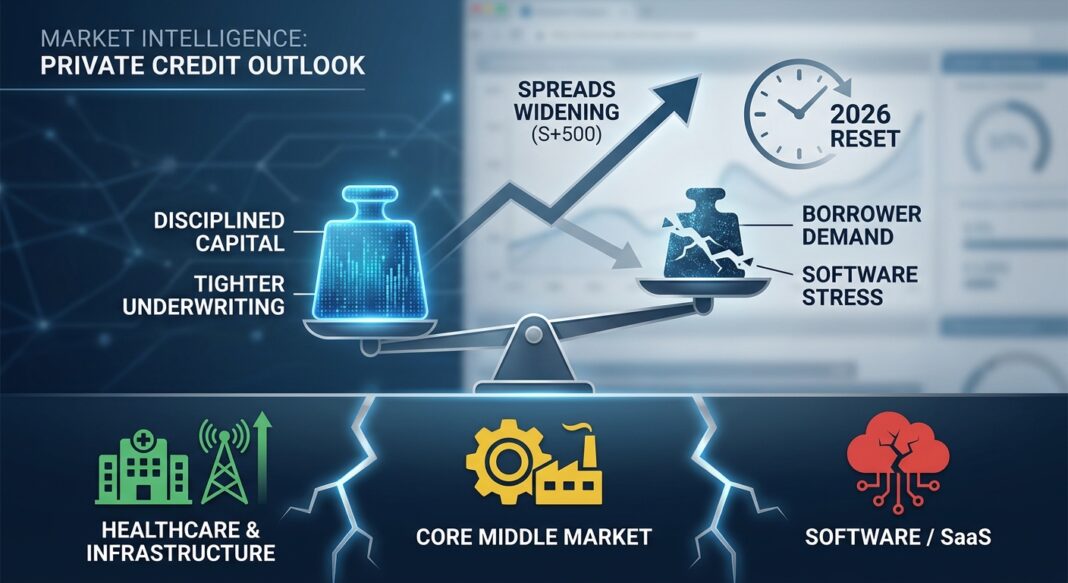
Market Headline: A Structural Reset Is Underway, And It Favors Disciplined Capital
The private credit market is navigating its most consequential inflection point since the post-GFC expansion began. As of August 2026, three converging forces have fundamentally rebalanced the lender-borrower dynamic: a 50–100 basis point widening in middle-market spreads since late 2025, the AI-driven repricing of software sector credit, and a landmark regulatory deregulation that is quietly inviting banks back to the leveraged lending arena.
According to PitchBook data cited by Lord Abbett (June 2026), spreads have widened by roughly 50 to 100 basis points since late 2025, while loan documentation, covenant packages, and leverage constraints have all improved materially for lenders. Simultaneously, Hamilton Lane (April 2026) reports that private credit spreads have moved back to the S+500 context, up from the mid-400 bps level seen during the spread compression phase of 2024–early 2025.
The headline spread widening, however, obscures a more nuanced story: capital is becoming more selective, not more scarce. Deal flow improved materially in Q1 2026, Northleaf Capital (May 2026) reports that U.S. M&A/LBO deal volumes in Q1 2026 increased by more than 30% relative to the same period last year, while elevated BDC redemptions and software-related non-accrual concerns have caused some capital providers to pull back, improving pricing and structuring dynamics for well-capitalized lenders with dry powder. The H2 2026 outlook is defined by one word: dispersion.
Quantitative Market Snapshot
The table below presents key market metrics as of August 14, 2026, alongside prior-period comparisons and source links.
| Metric | Current Level | Prior Period | Change | Source |
|---|---|---|---|---|
| Middle Market Private Credit Spread (SOFR+) | S+500 bps | S+450–475 bps (mid-2025) | +50–100 bps | Hamilton Lane, Apr 2026 |
| SOFR (Overnight, NY Fed) | 3.62% | 3.68% (3-mo Term SOFR, Q2) | Stable | NY Fed / SOFRrate.com, Aug 12, 2026 |
| Fed Funds Target Rate | 3.50%–3.75% | 3.75%–4.00% (Q1 2025) | –25 bps (Dec 2025 cut) | Federal Reserve / PrimeRates.com |
| Private Credit vs. Public High Yield Spread Premium | ~150–200 bps | ~350 bps (2019) | –150–200 bps (structural compression) | Owners.pe, Apr 2026 |
| Software Sector Secondary Spread Premium vs. B-Rated Loan Index | +229 bps | At index (YE 2025) | +245 bps vs. YE 2025 | VRC / PitchBook LCD, June 19, 2026 |
| Median BDC Non-Accrual Rate (Publicly Traded) | 0.33% | 0.00% (2022) | Rising; 75th pctile at 1.37% | Wellington Management, Q1 2026 |
| Private Credit Direct Lending Default Rate (est.) | 1.6%–4.7% | <1.5% (2023) | Rising; ex-distressed exchanges | Moody’s, Apr 2026 |
| C&I Lending Standards (Large/Mid-Market, SLOOS) | Unchanged / Slightly Easier | Tighter (Q1 2026 SLOOS) | Easing vs. Q1 2026 | Federal Reserve SLOOS, July 2026 |
| Private Credit Global AUM | ~$1.96–$2.0T | $1.75T (YE 2025) | +12% YoY | Mordor Intelligence / Moody’s, 2026 |
Regulatory Reset: The OCC/FDIC Deregulation and Its Leverage Implications
A pivotal but underappreciated shift reshaping credit availability occurred on December 5, 2025: the OCC and FDIC rescinded the 2013 Interagency Leveraged Lending Guidance, which had functioned as a de facto 6.0x total debt-to-EBITDA ceiling for bank-originated leveraged loans. Calling the prior guidance “overly restrictive,” the agencies stated it had inadvertently driven activity outside the regulated banking system and into non-bank private credit. Chambers (March 2026) notes this development gives private credit lenders greater flexibility to underwrite a broader range of loans and develop institution-specific definitions of leveraged lending. Critically, it also reintroduces bank competition in the upper middle market, a structural shift that began to materialize in Q2 2026, when VRC (June 2026) reported that banks gradually returned to the market, contributing to increased competition and alleviating some upward pressure on spreads in the upper middle market segment.
For underwriting benchmarks, the prior guidance had also required lenders to demonstrate the ability to fully amortize senior secured debt or repay at least 50% of total debt over five to seven years, effectively a minimum FCCR and debt paydown capacity standard. With that constraint lifted, lenders on both the bank and non-bank sides must now rely more heavily on their own internal underwriting frameworks to define acceptable fixed charge coverage ratios, leverage multiples, and repayment capacity thresholds.
Sector Analysis: Hot Sectors, Cold Sectors, and the AI Credit Fault Line
🔴 Software / SaaS: The Market’s Most Acute Stress Point
The single most disruptive force in private credit in 2026 is AI-driven repricing of software and SaaS sector loans. The BIS (March 2026) reports that outstanding loans to SaaS firms grew from approximately $8 billion in 2015 to over $500 billion, representing 19% of total direct loans: by end-2025, with a third of private credit funds carrying SaaS exposure. Software company stocks collapsed by nearly 30% between October 2025 and February 2026, while BDC stock prices fell roughly 10% on average and discounts to NAV deepened. VRC (June 2026) quantifies the spread damage: software secondary spreads are approximately 245 basis points wider than year-end 2025 levels and 229 bps above the broader B-rated loan index. LPL Research estimates that roughly 15% of SaaS borrowers are struggling to cover interest expenses, creating acute FCCR pressure across a sector that once defined the asset class’s growth narrative. Lender appetite for new software underwriting is now bifurcated: capital is available for AI-native and AI-adopting businesses, while legacy SaaS models face materially tighter terms and higher pricing.
🟢 Healthcare: Defensive Demand, Steady Spread Premium
Octus (2026) reports that healthcare led the way for private credit in 2025, accounting for 19% of all direct lending deals, and was the only major industry not to see significant year-over-year price tightening. Creative Planning (March 2026) highlights that demographic shifts and non-cyclical service models continue to attract lenders seeking stable, predictable cash flows. The sector’s inherent defensiveness against AI disruption and its recurring revenue characteristics make it a preferred destination for institutional capital, particularly from insurers and pension allocators.
🟢 Infrastructure & Digital Assets: The New Growth Engine
The most consequential emerging sector is infrastructure, specifically AI-driven digital infrastructure. Morgan Stanley estimates, cited by Creative Planning (2026), that private credit could supply more than half of the $1.5 trillion needed for global data center buildouts through 2028. HedgeCo (May 2026) notes that Apollo’s 2026 credit outlook identified AI infrastructure as a major source of incremental credit supply, with hyperscaler capital expenditure increasing sharply and forecasts pointing to trillions of dollars in cumulative AI-related spending from 2025 to 2029. Infrastructure and asset-backed finance (ABF) are now central to the private credit growth thesis, with Moody’s (January 2026) projecting investing will shift from a corporate lending focus to the ABF market.
🟡 Lower & Core Middle Market: Differentiated Opportunity with Selectivity Premium
Cliffwater data (Q1 2026) reveals a structural bifurcation within private credit itself: as of Q1 2026, only 39% of upper middle market issuers (over $100M EBITDA) are unique to a single portfolio, meaning heavy lender overlap, compared to 80% of lower middle market issuers (under $40M EBITDA). This concentration dynamic is driving a spread premium of approximately 50–200 bps in the lower and core middle market vs. UMM private loans, making it a structurally more differentiated and less competitive opportunity set for disciplined lenders.
🔴 Energy-Intensive Industrials: Underwriting Tightening
Capstone Partners (May 2026) documents that lenders have tightened underwriting standards for energy-intensive industries and businesses whose leverage was predicated on stable energy costs, a direct consequence of oil and energy price volatility driven by the U.S.-Iran military conflict. Deals with heavy energy cost exposure face additional scrutiny, wider spreads, and tighter covenant packages through at least H2 2026.
Implications for Institutional Investors and Operators
For Borrowers
The lender-friendly reset means the era of covenant-lite, aggressive PIK structures and maximum leverage is firmly in the rearview mirror for new originations. Lord Abbett (June 2026) notes that new loans are increasingly coming with less leverage, more covenants, fewer PIK requests, and tighter documentation. Borrowers in tariff-exposed, energy-intensive, or legacy software categories will face materially higher all-in costs of capital and enhanced diligence requirements. Conversely, operators in healthcare, infrastructure, and AI-native technology with strong FCCR profiles and durable free cash flow generation remain in a highly competitive market, particularly in the upper middle market where bank re-entry is adding lender supply. Middle-market operators should prepare detailed AI risk assessments as part of the credit application process, Capstone Partners (Q1 2026) confirms that an AI disruption evaluation has become a critical analytical component of new underwriting.
For Institutional Investors and Lenders
The key strategic implication is manager selection. According to PwC’s 2026 Global Private Credit Survey cited by Antares Capital, more than 80% of portfolio managers expect to increase allocations to private credit over the next year, even as dispersion between managers widens. Wellington Management (2026) data shows that median BDC non-accrual rates have risen from 0% in 2022 to 0.33% in Q1 2026, while the 75th percentile has reached 1.37%, a wide dispersion that underscores the importance of underwriting discipline and sector selection over broad asset-class exposure. Institutional allocators should scrutinize non-accrual rates, PIK income ratios, 2021–2022 vintage concentrations, and software sector exposure before committing capital. Opportunities increasingly favor managers in the lower and core middle market, European private credit (where Basel IV implementation is expected to accelerate a shift away from bank lending), and ABF strategies.
Credit Cycle Positioning
The weight of evidence positions the current credit environment in a mid-to-late cycle transition phase with idiosyncratic stress, not systemic breakdown. Moody’s (April 2026) reports that the average one-year expected probability of default for all U.S. listed companies stood at 7.9% in March 2026, down from 9.1% a year earlier, but still elevated by historical standards, with high yield company PDs declining to 3.2%. Default risk remains company-specific and sector-concentrated rather than systemic. The July 2026 Federal Reserve SLOOS confirms that C&I lending standards for large and middle-market firms are now basically unchanged from Q1’s tighter readings, with banks reporting stronger demand for C&I loans: a positive sign of underlying credit demand normalization. For forward positioning, the higher-for-longer rate environment anchored at 3.50–3.75% federal funds provides a supportive base rate floor for floating-rate private credit investors, while the wider spread environment (S+500 vs. S+450 twelve months ago) represents meaningful incremental yield capture for new vintage deployment.
Key Market Insights
- Spreads have reset to S+500 context: Middle market private credit spreads widened 50–100 bps since late 2025 per PitchBook/Lord Abbett data: a lender-favorable repricing that is accompanied by improved covenant terms, conservative leverage, and tighter documentation on new originations. New vintage deployment benefits from materially better risk-adjusted terms than 2023–2024 paper.
- The OCC/FDIC leveraged lending deregulation is a structural wildcard: The December 2025 rescission of the 2013 Leveraged Lending Guidance removed the de facto 6.0x debt-to-EBITDA ceiling for banks. This begins to restore bank competition in the upper middle market, which will likely compress spreads for the largest, most liquid deals while creating a widening opportunity gap in the less contested lower and core middle market.
- Software / SaaS represents the market’s most acute credit fault line: With SaaS secondary spreads 245 bps wider than year-end 2025 levels, roughly $500 billion in outstanding direct loans to the sector, and approximately 15% of SaaS borrowers struggling to cover interest expense, AI-driven credit repricing is the defining stress event of the 2026 cycle. Lenders must now independently model AI disruption risk as a core underwriting variable.
- The private credit vs. high yield illiquidity premium has compressed to its narrowest in a decade: At 150–200 bps of spread premium over comparable public high yield (down from 350 bps in 2019), institutional investors must rigorously re-examine whether illiquidity, information asymmetry, and concentration risks are being adequately compensated, particularly in upper middle market deals where lender overlap is extensive.
- Infrastructure and asset-backed finance (ABF) are the fastest-growing and most defensible opportunity sets: With Moody’s projecting private credit AUM to exceed $2 trillion in 2026 and approach $4 trillion by 2030, growth is shifting decisively toward ABF, digital infrastructure, and non-corporate direct lending. Morgan Stanley estimates private credit could supply more than half of the $1.5 trillion needed for global data center buildouts through 2028, a structural pipeline that is largely insulated from the AI disruption headwinds hitting corporate software lenders.


