
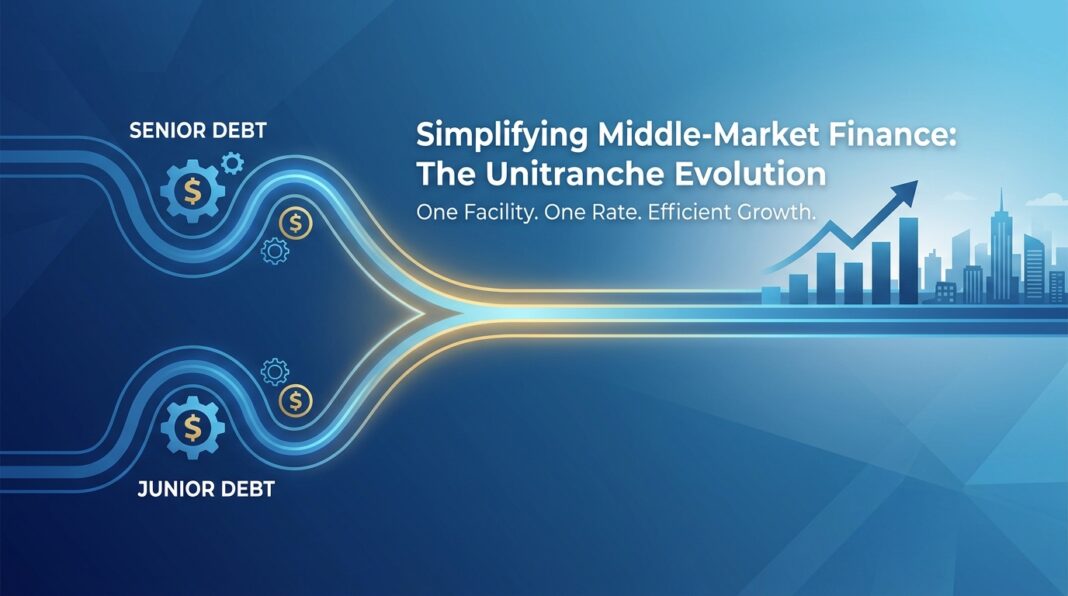
Why One Loan Changed Everything
Walk into a middle-market acquisition in 2026 and you are overwhelmingly likely to find a single piece of paper funding most of the debt: a unitranche loan. It is not a new idea, the structure has been around since the mid-2000s, but it has achieved something rare in finance: it genuinely simplified a process that the industry had made unnecessarily complicated. Before unitranche existed, a borrower financing a leveraged buyout had to negotiate with a senior bank lender, then separately negotiate with a mezzanine or second-lien lender, produce two sets of legal documents, and manage an intercreditor agreement that governed how those two creditors would behave if things went wrong. That friction was expensive in both time and legal fees. Unitranche collapsed the senior and subordinated tranches into one facility, one lender relationship, and one credit agreement, and the market rewarded that efficiency handsomely.
Today, understanding how unitranche debt works is foundational knowledge for any investor evaluating private credit funds or any business owner considering institutional debt capital. The structure dominates an asset class that has grown from roughly $250 billion in 2008 to more than $2 trillion in assets under management today.
The Concept: What Unitranche Actually Is
Unitranche debt is a hybrid loan that combines the features of senior secured debt and subordinated debt into a single credit facility governed by one credit agreement. The borrower pays a single blended interest rate to one lender (or a small club of lenders acting together) rather than separate rates to a senior lender and a junior lender.
Inside that single facility, however, the economics are not uniform. In many transactions, particularly larger ones, lenders internally split the economics between a first-out (FO) tranche and a last-out (LO) tranche, governed by an Agreement Among Lenders (AAL) that the borrower never sees. The FO tranche receives principal repayments first in a default, carrying lower risk and accepting a lower yield. The LO tranche absorbs losses first, functions economically like subordinated debt, and earns a meaningfully higher spread to compensate, in some cases SOFR+850 bps or more for the last-out portion of larger transactions.
From the borrower’s perspective, this internal split is invisible. They see one loan, one rate, one set of covenants, and one lender relationship. That simplicity is precisely why the structure took hold.
How It Works: A Concrete Example
Consider a hypothetical acquisition: a manufacturing business with $10 million of EBITDA being acquired at a $70 million enterprise value (7x EBITDA). The buyer wants to put in $30 million of equity and finance the remaining $40 million with debt.
Traditional two-lender structure:
- Senior bank term loan: $28M at approximately SOFR+400 bps (roughly 7.5% all-in in mid-2026)
- Mezzanine / second-lien: $12M at approximately 13–14% all-in (cash + PIK)
- Blended cost of debt: approximately 9.6%
- Two sets of legal documents, intercreditor negotiation, estimated close time: 100–130 days
- Total legal and structuring costs: $450,000–$650,000
Unitranche structure:
- Single unitranche facility: $40M at SOFR+550 bps (approximately 9.2–9.5% all-in in mid-2026)
- 2% original issue discount (OID), meaning the borrower receives $39.2M but owes $40M
- One credit agreement, one lender, estimated close time: 45–60 days
- Prepayment schedule: 102 / 101 / par over years 1–3
The unitranche rate is higher than the senior-only cost but meaningfully lower than the blended two-tranche cost once legal fees, time-to-close risk, and deal complexity are factored in. CT Acquisitions (May 2026) notes that unitranche financing can close 30 to 45 days faster than a syndicated or two-lender alternative, and sponsors often justify a 50–100 basis point spread premium simply by eliminating financing-gap and broken-syndication risk. For a $40M deal, that time saving is often worth more than the spread differential.
Current Market Relevance
Unitranche is not merely a clever structure; it has become the structural backbone of an asset class now measured in trillions. Here is where the market stands as of August 2026:
| Metric | Data Point | Source |
|---|---|---|
| Global Private Credit AUM | >$2.1 trillion (2025) | PwC Private Credit Survey 2026 |
| Unitranche Coupon Spreads (US, Q2 2026) | SOFR+475–550 bps (large/mid-cap); SOFR+500–700 bps (LMM) | Valuation Research Corp., Q2 2026 |
| Unitranche All-In Yields (US, Q2 2026) | ~9.00%–9.75% | Valuation Research Corp., Q2 2026 |
| Cliffwater Direct Lending Index Return (2025) | 9.3% total return; 10.4% interest income; 20-yr avg: 9.5% | Cliffwater / PR Newswire, March 2026 |
| Fed SLOOS: C&I Lending Standards (Q2 2026) | Basically unchanged; standards easier than historic midpoint | Federal Reserve SLOOS, July 2026 |
The spread context matters enormously for understanding unitranche’s competitive position. Valuation Research Corp.’s Q2 2026 update confirms that unitranche yields of roughly 9.0%–9.75% represent a decline of approximately 250 basis points from the late-2023 peak of 11.5%–12.5%, but still sit well above the pre-2022 historical range of 7%–8%. Meanwhile, the Federal Reserve’s July 2026 SLOOS shows bank lending standards for commercial and industrial loans are essentially unchanged and currently easier than the midpoint of their historic range, meaning banks have re-entered competition for quality credits. That creates a genuine choice for middle-market borrowers: bank debt at tighter spreads or unitranche at broader spreads with faster execution and fewer covenants.
One structural trend worth tracking: PwC’s 2026 Private Credit Survey notes the asset class is entering its first meaningful credit cycle as a high-profile market participant, with portfolio managers now navigating sustained credit stress at scale for the first time. This makes understanding where a unitranche sits in the capital stack (and what the first-out/last-out split looks like) more important than ever for investors.
Decision Framework
For Investors Evaluating Private Credit Funds
- Look beyond the headline yield: A fund marketing a 10%+ gross yield on a unitranche book may be holding meaningful last-out exposure. Investors consider asking what percentage of the portfolio is first-out vs. last-out, since last-out positions carry subordinated economics inside a first-lien label.
- Vintage matters: Loans originated at SOFR+600–700 bps in 2023 generate structurally different economics than loans written at SOFR+475–500 bps in 2026. Investors evaluate whether fund performance figures reflect the current origination environment.
- Non-accrual trends are the early warning system: The Cliffwater Direct Lending Index held non-accruals well below historical averages through 2025, but PwC’s survey cautions that the first real credit cycle for modern private credit is now underway.
For Business Owners and Operators Considering Unitranche
- Unitranche is most valuable when speed is the constraint: If a deal requires committed financing in two to three weeks or carries complex adjustments requiring bespoke diligence, the single-lender structure is often worth the spread premium over a bank execution.
- Compare total cost, not just the rate: The blended cost of a senior bank loan plus mezzanine (including legal fees, intercreditor negotiation time, and financing-gap risk) often exceeds a unitranche’s all-in cost once all variables are on the table.
- Know when unitranche is the wrong tool: Businesses with strong, bankable collateral (real estate, receivables, hard assets) may access cheaper capital through an asset-based lending facility. Companies with near-term public-market refinancing catalysts may find the broadly syndicated loan market offers better pricing once execution certainty is less of a premium.
Key Takeaways
- Unitranche combines senior and subordinated debt into one facility: one rate, one credit agreement, one lender relationship, eliminating the intercreditor complexity of traditional two-tranche structures.
- The all-in cost is a blended rate, typically higher than standalone senior debt but often competitive with (or cheaper than) the total cost of a senior-plus-mezz structure when legal fees and time-to-close are included.
- Internal first-out/last-out splits are invisible to borrowers but determine real risk allocation among lenders, investors in private credit funds need to understand how much last-out exposure sits in a given portfolio.
- Current US unitranche yields of ~9.0%–9.75% (Q2 2026) are well below late-2023 peaks but remain above pre-2022 levels, reflecting both the Fed rate cutting cycle and intensifying competition among direct lenders as private credit AUM surpasses $2 trillion.
- The Federal Reserve’s re-entry into C&I lending (SLOOS, July 2026) means borrowers now have a genuine choice between bank and non-bank capital: making it more important than ever to evaluate execution certainty, covenant structure, and total cost rather than spread alone.


