
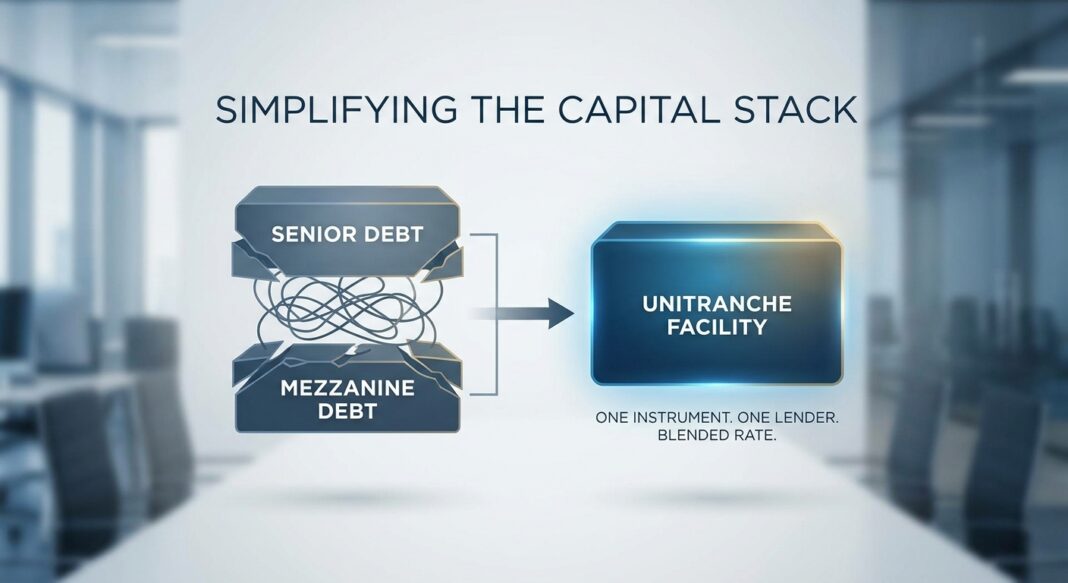
Why the Capital Stack Just Got Simpler
For decades, a business owner or private equity sponsor seeking acquisition financing faced a familiar choreography: negotiate with a senior bank lender, then separately convince a mezzanine fund to fill the gap, align two sets of covenants, survive two rounds of legal documentation, and manage two creditor relationships post-close, all before a deal could close. The process was expensive, slow, and prone to falling apart when lenders disagreed.
Enter the unitranche loan: a single credit facility that collapses the traditional multi-layered debt structure into one instrument, one lender, one interest rate, and one credit agreement. What began as a niche private credit innovation after the 2008 financial crisis has become the defining capital structure of middle-market leveraged finance. Understanding how unitranche works (and when it is and is not the right tool) is now foundational knowledge for both institutional investors allocating to private credit and business operators evaluating financing options.
This article explains the mechanics, walks through a side-by-side numerical comparison, and connects the structure to current market conditions heading into the second half of 2026.
What Is a Unitranche Loan?
Unitranche debt is a single-facility loan that combines what would traditionally be separate senior secured debt and subordinated (mezzanine) debt layers into one instrument with one set of documents, one blended interest rate, and one lender relationship. As defined in Goldman Sachs’s SEC-filed BDC disclosures, unitranche loans are first-lien instruments that extend deeper into a borrower’s capital structure than traditional first-lien debt, effectively absorbing the risk that a mezzanine layer would otherwise carry.
The borrower signs one credit agreement. There is no intercreditor agreement between competing creditor groups to negotiate. The entire debt structure below equity collapses into a single instrument with a blended rate that reflects the weighted average cost of what would otherwise be separate senior and subordinated tranches.
Internally, some unitranche facilities are bifurcated between a “first-out” lender (who holds the senior-equivalent portion with priority payment rights) and a “last-out” lender (who assumes the subordinated-equivalent risk at a higher yield), governed by an Agreement Among Lenders (AAL). This internal split is invisible to the borrower, who still deals with a single credit agreement, but it allows two direct lenders to share a single transaction while pricing their respective risk positions differently.
The structure is particularly well-suited to the middle market: CT Acquisitions (May 2026) notes that unitranche has become the financing standard for acquisitions valued between $25 million and $200 million in enterprise value.
How It Works: A Side-by-Side Example
Consider a private equity sponsor acquiring a manufacturing services company for $60 million at 6x EBITDA (implying $10 million in EBITDA). The sponsor wants to finance $40 million in debt (4x leverage) and contribute $20 million in equity. Here is how the two structures compare:
Traditional Senior + Mezzanine Structure:
- Senior debt: $25M at SOFR + 400 bps ≈ 8.0% all-in (first-lien secured, 2.5x leverage)
- Mezzanine debt: $15M at 12.5% cash + 2% PIK (subordinated, 1.5x additional leverage)
- Blended all-in cost: approximately 9.8% on $40M total debt
- Parties involved: Senior bank, mezzanine fund, intercreditor counsel, two separate closings
- Estimated timeline: 100–130 days to close
Unitranche Structure:
- Single facility: $40M at SOFR + 550 bps ≈ 9.2% all-in (based on 3-month Term SOFR of approximately 3.69% as of Q2 2026)
- Blended all-in cost: approximately 9.2% on $40M
- Parties involved: One direct lender, one credit agreement, no intercreditor
- Estimated timeline: 45–75 days to close
The cost difference in this example is roughly 60 basis points, but the speed advantage can be decisive in a competitive auction. As Private Equity Bro notes, “if unitranche financing can close 30 to 45 days faster than a syndicated alternative, sponsors often justify 50 to 100 basis points of extra spread by avoiding financing gaps, broken syndications, or delayed closings.” For the borrower, the modest rate premium is frequently the cost of certainty, not excess interest expense.
On a $50M unitranche facility with a 2% original issue discount (OID), the borrower receives $49M at funding but owes $50M in principal. That OID functions as upfront yield to the lender, amortizing to roughly 33 basis points of annualized additional yield over a six-year loan term, a structure that direct lenders use to enhance returns without moving the headline coupon.
Current Market Relevance: Where Unitranche Stands in Mid-2026
The unitranche structure sits at the intersection of several powerful market forces shaping private credit in 2026:
Market Size & Dominance: The U.S. Office of Financial Research (March 2026) reported that the U.S. private credit market, including BDCs, exceeds $1.6 trillion, larger than both the broadly syndicated loan and high-yield bond markets combined. CT Acquisitions (Q1 2026) notes that the top 30 private credit managers collectively oversee more than $3.4 trillion globally. Within that universe, unitranche represents the plurality of new middle-market transactions.
Pricing in 2026: According to Valuation Research Corp.’s Q2 2026 Private Markets Update, unitranche structures continue to dominate new issuance, with coupon spreads generally ranging from 4.75% to 5.50% over SOFR, approximately 25 basis points higher than year-end 2025 levels. All-in unitranche yields range between approximately 9.00% and 9.75%, representing a decline of roughly 250 basis points from late 2023 peak levels, but remaining above pre-2022 historical ranges of approximately 7% to 8%.
Bank Lending Context: The Federal Reserve’s July 2026 SLOOS reported that C&I lending standards were broadly unchanged in Q2, with banks reporting stronger demand from large and middle-market firms. However, the April 2026 SLOOS found that banks reported tighter standards for non-depository financial institution (NDFI) loans (including to private equity funds and business credit intermediaries) with tighter covenants, shorter maturities, and higher risk premiums. This dynamic reinforces private credit’s structural role: as banks become more selective on their exposure to leveraged and non-bank borrowers, unitranche lenders fill the gap.
Lender-Friendly Reset: According to Lord Abbett’s 2026 Midyear Outlook, spreads have widened by roughly 50 to 100 basis points since late 2025, while new loans are increasingly structured with improved credit terms. Northleaf Capital (Q1 2026) noted that direct lending continues to generate high single-digit unlevered asset returns, an attractive premium relative to public credit alternatives.
| Metric | Value | Source |
|---|---|---|
| Unitranche all-in yield range (Q2 2026) | 9.00% – 9.75% | Valuation Research Corp., Q2 2026 |
| Unitranche coupon spread over SOFR (Q2 2026) | 4.75% – 5.50% | Valuation Research Corp., Q2 2026 |
| 3-month Term SOFR (June 2026) | 3.69% | Valuation Research Corp., Q2 2026 |
| U.S. private credit market AUM (year-end 2024) | $1.6 trillion+ | U.S. Office of Financial Research, March 2026 |
| Share of middle-market sponsored transactions using unitranche | ~70–80% (in $25M–$200M EV range) | CT Acquisitions, May 2026 |
| Cliffwater Direct Lending Index, total return (2025) | 9.3% | Angel Investors Network / Cliffwater, 2026 |
Decision Framework: Investors and Operators
For Investors Evaluating Private Credit Exposure:
- Yield vs. complexity trade-off: Unitranche facilities offer a single blended yield that compensates for both senior and subordinated risk. Investors consider whether the all-in spread (currently 475–550 bps over SOFR for quality credits) adequately compensates for the deeper leverage profile relative to pure first-lien senior debt.
- First-out vs. last-out positioning: Within a bifurcated unitranche, first-out holders receive payment priority and carry lower risk; last-out holders earn a higher yield premium but absorb first losses after the equity cushion. Institutional allocators evaluate which position aligns with their risk tolerance and mandate.
- Covenant quality matters more now: With spreads compressing from peak levels, covenant and documentation quality has become a key differentiator. According to Lord Abbett’s 2026 midyear analysis, improved credit structures, not just wider spreads, define the current setup for new capital deployment.
- Manager concentration risk: Octus data shows Blackstone Credit maintained the most active direct lending position in 2025, closing 225 deals. Institutional investors assess whether fund concentration in a few mega-managers creates correlated risk across portfolios.
For Business Operators and Sponsors Evaluating Unitranche:
- Use unitranche when speed is the constraint: Competitive auctions, time-sensitive acquisitions, and add-on transactions with tight timelines favor the one-stop structure. The 30–45 day execution advantage can be worth 50–100 bps in additional spread.
- Avoid it when cheaper alternatives exist: Companies with investment-grade-adjacent credit profiles, significant hard assets, or access to the broadly syndicated loan market may achieve meaningfully lower all-in cost through those channels. Unitranche is priced for the middle market; larger credits above $300M enterprise value often access cheaper BSL financing.
- Evaluate the OID carefully: The headline coupon is not the full cost of debt. Original issue discounts, upfront fees, and prepayment schedules (typically 102/101/par over the first three years) affect the total effective cost of capital and should be modeled explicitly.
- Understand covenant obligations: Unitranche facilities typically include a maintenance covenant (often a leverage or interest coverage ratio tested quarterly). Operators evaluate whether their business model (particularly through integration or growth investment phases) can consistently meet those tests without triggering technical defaults.
Key Takeaways
- Unitranche consolidates the capital stack. By combining senior and mezzanine debt into one instrument, it eliminates intercreditor complexity, reduces legal costs, and delivers execution certainty, often at a blended rate only marginally higher than a comparable multi-tranche structure.
- Current pricing reflects a rate-and-spread environment in transition. All-in unitranche yields of 9.00%–9.75% in Q2 2026 sit well below 2023 peaks of 11.5%–12.5%, yet remain above the pre-2022 historical range, offering direct lenders an attractive risk-adjusted return compared to public credit alternatives.
- Bank lending trends reinforce private credit’s structural role. The Federal Reserve’s 2026 SLOOS data shows banks tightening standards for non-bank financial intermediaries while keeping C&I standards broadly steady, a pattern that sustains demand for private direct lending as a complement or substitute for bank capital.
- The structure has bifurcated risk internally even when it looks simple externally. Investors need to understand whether they are holding first-out or last-out exposure within a unitranche, because the risk, yield, and recovery profile of each position differ materially.
- Covenant and documentation quality are the differentiators in a tighter spread environment. As spreads compress from peak levels, investors and operators alike focus on the structural protections embedded in the credit agreement, not just the headline rate, to assess the true risk-reward of any unitranche transaction.


