
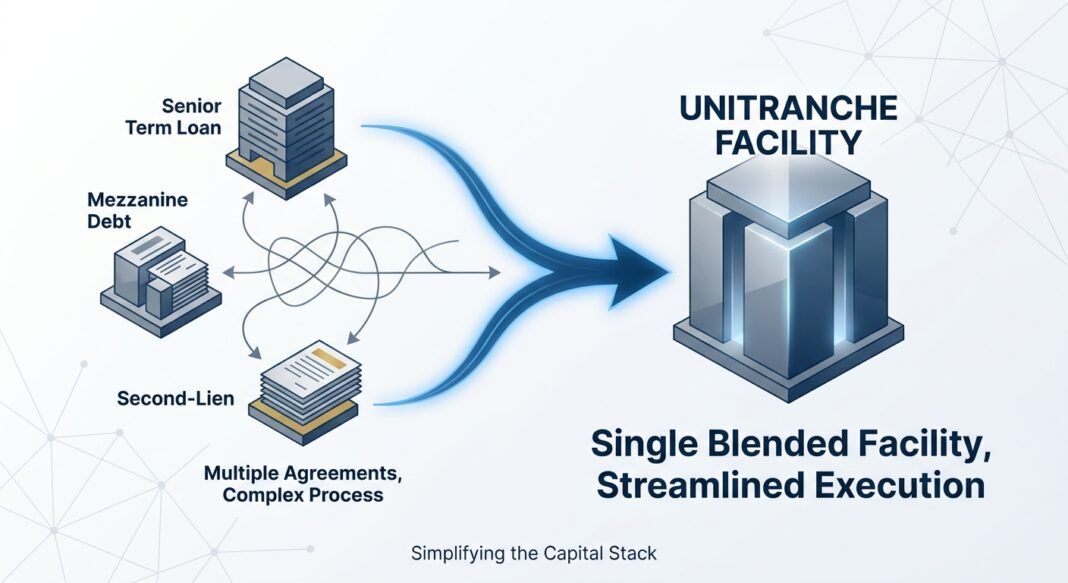
Why Borrowers Keep Choosing One Loan Over Three
Imagine financing a $50 million leveraged buyout in 2015. You would have spent weeks negotiating with a senior secured lender, a mezzanine fund, and possibly a second-lien provider: three separate credit agreements, three sets of covenants, three closing timelines, and an intercreditor agreement governing how those parties would fight each other in a workout. The process was slow, expensive, and fragile.
Now imagine doing the same deal with a single phone call, a single credit agreement, and a single closing, typically in four to six weeks. That is what the unitranche loan made possible, and it is the primary reason the structure has come to dominate middle-market private credit origination.
Understanding how a unitranche works (and why lenders and borrowers both accept its trade-offs) is essential knowledge for any investor evaluating direct lending funds or any business owner considering a private credit raise. The structure is not a marketing term. It is a precise legal and economic architecture with specific mechanics, specific risks, and specific advantages that do not exist in traditional bank lending.
What a Unitranche Loan Actually Is
A unitranche loan is a single secured credit facility that blends what would traditionally be multiple layers of debt (most commonly senior and subordinated debt) into one lending arrangement with one interest rate payable by the borrower. The simplicity is visible to the borrower. The complexity lives underneath, among the lenders.
As Mayer Brown described in a July 2026 analysis, a unitranche facility is typically documented in a single credit agreement, with the borrower paying a single blended interest rate to a group of lenders represented by a common agent. Internally, however, lenders participating in the facility allocate risk and return among themselves through a side agreement called the Agreement Among Lenders (AAL).
The AAL establishes a “first out / last out” structure. The first-out lenders receive their principal and interest back first in any payment waterfall or enforcement scenario; they accept lower risk and earn a lower effective yield. The last-out lenders absorb losses first and earn a higher yield in exchange. From the borrower’s perspective, none of this internal seniority exists: they owe one blended rate, one maturity date, and deal with one agent. The subordination is invisible to them, but it is legally enforceable among lenders.
This is critically different from a traditional first-lien / second-lien structure, where two separate liens exist on the collateral, governed by a public intercreditor agreement between two distinct creditor groups, a structure that is more transparent but far slower to execute and harder to amend.
How the Economics Work: A Concrete Example
Consider a private equity sponsor acquiring a software business with $8 million in EBITDA at a 6.5x purchase multiple, a $52 million total enterprise value. The sponsor contributes $17 million in equity (roughly 33% of the cap structure) and needs $35 million in debt financing at 4.4x leverage on EBITDA.
Under a traditional two-tranche structure, that $35 million might be split into:
- $25 million senior secured first-lien term loan at SOFR + 350 bps (≈ 8.5% all-in)
- $10 million second-lien / mezzanine at SOFR + 700 bps (≈ 11.9% all-in)
- Weighted blended cost to borrower: ≈ 9.5%
- Two closings, two credit agreements, intercreditor negotiation: add 4–8 weeks and $300,000+ in legal fees
Under a unitranche structure, the same borrower receives:
- $35 million unitranche term loan at a single blended rate of SOFR + 500 bps (≈ 9.8% all-in at current SOFR)
- One credit agreement, one closing, one agent: 4–6 week timeline, lower legal costs
- Behind the scenes: the lead lender sells a “last out” participation to a co-lender at a higher yield to reflect their junior position
The borrower pays slightly more on the blended rate compared to a perfectly structured two-tranche deal, but gains certainty of execution, speed, and a single counterparty relationship. For a middle-market company running a competitive sale process, that certainty is often worth the incremental cost of capital.
Current Market Relevance: Unitranche Pricing and Market Conditions in 2026
Unitranche structures have moved from niche innovation to standard architecture across the middle market. According to PIMCO (June 2026), global private credit AUM now stands at approximately $3.2 trillion, underscoring the scale at which these structures operate. The PwC Private Credit Survey 2026 puts the figure above $2 trillion in the U.S. alone, with growth driven partly by borrower demand for exactly the streamlined execution unitranche provides.
On pricing, Valuation Research Corporation’s Q2 2026 Private Markets Update reported that unitranche coupon spreads in Q2 2026 generally ranged from SOFR + 475 to SOFR + 550 bps: approximately 25 basis points higher than year-end 2025 levels. All-in unitranche yields ranged between 9.00% and 9.75%, a decline of roughly 250 basis points from the late-2023 peak of approximately 11.5%–12.5%, but still meaningfully above the pre-2022 historical range of 7%–8%.
The direction of spreads also matters. Per the PitchBook U.S. Private Credit Monitor (April 2026), direct lending spreads showed early signs of widening in Q2 2026, with direct lending leading the move even as the gap between broadly syndicated loans and direct lending compressed as both channels compete for the same borrowers.
Meanwhile, the lending environment driving demand for private credit continues to evolve. The Federal Reserve’s July 2026 SLOOS showed that bank C&I lending standards were broadly unchanged in Q2 2026, with standards for C&I loans described as easier than the historic midpoint for large and middle-market firms. However, the April 2026 SLOOS noted tighter bank standards for non-depository financial institution (NDFI) loans, including to private equity funds, across all categories, with banks reporting higher risk premiums, stricter covenants, and lower credit-line maximums for those borrowers. This dynamic reinforces private credit’s role filling gaps where bank appetite remains selective.
From a market structure standpoint, Lord Abbett’s 2026 Midyear Outlook noted that new unitranche loans are increasingly structured with better credit terms: less leverage, more covenants, fewer PIK requests, and tighter documentation: making mid-2026 a more favorable environment for disciplined lenders than late 2025.
| Metric | Value | Source |
|---|---|---|
| Global Private Credit AUM | ~$3.2 trillion | PIMCO, June 2026 |
| Unitranche All-In Yield Range | 9.00%–9.75% | VRC Private Markets Update, Q2 2026 |
| Unitranche Coupon Spread Range | SOFR + 475–550 bps | VRC Private Markets Update, Q2 2026 |
| Spread Change Since Late 2025 | +50 to +100 bps wider | Lord Abbett Midyear Outlook, 2026 |
| Bank C&I Lending Standards (Q2 2026) | Basically unchanged; easier than historic midpoint | Federal Reserve SLOOS, July 2026 |
Decision Framework: Investors and Operators
For Investors Evaluating Direct Lending Funds:
- Understand your fund’s position within unitranche deals. Is the manager typically the first-out or last-out lender? Last-out exposure carries more downside risk and warrants scrutiny of the underlying credit quality and the manager’s restructuring experience.
- Examine AAL terms, not just stated yields. The Agreement Among Lenders governs who controls enforcement in a default. Investors should understand whether their manager has genuine control rights or depends on a first-out bank to agree before acting.
- Evaluate covenant quality. The 2026 shift toward more covenants in new unitranche loans, flagged by Lord Abbett, represents a structural improvement for lenders. Investors should ask managers how their covenant ratios compare to the market at time of origination.
- Assess sector concentration. Per the PitchBook April 2026 Monitor, credit pressure is concentrating in Commercial Services and Software. Unitranche lenders with heavy exposure to these sectors face elevated risk regardless of structural seniority.
For Business Owners Considering a Unitranche Raise:
- Price the certainty premium honestly. Unitranche rates are typically higher than a well-executed senior-plus-mezz structure. Operators should model whether the speed and simplicity justify the incremental interest expense, particularly if EBITDA growth can support a refinancing within 24–36 months.
- Understand who holds your loan. A unitranche from a well-capitalized direct lender with patient capital is very different from one quickly syndicated to multiple last-out participants. Ask your lender about their fund life, reinvestment rights, and amendment flexibility before closing.
- Negotiate the basket carefully. Unitranche documents often include incremental facilities, ratio-based debt baskets, and EBITDA add-back provisions. These define future flexibility. Tight baskets protect today’s lender; generous ones preserve tomorrow’s operating room.
Key Takeaways
- One facility, layered economics. A unitranche loan presents a single rate and document to the borrower, but internally allocates risk between first-out and last-out lenders through an Agreement Among Lenders (AAL), an invisible but legally critical structure.
- Speed is the core value proposition. The ability to close in four to six weeks with one counterparty is the primary reason unitranche has captured the middle-market, particularly in competitive M&A processes where certainty of execution outweighs cost of capital.
- Current yields are attractive but off peak. Unitranche all-in yields of 9.00%–9.75% in Q2 2026 are significantly below 2023’s peak of 11.5%–12.5%, but still above the historical pre-2022 range, offering lenders a meaningful risk premium in absolute terms.
- The market is structurally shifting toward lenders. Wider spreads, improved covenants, and lower leverage in new 2026 originations represent a reset that benefits disciplined lenders relative to the compressed conditions of 2024–2025.
- Banks remain selective, reinforcing private credit demand. With the Fed’s July 2026 SLOOS showing tighter bank standards for NDFI borrowers including private equity funds, the structural demand for unitranche and direct lending solutions remains intact even as bank C&I standards broadly stabilize.


