
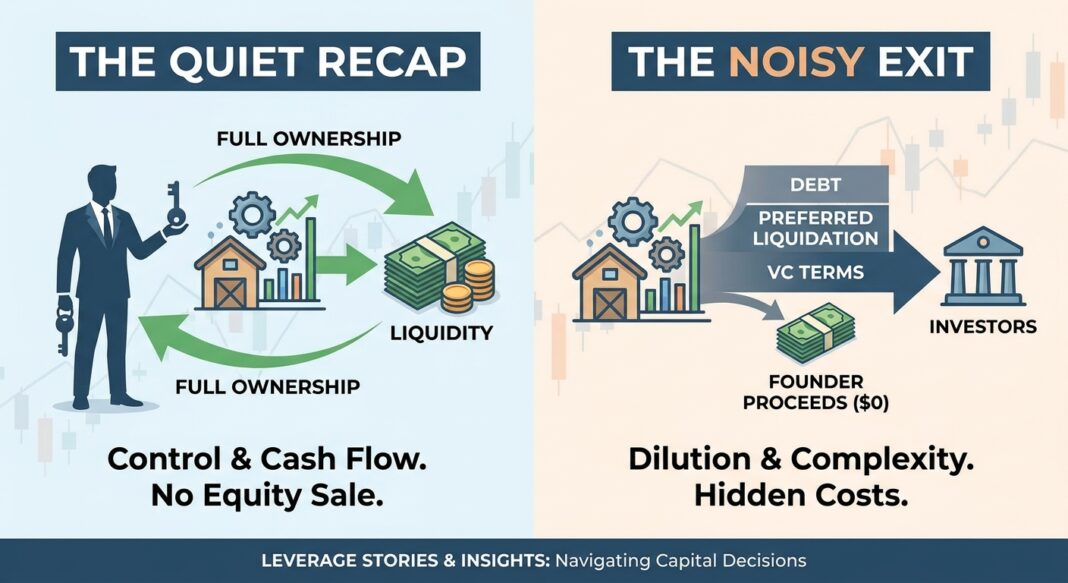
The Story: A Billion-Dollar Warning and a Quieter Win
In early 2025, the rent-to-own startup Divvy Homes sold to Brookfield Properties for approximately $1 billion. On paper, it sounded like a victory lap. In practice, it was a wake-up call for every founder who had ever taken venture capital on optimistic terms.
The outcome was stark. The company had accumulated over $735 million in debt obligations that sat first in the repayment waterfall. After that came the liquidation preferences from Series A through Series D preferred investors: stacked, senior to common, and unforgiving. When the math was done, the founders received nothing. Employees received nothing. Many early investors received nothing. As Bond Capital previously reported, CEO Adena Hefets confirmed to shareholders that after debt repayment and liquidation preferences, neither common shareholders nor founder preferred shares would receive any proceeds from the sale.
The billion-dollar headline masked a zero-dollar outcome for the people who built the company.
Now contrast that with a quieter story, one that didn’t make the newswires but that plays out every year in the lower middle market. A founder, let’s call him Marcus, built a regional industrial services company over 14 years. By 2023, the business was generating $3.2 million in EBITDA on $18 million in revenue, with stable recurring contracts and a predictable cash flow profile. He was 54 years old, personally illiquid, and not ready to sell.
He faced a decision that every successful owner-operator eventually confronts: how do you get paid for what you’ve built, without giving up what you built?
Note: The “Marcus” scenario below is a composite hypothetical case study built from publicly documented deal mechanics and market data. It is illustrative, not a representation of a specific individual or transaction.
The Decision: Equity Would Have Cost Him the Company
Marcus had options. A growth equity investor had approached him with a term sheet valuing the business at $16 million, a 5x EBITDA multiple that felt fair on paper. The deal: sell 40% of the company for $6.4 million in cash. Retain 60% going forward. Accept two board seats for the investor, standard protective provisions, a drag-along clause, and a 2x liquidation preference on the investor’s preferred shares.
The math looked good until he stress-tested the exit. If the business sold in five years at the same 5x multiple, no growth, and reached $20 million EBITDA (an optimistic scenario), the enterprise value would be $100 million. After the preferred liquidation stack was satisfied, Marcus’s 60% share would yield approximately $52 million. Not bad. But he would have surrendered two board seats, accepted a drag-along that could force a sale on the investor’s timeline, and permanently altered the governance of a company he had spent 14 years building.
His advisor introduced a second option: a leveraged dividend recapitalization funded by a private credit lender.
The structure was straightforward. The lender appraised the business at $16 million enterprise value and extended a senior secured term loan of $4.8 million, approximately 1.5x EBITDA, at a rate of SOFR plus 400 basis points (roughly 9% all-in at the time). The proceeds flowed directly to Marcus as a special dividend. He retained 100% of the equity, 100% of the board, and 100% of the operating decisions. His annual debt service obligation was approximately $540,000, well within the business’s $3.2 million EBITDA cushion, leaving a debt service coverage ratio above 4x.
He took the recap.
The Outcome: Liquidity Now, Upside Later
By mid-2026, two years after the recap closed, the business had continued to grow. EBITDA had climbed to $4.1 million. The debt balance, now reduced to approximately $3.8 million through scheduled amortization, represented less than 1x forward EBITDA. Marcus had used the first year of breathing room to hire a VP of Operations, a hire he had previously postponed to protect cash, and had expanded into a second regional market, adding two contract clients that together accounted for $280,000 in incremental annual EBITDA.
Now consider the counterfactual. Had Marcus taken the growth equity deal at the same moment, the $6.4 million in proceeds would have been partially offset by legal fees, dilution mechanics, and the board dynamics of managing two investor representatives with a 2x liquidation preference. Every acquisition he considered in the two years following would have required investor approval. The VP of Operations hire, the one that catalyzed the new market expansion, would have required a board vote.
Instead, Marcus made both decisions in an afternoon.
This dynamic is not incidental; it is the core value proposition of well-structured debt over dilutive equity. As market data confirms, the total leveraged loan issuance value tied to sponsored dividend recaps grew 11% year-over-year to $74.3 billion in 2025, reflecting sustained lender appetite and owner urgency to access liquidity without forcing full exits. In the lower middle market specifically, where founders are often the only decision-makers who truly understand the business, preserving that governance is itself a financial asset.
Marcus’s $4 million in personal liquidity cost him approximately $960,000 in total interest over two years. The equity path would have cost him a board, a liquidation preference, and his autonomy, permanently.
The Lessons: When the Recap Works, and When It Doesn’t
Marcus’s story is instructive precisely because it is ordinary. The leveraged recapitalization is not a niche instrument reserved for sophisticated PE sponsors; it is increasingly accessible to owner-operators in the lower middle market who have built businesses with durable, predictable cash flows. The mechanics have become more founder-friendly as private credit has deepened its presence in the mid-market, with private capital’s ability to provide capital structure flexibility allowing it to dominate refinancings and recapitalizations even as competition from traditional bank lenders increased in 2025.
But the structure is not universally appropriate, and the Divvy Homes story carries a mirror-image lesson. Divvy’s downfall was not that it raised equity per se; it was that it layered debt obligations and multiple rounds of liquidation preferences into a business model whose unit economics were deeply sensitive to interest rates. When rates rose, the model fractured. The capital structure that had funded rapid growth became the mechanism of founder dispossession.
The recap works when three conditions are present. First, the business generates stable, recurring, predictable free cash flow, the kind that lets a lender underwrite comfortably and lets an owner sleep at night. Second, the owner wants personal liquidity without ceding strategic control or accepting a third-party’s exit timeline. Third, the debt service coverage ratio at close leaves meaningful headroom (typically 3x or above) so that a moderate revenue disruption does not trigger a covenant breach.
The recap struggles (or fails) when cash flows are lumpy, when the business is in a capital-intensive growth phase that requires reinvestment rather than distribution, or when the owner mistakes a structurally declining business for a temporarily depressed one and uses the recap as a disguised exit from operational risk.
The framework is simple: own the debt service math before you own the liquidity check. If the numbers work at 75% of current EBITDA, the structure is probably sound. If they only work at 100% of peak performance, you are financing optimism with leverage, and that is a different, more dangerous transaction.
In the current environment, the window remains open but is more disciplined than it was. Lender appetite for dividend recap structures is showing resilience (with $11 billion deployed in Q1 2026 alone, exceeding the long-run quarterly median) but average leverage multiples are being scrutinized more carefully than in 2021 and 2022. Owners who bring clean financials, defensible EBITDA, and a clear post-recap operating plan are still being received well by private credit providers. Those who come with complexity, customer concentration, or cyclical exposure face tighter terms.
Key Insights
- Liquidity and control are not mutually exclusive. A leveraged dividend recapitalization allows owners to extract meaningful personal wealth from a business without selling equity, surrendering board seats, or accepting an investor’s preferred liquidation stack, provided the business generates stable, serviceable free cash flow.
- The liquidation waterfall is the venture equity story nobody tells at the term sheet. Divvy Homes’ $1 billion exit returned $0 to founders and common shareholders after debt and preferred liquidation preferences were satisfied. Capital structure is not a detail; it is the outcome.
- Debt is cheaper than equity in high-growth businesses. The more valuable a business becomes, the more expensive it is in hindsight to have sold equity early. A founder who sold 40% at a 5x multiple and then grew the business to a 10x exit gave away twice the value they modeled at the time of signing.
- The market for recap financing has matured and broadened. Total leveraged loan issuance for dividend recaps reached $74.3 billion in 2025, and private credit continues to deepen its presence in the mid-market, giving owner-operators access to structures that were once reserved for PE-sponsored companies.
- The right recap is a governance decision, not just a financing decision. Owners who use the structure to preserve operational autonomy (and who reinvest the freed-up mental bandwidth into growth) often find that the two years following a recap are among the most productive of their tenure. Marcus’s new market expansion, funded by clarity of ownership and not by investor capital, is the clearest illustration of that principle.


