
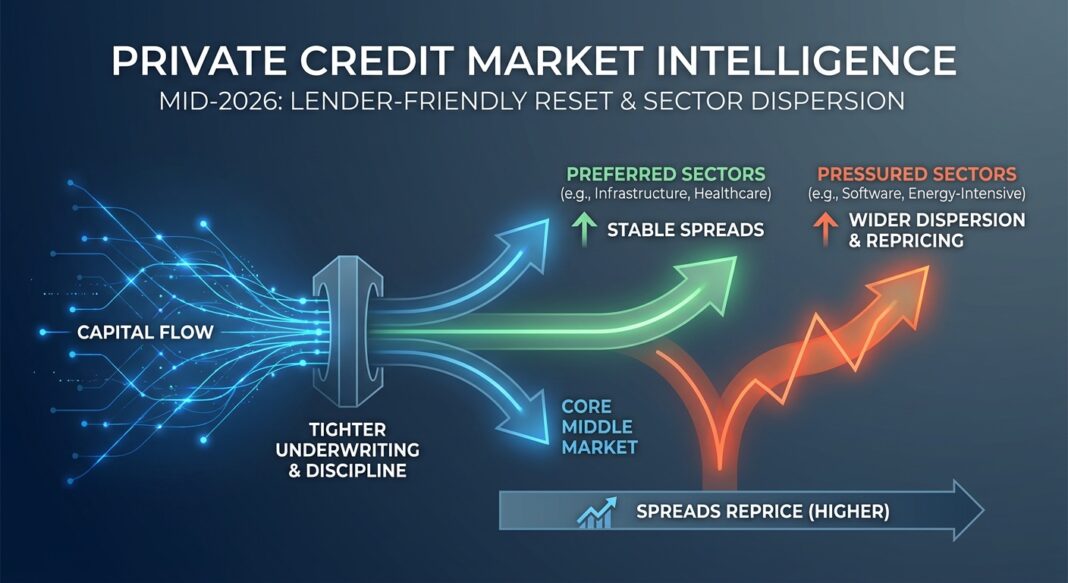
Market Headline: A Structural Repricing Is Underway
The U.S. private credit market entered mid-2026 in the midst of what institutional observers are calling a “lender-friendly reset”: a confluence of spread widening, selectivity-driven underwriting, and widening dispersion between high-quality and impaired credits. After years of compressed spreads driven by excess dry powder chasing limited deal flow, the market is recalibrating. Lord Abbett’s midyear analysis captures the shift succinctly: the market has moved toward lender discipline, with stronger documentation, more selective capital deployment, and better deal structuring for new loans: even as headline stress around software, AI-disrupted credits, and BDC redemptions continues to climb.
Three macro forces are driving this transition simultaneously. First, the Federal Reserve’s July 2026 SLOOS confirmed that bank C&I lending standards remained broadly unchanged in Q2, but critically, banks reported stronger demand from large and middle-market firms: a sign that corporate borrowers are stepping up capital deployment even as the rate environment holds higher for longer. Second, AI-related disruption concerns triggered a sharp secondary market selloff in software and technology loans that began in Q1 and has reshaped how underwriters assess technology-exposed credits across the entire credit stack. Third, geopolitical volatility stemming from the Middle East conflict added upside pressure to inflation and energy costs, complicating the Fed’s policy path and forcing lenders to stress-test energy-intensive credits more aggressively. The result is a credit market that is simultaneously more expensive, more disciplined, and more differentiated than at any point since 2022.
Quantitative Market Snapshot
The data box below synthesizes the most current publicly available market metrics across public and private credit as of Q2/early Q3 2026.
| Metric | Current Value | Prior Period | Change | Source |
|---|---|---|---|---|
| ICE BofA HY OAS (All HY) | ~273 bps (Aug 2026) | ~269 bps (Jul 21, 2026) | +4 bps (widening) | Fed via Trading Economics |
| Private Credit Spreads (Middle Market) | ~S+500 bps context | S+475–490 bps (Q4 2025) | ~+25–50 bps since Q1 2026 | Hamilton Lane (Apr 2026) |
| 3-Month Term SOFR | 3.68% (Q2 2026) | 3.67% (Q1 2026) | +1 bp QoQ | VRC Q2 2026 Report |
| 5-Year U.S. Treasury Yield | 4.23% (Jun 2026) | 3.92% (Mar 2026) | +31 bps QoQ | VRC Q2 2026 Report |
| Middle Market Total Debt / EBITDA | ~5.5x (Q1 2026) | ~4.5x (2013 baseline) | +1.0x over cycle | TCW Direct Lending (May 2026) |
| Middle Market Interest Coverage (FCCR Proxy) | ~1.6x (2025 median) | 3.1x (2021) | −1.5x since peak | Angel Investors Network / PitchBook |
| Private Credit H1 2026 Fundraising | $262 billion | $202 billion (H1 2025) | +30% YoY | The Credit Crunch (Jun 2026) |
| Private Credit Dry Powder | ~$264 billion | N/A (elevated historically) | Deployment-constrained | VRC Q2 2026 Report |
| Software Sector Secondary Spreads vs. Broad B-Index | ~+229 bps (Jun 2026) | Tight / near index (YE 2025) | ~+245 bps vs. YE levels | PitchBook LCD via VRC |
| BDC Non-Accrual Rate (Median, Publicly Traded) | 0.33% (Q1 2026) | 0.00% (2022) | Steady but controlled rise | Wellington Management (Jul 2026) |
Note: Private credit spreads are indicative ranges compiled from institutional manager and third-party valuation reports. All-in yields for upper middle market direct lending approximate SOFR + 500 bps, or roughly 8.7%–9.2% on a blended basis at current SOFR. BDC non-accrual at the 75th percentile has risen to 1.37% (Q1 2026) versus 0.61% in 2022, per Wellington Management.
Sector Analysis: Hot Credits, Cold Credits, and the AI Fault Line
The defining structural feature of mid-2026 credit markets is dispersion. Lender appetite is no longer uniform across industries; it is highly conditional on a sector’s perceived AI exposure, energy input sensitivity, and cash-flow predictability. Institutional lenders are actively tiering their underwriting standards by sector in ways that have direct implications for spread pricing and structural protections.
🔴 Under Pressure: Software & AI-Exposed Technology
PitchBook LCD data as of June 19, 2026 shows software sector secondary spreads approximately 245 basis points wider than year-end 2025 levels and roughly 229 basis points above the broader B-rated loan index, reflecting continued market uncertainty around AI-driven disruption to legacy software business models. This is not a systemic default signal; rather, it represents a concentrated repricing of AI-transition risk at the issuer level. VRC’s Q1 2026 analysis confirmed that primary market activity for software credits slowed late in the quarter while secondary spreads widened, a classic price-discovery dynamic. Morgan Stanley’s private credit team has noted a significant underweight to healthcare credits on non-accrual, while AI-exposed software remains the focal point of lender caution.
🟡 Cautious Appetite: Energy-Intensive Industrials & Manufacturing
Capstone Partners’ Q1 2026 Leveraged Finance Report notes that lenders have responded to geopolitical-driven energy volatility by tightening underwriting standards for energy-intensive industries and businesses whose leverage was predicated on stable energy costs. Market participants expect spread pricing to tick up 25–50 basis points for lower-quality or sector-exposed deals over the next several quarters, with 84.4% of new-issue LBO spreads in direct lending still pricing below S+550 bps, but that floor is under pressure.
🟢 Preferred Sectors: Healthcare, Infrastructure & Digital Assets
Healthcare led all sectors in direct lending deal share in 2025, accounting for 19% of all direct lending deals per Octus Data, and was the only major sector to avoid significant year-over-year spread tightening, making it both defensively positioned and attractively priced relative to risk. Morgan Stanley estimates, cited by Creative Planning, suggest private credit could supply more than half the $1.5 trillion needed for global data center buildouts through 2028. AI-related private credit loans nearly doubled in the 12 months through early 2025, per UBS data cited in the same source. Digital infrastructure financing has emerged as a structurally differentiated growth lane, with private credit winning deals by providing joint-venture structures that avoid on-balance-sheet debt treatment: as exemplified by landmark transactions with Meta, Intel, and Rogers Communications, per Cleary Gottlieb’s 2026 credit outlook.
Regulatory Tailwind for Leverage Flexibility
A meaningful structural shift occurred on December 5, 2025, when the OCC and FDIC jointly rescinded the 2013 Interagency Guidance on Leveraged Lending. Per Chambers and Partners’ 2026 U.S. Private Credit Guide, this rescission gives private credit lenders greater flexibility to underwrite a broader range of loans and to develop institution-specific definitions of leveraged lending, potentially enabling more competitive underwriting at deeper leverage levels than previously permitted under regulatory guidance.
Implications for Borrowers, Lenders, and Investors
For Borrowers: Execution Quality Is Now a Pricing Input
The days of uniformly aggressive terms are over for borrowers outside the upper middle market’s most coveted names. VRC’s Q2 2026 analysis confirms that while lending activity remains competitive for higher-quality deals, risk premiums are now materially higher for AI-, tariff-, and cycle-exposed assets. Borrowers in software, energy-intensive manufacturing, and sectors with blurred AI transition timelines should expect lenders to demand higher FCCRs at close, ideally north of 2.0x on a stabilized basis, and more conservative leverage caps. The aggregate interest coverage ratio across the private credit middle-market borrower base has fallen from 3.1x in 2021 to approximately 1.6x in 2025, according to PitchBook data, compressing lender comfort levels and raising the minimum FCCR bar for new originations. Companies entering refinancing processes should prioritize transparent cash flow documentation and conservative leverage assumptions to meet the current underwriting environment.
For Lenders & Institutional Investors: Dispersion Is the Opportunity
With private credit managers raising $262 billion in H1 2026, up 30% year-over-year, and dry powder sitting at approximately $264 billion, the challenge for lenders is no longer capital availability but deployment discipline. Cliffwater data as of Q1 2026 highlights a structural differentiation opportunity: only 39% of upper middle market issuers are unique to a single portfolio, versus 80% for lower middle market issuers, meaning the lower and core middle market offers materially less overlap and greater alpha potential for disciplined allocators. TCW’s May 2026 direct lending analysis warns that the market could be entering its first serious test of underwriting decisions made under unusually favorable conditions, with outcomes expected to diverge meaningfully across managers. Allocators should closely monitor PIK income as a share of total income (flagging above 15–20%), non-accrual trajectory, and the vintage concentration of 2021–2022 deployments in any fund under evaluation.
Forward-Looking View: H2 2026 and Into 2027
VRC’s Q2 2026 report confirms that market expectations reflect a higher-for-longer rate environment, with the forward curve broadly flat as of June 2026. Banks, having gradually returned to the upper middle market in June, are adding competitive pressure on larger deals, but the sub-$40M EBITDA middle market remains a distinctly private credit domain with structurally wider spreads and less capital overlap. The rescission of leveraged lending guidance, combined with the reduction of the Community Bank Leverage Ratio from 9% to 8% (effective July 1, 2026, per the Federal Register), creates a dual dynamic: banks will compete more aggressively in the upper market, while non-bank private lenders with flexible mandates gain structural advantage in complex, sector-specific, and cross-border credits. Northleaf Capital’s Q1 analysis notes that periods of broader disruption may create fertile opportunities for long-term private capital to capture share on attractive terms, a dynamic that appears to now be structurally in place rather than episodic.
Key Market Insights
- 📊 Spread Repricing Is Real but Selective: Middle market private credit spreads have moved back toward the S+500 bps context after years of compression, with market participants expecting an additional 25–50 bps of widening for lower-quality or sector-exposed credits over the next two quarters. High-quality, high-EBITDA-margin businesses still command tight pricing. (Capstone Partners, May 2026)
- 🏦 SLOOS Signals Stabilization, Not Loosening: The July 2026 Fed SLOOS confirmed that C&I lending standards were essentially unchanged in Q2, with stronger demand from large and middle-market firms, but banks are tightening on non-depository financial institution (NDFI) loans, directly impacting credit lines to private credit vehicles and BDCs. Operators seeking bank-sponsored credit facilities should expect stricter covenants, higher risk premiums, and shorter maximum maturities than in 2024. (Federal Reserve, July 2026)
- ⚠️ FCCR Compression Is the Systemic Stress Signal: The decline in median FCCR proxy (interest coverage) from 3.1x to 1.6x since 2021 is the single most important credit quality metric for operators to track. Companies operating below 1.5x interest coverage with variable-rate debt and limited cash reserves are the most exposed to covenant stress in an extended higher-for-longer environment. PIK income rising above 15–20% of total portfolio income is a leading indicator of portfolio deterioration. (PitchBook / Angel Investors Network)
- 🏗️ Infrastructure & Digital Assets Are the Structural Growth Lane: Private credit’s expanding role in data center, renewable energy, and AI infrastructure financing represents a multi-year secular opportunity. Morgan Stanley estimates private credit could supply more than half the $1.5 trillion required for global data center buildouts through 2028. These deals are often structured to avoid on-balance-sheet debt treatment, making them attractive to both borrowers and lenders seeking asset-backed, covenant-rich exposures. (Creative Planning / Morgan Stanley analysis)
- 🔍 Manager Selection Is the Alpha Source: With $262 billion raised by private credit managers in H1 2026 and dry powder at $264 billion, the asset class is not capital-constrained; it is discipline-constrained. TCW’s direct lending team warns of meaningful performance divergence across managers tied to underwriting standards from 2020–2022 vintage loans. Allocators should conduct rigorous due diligence on vintage exposure, documentation quality, non-accrual trends, and sector concentration before committing to any new direct lending fund. (TCW, May 2026; The Credit Crunch, June 2026)
Published: August 9, 2026 | Bond Capital Market & Sector Intelligence Desk | Data sourced from: Federal Reserve SLOOS, PitchBook LCD, Valuation Research Corp., Hamilton Lane, Lord Abbett, Wellington Management, TCW Direct Lending, Capstone Partners, Northleaf Capital, Creative Planning, Cleary Gottlieb, Octus Data, Trading Economics (ICE BofA), The Credit Crunch, Chambers & Partners, Federal Register.


