
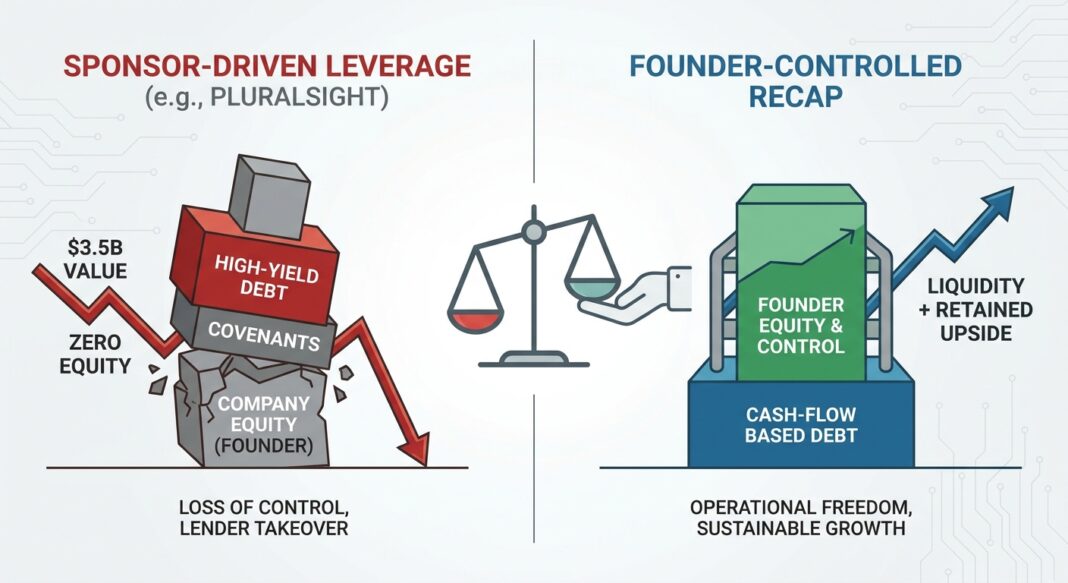
The Story: A $3.5 Billion Bet That Belonged to Everyone Except the Founder
In late 2020, Pluralsight, a Utah-based technology workforce development platform co-founded by Aaron Skonnard, agreed to go private in a deal with Vista Equity Partners, valued at approximately $3.5 billion. For Skonnard, who had built Pluralsight from a small tech training shop into a publicly traded software company, it looked like a triumphant moment. The deal priced shares at a premium, gave the company access to institutional resources, and freed it from the scrutiny of quarterly public markets.
But the capital structure Vista imposed on the transaction would ultimately define (and destroy) the company’s next chapter. The acquisition was funded with over $1.5 billion in debt, including a $1.175 billion recurring revenue term loan and a $100 million revolving credit facility, with private credit lenders led by Blue Owl Capital providing the bulk of the financing. The equity check from Vista was substantial, but so was the mountain of obligations now sitting on Pluralsight’s balance sheet.
By early 2024, Vista had marked the equity value of its Pluralsight stake from $2.3 billion down to $1.5 billion, and then from $1.5 billion to zero, in a single quarter. Aaron Skonnard stepped down as CEO in April 2024. Vista formally ceded control of the company to its creditors shortly thereafter. The co-founder who had built the platform over more than a decade watched it transferred to lenders, not because he had borrowed, but because a private equity firm had borrowed in his company’s name.
This is the story that every operator, founder, and family business owner needs to understand before they take the first meeting with a PE firm bearing a term sheet.
The Decision: Whose Leverage Is It, Anyway?
The mechanics of a leveraged buyout are deceptively simple. A private equity sponsor acquires a company using a combination of its own equity and significant borrowed capital, then attaches that debt to the acquired company’s balance sheet. The debt belongs to the company. The upside, if the bet pays off, belongs largely to the sponsor.
Vista’s bet on Pluralsight was a calculated wager that the pandemic-era surge in enterprise IT training spend would continue. When it didn’t (when corporate customers began laying off IT staff and competitors began offering learning products for free) the company’s revenue trajectory stalled. Rising interest rates made the debt burden even heavier. Pluralsight’s annual interest expense climbed to a level that consumed cash the business needed for product development and competitive repositioning.
The structure itself was aggressive. Lower-middle-market buyout multiples averaged 7.2x TTM EBITDA in 2024 according to GF Data, yet Pluralsight was bought at a valuation reflecting software growth premiums, loaded with debt calibrated against recurring revenue rather than cash earnings. A recurring revenue loan uses ARR-based covenants rather than EBITDA, which provides flexibility in good times but masks the severity of deterioration. When the business slowed, the covenants offered less protection to anyone, including the company itself.
What Pluralsight needed at the outset was not an LBO. It needed a capital partner whose interests were aligned with sustainable growth and operational longevity: not a fund with a three-to-seven-year hold, a mandate to return capital to LPs, and a balance sheet engineered for exits, not endurance.
“The forecast, combined with liquidity constraints due to the debt structure, resulted in the equity value being marked to zero.”: Vista Equity Partners, internal fund document, May 2024
The Pluralsight situation was not unique. In Q1 2025, 7 out of 10 bankruptcies at companies with over $1 billion in liabilities were at companies owned by a private equity firm, despite private equity accounting for only 6.5% of the U.S. economy. Moody’s reported that private equity-backed companies defaulted at twice the rate of non-PE-backed companies in 2024. The pattern is systemic: debt layered onto companies by sponsors who bear limited downside produces outcomes that hurt everyone: employees, customers, and founders who thought they had found a partner.
The Outcome: What the Numbers Actually Show
The Pluralsight collapse generated a measurable trail of damage. Vista’s equity in Pluralsight went from a reported $2.3 billion carrying value in early 2023 to zero by May 2024. Lenders led by Blue Owl Capital, BlackRock, Goldman Sachs, and others ultimately took control of the company, converting approximately $1.2 billion of debt into equity and injecting $275 million of fresh capital to stabilize operations. The original founding equity, the institutional equity, and years of platform value were effectively wiped out.
Aaron Skonnard, the founder who built Pluralsight from concept to a publicly traded $3.5 billion company, had no equity, no control, and no operational role when the dust settled. The company he built was now owned by lenders who had no particular interest in its mission, its culture, or its product roadmap. They were creditors pursuing recovery, not stewards pursuing growth.
The Hypothetical Contrast: What a Founder-Controlled Leveraged Recap Looks Like
(Hypothetical Scenario, Illustrative Example Only)
Consider instead a scenario that mirrors what a discipline-first leveraged recapitalization actually looks like when the founder retains control of the capital structure. Imagine a profitable B2B SaaS company generating $40 million in ARR and $8 million in EBITDA, smaller than Pluralsight, but stable. The founder is approached by three parties: a growth equity fund offering $20 million for 25% of the company; a traditional PE firm proposing a full buyout at 8x EBITDA ($64 million) using 4x leverage; and a private credit lender offering a $24 million senior term loan at 10% interest against 3x EBITDA, with the founder retaining 100% of the equity.
- The PE buyout path: Founder receives $64 million upfront but gives up the company entirely. Annual debt service of approximately $2.5 million is manageable, until revenue softens and interest rates rise. There is no founder upside in the next chapter unless a rollover equity stake is negotiated at closing.
- The growth equity path: Founder raises $20 million but immediately dilutes by 25%, with protective provisions that constrain future capital decisions. If the company raises another round before an exit, dilution compounds. By exit, founder ownership has drifted from 100% to perhaps 55–60%.
- The leveraged recap path: Founder takes $24 million off the table, meaningful personal liquidity, while retaining 100% of the equity and full operational control. Annual interest of approximately $2.4 million is serviced by existing cash flow. The debt paydown schedule over five years is predictable. If the business doubles to $16 million EBITDA over that period, the founder owns the entire upside: no dilution, no exit forced by a fund’s LP cycle, no sponsor whose return model requires a sale in year four.
The leveraged recap also allows the founder to use the recapitalized balance sheet as a platform for add-on acquisitions (funded by debt, not equity) further building value without surrendering ownership. This is the model that serves the operator, not the fund.
The Lessons: A Framework for Operators Facing a Capital Decision
The Pluralsight story is not a story about debt being dangerous. It is a story about whose debt it is and who bears the consequences when it goes wrong. Private equity’s core mechanic, layering leverage onto an acquired company’s balance sheet, transfers risk to the operating business while concentrating upside to the sponsor. When the thesis holds, everyone wins. When it breaks, the company absorbs the damage.
The global private credit market stood at approximately $3 trillion at the start of 2025, more than doubling from roughly $2 trillion in 2020, with Morgan Stanley projecting growth to $5 trillion by 2029. That capital is available to founders, not just to PE sponsors. The question is whether operators use it on their own terms or let sponsors use it against them.
A 2024–2025 Venture Debt Review produced by Runway Growth Capital and PitchBook found that a majority of founders and investors now view debt as a flexible, founder-friendly alternative to equity that supports growth without dilution, a meaningful shift in how non-dilutive capital is perceived at the operator level. The U.S. venture debt market reached an estimated $53.3 billion in deal volume in 2024, nearly double the prior year, according to PitchBook data.
Meanwhile, late-stage tech valuations remain roughly 40% below their 2021 peaks, making equity more expensive in dilution terms than it was at the last market peak. In that environment, trading equity for capital is a structurally worse deal than it was three years ago. Debt, calibrated to cash flow and serviced with discipline, is often the better tool.
The Founder’s Leverage Framework
Before accepting any outside capital, operators should ask four questions:
- Who bears the debt? If a sponsor is putting leverage on your company to fund their acquisition, you are not a partner, you are collateral. The distinction matters when markets shift.
- What is the hold period and exit pressure? PE funds have fund cycles. That cycle may not align with your business cycle. A capital partner with a five-year hold and LP distribution pressure is not the same as a lender whose only requirement is principal and interest.
- Can I service this debt from existing cash flow? Debt calibrated to your actual EBITDA, not to aggressive growth projections, is sustainable. Debt underwritten to a best-case scenario becomes a liability when reality diverges from the model.
- What does the counterfactual cost me in equity? Every point of equity you sell permanently transfers future enterprise value to someone else. Model the dilution over five years, not just the check you receive today.
Key Insights
- Leverage placed by a sponsor is not the same as leverage taken by a founder. In an LBO, the company bears the debt while the sponsor controls the equity, misaligning incentives from day one of ownership.
- The Pluralsight collapse was structural, not operational. The business generated real revenue and had a real market. What killed the equity was a capital structure that could not absorb a macro headwind, precisely what disciplined leverage management is designed to prevent.
- PE-backed companies default at twice the rate of non-PE companies. That statistic isn’t a coincidence; it reflects the systematic risk embedded in sponsor-driven leverage that is sized for upside, not resilience.
- Founder-controlled leveraged recapitalizations offer liquidity without surrender. A structured recap can return 80–90% of a company’s equity value to the founder in cash while preserving full operational control and meaningful ownership of future upside.
- The private credit market is now large enough to serve founders directly. With $3 trillion in assets and growing, non-bank lenders offer flexible, covenant-light structures that were once available only through PE intermediaries, meaning operators can access institutional capital without giving up the company to access it.


