
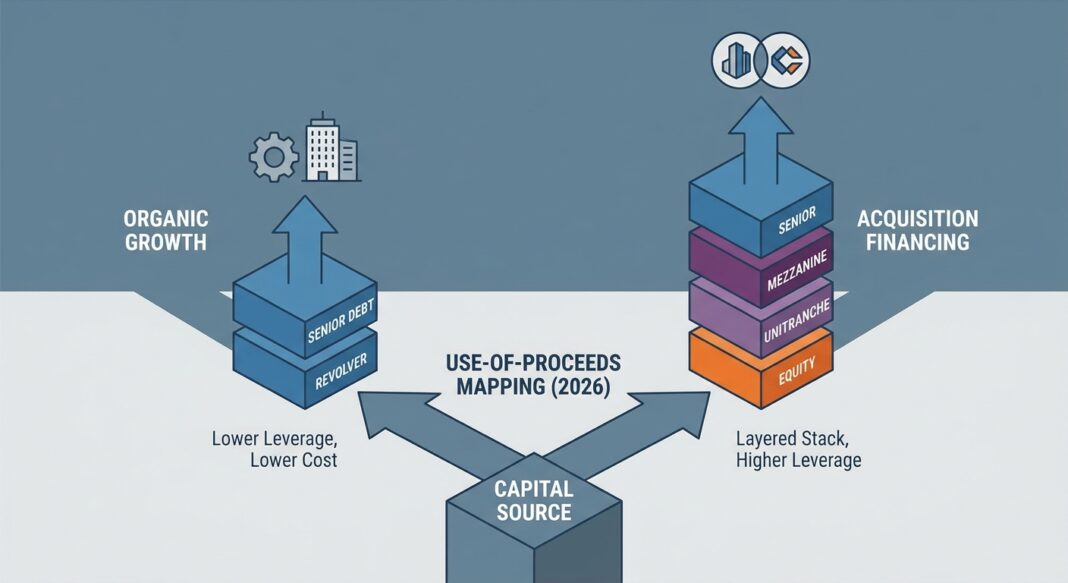
The $10M EBITDA Problem: Same Company, Two Very Different Capital Structures
Picture two operators. Each runs a services business generating $10M in EBITDA. One wants to hire a sales team, upgrade ERP infrastructure, and open two regional offices, call it organic growth requiring $8M of primary capital over 18 months. The other wants to acquire a bolt-on competitor at a $40M enterprise value, fund the purchase price, and integrate over 24 months. Same EBITDA base. Radically different capital structures.
This distinction, growth capital versus acquisition financing, is where operators make their most structurally expensive decisions. Get it right and you fund the plan at the lowest blended cost with maximum operational flexibility. Get it wrong and you either over-dilute on a capital raise that could have been debt, or you load a balance sheet with covenant-heavy acquisition debt that strangles the integration phase.
In 2026’s lending environment, capital structure is no longer a static decision. As IMAP’s 2026 debt advisory guide observes, while interest rates have stabilized, they remain structurally higher than the 2010s and lending markets have become more segmented, meaning the real competitive advantage is no longer just price, but structure: flexibility, covenant headroom, and alignment with the business plan.
This article maps both paths across the full cost-of-capital spectrum, provides a detailed structural breakdown for each scenario, and walks through the Gap Capital Playbook that practitioners use to quantify the need, prepare materials, run the process, and negotiate the final structure.
The Cost-of-Capital Spectrum: Banks → Private Credit → Mezzanine → Equity
Before mapping use-of-proceeds, operators must understand the full range of capital available, and its true cost, inclusive of dilution, covenants, and structural friction.
Layer 1: Senior Bank / Revolving Credit
The cheapest capital available to a profitable lower-middle-market business. Senior debt in 2026 prices at SOFR + 500–800 bps depending on leverage and industry, per Refinitiv LPC quarterly LMM lender surveys. It carries no dilution and no board seat, but it does require monthly cash service, financial maintenance covenants, and often personal guarantees on sub-$20M EBITDA deals. Banks still provide revolvers and senior term loans, particularly for asset-rich or cash-flow-stable businesses, but their mid-market appetite has contracted, creating the gap that private credit fills.
Layer 2: Unitranche (Private Credit Senior)
The dominant structure for lower-middle-market acquisition financing in 2026. A unitranche loan combines what would otherwise be senior debt and mezzanine into one instrument, one lender, and one credit agreement. Total leverage typically reaches 4–6x EBITDA, with a blended all-in rate of SOFR + 500–700 bps for typical LMM deals, translating to approximately 9.5%–11.5% all-in given current base rates. The market has grown from roughly $20B in annual issuance in 2015 to over $200B in 2025 as direct lenders displaced traditional bank syndication for sub-$1B EBITDA borrowers.
Execution speed is a structural advantage: private credit can close within 4 weeks while bank syndications require 6–8 weeks. For acquisitions with definitive agreement timelines, this speed premium justifies 50–100 bps of extra spread.
Layer 3: Mezzanine (Junior / Subordinated Debt)
Mezzanine sits junior to senior debt but senior to common equity in the capital stack. It is structurally defined by three components: a cash interest coupon (typically 8–12%), a Payment-in-Kind (PIK) toggle that preserves near-term cash flow, and an equity kicker via warrants or conversion rights (typically 3–8% of loan amount). All-in mezzanine yields run 12–20%, but this cost must be compared to the dilution cost of equity, which frequently exceeds 30% on an IRR basis. Mezzanine is most useful in three scenarios: funding growth capex without equity dilution, filling the leverage gap in an LBO where senior debt is capped, and executing a shareholder buyout.
The 2024–2026 mezzanine market has been reshaped by three forces: private credit AUM growth, senior bank retrenchment leaving a 1.0x–1.5x EBITDA gap in mid-market deals, and PE dry powder of $955B per Bain & Co’s 2026 Global Private Equity Report chasing scarce quality deals. These dynamics pushed sub-debt origination volume up 34% year-over-year in 2025 per PitchBook.
Layer 4: Preferred & Growth Equity
Growth equity (minority or majority) and preferred equity sit at the top of the cost spectrum in terms of long-run dilution. In 2026, growth equity minority checks typically demand 15–25% ownership stakes. Family offices such as Pritzker Private Capital, Grafine Partners, and Corten Capital write direct acquisition equity checks between $10M and $100M and often preserve operator control, making them structurally preferable to traditional PE when the operator wants to stay in the CEO seat. A critical warning: operators must distinguish between true equity and “friendly capital”, cash-pay preferred with mandatory redemption at cost plus coupon and observer rights that convert to full board seats on covenant breach. This structure looks attractive on a term sheet and becomes punishing in year three when the growth plan misses projection.
Structure Breakdown: Growth Capital vs. Acquisition Financing, Two Scenarios, Two Structures
Scenario A: Organic Growth Capital ($8M Use-of-Proceeds, $10M EBITDA Business)
For a $10M EBITDA services business funding internal growth (headcount, technology, market expansion), the optimal structure in most cases is a senior cash-flow term loan or revolving credit facility from a private credit fund or bank, sized to 2.5–3.0x EBITDA, roughly $25M–$30M of available borrowing capacity.
The $8M deployment draws only a portion of available capacity, preserving dry powder for opportunistic add-ons and providing covenant headroom under a max leverage test. Typical terms for this profile in 2026:
- Facility Type: Senior secured term loan + revolver
- Size: $25M term + $5M revolver
- Pricing: SOFR + 525–575 bps (all-in ~9.8%–10.3%)
- Tenor: 5 years
- Amortization: 5–10% per annum, bullet at maturity
- Covenants: One maintenance covenant (max total leverage, e.g., 3.5x stepping down to 3.0x), quarterly tested, plus standard incurrence covenants on additional debt and acquisitions
- OID: 1–2%
- Prepayment: 102/101/par (years 1/2/3+)
Why not mezzanine or equity for this scenario? Because the use-of-proceeds is operational and recurring, the return on invested capital from organic headcount and infrastructure is realized through EBITDA expansion, not a near-term liquidity event. Mezzanine’s PIK toggle and equity kicker make economic sense only when a shorter-duration exit crystallizes the equity upside. Deploying equity here for $8M of operating expenses is structurally wasteful: you are paying a 25–30%+ dilution cost for capital that a lender would provide at 10%.
Scenario B: Bolt-On Acquisition Financing ($40M EV Target, $10M EBITDA Platform)
For the same operator buying a $40M enterprise value competitor, the capital stack must be built in layers. Senior leverage multiples in the middle market averaged 3.7x in Q1 2026 per GF Data, with total leverage at 4.6x on average across the LMM. In practice, this means:
- Senior / Unitranche: $37M at SOFR + 600 bps (9.5% all-in), 2% OID, 6-year term, max leverage stepping down annually, covers 3.5x–4.0x combined EBITDA post-close
- Mezzanine / Junior Tranche: $8M at 13% (8% cash pay + 5% PIK), 5% warrant coverage, 5-year bullet maturity, fills the gap from 4.0x to 4.75x
- Equity (Rollover + Buyer): $15M, approximately 30% of transaction value, sourced from buyer check and seller rollover
- Total: $60M capitalization on $40M EV (including transaction costs and integration reserve)
The blended cost of this stack is approximately 10.8% on the debt and ~30%+ on the equity. The mezzanine component runs 12–15% all-in but displaces equity that would cost more, the classic “cost of mezzanine vs. cost of dilution” trade-off that drives sub-debt origination in the LMM.
Alternatively, a pure unitranche structure (one lender, one credit agreement, SOFR + 600 bps across the full debt stack) eliminates the intercreditor complexity between senior and mezz lenders, reduces legal/closing costs by $200–400K, and compresses the timeline by 15–30 days. The trade-off: the unitranche all-in rate is marginally higher than a well-priced senior tranche, with the cost premium over a senior + mezz split typically running $600–800K over a 5-year hold on a $50M transaction. For many operators, that premium is rational given the structural simplicity and execution certainty.
Covenant Design: The Most Negotiated, and Misunderstood, Term in the Stack
Covenant design is where structure meets control rights. The distinction between maintenance and incurrence covenants determines when creditors can intervene, how much operational flexibility operators retain between transactions, and where value can leak in a weakening credit.
A maintenance covenant is a recurring financial test, usually quarterly, that a borrower must pass whether or not it has taken any new action. A maximum leverage ratio of 4.5x, tested every 90 days, is a classic example. A incurrence covenant is a permissioning test triggered only when a borrower proposes a specific transaction: raising additional debt, making an acquisition, or paying a dividend. Between transaction events, the borrower can operate without triggering any test, even as financials deteriorate.
The market bifurcation in 2026 is stark. In the broadly syndicated loan market, approximately 90% of new loans in 2024 remained covenant-lite, continuing borrower-friendly documentation trends. However, private credit lenders have maintained firmer positions on covenant inclusion, particularly for mid-market transactions: with maintenance covenants, specifically quarterly tests of leverage or fixed charge coverage, returning to many PE-backed deals financed by non-bank lenders.
A further nuance has emerged: “covenant loose” structures, where private credit funds include a single maintenance covenant but set the cushion so generously that it is unlikely ever to be triggered. This is a compromise position, operators get operational flexibility; lenders get a technical intervention right. From a borrower’s perspective, the width of the covenant cushion matters as much as its type. Negotiate for 30–35% headroom above the projected leverage peak, not 10–15%, the latter leaves no room for an underperforming quarter to force a waiver conversation.
One structural warning: ABF Journal’s March 2026 analysis of the covenant divide confirms that restructurings initiated at the covenant-breach stage, before a payment default, produce materially higher recoveries than those triggered by missed payments. The early-warning function of a maintenance covenant is not a documentation formality; it is the mechanism that preserves enterprise value in a workout. For operators, this cuts both ways: tighter covenants limit flexibility, but they also create a structured renegotiation trigger that is far less value-destructive than a payment default spiral.
The Gap Capital Playbook: Quantify, Prepare, Run, Negotiate
“Gap capital” is the tranche of the capital stack that sits between what a senior lender will provide and what the transaction or growth plan requires. Filling it efficiently (at the right cost, with the right structure) is a four-stage process.
Step 1: Quantify the Gap
Start with a three-statement financial model including base, downside, and upside cases. Determine the maximum senior leverage your business can support given free cash flow conversion. Golub Capital’s 2026 Middle Market Report noted that free cash flow conversion below 60% of EBITDA typically caps sustainable leverage at 3.5x total, well below the 4.2x LMM median. If your plan requires 4.5x–5.0x total leverage, the gap between 3.5x and 4.5x, one full turn of EBITDA, is your mezzanine or junior capital requirement. Quantify it precisely before approaching any capital provider.
Step 2: Prepare Materials
The minimum package for a private credit process in 2026 includes: a Confidential Information Memorandum (CIM) covering business description, competitive position, management team, and financial history; a 3-year financial model with covenant sensitivity; a use-of-proceeds waterfall showing exactly how capital will be deployed and in what sequence; and a management presentation for lender diligence calls. Rushed processes trade 50–150 bps of pricing, per Lincoln International’s Q1 2026 middle market monthly, incomplete materials are the primary driver of rushed timelines. Prepare the diligence package before the first lender conversation, not after.
Step 3: Run a Competitive Process
The active 2026 LMM acquisition financing lender universe includes roughly 300 debt funds and 800 SBA-eligible banks. For a $10M EBITDA business, the target competitive process should generate three to five term sheets across senior and junior capital simultaneously. Run debt and equity tracks in parallel to preserve leverage, a well-run process typically produces two or three competing capital packages by week 10 of a 16–24 week process. Ask prospective advisors for the last five LMM debt raises they completed, the number of term sheets generated in each, the winning coupon and warrant coverage, and a reference contact for each. Advisors who cannot produce that data promptly should be deprioritized.
Step 4: Negotiate the Structure
Five negotiation points matter most for growth-stage and acquisition financing in 2026:
- Spread and OID: On a competitive term sheet round, LMM lenders will often compress spread by 25–50 bps and reduce OID from 2% to 1.5% when facing a credible competing offer. The most negotiable variable is OID, lenders protect headline spread for portfolio comparability but have more flexibility on upfront fees.
- Covenant Headroom: Push for 30–35% cushion above your projected leverage peak. A 4.5x max leverage covenant with a projected 3.4x peak leverage gives you meaningful room; a 4.5x covenant with a 4.1x projected peak does not survive one soft quarter.
- PIK Toggle: For mezzanine tranches, negotiate the PIK toggle as a borrower-elected feature rather than lender-elected. This preserves cash flow optionality during integration or capex-heavy periods without requiring lender consent.
- Prepayment Flexibility: Standard LMM call schedules run NC1-103-102-101 (non-callable in year 1, then declining prepayment premiums). Push for a make-whole through year 1 only, then clean par prepayment by year 3, particularly important if refinancing risk is a concern as rates evolve.
- Lender Counsel Fee Cap: Lender counsel on a $50M LMM unitranche can bill $600K–$1.2M if left uncapped. A hard cap of $250K–$400K is negotiable and market, include it in the term sheet, not just the credit agreement.
Key Takeaways
- Match structure to use-of-proceeds first. Organic growth capital (headcount, technology, infrastructure) is most efficiently funded with senior cash-flow debt at 2.5–3.0x EBITDA. Acquisition financing requires a layered stack (senior plus mezzanine or unitranche) to reach the 4.5–5.0x total leverage that LMM transactions require in 2026.
- Unitranche vs. senior + mezz split is a cost-certainty trade-off, not a pure cost-minimization decision. The unitranche premium runs roughly $600–800K over a 5-year hold on a $50M transaction: a rational price for execution certainty, single intercreditor, and 15–30 days faster close.
- Covenant design determines control rights, not just financial ratios. The difference between maintenance and incurrence covenants is the difference between lender-as-monitor and lender-as-gatekeeper. In a mid-market private credit deal, negotiate for covenant type, cushion width, and cure rights simultaneously.
- PIK toggle and equity kickers are mezzanine features, not red flags. A 5% PIK toggle preserves $500K of annual cash flow on a $10M mezzanine tranche. A 5% warrant coverage on a $10M loan is $500K of equity, meaningful dilution that must be priced against the alternative cost of equity capital.
- Process quality determines pricing more than credit quality in a competitive 2026 market. With $1.2 trillion of private equity dry powder and roughly 300 active LMM debt funds, capital is available, what is scarce is well-prepared, competitively run processes. Rushed processes trade 50–150 bps. A 90-day competitive process, properly managed, is the highest-return activity a CFO or capital advisor can run.


