
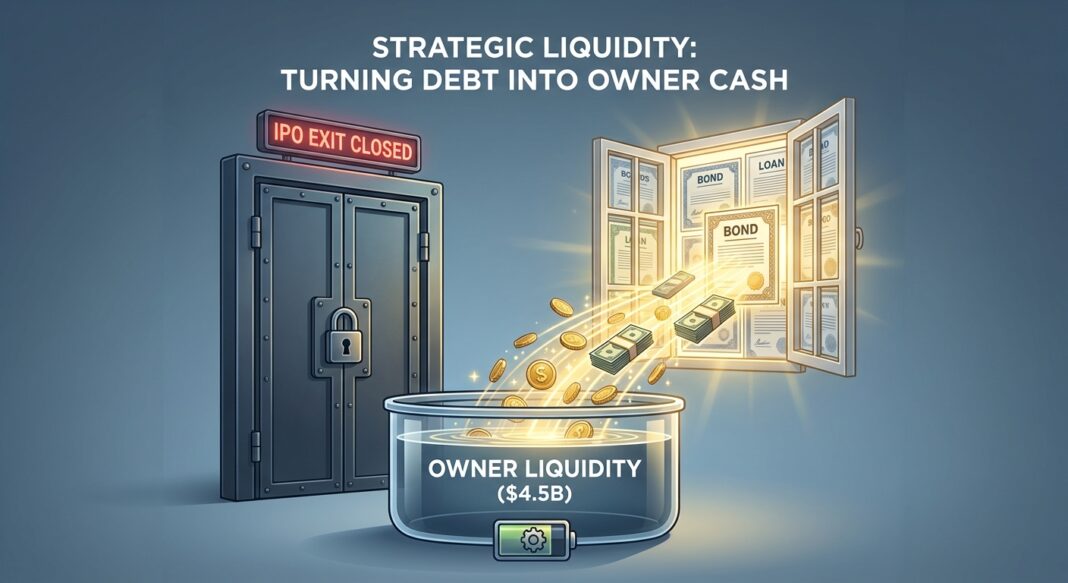
The Story: When an IPO Door Closes, a Debt Window Opens
By January 2025, Clarios International had been sitting in Brookfield Asset Management’s portfolio for more than five years. The Wisconsin-based car battery maker (whose Varta, LTH, and Heliar brands power one in three vehicles on the road globally) was a dominant, cash-generative industrial business with a straightforward problem: its owners needed liquidity, and the public markets weren’t cooperating.
Brookfield and co-investor CDPQ (the Canadian pension fund Caisse de Dépôt et Placement du Québec) had acquired Clarios from Johnson Controls in 2019 for roughly $13 billion. They filed for an IPO in 2021, expecting to ride the frothy equity markets to a clean exit. Instead, Clarios indefinitely postponed and eventually withdrew the IPO plans in early January 2025, citing market conditions and volatility. The exit door that sponsors most prefer had swung shut.
But Brookfield’s team wasn’t panicking. They had spent five years quietly doing something that made an alternative path possible: paying down debt. Between 2020 and 2024, Clarios had cut approximately $2.1 billion of debt from its balance sheet, building the kind of headroom that transforms a constrained balance sheet into a tool. And when lenders started showing appetite again, Brookfield knew exactly what to do with it.
The result was one of the most instructive capital structure maneuvers in recent memory, not because it was clever, but because it was disciplined.
The Decision: Debt Over Sale, Liquidity Over Exit
The choice Brookfield faced in late 2024 was one every sponsor (and every operator-owner) will eventually encounter: How do you return capital to your stakeholders when the conventional exit paths are closed or unattractive?
The options were familiar. Sell a minority stake at a negotiated private valuation. Push the IPO again into a choppy market. Wait indefinitely, stranding LP capital and testing fund-life constraints. Or, explore a so-called dividend recapitalization, using new debt to hand cash directly to owners while retaining full control of the business.
They chose the recap. The structure was formidable in its scale: Clarios issued a $1.2 billion senior secured bond alongside two seven-year Term Loan B facilities totaling $3.3 billion, denominated in both dollars and euros. The total debt raised: approximately $5 billion. The dividend distributed to shareholders: $4.5 billion, among the largest such transactions ever executed in the leveraged finance market, according to Debtwire.
What made the deal credible (and fundable) was the underlying business. During fiscal year 2024, Clarios generated approximately $2.1 billion in EBITDA, a figure that jumped to $3.1 billion when tax credits were included. Post-recap, gross leverage would rise to approximately 6x EBITDA, elevated, but serviceable given the company’s cash flow profile. Demand from lenders was strong enough that the deal was reportedly upsized, a market signal that carried its own validation.
Not a single share was sold. Not a single new equity investor was admitted to the cap table. Brookfield and CDPQ retained full ownership, preserved the optionality of a future IPO or sale, and returned billions of dollars to their LPs, all financed by the company’s own earning power, accessed through the credit markets.
The Outcome: Liquidity Returned, Upside Preserved
The numbers tell the story cleanly. Brookfield had invested in a business that spent five years deleveraging, reducing its debt by more than $2 billion from a highly leveraged post-acquisition position. That discipline created the capacity to re-lever responsibly at a moment of the sponsor’s choosing, not the market’s. The $4.5 billion dividend effectively returned a substantial portion of the original invested equity capital to LPs while Brookfield maintained exposure to Clarios’s future value, including meaningful potential from tax credits and the ongoing automotive battery cycle.
Consider the counterfactual: had Brookfield pushed the IPO in a reluctant equity market, they might have accepted a lower-than-preferred valuation to complete the exit, or pulled the deal entirely again, further extending a holding period that was already straining LP patience. Notably, 2016 has been the most recent vintage year with an average Distributions to Paid-In Capital (DPI) multiple above 1.0x across the middle market private equity universe, a reminder that returning actual cash to LPs is a persistent challenge in today’s environment, and one the Clarios recap directly addressed.
The broader market context only reinforces the timing. Total dividend recap volume climbed 128.8% year-over-year in 2024 and another 22.8% year-over-year in 2025, as a generation of sponsors navigated the same problem: strong portfolio companies, weak exit windows, and LPs demanding real distributions. Leveraged loan issuance tied to sponsored dividend recaps grew 11% year-over-year to $74.3 billion in 2025 after rising 326% year-over-year in 2024.
Clarios didn’t stumble into this outcome. It was engineered. The years of delevering weren’t just balance sheet hygiene; they were the construction of a future optionality tool, one that ultimately delivered more practical liquidity than an IPO that never came.
The Lessons: What Founders and Operators Can Learn From a $4.5B Recap
The Clarios story isn’t just a PE sponsor playbook, it’s a master class in capital structure thinking that applies to any business owner sitting on a profitable, cash-generative company. The principles translate directly to founder-owned middle-market businesses, family offices holding operating companies, and growth-stage companies weighing their next financing step.
1. Delevering Creates the Right to Re-Lever
The Clarios recap was only possible because Brookfield spent years reducing debt first. Discipline in the quiet period built the capacity for a decisive move when conditions were right. For founders, the lesson is structural: a clean balance sheet isn’t just a defensive posture, it’s a future optionality reserve. Lower middle market leveraged recapitalizations typically close at 3x to 5x EBITDA in total debt, the room available to a founder depends almost entirely on how much debt the business currently carries.
2. Debt Is Not the Enemy of Equity: It Is Its Complement
The conventional founder instinct is to treat debt as risk and equity as safety. The Clarios story inverts that: equity dilution is permanent, while debt is temporary and self-extinguishing through cash flows. The after-tax cost of debt financing typically runs between 3% and 8%, while equity investors generally expect returns of 15% to 25%, making debt significantly less expensive for founders with the cash flow to support it. Clarios didn’t dilute a single basis point of ownership to return $4.5 billion.
3. The Exit Markets Work For You: Not On Their Schedule
One of the most corrosive dynamics in founder and PE capitalism alike is the assumption that liquidity requires a formal exit event. The Clarios recap demonstrates that a well-structured business can manufacture its own liquidity, on its own timeline. A leveraged recapitalization is initiated by the existing owner to extract cash while retaining control, a fundamentally different posture than waiting for a buyer to decide what your business is worth.
4. The Cautionary Contrast Is Real: Structure Matters Enormously
Not every recap story ends in triumph. The same tool that worked elegantly for Clarios destroyed Steward Health Care: Steward, the largest U.S. private hospital chain, paid about $800 million in dividends via recap and filed for bankruptcy in May 2024. The difference wasn’t the instrument; it was the underlying business quality, free cash flow sustainability, and the integrity of the solvency analysis. Recaps work when the business can absorb the debt load. When they don’t, communities pay the price.
5. Private Credit Has Made This More Accessible Than Ever
The infrastructure now exists to bring this playbook beyond mega-deals. According to Morgan Stanley, the private credit market stood at approximately $2 trillion in 2020, grew to $3 trillion entering 2025, and is projected to reach approximately $5 trillion by 2029, with much of that growth driven by middle-market borrowers. For founders in this segment, the universe of debt options has expanded substantially and can include senior debt, unitranche facilities, mezzanine financing, asset-based lending and specialty structures. The question is no longer whether the product exists, it’s whether the business qualifies.
The Framework: Four Questions Before You Pursue a Recap
- Cash flow durability: Can your business service new debt through a down cycle, not just in the base case?
- Current leverage headroom: What is your current Debt/EBITDA, and what is the ceiling for your sector and lender universe?
- Use of proceeds discipline: Are you recapping for genuine liquidity or deferred value creation, and have you stress-tested the difference?
- Solvency margin: A solvency opinion is not just a formality. It is the document that stands between a successful recap and a fraudulent conveyance claim. Treat it accordingly.
Key Insights
- Liquidity without dilution is real, if earned. Clarios’s $4.5 billion dividend recap returned enormous capital to owners without surrendering a single share. The prerequisite was five years of delevering and strong underlying EBITDA generation. Control was never on the table.
- The IPO is one exit path, not the only one. When equity markets close their doors, a well-structured balance sheet opens a credit window. Sponsors and founders who understand this avoid the hostage dynamic of depending on public market timing for private business value.
- Debt’s real cost advantage is structural, not cyclical. At 3–8% after-tax versus 15–25% for equity, the cost of debt capital is a permanent advantage for businesses with reliable cash flows, regardless of interest rate environment.
- The difference between Clarios and Steward Health Care is business quality, not instrument choice. Dividend recaps are not inherently dangerous; they are dangerous when applied to businesses that cannot durably service the resulting debt. The tool is neutral; the judgment is not.
- Private credit has democratized the playbook. A strategy once reserved for billion-dollar buyouts is now accessible to founder-owned businesses across the middle market, as a $5 trillion private credit market continues to expand its reach into the $10M–$150M EBITDA segment.


