
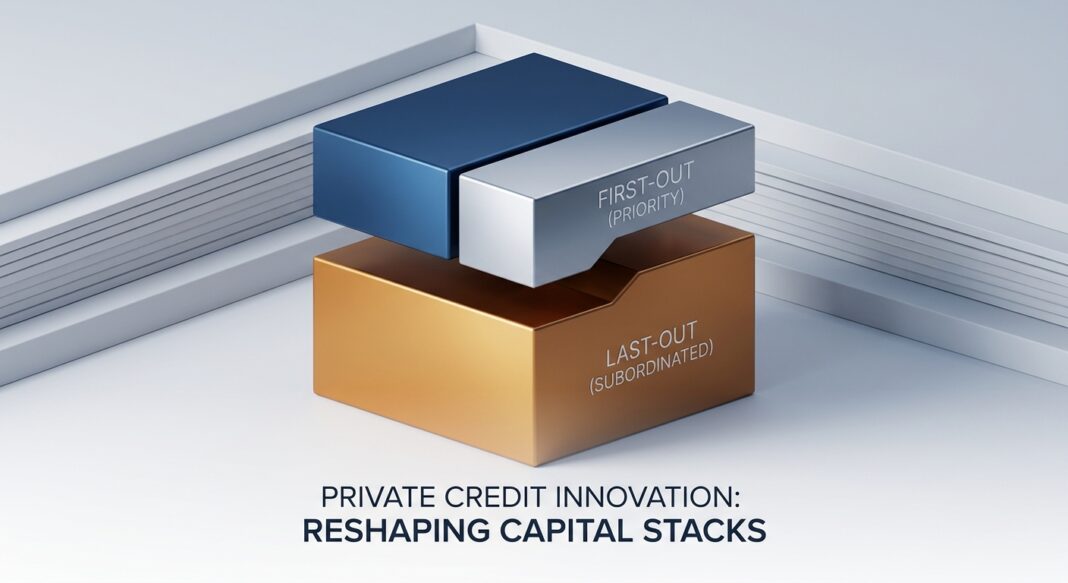
One Loan, Two Realities: The Unitranche Innovation
When a private equity sponsor finances a mid-market acquisition today, there is a good chance the debt package arrives as a single loan from a single lender: clean documents, one closing, one set of reporting requirements. What the borrower signs looks straightforward. What sits behind it is one of the most sophisticated structural innovations in modern credit markets: the unitranche.
Unitranche financing has moved from a niche instrument to the dominant deal structure in direct lending. PitchBook LCD (January 2026) reported that the median spread on private equity-backed acquisition financing in 2025 priced at S+475 bps, the benchmark for unitranche product in the middle market. Meanwhile, Valuation Research Corporation (June 2026) noted that unitranche structures continue to dominate new issuance, with coupon spreads generally ranging from 4.75% to 5.50% through Q2 2026.
Understanding why this structure exists (and how it quietly splits a single loan into a first-out and last-out position) is foundational knowledge for anyone participating in private credit as an investor or as a capital-seeking business owner.
What a Unitranche Loan Actually Is
At its core, a unitranche loan is a single secured credit facility in which two or more groups of lenders share the same security interest in the borrower’s collateral but agree among themselves, not with the borrower, on payment priority and economic terms. The borrower sees one lender, one credit agreement, and one blended interest rate. The structural complexity is entirely invisible to them.
Behind the scenes, the loan is governed by an Agreement Among Lenders (AAL), a private contract that divides the facility into two internal positions:
- First-Out (FO) Tranche: Receives priority on all principal and interest payments, bears lower credit risk, and therefore earns a lower yield. Often structured as a revolving credit facility or the initial term loan repayments.
- Last-Out (LO) Tranche: Subordinated within the AAL to the first-out piece, absorbs losses first in a distressed scenario, and earns a materially higher yield to compensate. This is the piece most commonly retained by private credit funds.
As Mondaq (2026) explains, the structure is intended to provide the first-out lender reduced risk and return, while providing the last-out lender increased risk and return, and the borrower a single, streamlined credit facility. Critically, this internal subordination is synthetic: in a bankruptcy filing, the entire facility still appears as a single first-lien loan. It is only through the AAL that the two lender groups resolve their respective recoveries.
How It Works: A Concrete Example
Imagine a private equity firm acquiring a software business with $15 million of EBITDA at a 7x multiple, a $105 million enterprise value. The sponsor contributes $42 million in equity (40%) and finances the remaining $63 million with a unitranche loan (4.2x leverage on EBITDA).
The unitranche is structured at a blended rate of SOFR + 500 bps (approximately 9.0–9.5% all-in with current rates). Internally, the AAL splits the $63 million into:
- First-Out ($20M): Revolver plus initial amortization priority. Earns SOFR + 350 bps (~8.0%). Lower risk, protected by $43M of subordinated debt and equity beneath it.
- Last-Out ($43M): Term loan remainder. Earns SOFR + 575 bps (~10.1%). Higher risk, but secured by a direct first-lien claim on all company assets alongside the FO piece.
The borrower writes one check each quarter to the lead lender at the blended rate. The lead lender then allocates proceeds per the AAL. The borrower never negotiates separately with two creditor groups: no intercreditor fights, no dual diligence timelines, no misaligned documentation. For middle-market sponsors where deal speed matters, this structure routinely compresses closing timelines versus a traditional first-lien / second-lien bifurcated package.
A real-world illustration: PitchBook LCD (March 2026) reported that WWEX Group’s $4.815 billion unitranche loan (led by Ares Capital and involving 33 lenders) priced at S+575 in Q1 2026, supporting a Thoma Bravo acquisition. Even at multi-billion-dollar scale, the unitranche structure held.
Current Market Relevance
The unitranche’s rise is inseparable from a broader structural shift in credit markets. Several converging forces make this the right moment to understand the instrument deeply:
Bank lending standards are tightening. According to the Federal Reserve April 2026 SLOOS, banks reported tighter standards for all categories of C&I loans in Q1 2026, with significant net shares also reporting stricter covenants, higher premiums on riskier loans, and stricter collateralization requirements. Each tightening cycle historically expands the addressable market for direct lenders offering unitranche solutions.
Spreads have reset wider, improving lender economics. According to Lord Abbett / PitchBook (June 2026), direct lending spreads have widened roughly 50 to 100 basis points since late 2025, shifting market dynamics toward lenders with dry powder. The last-out position in a unitranche captures this widening most directly.
Unitranche dominates new issuance at current rate levels. Valuation Research Corporation (June 2026) confirmed that unitranche structures continue to dominate new issuance in Q2 2026, with coupon spreads generally ranging from 4.75% to 5.50%.
Middle market deal activity is recovering. VRC (June 2026) also noted that middle market private equity deal value increased approximately 10.7% year-over-year, creating fresh demand for unitranche financing.
The asset class behind it is growing rapidly. According to S&P Global / Preqin (November 2025), private credit AUM is expected to nearly double to $4.5 trillion by 2030. Major managers are scaling unitranche capacity accordingly: Ares Management reported private credit AUM of $391.5 billion as of Q3 2025, up 22% year-over-year from 2023.
| Metric | Value | Source |
|---|---|---|
| Unitranche coupon spread range (Q2 2026) | 4.75% – 5.50% | VRC, Jun 2026 |
| Spread widening since late 2025 (direct lending) | +50 to +100 bps | Lord Abbett / PitchBook, Jun 2026 |
| Median LBO unitranche spread (full-year 2025) | S+475 bps | PitchBook LCD, Jan 2026 |
| Private credit AUM projection (2030) | $4.5 trillion | S&P Global / Preqin, Nov 2025 |
| Covenant-lite share of direct lending deals (2025) | 21% (up from 4% in 2023) | McKinsey / Proskauer, Jun 2026 |
Decision Framework
For Investors Evaluating Private Credit: When assessing a direct lending fund or BDC, investors consider whether the manager primarily holds first-out or last-out positions within its unitranche book. A portfolio weighted toward last-out exposure carries materially higher recovery risk in a default scenario but earns a yield premium of 150–225 bps over the first-out piece on the same underlying credit. Investors evaluate: (1) the equity cushion beneath the entire unitranche (sponsor equity typically represents 40–50% of enterprise value), (2) whether the AAL has been battle-tested in the manager’s history, and (3) how the manager marks last-out positions in a stress, since the internal subordination is invisible to standard lien-based analysis. With spreads having widened 50–100 bps since late 2025, last-out tranches may now compensate investors more fairly for the risks embedded in the structure.
For Business Owners and Operators Needing Capital: Operators evaluate unitranche when speed and simplicity carry strategic value: competitive M&A auctions, tight closing windows, and situations where running parallel bank and mezzanine processes would be disruptive or disqualifying. The all-in pricing will generally exceed a traditional bank term loan by 200–350 bps, but the speed premium, covenant flexibility, and single-lender relationship often justify the cost. Operators also consider that unitranche lenders tend to offer larger hold sizes and more certainty of close than syndicated alternatives, particularly relevant given the April 2026 SLOOS data showing continued bank C&I tightening. The structure is most appropriate for businesses with stable, recurring cash flows (EBITDA margins above 20% are common underwriting benchmarks), predictable leverage trajectories, and experienced sponsor ownership.
Key Takeaways
- One loan, two economic realities: The unitranche structure presents a single credit agreement to the borrower while internally allocating risk and return between first-out (lower yield, priority payment) and last-out (higher yield, subordinated recovery) lender groups via an Agreement Among Lenders.
- Speed and simplicity are the borrower’s premium: Operators pay a higher all-in rate than traditional bank debt in exchange for faster closes, fewer counterparties, and more flexible documentation, a trade-off that makes quantitative sense in competitive M&A environments.
- Widening spreads are improving lender economics: Direct lending spreads have widened approximately 50–100 bps since late 2025, according to PitchBook data cited by Lord Abbett, restoring yield compensation that had compressed during 2024–early 2025 repricing cycles.
- Bank tightening structurally expands the market: The Federal Reserve’s April 2026 SLOOS confirms continued C&I tightening, with banks reporting stricter covenants, higher risk premiums, and tighter collateral requirements, conditions that historically direct more borrowers toward private credit unitranche solutions.
- Due diligence requires looking past the lien label: Investors assessing unitranche-heavy portfolios evaluate the AAL terms, the equity cushion protecting the entire facility, and the manager’s track record on last-out recoveries, details that standard first-lien categorizations do not surface.


