
The Story: Built on $20 of Code, Buried Under $1.5 Billion of Debt
In 2004, four developers in Draper, Utah each put in $5,000 and started building a technology training platform. No venture capital. No institutional backing. Just a clean cap table, a clear product vision, and compounding patience. For the next nine years, Pluralsight grew quietly (and profitably) on its own terms.
By 2017, the company had become one of the most successful bootstrapped software companies in American history. It took venture capital late, only after it was already winning, and in 2018 completed what was then the largest venture-backed IPO in Utah history, with shares popping 33% on day one. The founders had built something real, and the market knew it.
Then came 2021. Vista Equity Partners, one of the most respected enterprise software investors on earth, took Pluralsight private in a $3.5 billion deal. It looked like a triumph: founders and early investors cashed out at a premium, a seasoned PE firm took the wheel, and Wall Street approved. The product worked. The revenue was real. The brand was established.
Three years later, Vista wrote its equity stake to zero. Lenders seized the keys. Co-investors (including sovereign wealth funds and pension giants) absorbed billions in losses. The restructuring that followed became one of the most closely studied capital structure failures of the decade. What went wrong had nothing to do with the product. It had everything to do with the debt.
The Decision: A $3.5B Take-Private, Financed at Peak Everything
Vista acquired Pluralsight at an approximate $3.5 billion valuation, funding the transaction with over $1.5 billion in debt, anchored by a $1.175 billion recurring revenue term loan and a $100 million revolver, with private credit lenders led by Blue Owl Capital providing the financing. This was not traditional EBITDA-based leverage. It was a structure that allowed for higher-than-normal debt loads relative to cash flow, predicated on the assumption that recurring software revenues would grow indefinitely and interest rates would stay low.
The deal was made at peak pandemic software valuations, the same moment that represented a high-water mark for demand for technology upskilling courses. Two macro forces then moved simultaneously in the wrong direction: topline growth turned negative just as the Federal Reserve began its most aggressive rate-hiking cycle in forty years. The company’s unhedged, floating-rate debt became dramatically more expensive precisely when it could least afford it.
By late 2023, Pluralsight was struggling under the combined weight of rising interest costs, increased competition, and softening enterprise demand. Vista attempted a series of rescue measures: providing $75 million in new equity to shore up liquidity, arranging a controversial drop-down transaction that moved intellectual property into an unrestricted subsidiary to secure fresh financing, and replacing the CEO. None of it was sufficient. Vista eventually marked down its equity to zero and began restructuring negotiations with lenders.
The outcome: lenders converted roughly $1.2 billion of Pluralsight’s debt to equity, took an 85% controlling stake, and injected $275 million in fresh capital to stabilize the business. Vista and its co-investors (including Saudi Arabia’s Public Investment Fund and AustralianSuper, which alone wrote off approximately A$1.1 billion) absorbed a combined loss of roughly $4 billion.
“What killed it was the capital stack: three successive owners, each paying for a version of the company that didn’t exist yet, until the debt finally did what debt does.”
Independent analysis, Brendon Beebe, Substack
The Contrast: What a Founder-Controlled Leveraged Recap Looks Like Instead
Now consider the structure that Pluralsight’s original founders could have used, and that thousands of founder-owned middle market companies have used to achieve liquidity, reduce personal risk, and retain strategic control simultaneously: the leveraged recapitalization.
A leveraged recap is structurally simple: a founder-owned company takes on new senior debt (typically 3x to 5x EBITDA in the lower middle market, per the Pepperdine Private Capital Markets Report) and distributes the proceeds back to the owner as a special dividend or equity redemption. No outside equity investors. No board control transferred. No venture clock ticking.
The math for a typical lower middle market operator is instructive. Hypothetical Case Study: Consider a founder-owned industrial services business generating $8 million in EBITDA, currently unlevered, valued at approximately $44 million (5.5x multiple). Rather than selling outright to a PE buyer and being asked to roll 20% of proceeds back into a structure she no longer controls, the founder instead executes a leveraged recapitalization: borrowing 4x EBITDA, or $32 million, from a private credit lender at a blended rate of approximately 9%. The proceeds go directly to her as a dividend. She retains 100% equity ownership, full operational autonomy, and a business now valued at the same $44 million, with $32 million of debt she is fully capable of servicing on $8 million of cash flow.
The personal outcome is stark: $32 million of immediate liquidity, no dilution, no co-investor governance rights, no drag-along provisions, no five-year PE hold period with an uncertain exit. She continues running the business she built, and if EBITDA grows to $11 million over four years, the eventual sale at 6x values the business at $66 million. After retiring the debt, the net equity she receives is larger than if she had sold outright at year one.
This is precisely the logic behind the surge in leveraged recap activity. According to PitchBook LCD data tracked by market observers, dividend recap loan volume reached roughly $76 billion in 2024: the third-highest annual total on record and a 240% jump versus 2023. The first quarter of 2025 alone produced $31 billion in issuance, putting the market on pace to challenge the 2021 record of $88 billion.
The Outcome: Two Structures, Two Completely Different Worlds
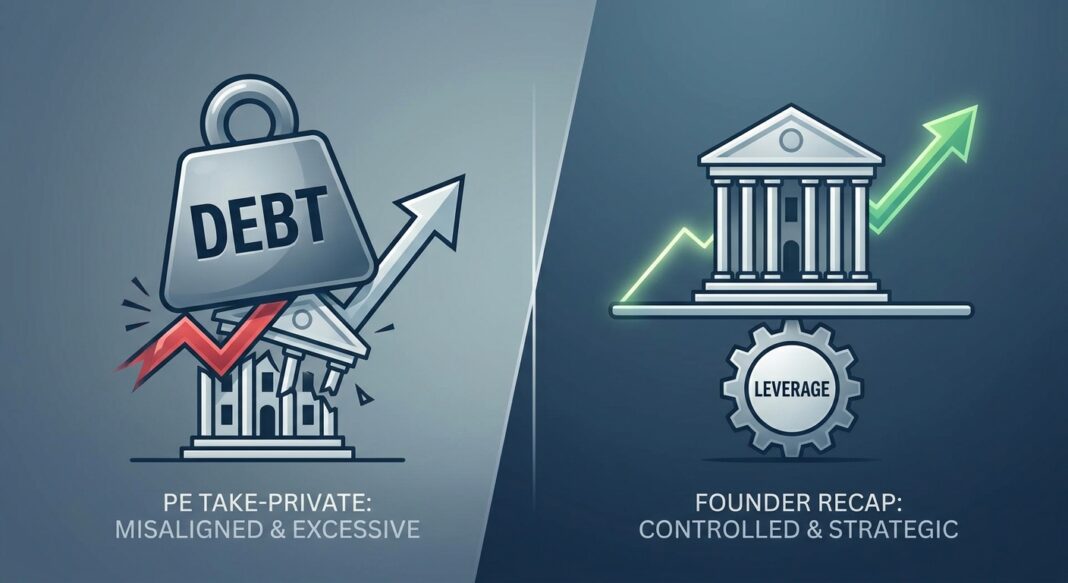
The contrast between Pluralsight’s PE-engineered capital stack and a founder-controlled leveraged recap illustrates a principle that gets obscured in the heat of a deal process: leverage is a tool, not a strategy. Its power depends entirely on who controls it, when it is applied, and whether the underlying business can realistically service it across the full range of macro environments.
In the Pluralsight case, leverage was applied by a sponsor whose incentives diverged fundamentally from those of the operating company. Private equity firms are structurally motivated to maximize debt at acquisition; it amplifies IRR on the upside, and the downside risk is largely borne by the portfolio company’s employees, creditors, and co-investors rather than the GP. Moody’s highlighted this dynamic in 2024, noting that PE-backed companies defaulted at twice the rate of non-PE-backed companies, a disparity driven directly by aggressive leverage combined with rising interest costs.
The broader numbers are damning. PE and venture capital-backed US companies filed for bankruptcy at record rates in 2024-110 filings, up more than 15% year-over-year, per S&P Global Market Intelligence. PE firms accounted for 54% of the largest U.S. corporate bankruptcies in 2025 (those with liabilities of $1 billion or greater), despite representing only 7% of the U.S. economy.
Compare that to the founder who uses a leveraged recap on her own terms. She controls the timing. She controls the leverage quantum. She can choose conservative multiples that allow meaningful debt paydown even in a slow year. She has no LP distribution pressure forcing a dividend recap at the worst possible moment. And critically, she retains the optionality that matters most: the ability to sell when she chooses, at a multiple she believes reflects full value, not when a fund’s lifecycle demands it.
The Lessons: A Framework for Operators Facing the Same Decision
The Pluralsight story is not an indictment of private equity as a category or of leveraged transactions broadly. Vista is a sophisticated firm, and the deal was structurally rational given the assumptions of 2021. The lesson is more precise: leverage applied at peak valuation, peak leverage multiples, on a floating-rate basis, with misaligned incentives between sponsor and operator, in a macro environment that subsequently reversed, is a compounding catastrophe waiting for a trigger.
The founder-controlled leveraged recap avoids nearly every one of those failure modes. Here is the framework Bond Capital uses when evaluating whether a leveraged recap is the right instrument for an operator:
Four Conditions That Make a Leveraged Recap Work
- Stable, recurring cash flow: The business must be able to service the debt through a down year, not just at EBITDA peak. A coverage ratio of 2x or better on interest payments is a reasonable floor. Cyclical businesses with lumpy revenues require more conservative leverage sizing.
- Conservative leverage quantum: Lower middle market recaps that close at 3x to 5x EBITDA provide the operator meaningful liquidity while leaving the balance sheet serviceable. The Pluralsight structure stretched this logic past its breaking point, not because leverage is inherently dangerous, but because the leverage was sized to a revenue-multiple model that assumed perpetual growth.
- Control retention: The decisive advantage of a founder-executed leveraged recap over a PE-sponsored one is control. When the founder owns 100% of the equity post-transaction, there are no drag-along rights, no board composition requirements, and no external timeline for an exit. The business runs on operator logic, not financial engineering.
- Rate environment awareness: Pluralsight’s unhedged floating-rate debt in a rising rate environment was a structural flaw that amplified every other problem. Fixed-rate or hedged structures, particularly in uncertain macro conditions, are not optional for operators who intend to hold the business through a full cycle.
When to Reject the Recap
A leveraged recap is the wrong tool when the business is in cyclical contraction, when cash flow predictability is low, when the purpose is growth funding rather than owner liquidity (where venture debt or revenue-based financing may be better-suited instruments), or when the owner plans to exit fully within 12 to 18 months, at which point a clean sale process typically delivers better economics.
Key Insights
- Leverage is alignment-dependent. In a founder-controlled recap, the operator and the debt are in the same boat: every incentive points toward conservative sizing, disciplined paydown, and long-term stewardship. In a sponsor-led LBO, the GP’s carry is asymmetric: maximum upside with limited downside exposure, which structurally encourages over-leverage.
- The product doesn’t have to fail for the deal to fail. Pluralsight’s technology worked. Its revenue was real. What killed the transaction was a capital structure sized to a macro environment that no longer existed. The business was sound; the debt stack was not.
- Timing and rate exposure matter as much as leverage quantum. A 4x EBITDA leveraged recap at a fixed rate in 2024 is a very different instrument than a 6x recurring-revenue loan at floating rates in 2021. The same nominal leverage multiple carries radically different risk profiles depending on rate environment and how the coupon is structured.
- The dividend recap market is at record levels, for a reason. With M&A exit markets constrained and PE holding periods extending well past five years, dividend recaps have become the dominant alternative liquidity mechanism. $76 billion in 2024 and $31 billion in Q1 2025 alone signal that operators and sponsors alike are rethinking when and how they monetize without selling. Founders who understand this market have a tool their predecessors didn’t.
- Control retained is optionality preserved. The founder who executes a leveraged recap on her own terms, taking 50–70% of business value off the table in cash while retaining 100% of equity, maintains the single most valuable thing in private markets: the right to decide when, to whom, and at what price she sells the rest. That optionality compounds in value the longer the business grows.


