
The Story: A Founder Who’d Seen the Dilution Movie Before
Danny Yeung has a particular relationship with equity destruction. In 2021, he took Prenetics public on the Nasdaq at a billion-dollar valuation after building Hong Kong’s dominant COVID-19 testing business, a company that processed 28 million PCR tests and generated more than $800 million in revenue across three years. Then, as the pandemic wound down, the market re-rated with brutal efficiency. The stock fell from a billion-dollar listing to a $40 million market cap within 18 months.
Most founders would retreat. Yeung pivoted. He made a decision that most public company CEOs would find professionally uncomfortable: he bet the entire enterprise on a new consumer brand. He cut his workforce from 2,000 employees to under 100, reset the corporate identity, and co-founded IM8: a premium, AI-native direct-to-consumer supplement brand, alongside David Beckham, who joined as co-founding equity partner.
IM8 launched in December 2024. Its flagship product, Daily Ultimate Essentials, packaged 90 ingredients into a single daily serving, designed to replace 16 separate supplements. By month 11, IM8 had hit $100 million in annualized recurring revenue. By month 18, it had doubled to $200 million ARR, the fastest growth trajectory in supplement industry history. The brand was operating in 43 countries, with a performance marketing engine running thousands of simultaneous ad creatives across Meta and Google.
Then came the moment that defines every high-growth DTC founder’s career: the ceiling question. How do you keep feeding the machine without handing the machine to someone else?
The Decision: Three Paths, One Real Choice
By mid-2026, IM8 was spending aggressively on customer acquisition, and for good reason. Every dollar deployed acquiring customers had returned $1.44 in gross profit across all mature cohorts, and because IM8 operates a subscription model, that number kept rising each month as customers reordered. The business had strong unit economics and roughly $139.7 million in combined cash and liquid assets on its balance sheet. It was not raising capital from a position of weakness.
But to become what Yeung envisioned, a multi-billion-dollar global consumer health category leader, the marketing engine needed fuel at a scale that would strain even a healthy balance sheet. The company faced a classic high-growth trilemma:
- Option 1, Dilutive equity raise: Issue new shares, bring in growth investors, and fund the marketing push. Fast, certain, but permanently dilutes existing shareholders in a business with compounding subscriber economics. Every future reorder, every product launch, every country expansion, a slice of that value now belongs to someone else forever.
- Option 2, Traditional debt: Draw on credit facilities with fixed repayment schedules and financial covenants. But marketing spend is not a capital asset on a bank’s collateral schedule. Covenants tied to consolidated performance create a dangerous feedback loop when spend is intentionally elevated ahead of revenue recognition.
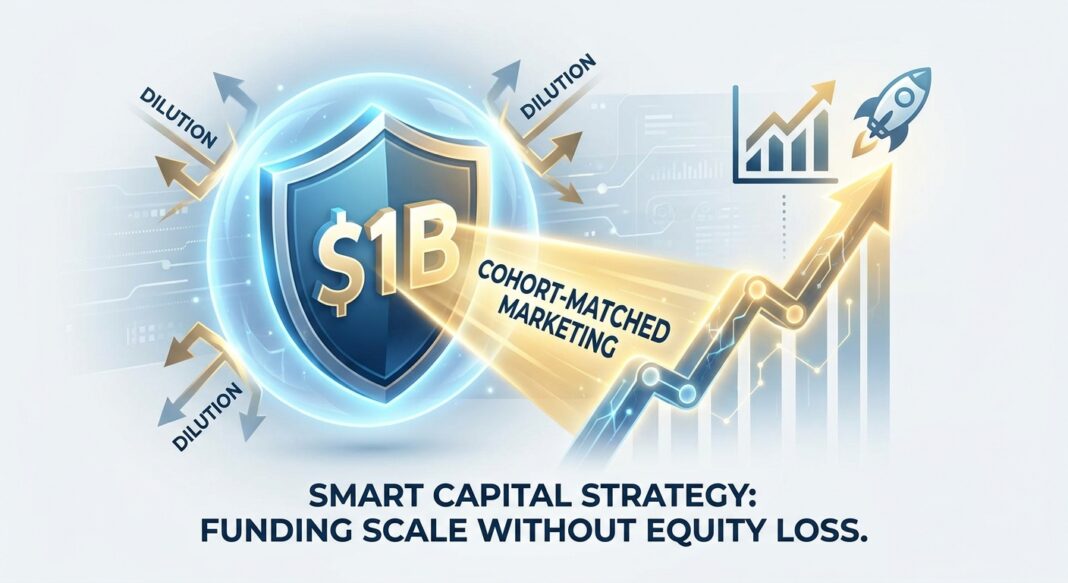
- Option 3, Cohort-matched non-dilutive capital: Find a structure that treats marketing spend as what it actually is (a short-duration, self-liquidating asset tied directly to the revenue it generates) and finance it on those terms.
Yeung chose Option 3. On July 14, 2026, Prenetics announced the closing of $1 billion in growth financing from General Catalyst’s Customer Value Fund (CVF), with zero equity issued, zero warrants, and zero convertible instruments attached.
The Structure in Plain English
The CVF deal works like this: General Catalyst finances up to 70% of IM8’s monthly marketing spend, with IM8 retaining full discretion over whether and how much of the facility to draw. Each month’s funded marketing spend creates a discrete customer cohort, tracked independently. General Catalyst receives a capped share of income tied to the performance of each cohort until it has recovered its capital plus a predetermined return, after which all subsequent value from those customers flows entirely and permanently back to IM8.
The payback economics are tiered by speed. According to the SEC filing, IM8’s mature cohorts pay back within roughly three to six months, placing them in the 4.7%–7.6% blended premium range, well inside the spread the business generates on deployed marketing dollars. The cap on General Catalyst’s return is hard-set at 1.17×. There is no fixed repayment schedule, no maturity date, no financial covenants, and no recourse to Prenetics beyond the funded cohorts themselves.
For accounting purposes, the arrangement sits as a financial liability on the balance sheet, with the return component recognized as interest expense below the operating income line, meaning gross margin and operating metrics are completely unaffected.
The Outcome: What the Numbers Actually Say
The deal closed against a backdrop of genuine operational momentum. Alongside the announcement, Prenetics raised its full-year 2026 IM8 revenue guidance to $210–220 million, up from a prior range of $190–210 million, its second upward revision of the year. Management projected $300 million in annualized run-rate revenue by year-end 2026 and more than $400 million in full-year 2027 revenue. In June 2026, IM8 delivered its strongest month on record, with approximately $17 million in preliminary unaudited monthly revenue.
Now consider the counterfactual. A traditional Series B or growth equity round at IM8’s trajectory would likely have priced at a meaningful discount to intrinsic value: as most rounds do, even for high-performers, because growth equity investors need to price in execution risk. If Prenetics had raised $300–500 million in dilutive equity to fund a comparable marketing push, existing shareholders would have permanently surrendered a percentage of every future subscription renewal, every new product category, every geographic expansion, every eventual exit or royalty stream. The dilution would not expire. The subscriber base being built with that capital compounds in perpetuity, and under an equity structure, so does the dilution.
Under the CVF structure, the math inverts. Financing self-liquidating spend with equity means trading permanent ownership for something that turns in a quarter or two. The dilution lasts forever. The asset can potentially turn in 90 days. By matching the duration of the financing instrument to the payback cycle of the underlying asset (in IM8’s case, roughly three to six months) the CVF deal transforms what would have been a permanent equity cost into a temporary, capped financing premium. Once General Catalyst recovers its investment and capped return on any given monthly cohort, all subsequent value from those customers accrues entirely and permanently to IM8.
The competitive asymmetry is also structural. General Catalyst’s CVF has been deployed across more than 40 companies over the past several years, including Fivetran and Lemonade, but the IM8 deal represents one of the largest deployments of the structure to date. Category peers constrained to self-fund acquisition from cash flow, or raise dilutive equity in a challenging market, simply cannot match the volume or aggressiveness of spend that $1 billion in cohort-matched capital enables. The financing advantage compounds every quarter it runs.
The Lessons: A Framework for Founders Facing the Same Question
The IM8–General Catalyst deal is not a blueprint for every business. It works because of a very specific set of preconditions, and understanding those preconditions is the actual lesson.
1. The Asset Has to Be Self-Liquidating
The CVF model functions because IM8’s customer acquisition spend generates measurable, subscription-based revenue within a defined and short window. General Catalyst’s Customer Value Fund structures its investments to align repayment with the revenue generated from the funded marketing activities, treating sales and marketing expenditures as assets. If your marketing spend does not produce traceable, recurring revenue within a predictable timeframe, cohort-matched financing cannot price your risk accurately, and you likely cannot access it on favorable terms.
2. Non-Dilutive Capital Should Match the Duration of the Asset It Finances
This is the core principle that most founders miss when evaluating growth capital. Equity is permanent capital: appropriate for permanent assets like brand infrastructure, IP, proprietary technology, or long-duration market-building. But customer acquisition spend in a subscription DTC model is not permanent. It turns in months. Financing it with permanent equity creates a duration mismatch that silently destroys founder wealth at scale.
3. Strength Is a Precondition, Not an Afterthought
Prenetics entered this arrangement from a position of financial strength, $139.7 million in liquid assets and a $40 million share repurchase already underway. Management described the rationale as structural rather than liquidity-driven. This matters enormously. Non-dilutive, performance-linked capital is not a rescue instrument. It is an amplification instrument; it makes strong unit economics faster and bigger, but it does not repair weak ones. Founders who approach these structures from desperation will find the terms reflect it.
4. The True Cost of Equity Is Not the Headline Dilution
When founders calculate the cost of a growth equity round, they typically model the percentage diluted at closing. The more honest calculation includes the dilution applied to every future cash flow the business will ever generate. In a subscriber business with compounding cohort economics, the net present value of that permanent dilution often dwarfs the nominal funding amount. The structure of the CVF deal turns on the question of what kind of capital should pay for growth, and what that capital actually costs once modeled out fully.
5. Market Context in 2026 Favors This Structure
The CVF model is not new, but its scale and accessibility are expanding. Function Health separately secured $450 million from General Catalyst’s Customer Value Fund in a deal tied to its own subscription membership growth. Musely, a direct-to-consumer telemedicine platform, secured $360 million from the same fund in a non-dilutive, revenue-linked financing structure, and the company said the structure proved more favorable after financial modeling. As customer acquisition costs rise across DTC verticals and the equity markets remain selective, revenue-linked non-dilutive capital is evolving from a niche instrument into a mainstream growth finance tool for subscription businesses with verified cohort economics.
Key Insights
- Duration Matching Is the Core Discipline: Non-dilutive, cohort-matched capital aligns the financing instrument’s payback to the underlying asset’s revenue cycle. For DTC subscription businesses with 90–180 day payback periods, this eliminates the permanent equity cost of funding short-duration spend with long-duration ownership.
- The Real Dilution Math Is Forward-Looking: Every percentage point of equity surrendered today is a percentage of all future subscriber renewals, product extensions, and exits. In a compounding subscription business, the NPV of that dilution is orders of magnitude larger than the face value of the round.
- Verified Cohort Economics Are the Qualification Bar: Access to structures like the CVF requires demonstrable, traceable, cohort-level return data. Every IM8 cohort since launch exceeded the contractual performance thresholds; that proof, not the brand or the celebrities, is what unlocked the capital.
- Non-Dilutive Capital Is an Amplifier, Not a Lifeline: The IM8 deal worked because the underlying economics were already strong. Prenetics entered from a position with ~$140M in liquidity and a share buyback in progress. These structures reward demonstrated performance; they do not rescue underperforming unit economics.
- The Competitive Moat Is Capital Architecture, Not Just Product: Owning $1 billion in cohort-matched marketing capacity in a category where peers must choose between self-funding growth or diluting themselves to do it is a durable structural advantage, one that compounds each quarter the facility is active and competitors cannot replicate.


