
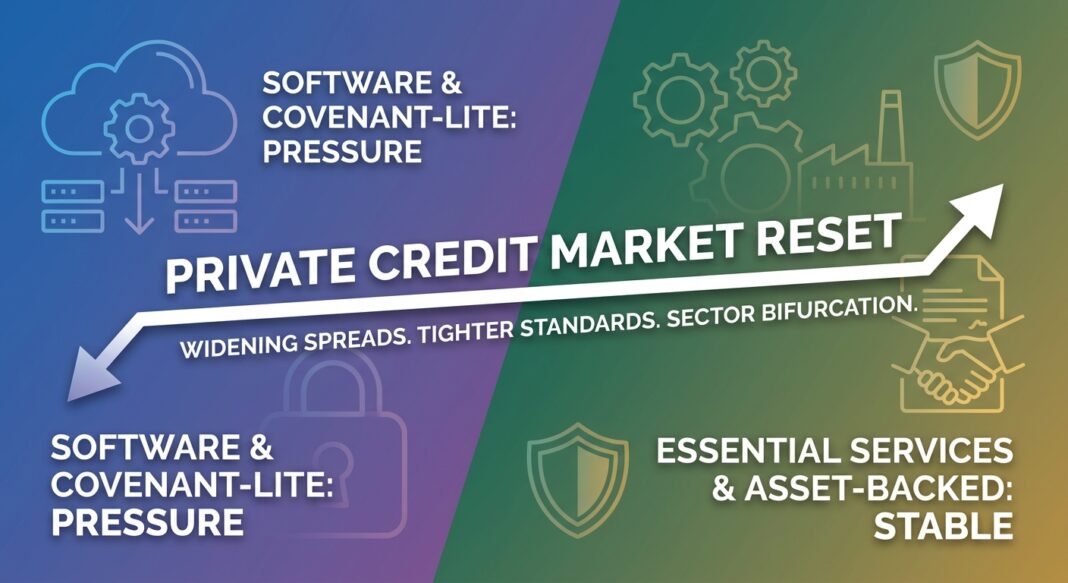
MARKET HEADLINE: The Lender-Friendly Reset Is Real, And the Data Confirms It
Private credit markets entered the second half of 2026 in a materially different posture than they occupied twelve months ago. Three converging forces (an AI-driven reassessment of software credit quality, a wave of Business Development Company (BDC) redemption requests, and sustained bank tightening confirmed by the Federal Reserve’s own survey data) have collectively snapped the multi-year era of spread compression and covenant erosion. The result is a market recalibration that is simultaneously uncomfortable for some existing borrowers and constructive for disciplined new lenders.
What is unfolding is not a systemic credit crisis, but rather a structural bifurcation: capital is concentrating in high-quality, asset-backed, and essential-services credits, while software-heavy, covenant-lite, and over-leveraged borrowers face materially higher pricing, reduced availability, and tighter documentation requirements. Per Sikich, “credit markets became increasingly bifurcated in Q2 2026, with capital flowing to higher-quality borrowers while sponsor-backed, software, and lower-rated credits faced greater pricing pressure and tighter financing conditions.” The strategic implication is direct: where a borrower sits in this bifurcation, not just its absolute credit quality, now determines its access and cost of capital.
Critically, bank lenders are not filling the gap. The Fed’s April 2026 SLOOS reported tighter lending standards for C&I loans to firms of all sizes and tightened standards across all categories of non-depository financial institution (NDFI) loans, reinforcing private credit’s continued structural role, but also constraining the aggregate supply of credit for weaker borrowers.
QUANTITATIVE SNAPSHOT: Key Market Metrics, Mid-2026
| Metric | Current Value (Mid-2026) | Prior Period | Source |
|---|---|---|---|
| Unitranche All-In Yield (Middle Market) | 9.00% – 9.75% | ~8.50% – 9.25% (YE 2025) | Valuation Research Corp., Q2 2026 |
| Unitranche Coupon Spreads (New Issuance) | S+475 – S+550 bps | S+450 – S+525 bps (YE 2025) | Valuation Research Corp., Q2 2026 |
| Spread Widening Since Late 2025 | +50 to +100 bps | Extended compression cycle 2023–2025 | Lord Abbett Midyear 2026 |
| “Down-the-Fairway” Deal Spreads (Direct Lending) | +25 to +50 bps vs. early 2026 | No LBO >$2B closed since early March 2026 | Sikich Q2 2026 |
| B-Minus (B3) Leveraged Loan Spreads | S+409 bps | ~S+354 bps (prior quarter) | Sikich Q2 2026 |
| Lower Middle Market Spreads (LMM) | S+475 – S+525 bps; select deals S+650–S+800 | Tighter through 2024–2025 | PitchBook / Star Mountain Capital |
| Large Corp. 90-Day Rolling Avg. Spread | 282 bps; all-in yield ~6.80% | Wider than late-2025 lows | Crowdfund Insider / PitchBook, July 2026 |
| Distressed Exchanges as % of Private Credit Defaults | 94% of D/SD downgrades | +78% YoY increase in default events (2025) | Morningstar DBRS, March 2026 |
| Fed SLOOS: C&I Tightening (Large/Mid-Market Firms) | +8.1% net tightening (Q2 2026) | Continued trajectory from Q4 2025 | Federal Reserve SLOOS / FRED |
| BDC Capital Outflows (10 Largest Direct Lending Funds) | ~$1.8B net withdrawals (Q1 2026) | Net inflows through most of 2025 | Valuation Research Corp., Q2 2026 |
Term SOFR (3-month): 3.69% as of June 2026 | 3-Year SOFR Swap: 4.04% as of June 2026 | Sources: VRC, Fed NY, FRED
SECTOR ANALYSIS: Hot, Cold, and Structurally Shifting
🔴 Software / SaaS: Repricing Under AI Disruption Pressure
Software has become the defining fault line of the 2026 credit cycle. Schroders’ July 2026 Credit Lens documents US leveraged loan software sector spreads surging to approximately 950–1,000 bps, the highest level in the shown period, while US high yield software/services spreads have risen to around 550 bps, approaching cycle highs. Per CAPX, SaaS and software exposure grew to approximately 19% of total direct private credit loans by end-2025, with one-third of all private credit funds holding sector exposure. The AI-disruption thesis directly challenged the growth assumptions underpinning many SaaS loans, and has become a proximate trigger for BDC redemption pressure. According to AL Capital Advisory, a record $25B in software loans now trade below 80 cents on the secondary market (citing Morningstar LSTA, February 2026). Lender posture: Cautious. Underwriting assumptions being repriced. Covenants tightening.
🟡 Healthcare Services: Performing Platforms vs. Roll-Up Scrutiny
Healthcare remains a significant private credit concentration, but lender appetite is bifurcating between high-performing platforms and aggressive roll-up structures, particularly covenant-lite vintage deals. CAPX notes that performing healthcare platforms continue to attract interest, while roll-ups face heightened scrutiny. Lenders are demanding stronger FCCR (fixed charge coverage ratio) floors and more conservative leverage multiples on new transactions. Lender posture: Mixed, execution and quality dependent.
🟢 Manufacturing, Industrials & Essential Services: Active Competition
CAPX notes that S&P Global’s April 2026 cross-industry analysis confirms that manufacturing, infrastructure, and essential-services credits attract active lender competition even as software credits see pullback. Private credit lenders specializing in industrial and manufacturing borrowers are expanding market share, with competition pushing spreads lower on quality credits in these segments. Lender posture: Active deployment.
🟢 Lower Middle Market (LMM): The New Consensus Opportunity
The lower middle market is emerging as a structural opportunity as institutional capital gravitates away from the crowded, software-exposed upper middle market. PitchBook reports that JPMorgan has formed a small-cap investment team focused on deals of $100–$500 million, validating the strategy institutionally. In June 2026, Crescent Capital raised $10.8 billion for its largest-ever direct lending vehicle dedicated to the LMM. Institutional investors are recognizing the LMM’s lower software correlation, better covenant packages, and aging PE portfolio dynamics as durable structural tailwinds. Lender posture: Positive, growing institutional interest.
🟡 B2B Business Services, Transportation & Logistics
PitchBook highlights that Lafayette Square has seen deal activity gain traction within B2B industries including Business Services, Tech & Telecom, Healthcare & Franchising, and Transportation & Logistics. Performance dispersion within business services is widening, requiring deeper underwriting diligence. Lender posture: Selective.
IMPLICATIONS: What This Means for Borrowers and Institutional Investors
For Business Operators & Borrowers
Cost of capital has structurally reset upward. Operators should model all-in financing costs in the 9.00%–9.75% range for unitranche structures (middle market) against tighter FCCR expectations. Lord Abbett emphasizes that free cash flow, not EBITDA, is now the primary lens lenders use to evaluate interest payment capacity, with loan-to-value ratios serving as the key margin-of-safety metric. Operators with EBITDA-heavy but cash-light profiles face the toughest scrutiny.
Your lender’s internal dynamics matter as much as your own credit. CAPX notes that BDC maturity pressure (with Moody’s identifying 23 of 32 rated BDCs carrying unsecured debt maturing in 2026, a 73% increase over the prior year) means that fund-level liability refinancing can materially constrain new origination, even for performing borrowers with stable fundamentals. Relationship team turnover and longer approval timelines are observable early signals worth monitoring.
Sector classification now drives pricing more than firm-specific metrics. A software company with strong fundamentals faces materially higher spreads and more restrictive covenants than a manufacturing company with equivalent leverage simply due to sector-level risk repricing. Borrowers should proactively differentiate their AI exposure narrative and revenue defensibility in lender presentations.
For Institutional Investors & Lenders
The setup for new capital deployment is more attractive than at any point since 2022. Morgan Stanley IM’s 2026 Midyear Outlook concludes that wider spreads, stable borrower fundamentals, and growing financing demand make forward return potential more attractive today than at the start of the year. Lenders with dry powder and disciplined underwriting can now negotiate meaningfully better documentation, covenant protection, and economics than was achievable during the 2024–2025 spread compression cycle.
Differentiation between managers is now the primary alpha driver. Chicago Atlantic’s Q2 2026 update highlights that differences in underwriting standards, leverage levels, documentation quality, and valuation assumptions are becoming increasingly consequential. “Some of the better risk-adjusted opportunities may increasingly exist outside the most crowded segments,” particularly where lenders can negotiate tighter structures and stronger covenant protections.
Default trajectory demands disciplined vintage analysis. Morningstar DBRS forecasts continued acceleration of defaults following a 78% year-over-year increase in 2025, with CCC–C rated borrowers (16% of active private credit ratings) expected to weaken further, particularly those relying on covenant waivers or external capital support. Payment-in-kind (PIK) adoption is a leading indicator: PIK interest as a share of BDC income has been climbing from 5.9% in 2023 toward 7%+ by late 2025, flagging deferred stress that has yet to fully surface.
FORWARD-LOOKING VIEW: Liquidity and Lending Dynamics Through H2 2026
The second half of 2026 is likely to be defined by dispersion across managers, sectors, and deal structures: not a broad market direction call. Lord Abbett characterizes this as a period where M&A recovery creates incremental deal flow, but capital remains selective, covenants continue to improve, and managers with dry powder can afford patience and structural discipline. The private equity exit backlog, with unsold PE assets potentially nearing $903 billion by 2029 per Morgan Stanley IM estimates, will continue to generate demand for hybrid and flexible capital structures outside traditional direct lending, particularly for fundamentally sound assets facing liquidity deadlines.
Bank behavior remains a critical variable. The Fed’s April 2026 SLOOS confirmed tighter standards across all NDFI loan categories, reinforcing the structural gap that private credit fills, but also signals that even fund-level bank financing is becoming more constrained. Institutional LPs (pension plans, insurers) remain net allocators to private credit, attracted by income generation and diversification, providing a demand base that offsets retail-channel BDC redemptions. The market is normalizing, not breaking, but the normalization is uneven, and sector and vintage selection have never mattered more.
KEY MARKET INSIGHTS
- Spreads have reset materially: Unitranche new-issue spreads are S+475–S+550 bps with all-in yields of 9.00%–9.75%, approximately 50–100 bps wider than late-2025 levels, creating a more compelling income entry point for new capital. (VRC Q2 2026; Lord Abbett)
- Software is a sector-level risk, not a single-name story: With ~19% of direct private credit loans in software/SaaS, lenders carrying legacy 2021–2022 vintage exposure face ongoing stress: software leveraged loan spreads have surged to ~950–1,000 bps, signaling a systemic repricing. (Schroders July 2026; CAPX)
- The lower middle market offers a structural arbitrage: Institutional capital migration toward LMM deals (driven by better covenant packages, less software correlation, and aging PE portfolio dynamics) is creating a constructive supply/demand imbalance for well-resourced LMM lenders. (PitchBook)
- Free cash flow and loan-to-value are the new underwriting anchors: Lenders are de-emphasizing EBITDA multiples in isolation, prioritizing free cash flow (for FCCR validation) and loan-to-value (for margin-of-safety discipline). Borrowers with high EBITDA but thin free cash flow conversion face the most friction. (Lord Abbett)
- Distressed exchange and PIK trends are leading default indicators: With 94% of private credit D/SD downgrades driven by distressed exchanges and PIK income rising across BDC portfolios, managers and borrowers should treat PIK adoption and covenant waiver accumulation as early-warning signals of impending structural stress, not routine restructuring tools. (Morningstar DBRS; AL Capital Advisory)


