
Bond Capital Market & Sector Intelligence, August 2, 2026
Private Credit’s Lender-Friendly Reset: Spread Widening, Rising Defaults & the Regulatory Reckoning Reshaping Mid-2026 Credit Markets
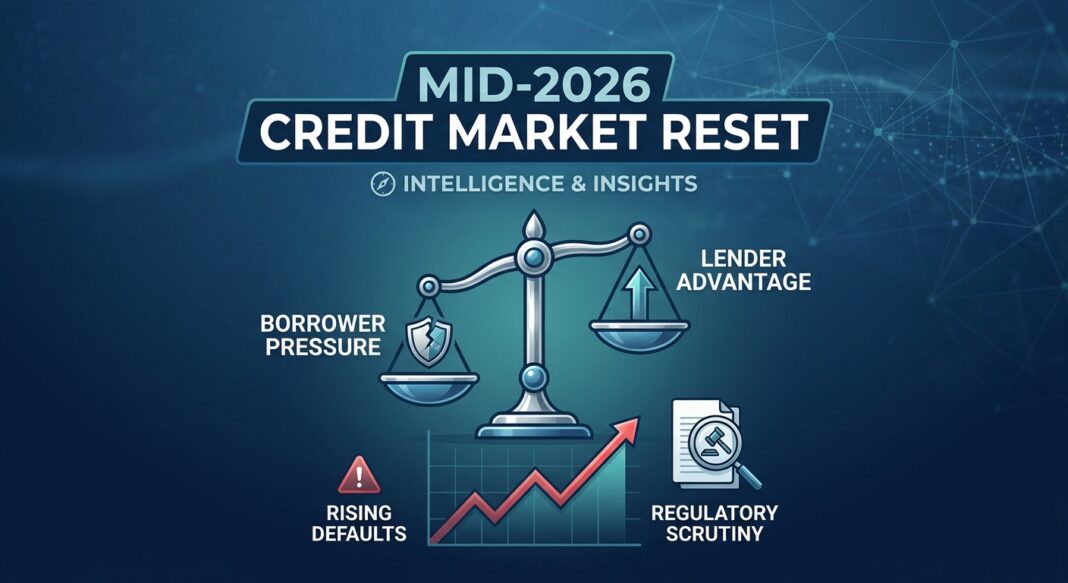
A convergence of wider spreads, tightening bank standards, escalating defaults, and mounting regulatory scrutiny is fundamentally restructuring the private credit landscape, creating a bifurcated market where disciplined, well-capitalized lenders hold decisive strategic advantage.
■ Market Headline: The Credit Cycle Has Turned
The private credit market is navigating a decisive inflection point. After years in which abundant capital, compressed spreads, and borrower-friendly documentation defined the cycle, 2026 has delivered a structural reversal. Spreads have widened materially, underwriting standards are tightening across both bank and non-bank channels, default rates are climbing to cycle highs, and global regulators are moving from observation to formal action.
The macro catalyst is clear: a persistent higher-for-longer rate environment, with 3-month Term SOFR holding at approximately 3.68%–3.69% as of June 2026 and 5-year U.S. Treasury yields at ~4.23%: has materially increased debt-service burdens across leveraged capital structures. VRC Q2 2026 Private Markets Update confirms three-month Term SOFR rose approximately one basis point quarter-over-quarter to 3.68% in June, while the forward curve remains broadly flat, reinforcing the higher-for-longer consensus.
The result is a market in active price discovery. Lord Abbett’s June 2026 Midyear Outlook characterizes the current period as a “lender-friendly reset”: one in which capital has grown more selective, covenants and documentation are improving, and managers with dry powder are in a position to be more selective about credits they choose to finance. The second half of 2026, multiple market participants agree, will be defined by dispersion: between sectors, between borrower quality tiers, and between well-capitalized lenders and those managing redemption pressure.
Critically, this is not merely a spread story. Fitch Ratings has reported a U.S. private credit default rate of 6.0% on a trailing twelve-month basis through April 2026, a record since Fitch began tracking the figure, while the Financial Stability Board issued a formal warning in May 2026 flagging bank interconnections, valuation opacity, and liquidity mismatches as credible financial stability vulnerabilities. Operators, sponsors, and institutional allocators must now navigate a market where the rules of the prior cycle no longer apply.
■ Quantitative Market Snapshot
The table below synthesizes current key market metrics from institutional sources, each hyperlinked to its primary data origin. All data reflects the most current available as of the article publication date of August 2, 2026.
| Metric | Current Value (Mid-2026) | Prior Period | Change | Source |
|---|---|---|---|---|
| Middle Market Direct Lending Spreads (plain-vanilla) | S+500–S+509 bps (avg.) | S+450–S+474 bps (late 2025/Q1 2026) | +50–100 bps wider | PitchBook LCD / Lord Abbett, Q2 2026 |
| 3-Month Term SOFR | ~3.68–3.69% | ~3.67% (Q1 2026) | +1 bps QoQ | VRC Q2 2026 Private Markets Report |
| 5-Year U.S. Treasury Yield | ~4.23% | ~3.92% (March 2026) | +31 bps QoQ | VRC Q2 2026 Private Markets Report |
| Fitch U.S. Private Credit Default Rate (TTM) | 6.0% (April 2026 TTM) | 5.8% (January 2026 TTM) | Record high | CNBC / Fitch Ratings, May 2026 |
| Proskauer Private Credit Default Index (Q1 2026) | 2.73% (697 loans; $189.2B) | 1.84% (two quarters prior) | +89 bps in two quarters | Forbes / Proskauer Default Index, May 2026 |
| BSL / High Yield New Issue Spread Widening | ~15–30 bps wider vs. Q4 2025 | Q4 2025 baseline | Widening | Northleaf Capital Q1 2026 Update |
| Software Sector Secondary Spread Premium vs. B-Rated Loan Index | ~229 bps above broader B-rated index | Year-end 2025 baseline | +245 bps vs. year-end | VRC / PitchBook LCD, June 2026 |
| Fed SLOOS: C&I Bank Lending Standards (Q1 2026) | Tighter (net basis, all firm sizes) | Unchanged / slightly tighter (Q4 2025) | Continued tightening | Federal Reserve April 2026 SLOOS |
Sources: VRC Q2 2026 Private Markets Report; PitchBook LCD Q2 2026; Northleaf Capital Q1 2026; Federal Reserve April 2026 SLOOS; Fitch Ratings May 2026; Proskauer Private Credit Default Index Q1 2026. Data as of most recent available publication dates.
Bank Lending Standards: The SLOOS Signal
The Federal Reserve’s April 2026 Senior Loan Officer Opinion Survey (SLOOS), covering Q1 2026 lending activity, delivered an unambiguous tightening signal for commercial credit. Survey respondents reported, on balance, tighter lending standards and essentially unchanged demand for commercial and industrial (C&I) loans to firms of all sizes. Banks also reported, on net, tighter standards across all categories of non-depository financial institution (NDFI) loans over the prior year, with higher premiums on riskier loans, stricter covenants, shorter maximum maturities, stricter collateralization requirements, and lower maximum credit line sizes all cited as widely reported changes.
KPI Benchmarks: What Lenders Now Require
Coverage ratio expectations are tightening in tandem with spread widening. Fixed Charge Coverage Ratios (FCCR) of 1.25x or higher are now the threshold at which lenders will offer most favorable terms, a ratio that signals the borrower generates 25% more operating income than required to service all fixed obligations. Ratios approaching 1.0x are viewed as high-risk, leaving little margin for revenue shortfalls or unexpected cost increases. Lenders are increasingly using both FCCR and DSCR in tandem: DSCR to assess default risk on the specific loan, FCCR to stress-test total fixed-charge obligations. According to Heron Finance’s Q2 2026 Private Credit Benchmark Report, debt/EBITDA ratios have remained broadly stable with no material upward drift, evidence that lenders have maintained leverage discipline, while borrower interest coverage ratios improved year-over-year due to modest EBITDA growth and some rate relief.
■ Sector Analysis: Lender Appetite & Structural Shifts
Software / SaaS: The Epicenter of Stress
Software remains the most acutely distressed sector in private credit. According to PitchBook LCD data through June 2026, software secondary spreads are approximately 245 basis points wider than year-end levels and roughly 229 bps above the broader B-rated loan index, a premium that reflects deep uncertainty around AI-driven disruption of SaaS business models. Software represents approximately 40% of all sponsor-backed private credit loans, per market reporting, making its distress a systemic concern rather than an isolated sector event. Lenders are demanding materially higher risk premiums, more conservative leverage assumptions, and greater equity cushions for any software exposure. Pipeline-driven covenant relief that was commonplace in 2024 is now largely unavailable for AI-exposed software credits.
Healthcare: Resilient Fundamentals, But Non-Accruals Rising
Healthcare remains private credit’s highest-volume sector, having led all sectors in 2025 direct lending deal share at approximately 19% of all transactions, according to Octus Data. Spreads in healthcare direct lending settled at approximately SOFR+500 bps in Q4 2025, the only major sector to avoid significant year-over-year price tightening, and are expected to remain elevated. Specialist private credit healthcare funds have generated median net IRRs of 15% versus 11% for generalist U.S. direct lending funds, per bfinance data cited by White & Case Debt Explorer. However, Morgan Stanley’s private credit platform carries a notable underweight to healthcare, citing it as the sector that has led all sectors in loans placed on non-accrual status over the past year, a divergence of view that underscores the granularity required within the sector.
Infrastructure & Data Centers: The High-Conviction Growth Trade
AI-related infrastructure and data centers are emerging as the highest-conviction growth sector for private credit in 2026–2028. Morgan Stanley estimates private credit could supply more than half of the $1.5 trillion needed for global data center buildouts through 2028, per a Reuters analysis cited by Creative Planning. Hybrid financing structures, combining joint venture mechanics with investment-grade rated notes, are gaining traction as large-scale AI infrastructure operators seek long-term, flexible capital. Freshfields projects that infrastructure-linked lending and data center financing will attract broader institutional participation, including pension plans and dedicated infrastructure funds, through 2026 and beyond.
Upper Middle Market: BSL Market Recaptures Share
A significant structural shift is underway in the upper middle market: broadly syndicated loan (BSL) markets have recaptured the majority of LBO financing volume in 2026, a reversal from the private credit dominance of 2022–2024. Banks gradually returned to the upper middle market in June 2026, increasing competition and alleviating some upward spread pressure. As a result, the competitive advantage of private credit in the upper middle market has narrowed, and deal terms for high-quality upper-market borrowers remain relatively attractive. For sub-$1 billion transactions, however, private credit remains the lender of choice, per Bain analysis, as syndicated markets remain less accessible for smaller deal sizes.
Structural Shift: Secondary Market Liquidity Emerging
One of the most consequential structural developments in 2026 is the emergence of an active secondary market for private credit loans, a function of redemption pressure and liquidity needs among fund managers. JPMorgan reported trading approximately $2 billion worth of private credit loans as of mid-May 2026, including loans across more than 20 unique borrowers, with secondary trading volume exceeding all prior years combined, per PitchBook LCD’s Q2 2026 US Private Credit Wrap. While initial reception to par-offered loans was tepid, transactions are now occurring with some loans trading at discounts ranging from 3 cents to over 10 cents below par, creating a nascent price-discovery mechanism that provides earlier signals of underlying credit stress than previously available.
■ Implications for Institutional Investors & Business Operators
For Borrowers & Operators
The current environment demands a fundamental recalibration of capital structure assumptions. The era of covenant-lite documentation, aggressive leverage, and lender competition driving price suppression is over, at least temporarily. Operators must now demonstrate cash flow durability, not merely projected growth. Lenders are conducting forensic underwriting focused on resilience and downside protection, scrutinizing management track records through the 2023–2025 volatility period, demanding meaningful equity cushions, and stress-testing FCCR under rate and revenue shock scenarios.
- Coverage ratios matter more than ever: Target FCCR of 1.25x or above to access competitive terms. Sub-1.15x FCCR will trigger higher spreads, tighter covenants, or outright credit denial.
- Leverage expectations are bifurcating by deal size: J.P. Morgan Asset Management data places average leverage at approximately 3.2x EBITDA for companies under $250M enterprise value versus 5.9x for companies over $1 billion, a gap that reflects both market structure and lender risk tolerance by segment.
- Software and AI-exposed borrowers face a structural repricing: New capital is available but at materially wider spreads and with substantively tighter covenants. Sponsors should actively stress-test AI disruption scenarios in any SaaS or technology services credit package.
- Refinancing risk is elevated: A $162 billion maturity wall of private credit debt requiring refinancing in 2026 at materially higher costs creates acute near-term pressure for borrowers with deteriorating coverage ratios or AI-exposed revenue profiles.
For Lenders & Institutional Investors
Well-capitalized lenders with institutional dry powder are the clearest beneficiaries of the current reset. Spreads in the S+500 context, up from the mid-400s bps level prevalent in 2024, provide a materially more attractive gross yield environment. Improved documentation, stronger covenants, and wider OID are available to disciplined deployers. Morgan Stanley’s view that a large refinancing wave will gradually overtake private credit supply in the medium term supports the thesis that the lender-friendly window extends beyond 2026.
- Allocators should demand transparency on PIK income: Fitch estimates 60% of 2026 defaults involved interest payment deferrals or conversion to payment-in-kind arrangements, a mechanism that allows distress to compound invisibly. Rising PIK income is an early-warning signal that warrants covenant scrutiny.
- BDC retail vehicles require heightened diligence: Redemptions from unlisted BDCs surpassed fundraising in Q1 2026, and the Stanger NL BDC Total Return Index posted its first negative quarterly return since 2022. Liquidity mismatch risk in semi-liquid structures is now a live concern.
- Sector selectivity is alpha-generative: Healthcare specialist funds generating 15% median net IRR versus 11% for generalist platforms demonstrates the return premium available to sector-disciplined lenders, but requires granular non-accrual monitoring at the loan level.
Regulatory Risk: From Observation to Action
Institutional investors and lenders must now price regulatory risk as a structural feature of the asset class, not a tail risk. The FSB’s May 2026 report, identifying four vulnerability clusters (bank interconnections, borrower credit quality and valuation opacity, concentration and liquidity mismatches, and data gaps): signals that global regulators are moving toward formal workstreams covering data standards, cross-border supervision, and nonbank interconnectedness. The SEC’s 2026 examination priorities specifically call out private credit funds with extended investment lock-ups, with disclosure adequacy, valuation methodology adherence, and conflict-of-interest mitigation all under active scrutiny. The FSB additionally flagged $220 billion in drawn and undrawn bank credit lines extended to the private credit sector: potentially twice as large when accounting for data gaps, as a transmission channel risk between private credit stress and traditional banking systems.
■ Forward-Looking View: H2 2026 & Into 2027
The most important forward-looking dynamic is the interplay between deal supply, dry powder deployment, and the refinancing wave. Over the next three to six months, Bond Capital’s analysis of current data points to the following dynamics:
- Spread stabilization with selective compression: Direct lending deal volumes were down in Q2 2026 per PitchBook LCD data, but LBO activity showed early signs of recovery, with deal value up approximately 10.7% year-over-year and exit activity rising 14% per PitchBook. As M&A activity broadens and the refinancing wave builds, deal supply should gradually absorb excess lender capacity, supporting spread discipline rather than a return to 2024’s borrower-friendly tightening.
- Defaults likely to remain elevated but range-bound: Fitch Ratings forecasts institutional loan default rates in the 4.5%–5.0% range for 2026, with the full-year private credit default rate (by volume) projected at approximately 2.5% on the DLD measure. The inclusion of distressed exchanges and PIK restructurings under Fitch’s broader methodology, however, pushes the relevant default rate to the 6%+ range already recorded, creating a persistent gap between reported headline rates and economic stress levels.
- Regulatory formalization will reshape fund structures: The FSB’s four workstreams and the SEC’s active examination program will likely produce new disclosure requirements for NAV loans, PIK structures, and semi-liquid fund vehicles within a 12–18 month horizon. Managers who proactively enhance transparency and reporting ahead of regulatory mandates will be positioned advantageously for institutional capital allocation.
- Secondary market maturation accelerates price discovery: The nascent secondary market for private credit loans, with JPMorgan reporting record 2026 volumes, will increasingly function as a real-time signal of underlying portfolio health, narrowing the opacity premium that has historically been embedded in private credit valuations. This is structurally healthy for long-term institutional confidence in the asset class.
- Infrastructure and data center credit remains the structural growth vector: Hybrid financing structures, AI-related infrastructure lending, and investment-grade rated notes backed by premier data center operators will attract an expanding pool of institutional capital (including pension plans and sovereign allocators) creating a lower-spread but higher-quality segment of private credit growth distinct from the stressed middle-market direct lending environment.
■ Key Market Insights: Five Actionable Takeaways
- 1. Spreads have reset to a lender-favorable range, but are not uniform. Plain-vanilla middle market direct lending spreads averaging S+509 bps (PitchBook LCD, Q2 2026) represent a 50–100 bps improvement from late 2025 levels. Operators should not anchor to 2024 pricing. Lenders with dry powder are exercising pricing discipline they have not had since 2022.
- 2. The default rate disparity between headline and economic reality is the central risk of the asset class. Proskauer’s index at 2.73%, Fitch at 6.0%, and Moody’s noting 65% of defaults involved distressed restructurings or PIK arrangements signal that reported rates materially understate economic stress. Institutional investors must insist on transparency regarding PIK income trajectories and non-accrual loan counts.
- 3. Software/SaaS exposure requires immediate structural scrutiny. Approximately 40% of sponsor-backed private credit loans carry software exposure, with secondary spreads 245 bps above year-end levels and the sector carrying AI disruption risk that lenders are only beginning to price correctly. Any portfolio with concentrated software exposure should be stress-tested against an AI-driven revenue erosion scenario.
- 4. The Fed SLOOS tightening signal is directly actionable for middle market operators. Banks tightening C&I standards on a net basis across all firm sizes (April 2026 SLOOS) means the bank alternative to private credit has narrowed for middle market borrowers, but at a cost. Operators facing near-term refinancing events should secure terms earlier rather than later; waiting for rate relief is a losing strategy if the forward curve remains flat through mid-2027.
- 5. The regulatory horizon is a structural, not cyclical, factor. With the FSB flagging $220 billion in bank-to-private credit lines, the SEC actively examining fund managers, and four formal FSB workstreams underway, institutional allocators must build regulatory risk (including potential forced disclosure changes, valuation methodology scrutiny, and retail investor protection requirements) into their private credit due diligence frameworks. This is no longer optional.


