
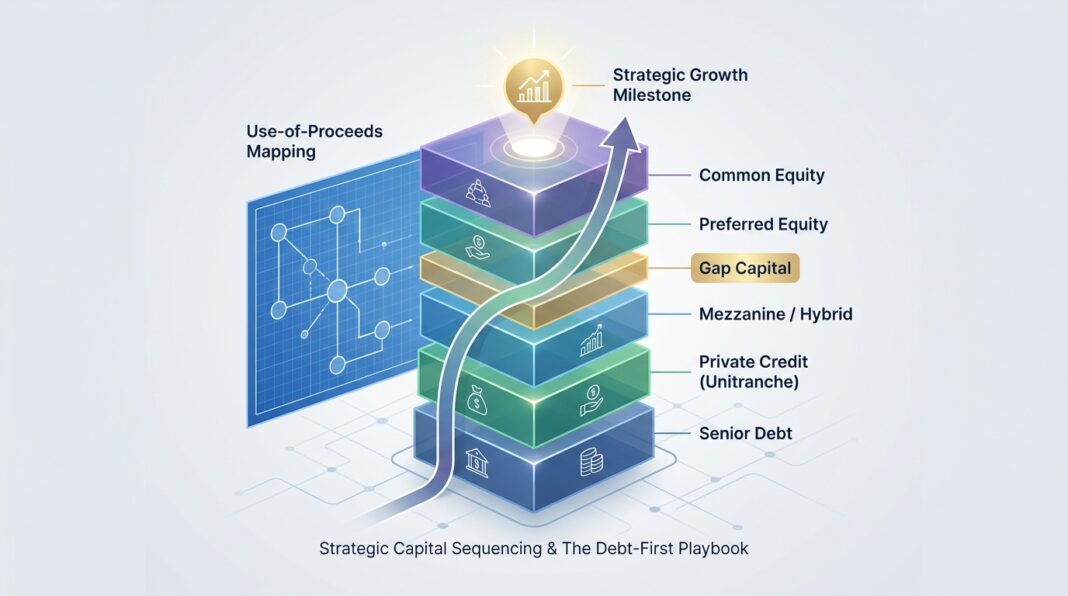
The Growth-Stage Financing Problem Is a Structure Problem, Not a Story Problem
A company at $5M–$20M in annual recurring revenue occupies the most structurally misunderstood position in the capital markets. It is too large for angel discretion, too small for institutional syndicated debt, and increasingly too capital-efficient to justify the dilution mathematics of a traditional venture equity round. The capital gap is real, but it is largely self-inflicted.
Most founders at this stage make the same error: they reach for equity because it is familiar, not because it is optimal. They model dilution as a percentage of the current round, not as a compounding cost measured at exit. They treat the capital stack as a single layer rather than a sequenced architecture. And they enter conversations with lenders and investors without a use-of-proceeds map that connects the capital ask to a measurable output: customer acquisition, geographic expansion, a tuck-in acquisition, a bridge to cash-flow breakeven.
The practitioners who consistently achieve the best capital outcomes at this stage share one discipline: they quantify the funding gap precisely, map the proceeds to a specific strategic milestone, and then work backward through the cost-of-capital spectrum to find the cheapest instrument that can serve that purpose. That process (not the pitch deck, not the relationship) is the playbook. This article walks through it in full.
Mapping the Cost-of-Capital Spectrum at the Growth Stage
Before selecting an instrument, operators must understand where each layer of the capital stack sits on the cost spectrum, and what obligations, controls, and optionality each layer carries.
Layer 1: Senior Bank Debt (Lowest Cost, Highest Selectivity)
Commercial banks remain the cheapest source of capital for qualifying borrowers. Bank commercial and industrial lending to non-financial corporations reversed an eighteen-month contraction in Q2 2026, growing at a 3.2% annualized rate, a signal that credit appetite is returning to the institutional banking channel. When accessible, bank lines and term loans undercut direct lending pricing by 100 to 200 basis points. The constraint is qualification: banks require two to three years of clean GAAP financials, positive or near-positive EBITDA, tangible collateral or strong receivables, and a demonstrated debt service coverage ratio. Growth-stage companies burning cash on purpose (investing in sales, product, or geography) rarely qualify. Bank debt is the right answer at the mature growth or cash-flow-positive stage; it is frequently the wrong answer before that milestone.
Layer 2: Private Credit / Unitranche (Accessible Growth Capital)
Private credit has become the dominant financing channel for the middle market. Direct lending AUM crossed $1.7 trillion in H1 2026, and the product set has materially expanded. Unitranche facilities (which combine senior and subordinated debt into a single instrument with a single lender, one credit agreement, and one covenant package) now represent the most common structure in sponsor-backed and founder-led mid-market transactions. Critically, unitranche is no longer reserved for leveraged buyouts. Unitranche facilities are now available to growth-stage companies with $15M or more in ARR and clean unit economics, a structural democratization that has fundamentally changed the growth-stage financing landscape.
Current all-in pricing for unitranche in the lower middle market runs SOFR + 500–700 basis points, implying a roughly 9–11% all-in cost in 2026. Total leverage typically sits at 4–6× EBITDA for cash-flow positive businesses, with lighter structures (2–3× ARR or NTM revenue) available for high-retention SaaS businesses underwritten on a recurring revenue basis rather than trailing EBITDA.
The structural features matter as much as the price. Direct lenders in 2026 underwrite off logo concentration, contract length, and gross retention, meaning the due diligence process for a growth-stage borrower looks fundamentally different from a traditional bank credit memo. A company with 110%+ net revenue retention, sub-5% logo churn, and 3-year contract terms can access unitranche capital that a company with equivalent EBITDA but higher churn cannot.
Layer 3: Mezzanine / Junior Capital (Higher Cost, Equity Optionality)
Mezzanine financing occupies the layer between senior secured debt and equity. It is structurally subordinated, typically carries a blended cash and payment-in-kind (PIK) coupon, and frequently includes an equity kicker (warrants or a co-investment right) that gives the lender participation in upside. All-in mezzanine cost in 2026 runs 10–14%, with the higher end reserved for pre-profitability borrowers or those requiring structural subordination behind a senior secured facility. PIK usage has risen notably in private credit in recent years, with public BDCs now receiving an average of 8% of investment income via PIK, a sign that PIK-heavy structures are normalizing as a cash-conservation tool for growth-stage borrowers who need to preserve working capital.
Mezzanine fundraising rebounded approximately 26% in 2025 after a sharp decline in 2024, reflecting renewed demand for the instrument in a market where sponsors and operators increasingly need capital solutions that sit below expensive senior debt but above dilutive equity.
Layer 4: Preferred Equity and Hybrid Structures (Control-Conscious Capital)
Hybrid capital structures (convertible preferred instruments, preferred equity with participation rights, secured debt with equity warrants) have expanded significantly as a category. These structures typically feature built-in return floors through dividend accumulation rights, paired with participation in value appreciation above predetermined thresholds, allowing management teams to maintain strategic control and preserve meaningful ownership while offering investors downside mitigation through priority cash flow claims.
Layer 5: Common Equity (Most Expensive, Permanent Capital)
Venture and growth equity remains the most expensive form of capital on a fully-loaded exit basis. Median dilution in 2025 sat at approximately 19.5% for seed rounds and 18% for Series A rounds, and these figures are higher than the 2021 peak, reflecting a market where capital has become more expensive and investors are demanding more ownership for the risk they take on. Stacking dilution from seed, Series A, and employee option pool top-ups, founders typically hold approximately 50% of the company post-Series A, a figure that compounds down materially through Series C and beyond.
Structural Mechanics: How to Fill the Gap Without Overshooting the Equity Raise
The practical insight from 2025–2026 deal flow is this: founders who arrive at an equity raise with a pre-modeled mixed stack (equity plus a debt tranche, or equity plus revenue-based financing, or venture debt as an extension mechanism) close their equity component 4 to 6 weeks faster than companies pitching equity-only. The mechanism is straightforward: the equity investor sees a founder who has already tested the market on cheaper capital and concluded equity is the right marginal dollar, which shortens the diligence loop on capital efficiency.
Worked Example: A $25M Growth Round for a $12M ARR SaaS Company
Consider a vertical SaaS business with $12M ARR, 115% net revenue retention, $2M EBITDA (16% margin), and a clear use of proceeds: hiring 20 enterprise AEs, expanding into two new verticals, and funding a $5M tuck-in acquisition of a complementary data product. The company needs $25M. Here is how the gap capital playbook structures it:
- Senior Unitranche Facility, $12M: 2.5× ARR, SOFR + 575bps (approximately 9.8% all-in), 5-year term, single leverage covenant (net debt/ARR ≤ 3.5×), 1% OID, 101/par soft call, revolving credit access of $2M for working capital. Drawn at close for the tuck-in acquisition ($5M) and working capital ($7M). Lender underwrites off ARR, retention, and logo concentration, not EBITDA multiples.
- Growth Equity Round, $13M: Series B priced at $65M pre-money (approximately 5.4× ARR). Proceeds fund the go-to-market headcount and geographic expansion. Dilution: approximately 17% on a post-money basis, versus approximately 28% that a $25M pure-equity raise at the same valuation would have produced.
Total capital deployed: $25M. Founder dilution: 17% versus 28% in a pure equity scenario: a difference of approximately 11 percentage points that, at a $150M exit, is worth roughly $16.5M to the founding team. The debt service obligation (approximately $980K per year in interest) is serviceable against $2M in EBITDA with modest growth assumptions built in.
The key structural discipline: the debt is sized to the acquisition and working capital use only. Equity funds the people and programs that will generate the revenue to service the debt. Each instrument is matched to the proceeds purpose it is best suited to fund.
Debt-First vs Equity-First: The Trade-Off Matrix
The debt-first capital stack is a financing sequence in which a growth-stage company with contracted recurring revenue draws senior secured or unitranche debt before raising a priced equity round, extending runway 12 to 18 months without dilution. It is not the right structure for every company, but the conditions under which it outperforms a pure equity approach are well-defined.
| Consideration | Debt-First / Mixed Stack | Pure Equity |
|---|---|---|
| Cost at exit | 8–10% after-tax cost of debt (senior secured) | 30–35% dilution of pre-money founder position at exit |
| Speed to close | 30–90 days (unitranche); 4–6 weeks faster for layered equity component | 6+ months for institutional VC |
| Control and governance | No board seats; covenant compliance only | Board observer/director rights; investor consent thresholds |
| Use-of-proceeds flexibility | Moderate; lender approval required for material changes | High; equity investors rarely restrict deployment |
| Qualification threshold | $15M+ ARR, strong retention, positive or near-positive EBITDA | Story + growth trajectory; pre-revenue accessible |
| Failure mode | Debt service stress if revenue misses; covenant breach | Valuation compression; down rounds; excessive dilution |
Covenant design also matters here. In the broadly syndicated loan market, approximately 90% of new loans in 2024 remained covenant-lite, replacing maintenance covenants (quarterly ratio tests) with incurrence covenants (triggered only by affirmative borrower action). Private credit lenders, however, have maintained firmer positions on covenant inclusion for mid-market transactions. Maintenance covenants (quarterly tests of leverage or fixed charge coverage) have returned to many PE-backed and founder-led deals financed by non-bank lenders. For growth-stage borrowers, a single maintenance covenant (e.g., net debt/ARR ≤ 3.5× with a 20% cushion to model) is operationally manageable and often preferable to the broader restriction sets embedded in equity preferred terms.
Current Market Terms: What the Data Shows (H1 2026)
The following data points reflect the current market environment for growth-stage and mid-market debt capital as of mid-2026:
- Unitranche pricing (US lower middle market): SOFR + 500–700bps all-in, implying approximately 9–11% total cost at current SOFR levels. S&P LCD’s middle-market print shows unitranche pricing tightened by 100 basis points in the twelve months to June 2026, reflecting competitive lender deployment pressure against a backdrop of strong deal flow.
- Mezzanine all-in cost: 10–14% blended, combining a cash coupon of 8–11% with PIK accrual of 2–4% and an equity kicker (warrants representing 2–5% of fully diluted shares or an equivalent IRR sweetener). Mezzanine fundraising rebounded approximately 26% in 2025, expanding the lender pool and supporting more borrower-friendly terms in competitive processes.
- Covenant-lite migration in private credit: Covenant-lite transactions rose to 21% of direct lending deals in 2025, up from 4% in 2023, though private credit lenders have maintained firmer covenant positions than the broadly syndicated market where covenant-lite exceeds 90% of volume. The divergence matters: lenders that maintain maintenance covenants have demonstrated materially higher recoveries in restructuring scenarios, roughly 75 cents on the dollar versus 65–67 cents for covenant-lite senior secured paper.
- Debt-inclusive capital event growth: Debt-inclusive capital events in the growth-stage band increased 47% year-over-year in H1 2026, while pure equity rounds declined 12%, a structural shift in how founders and sponsors are approaching the capital stack at the $10M–$50M funding stage.
- OID and fees: Average original issue discount on private credit deals runs approximately 1–2% of funded principal in H1 2026, down from the 2–3% range seen in H1 2024, reflecting competitive lender dynamics. Upfront fees and commitment fees on revolving credit facilities add 25–50bps to all-in cost on an annualized basis.
- Private credit AUM and dry powder: Global private credit AUM reached approximately $2.1 trillion in 2025. European private lenders continue to hold substantial dry powder, supporting competitive direct lending terms despite recent geopolitical-driven market volatility.
The Gap Capital Playbook: Four Steps to a Closed Deal
Knowing which instrument is theoretically correct is not the same as executing a financing. The following four-step process reflects how sophisticated operators and their advisors run a growth-stage capital process from mandate to close.
Step 1: Quantify the Gap Precisely
Before approaching any capital provider, build a bottoms-up model that isolates: (a) the specific use of proceeds and the revenue or EBITDA output it is expected to generate over 12–24 months; (b) the minimum capital required to fund that initiative without drawing on operating cash flow; and (c) the maximum debt service the business can support without breaching a 1.2× fixed charge coverage ratio at a conservative revenue case. This output determines the structure before the first lender call. A business with $2M EBITDA can service approximately $1.6M in annual interest at a 1.2× floor, implying a maximum senior debt facility of approximately $16–20M at 9% all-in. Everything above that ceiling is an equity decision, not a debt decision.
Step 2: Prepare the Right Materials
Debt capital providers underwrite differently from equity investors. Direct lenders in 2026 underwrite off logo concentration, contract length, and gross retention, not hockey-stick projections. The materials package for a private credit process should include: trailing 12 and 24-month cohort analysis (revenue retention by vintage); contract length distribution and renewal history; logo concentration (top-10 customer percentage of ARR); unit economics by channel; and a base-case financial model with debt sizing, covenant headroom, and a stress scenario showing 20% revenue miss. Lenders want to see the downside, not just the upside.
Step 3: Run a Competitive Process
A pan-process for a mid-market unitranche facility typically attracts indicative terms from 8–15 lenders, depending on ticket size and sector. Running a competitive process, even a soft one involving 4–6 lenders, materially improves terms. The variables that move most in competition are: OID (often compressible by 50–100bps), call protection (moving from 103/102/101 to 102/101/par), and covenant cushion (headroom expanding from 15% to 20–25% above base case). Speed premium is real: if unitranche financing can close 30 to 45 days faster than a syndicated alternative, sponsors often justify 50 to 100 basis points of extra spread by avoiding financing gaps or delayed closings.
Step 4: Sequence the Stack Correctly
Capital stacked without sequencing creates conflict. Running revenue-based financing and venture debt simultaneously against the same revenue stream produces overlapping covenants and restricted cash flow, a structure that benefits neither lender nor borrower. The discipline is to stack capital sequentially: bank or senior debt first (if accessible), unitranche or direct lending second, mezzanine as a gap filler for the acquisition or capital expenditure layer, and equity last, sized to the strategic initiative that only equity can fund. The hybrid strategy minimizes dilution in early stages when valuation is low, then accepts dilution in later stages when valuation supports it.
Negotiation Guidance: Five Points That Move the Deal
Once a term sheet is in hand, the negotiation is not over. The following five structural points are where growth-stage borrowers consistently leave value on the table:
- Covenant cushion, not just covenant level. The ratio set in the covenant matters less than the headroom between your base-case financial model and the covenant trigger. Negotiate a minimum 20–25% cushion to your conservative case, not to your base case. A leverage covenant that tests at 3.5× when your model projects 2.8× is functionally protective; one that tests at 3.0× when you project 2.8× is a default waiting for one missed quarter.
- Accordion facility sizing. If you are using the initial facility for an acquisition or specific investment, negotiate an uncommitted accordion, a pre-agreed right to upsize the facility by $5–10M without a full re-documentation, for follow-on capital needs. This is increasingly market-standard in 2026 and avoids a second financing process 12 months later.
- PIK optionality, not PIK requirement. If mezzanine is part of the structure, push for PIK toggle rather than mandatory PIK. PIK toggle allows you to elect cash payment when cash flow supports it, limiting the accreting balance effect. Mandatory PIK on a growing balance is a compounding cost that can crowd the equity return at exit.
- Prepayment premium step-down. Call protection on unitranche debt typically runs 102/101/par (years 1/2/3+). Negotiate for 101/par/par, particularly if refinancing risk is a concern in a declining rate environment. The improvement is achievable in competitive processes.
- Use-of-proceeds flexibility basket. Direct lenders will include a permitted acquisition or permitted investment basket in the credit agreement. Negotiate the size and conditions of this basket before closing, not as an amendment later. A basket allowing acquisitions up to $10M at a specified leverage level, without full lender consent, provides operational flexibility for a buy-and-build strategy without requiring a new financing each time.
Key Takeaways
- Match capital to purpose before selecting instrument. Working capital, acquisition financing, and people investment have different risk profiles, time horizons, and return characteristics; they warrant different capital sources.
- The cost of equity is measured at exit, not at close. A growth-stage equity round that feels like 18% dilution today typically represents 30–35% of the pre-money founder position on a fully-loaded exit basis. Debt structured at 9–11% all-in costs a fraction of that at comparable leverage.
- Unitranche access has democratized. Unitranche facilities, once the domain of sponsor-backed LBOs, are now accessible to growth-stage companies with $15M+ ARR, clean unit economics, and strong retention metrics. S&P LCD data shows pricing tightened 100bps in the twelve months to June 2026.
- Covenant design is a risk management tool, not a borrower penalty. Maintenance covenants, properly cushioned, give borrowers and lenders an early-warning system that historically produces materially higher recoveries than covenant-lite structures when performance deteriorates.
- Run a process, not a conversation. Competitive tension across 4–6 lenders consistently compresses OID by 50–100bps, softens call protection, and widens covenant headroom. The improvement from a structured process versus a single bilateral negotiation is quantifiable and significant.


