
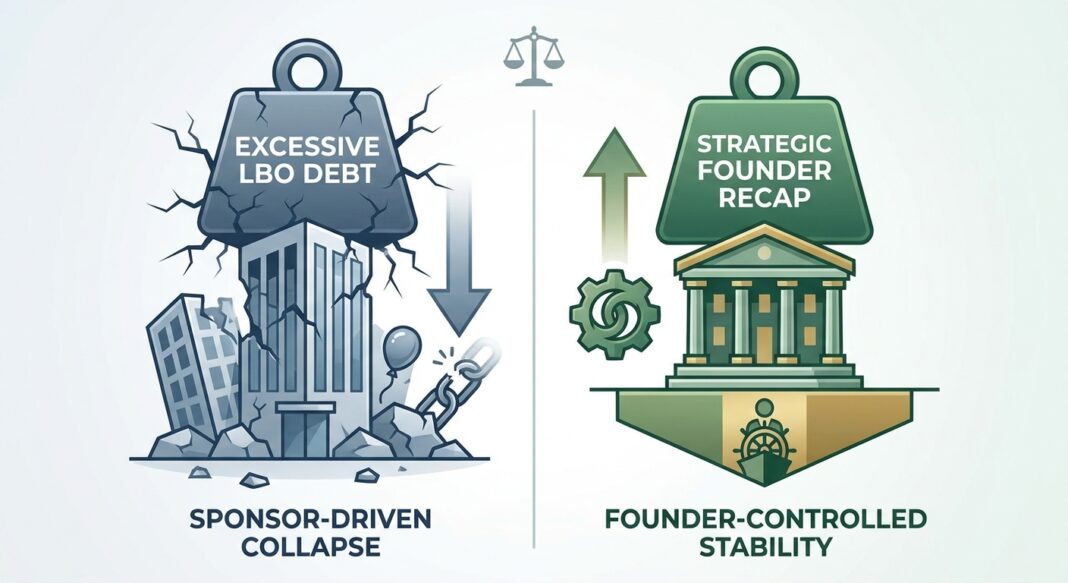
Two businesses. Two capital structures. One is a ghost. The other is still run by its founder.
The story of leverage is never just about interest rates or debt multiples. It is about who controls the machine once the debt is on the balance sheet, and whether the capital structure was built to serve the business, or the other way around. Party City’s decade-long slide into oblivion is a textbook example of what happens when leverage is designed to serve the sponsor’s return, not the company’s survival. A founder-controlled leveraged recapitalization (executed cleanly, with the right lender and the right structure) tells the opposite story.
Both use debt. Both use leverage. The outcomes could not be more different.
Part One: The Story That Ends in Liquidation
Party City and the LBO That Never Had a Chance
In 2012, private equity firm Thomas H. Lee Partners acquired Party City in a leveraged buyout. The thesis was familiar: a dominant, category-defining specialty retailer with recurring seasonal demand, acquired with a mix of equity and a substantial debt load placed on the company’s own balance sheet. The deal fit the classic PE playbook. What it did not fit was the company’s long-term operating reality.
Party City was a low-margin business in a competitive, inflation-sensitive category: selling balloons, streamers, and Halloween costumes to cost-conscious consumers. The margin profile was thin. The e-commerce moat was nonexistent. And yet, following the LBO transaction, Party City carried an extremely high debt-to-equity ratio relative to its retail peers, with a correspondingly low interest coverage ratio: the ratio that measures a company’s ability to service its debt from operating income.
For years, that debt sat like a stone on the company’s chest. Interest payments from the LBO amounted to $102 million in 2022 alone: the chain’s last full year before its first bankruptcy filing. That was $102 million that did not go into store renovations, digital infrastructure, or competitive pricing. It went to service a capital structure designed for financial engineering, not operational resilience.
In January 2023, the inevitable arrived. Party City filed for Chapter 11, struggling to service nearly $1.7 billion in debt. The restructuring eliminated roughly $1 billion of that load, but the company still emerged from bankruptcy carrying approximately $800 million, still overleveraged, still unable to invest, still bleeding. Fourteen months later, in December 2024, Party City filed again. This time there was no restructuring plan. The company announced it would wind down operations and permanently close all of its approximately 700 remaining stores.
The equity holders were wiped out. The stores were dark. The brand was gone.
Part Two: The Capital Decision That Changed Everything
What the PE Sponsor Chose, and What They Didn’t
To understand why Party City failed, you have to understand the structural incentive mismatch embedded in a traditional PE-sponsored LBO. In a leveraged buyout, the acquired company, not the PE fund, takes on the debt. The PE fund contributes equity. The company services the interest from its own cash flows. If the company goes bankrupt, the sponsor loses its equity check but is not personally liable for the debt. The asymmetry is fundamental: the sponsor’s upside is amplified by leverage; the company bears all the downside.
The three value-creation levers in a classic LBO are: paying down debt (deleveraging), selling at a higher multiple (multiple expansion), and growing earnings (operational improvement). When rates are low and credit is loose, all three can work simultaneously. But Party City’s LBO closed in a low-rate world, and when rates moved, the math collapsed. A company carrying $650 million in floating-rate debt saw its annual interest bill jump from roughly $26 million in 2021 to $58 million by mid-2023 as rates rose. For businesses with $100 million in EBITDA, that shift moved interest coverage from a manageable 3.8x to a dangerous 1.7x.
Party City’s low-margin retail model had no buffer. There was no room for error built into the capital structure. The debt was not sized to the business’s risk profile; it was sized to maximize the sponsor’s return on a short hold period. That is the key distinction. The debt served the deal, not the company.
Part Three: The Other Path
Hypothetical Case Study: A Founder-Led Leveraged Recapitalization
The following is a clearly labeled hypothetical scenario constructed to illustrate the structural principles of a founder-controlled leveraged recapitalization, grounded in actual market data and deal norms from 2024–2025.
Consider a founder, call her Dana: who has built a regional industrial services business over seventeen years. The company generates $9 million in EBITDA on $42 million in revenue. It is founder-owned, debt-free, and modestly growing. Dana is 54. She is not ready to sell. But she is tired of being entirely illiquid. Every dollar of wealth she has is locked inside a company she cannot touch without selling it, or selling a piece of it to a PE firm that will set its own clock on an exit.
She is approached by two paths. The first: a private equity firm offers to buy 70% of her business at 7x EBITDA, implying a $63 million enterprise value. She takes home approximately $44 million in cash, a life-changing number, but cedes majority control, accepts a board that answers to the sponsor, and rolls 30% of her equity into a structure where the sponsor controls the timeline on any future sale. The retained interest is now a risky, illiquid investment subject to future leverage, dilution, and second-exit risk she no longer controls.
The second path: a leveraged recapitalization using private credit. Dana works with a direct lender to place 3.5x EBITDA in senior secured debt, $31.5 million, on the company’s balance sheet. The proceeds are paid to her as a dividend distribution. She takes home $31.5 million in cash, retains 100% of her equity, remains CEO, and services the debt from the company’s existing cash flows. At $9 million EBITDA and an estimated $2.8 million annual interest cost (at approximately 9% on the senior facility), she maintains a healthy interest coverage ratio above 3.0x. The business can still invest, hire, and grow.
Dana did not sell control. She did not bring in a board that could remove her. She did not give anyone a drag-along right over her company. She used the company’s own earning power as collateral to manufacture liquidity, on her terms, on her timeline.
This is the core mechanic of a leveraged recapitalization: the company takes on new debt and distributes the proceeds to shareholders as a dividend or equity repurchase, while the owner retains control. The owner extracts cash from the business without selling to a third party. According to current market data, lower middle market leveraged recapitalizations typically close at 3x to 5x EBITDA in total debt, with pricing tied to prevailing senior secured rates. In practice, that means all-in yields of 11 to 13 percent on senior secured facilities for middle market borrowers in today’s environment, higher than the 2021 era of cheap money, but still serviceable for strong-cash-flow businesses.
Part Four: The Outcome, Numbers Tell the Story
| Scenario | PE Majority Recap (70% Sale) | Founder-Controlled Leveraged Recap |
|---|---|---|
| Liquidity Received | ~$44M (for 70% of equity) | ~$31.5M (100% equity retained) |
| Equity Retained | 30% (minority, illiquid) | 100% (founder-controlled) |
| Operational Control | Shared / board-dependent | Full |
| Future Exit Timeline | Sponsor-driven (3–7 year hold) | Founder’s discretion |
| Upside on Future Growth | 30% of remaining equity | 100% of remaining equity |
| Annual Debt Service | Debt sits on company (sponsor-sized) | ~$2.8M/yr (founder-sized, 3.5x EBITDA) |
| Risk of Removal as CEO | Real, board-controlled | None |
The PE path delivers more cash today, about $12.5 million more in this scenario. But it does so by selling the future. If Dana grows her business from $9M to $14M EBITDA over the next five years, entirely plausible for a founder-run industrial services company with a clear growth plan, the remaining 100% equity in the recap scenario is worth $98M–$112M at a 7x–8x exit multiple. The PE-backed scenario gives her 30% of that: roughly $29M–$34M. Add up both cash events and the leveraged recap scenario, even netting out five years of debt service, delivers materially superior total proceeds, with the founder still at the wheel.
The contrast with Party City is stark. Party City’s debt was sized and structured to extract value for the sponsor. Dana’s debt was sized and structured to preserve value for herself. One capital structure served its architects. The other served its operator.
Part Five: The Lessons, A Framework for Founders
The Party City story and Dana’s hypothetical recap illuminate a set of principles that apply directly to any founder, family-office operator, or business owner evaluating a capital event.
1. Debt Sized to Serve the Business Behaves Differently Than Debt Sized to Serve the Deal
Party City’s debt was sized at a leverage level that assumed a near-perfect operating environment. When conditions changed, there was no cushion. A founder doing a leveraged recap at 3.0x–4.0x EBITDA, a conservative level relative to the 4.5x–5.0x average for sponsored middle market deals in 2024, retains real operating flexibility. The business can absorb a bad year, a rate increase, or a competitive shock without triggering a covenant breach or forcing a distressed sale.
2. Interest Coverage Is the Number That Matters Most
Leverage multiples are entry-level. Interest coverage is the real stress test. A business with $9M EBITDA and $2.8M in debt service has 3.2x coverage: enough to fund growth, weather downturns, and still sleep at night. A business with $9M EBITDA and $7M in debt service has 1.3x coverage, and is one bad quarter from the CFO’s worst call. Know your coverage ratio before you sign anything.
3. Control Has a Compounding Value That Cash Cannot Replace in Full
The ability to make decisions (on hiring, strategy, timing a future exit) is worth real money. A founder can be removed from the company they built while still holding equity in it. That outcome is not hypothetical. It happens regularly in PE-backed businesses. The founder-controlled recap removes that risk entirely. The asymmetry between “control with debt” and “control without debt but with a sponsor” is one of the most underpriced variables in a capital decision.
4. Liquidity Without Exit Is Now a Mainstream Transaction
The market for founder-controlled leveraged recaps has never been deeper. Founder-led companies often prefer private credit investment, as it can be less dilutive by keeping equity in the hands of the business owner and key executive teams. Non-sponsor direct lending has emerged as a genuine alternative for founders who want liquidity without selling control. Private credit lenders remain the preferred solution for true middle market and lower middle market borrowers, and competition among lenders has kept terms accessible even in today’s elevated rate environment.
5. The Right Question Is Not “How Much Can I Borrow?”: It Is “How Much Debt Can This Business Carry Without Changing How It Operates?”
PE sponsors push leverage to the edge of what the market will allow. Founders should set leverage based on what the business can comfortably service across a range of scenarios: including a recession, a key customer loss, or a rate increase. The difference between 3x and 5x EBITDA in debt is not just financial. It is operational. At 5x, every strategic decision is filtered through the debt. At 3x, the debt is a tool. You remain the architect.
Key Insights
- Leverage Alignment Determines Leverage Outcomes: Party City’s LBO debt was aligned with the sponsor’s return model, not the company’s operating reality. Founders using leveraged recaps must structure debt to serve the business first, conservative sizing at 3x–4x EBITDA with adequate coverage protects operational freedom.
- The Founder-Controlled Leveraged Recap Is a Genuine Liquidity Event: A well-structured recap at current market terms (3x–5x EBITDA, senior secured) can deliver material liquidity, $30M+ for a $9M EBITDA business, while preserving 100% equity ownership, full operational control, and 100% of future upside. The tradeoff versus a PE majority sale is real but often favorable on a total-proceeds basis.
- Interest Coverage Is Your Business’s Vital Sign: The distance between 3.2x and 1.3x coverage is the distance between a business that operates freely and a business that is effectively managed by its lender. Model your coverage across stress scenarios, not just the base case, before accepting any debt structure.
- Control Has Compounding Economic Value: PE board structures create a real risk of founder removal. Control over timing the next exit, over operational decisions, and over future capital events has measurable dollar value that is frequently underweighted in deal negotiations. Retain control where the math permits it.
- The Private Credit Market Has Created a Founder-Friendly Window: Direct lenders, now dominant in middle market financing, actively compete for founder-led recapitalizations as a non-sponsor lending category. Dividend recap volumes reached approximately $76 billion in 2024, the third-highest annual total on record, signaling a deep, liquid market for business owners seeking non-dilutive liquidity solutions on their own terms.


