
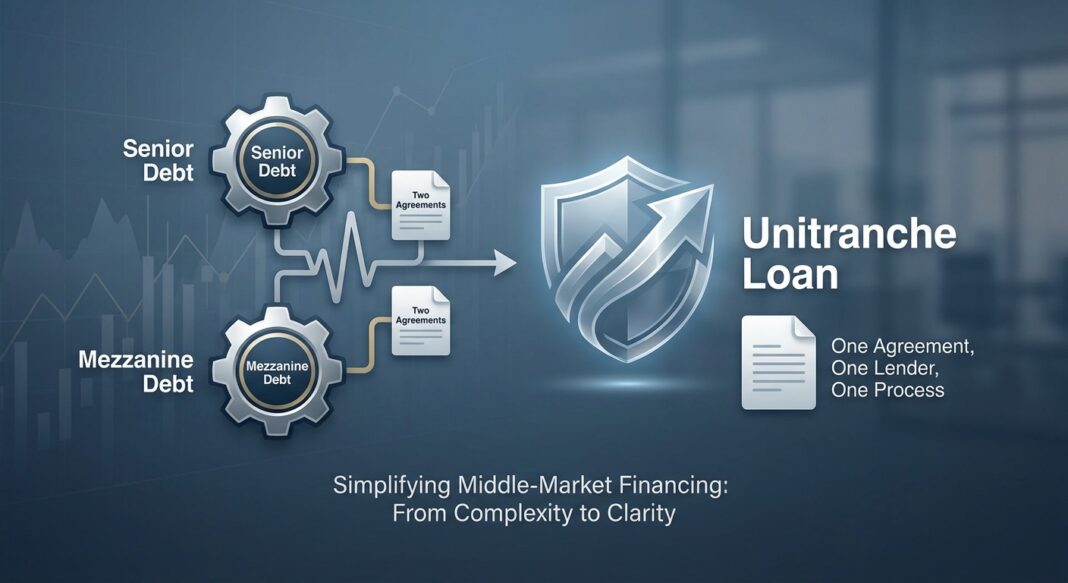
One Loan to Rule Them All
For decades, a business owner seeking acquisition financing had to manage at least two lenders with two separate agreements, two covenant packages, and often two conflicting sets of interests. Senior lenders controlled enforcement; mezzanine lenders demanded higher returns for their subordinated risk. The process was slow, expensive, and adversarial by design.
Then came the unitranche loan, and it changed the middle market’s financing architecture almost entirely.
Today, unitranche structures dominate lower middle-market direct lending. According to CT Acquisitions (June 2026), roughly 70 to 80 percent of acquisitions in the $25M–$200M enterprise value range use at least partial unitranche funding. The market has grown from approximately $20 billion in annual issuance in 2015 to over $200 billion in 2025. Understanding how unitranche works (and why it became the default structure) is essential knowledge for both investors evaluating private credit funds and operators considering their financing options.
What Is a Unitranche Loan?
A unitranche loan is a single-tranche debt facility that combines what would otherwise be separate senior secured debt and subordinated (mezzanine) debt into one instrument, one credit agreement, and one lender relationship. The borrower sees one loan with one interest rate, one set of covenants, and one point of contact.
According to Wall Street Prep, the mechanism behind the scenes is more complex: many unitranche facilities are internally bifurcated into a First-Out (FO) tranche and a Last-Out (LO) tranche through a separate document called the Agreement Among Lenders (AAL). The borrower may not even be aware of the AAL’s existence or terms.
As explained by the American Bar Association, the AAL, not a traditional intercreditor agreement, dictates the economic and control rights between the FO and LO lender groups. Key mechanics include:
- First-Out lenders receive a lower blended margin but get priority on interest and principal payments, and control enforcement rights in a default scenario.
- Last-Out lenders accept greater subordination risk in exchange for a higher allocation of the blended interest rate, often receiving payment-in-kind (PIK) interest rather than cash during stress periods.
- The borrower interacts with a single credit agreement, eliminating the multi-party negotiation friction of traditional tiered capital structures.
From the borrower’s perspective, as noted by Mayer Brown, the unitranche structure offers simplicity, speed of execution, lower transaction costs, and a lower overall blended yield compared to layering separate senior and mezzanine facilities independently.
How It Works: A Concrete Example
Consider a private equity-backed acquisition of a business services company with $10 million in EBITDA at a 7x enterprise value multiple, a $70 million deal.
Under a traditional structure, the sponsor might layer:
- Senior term loan: $35M at SOFR + 350 bps (~8.8% all-in)
- Mezzanine debt: $15M at a fixed 13–14%
- Equity: $20M sponsor contribution
- Total debt: $50M (5.0x EBITDA): two agreements, two lenders, two closing processes
Under a unitranche structure, the same deal looks like:
- Single unitranche facility: $45–50M at SOFR + 575 bps (~10.1% all-in in 2026)
- Equity: $20–25M sponsor contribution
- Total debt: $45–50M (4.5–5.0x EBITDA): one agreement, one lender, one closing
The blended rate is higher than senior-only debt but lower than the weighted average cost of combining senior and mezzanine separately. The borrower trades roughly 100–125 basis points of incremental spread for dramatically reduced execution complexity and speed. According to Private Capital Global, private credit can close within four weeks while bank syndication may require six to eight weeks, a meaningful competitive advantage in time-sensitive acquisitions.
According to CT Acquisitions (June 2026), current 2026 unitranche pricing runs SOFR + 500–700 bps, plus a 2–3% original issue discount (OID) and a 2–3% prepayment fee declining over the first 24 months, with all-in cost of capital for a typical 5x leverage deal ranging from 9.5–11% blended.
Current Market Relevance
The growth of unitranche lending reflects a structural shift in how middle-market companies access capital, a shift accelerated by bank retrenchment and now firmly institutionalized.
According to the Federal Reserve’s April 2026 SLOOS, banks reported, on balance, tighter lending standards for commercial and industrial (C&I) loans to firms of all sizes in Q1 2026, continuing a pattern of incremental tightening that has persisted since the post-GFC regulatory era. As noted by Morgan Stanley Investment Management, post-GFC bank regulation limiting loan underwriting at leverage levels at or above 6x debt-to-EBITDA effectively pushed banks back from the very segment where unitranche lenders now operate.
The numbers tell the story of what filled that gap:
| Metric | Data Point | Source |
|---|---|---|
| Global private credit AUM | >$2 trillion | PwC Private Credit Survey 2026 |
| U.S. private credit market size | ~$1.3 trillion | Creative Planning, March 2026 |
| Unitranche pricing range (2026) | SOFR + 500–700 bps | CT Acquisitions, June 2026 |
| Global new-issue spread (median, yr-end 2025) | 544 bps (down from 716 bps peak in Mar 2023) | McKinsey Global Private Markets Report, June 2026 |
| Spread reset since late 2025 | +50 to +100 bps wider | Lord Abbett Midyear Outlook, June 2026 (per PitchBook) |
| Projected global private credit AUM by 2030 | ~$4.5 trillion | Preqin via S&P Global, Nov 2025 |
Importantly, the market has recently shifted in a lender-friendly direction. According to Lord Abbett’s 2026 Midyear Outlook, new loans are increasingly coming with better credit structures: less leverage, more covenants, fewer PIK requests, and tighter documentation. Meanwhile, according to Morgan Stanley Investment Management, loan-to-value ratios in senior secured middle-market lending generally remain in the 40% range, providing meaningful insulation for lenders even in stress scenarios.
Decision Framework
For Investors Evaluating Private Credit Funds
Unitranche exposure can appear throughout a private credit fund’s portfolio, but not all unitranche positions carry the same risk profile. Investors may consider evaluating:
- FO vs. LO positioning: Does the fund hold First-Out positions (lower yield, senior payment priority) or Last-Out positions (higher yield, subordinated payment)? This distinction directly impacts downside protection.
- Leverage discipline: Unitranche leverage typically ranges 4–6x EBITDA. Portfolios underwriting to 5.5–6x in an uncertain environment carry meaningfully more risk than those anchored at 4–4.5x.
- Covenant quality: The 2026 market reset has produced more covenant-rich documentation. Investors may look for funds originating in this environment versus those with legacy covenant-lite portfolios from 2021–2023.
- AAL negotiation strength: Scaled platforms with established sponsor relationships tend to negotiate more protective AAL terms. Manager selection matters structurally, not just analytically.
For Operators Considering Unitranche Financing
Unitranche is not the right structure for every situation. Operators and their advisors may evaluate the following:
- Deal size sweet spot: According to CT Acquisitions, unitranche works best for transactions in the $25M–$200M enterprise value range. Smaller deals may benefit more from SBA financing plus seller notes; larger deals above $300M often access cheaper broadly-syndicated loans.
- Speed and certainty premium: If closing certainty and speed matter, as they typically do in competitive M&A processes, the unitranche’s single-lender execution model may justify the spread premium over bank syndication.
- Covenant tolerance: Unitranche lenders in 2026 are negotiating tighter covenant packages. Operators should assess their EBITDA trajectory and liquidity headroom before accepting financial maintenance covenants.
- Refinancing optionality: Prepayment fees (typically 2–3% in year one, declining thereafter) mean unitranche capital is not free to refinance immediately. Operators expecting a near-term liquidity event should factor this into total cost of capital calculations.
Key Takeaways
- Unitranche replaced the two-lender model: By combining senior and subordinated debt into one facility, unitranche eliminated the structural friction of traditional tiered capital structures, and now dominates the $25M–$200M M&A financing market.
- The AAL is the hidden architecture: Internally, most unitranche facilities bifurcate risk between First-Out (senior, lower-yield) and Last-Out (junior, higher-yield) positions through an Agreement Among Lenders. Investors should understand which position their fund holds.
- Pricing has widened in 2026: After compressing through 2024–2025, spreads have reset 50–100 basis points wider since late 2025, creating a more attractive origination environment for disciplined lenders entering new positions.
- Bank retrenchment is structural, not cyclical: Ongoing bank tightening, confirmed by the Fed’s April 2026 SLOOS, means the origination opportunity for unitranche lenders is not a temporary gap. It reflects a durable reshaping of who finances middle-market America.
- Covenant and structural quality matters now more than headline yield: The best risk-adjusted opportunities in 2026 unitranche lending may come not from chasing yield, but from disciplined underwriting into a market that is finally rewarding lender selectivity with better documentation and structure.


