
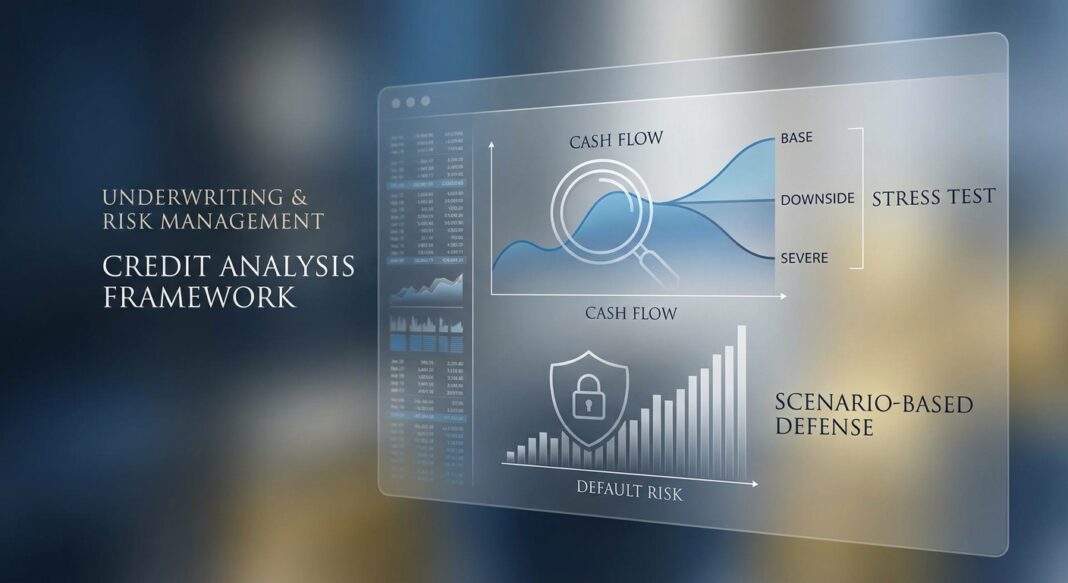
Underwriting & Risk Management | Credit Analysis
Bond Capital, July 29, 2026
The Underwriting Question Every Credit Committee Must Answer First
A sponsor-backed manufacturer with $10 million in trailing EBITDA requests a $45 million unitranche facility. The management deck projects 8% annual revenue growth, margin expansion to 22%, and comfortable 2.5x interest coverage throughout the hold period. The deal looks fundable. The question is: does it still look fundable when reality deviates from the management case?
That question is the entire point of cash flow stress testing, and in 2026, it is not a theoretical exercise. Fitch Ratings reported that the U.S. private credit default rate hit a record high of 6.0% in April 2026, with private-credit-backed borrowers experiencing a 9.2% default rate across 2025. Moody’s data shows that distressed restructurings (debt exchanges and maturity extensions agreed under duress) accounted for roughly 65% of all 2025 private credit defaults. The losses were not random; they were concentrated in credits where lenders accepted management projections at face value and built no structural cushion for operational variance.
Stress testing is the methodology that converts optimistic projections into risk-calibrated underwriting decisions. This article teaches the complete framework, from scenario architecture through covenant headroom analysis, using a working example throughout.
The Analytical Framework: Three-Scenario Architecture
Institutional-grade cash flow stress testing is built around at least three distinct scenarios constructed before the credit committee meeting, not during it. The Federal Reserve’s interagency leveraged lending guidance makes clear that projections should include “one or more realistic downside scenarios that reflect key risks identified in the transaction”, and that a borrower’s capacity to fully amortize senior secured debt or repay at least 50% of total debt over a five-to-seven year period is the standard test of adequate repayment capacity.
The Three Scenarios
- Base Case: Conservative interpretation of the business plan. Not management’s upside. Revenue growth is capped at historical averages; margins are held at current levels, not projected peaks. This is the floor of acceptable deal economics.
- Downside Case: A realistic, plausible deterioration. Industry cyclicality, customer concentration, input cost pressure, or a single contract loss. Typically models a 10–15% EBITDA decline from base and assumes no immediate remediation.
- Severe Case: A structural or macro shock: a recession, a key customer bankruptcy, or a significant rate spike. ABF Journal’s middle-market stress analysis models a severe scenario with rates at 5.5% and a –20% EBITDA decline, a calibration consistent with observed distress cycles.
Working Example: $10M EBITDA Manufacturing Borrower
Assume the following at close: $10.0M Adjusted EBITDA, $45.0M total debt (4.5x leverage), floating rate at SOFR + 575bps (approximately 10.2% all-in), annual debt service (interest + 1% amortization) of approximately $5.1M. Base case DSCR calculates as:
DSCR = EBITDA ÷ Total Debt Service = $10.0M ÷ $5.1M = 1.96x
A 1.96x DSCR looks healthy. Stress testing will determine whether it survives.
Walking Through the Calculations: Where Deals Break
Step 1: Stress EBITDA by Scenario
Apply percentage haircuts to normalized EBITDA across your three scenarios. In the downside case, a 15% EBITDA haircut takes the borrower from $10.0M to $8.5M. In the severe case, a 20% decline produces $8.0M. These are not worst-case extremes; they reflect the observed range of performance deterioration in leveraged middle-market credits during the 2023–2025 tightening cycle, during which interest coverage ratios declined to approximately 1x across floating-rate borrowers as interest costs rose more than 50%.
Step 2: Stress the Interest Expense Line
Because most private credit loans are floating-rate instruments, rate sensitivity is a primary stress variable. A 100bps rate increase on $45M of floating debt adds $450,000 in annual interest expense, a 9% increase in debt service that flows directly to DSCR compression. Underwriters must model rate stress independently from EBITDA stress, and then combine them.
| Scenario | EBITDA | Debt Service (Rate +100bps) | DSCR | Verdict |
|---|---|---|---|---|
| Base Case | $10.0M | $5.1M | 1.96x | ✓ Pass |
| Downside (−15% EBITDA) | $8.5M | $5.55M | 1.53x | ⚠ Watch |
| Severe (−20% EBITDA + rate stress) | $8.0M | $5.55M | 1.44x | ✕ Marginal |
Step 3: Test Deleveraging Capacity
The Federal Reserve’s interagency guidance establishes that supervisors commonly assume the ability to repay at least 50% of total debt over a five-to-seven year period as evidence of adequate repayment capacity. In the severe scenario, free cash flow after interest narrows to approximately $2.45M per year. Over five years, total principal repayment reaches approximately $12.25M, or 27% of the $45M debt load, well below the 50% threshold. This credit does not de-lever adequately under stress and requires either a lower initial leverage point or tighter structural protections.
Step 4: Enterprise Value Stress
Per regulatory guidance, when a borrower faces a financial downturn, lenders should stress both cash flow and the sales multiples used to assess enterprise value. If the base case assumes an 8x EBITDA exit multiple and the severe scenario compresses that to 6x on $8.0M of stressed EBITDA, enterprise value falls from $80M to $48M, providing only $3M of cushion above the $45M debt load. Lenders should perform their own discounted cash flow analysis rather than relying solely on entry multiple proxies.
Industry Standards, Red Flags, and the Covenant Erosion Crisis
What Institutional Lenders Require
The interagency leveraged lending guidance identifies a leverage level exceeding 6.0x Total Debt/EBITDA as raising concerns for most industries. Buyout leverage in the middle market sat at 4.1x in 2024, down from 4.7x in 2021, reflecting some post-rate-cycle discipline. However, unitranche structures blending senior and junior debt routinely approach 6x, which is why cash flow stress testing, not leverage entry ratios alone, must serve as the primary underwriting gatekeeper.
The Covenant Erosion Problem
Stress testing is only as useful as the early warning systems that can trigger lender action when performance deteriorates. That system is collapsing. According to Resonanz Capital’s analysis, 91.09% of outstanding U.S. leveraged loans were covenant-lite at year-end 2024, representing roughly $1.29 trillion in face value, with 93% of all new institutional issuance in 2024 carrying no maintenance covenants. In a covenant-lite structure, a lender cannot use a borrower’s rising leverage or declining coverage as a renegotiation trigger. The lender learns about deterioration only when a payment is missed, at which point recovery options have narrowed materially.
The data confirms the penalty: restructurings initiated at the covenant-breach stage, before a payment default, produce materially higher recoveries than those triggered by missed payments. Maintenance covenants are not bureaucratic friction; they are the mechanism that converts early-warning signals into capital preservation.
Red Flags in Cash Flow Underwriting
- PIK Interest Accumulation: As of Q4 2025, 6.4% of private credit loans carried “bad PIK” (interest deferred mid-loan due to liquidity strain, not structured at origination) nearly triple 2021 levels. Rising PIK elections signal deteriorating DSCR that is not captured in headline default statistics.
- EBITDA Add-Backs Without Verification: Management-adjusted EBITDA frequently includes run-rate synergies, one-time cost eliminations, and pro-forma acquisitions that never materialize. Lenders must independently audit every add-back exceeding 10% of reported EBITDA.
- High Sensitivity to Rate Movement: Floating-rate loans with thin coverage ratios (below 1.75x) are structurally fragile. When SOFR rose over 500bps in 2022–2023, coverage ratios across floating-rate borrowers declined to approximately 1x, meaning cash flow was barely covering interest, with no capacity for principal repayment or capital expenditure.
- Nominal Deleveraging Projections: Per the Federal Reserve’s guidance, if projected capacity to pay down debt from cash flow is nominal with refinancing as the only viable exit, the credit will typically receive an adverse risk rating even if recently underwritten.
- Software and Technology Concentration: Moody’s found software represents approximately 25% of BDC portfolios on a median basis, with AI disruption flagged as a developing credit risk. ECB stress tests applied 30% default rates at 80% LGD to software exposures in a severe scenario.
📊 Credit Performance Data Box
- 6.0%: U.S. private credit default rate, April 2026 record high (Fitch Ratings, May 2026)
- 9.2%: Private-credit-backed corporate borrower default rate, full year 2025 (Fitch Ratings)
- 2.73%: Proskauer Private Credit Default Index, Q1 2026, up from 1.84% just two quarters prior (Proskauer, 697 loans / $189.2B)
- 91%: Share of U.S. leveraged loans outstanding that were covenant-lite, year-end 2024 (Resonanz Capital)
- 65%: Share of 2025 private credit defaults that were distressed restructurings, not outright payment defaults (Moody’s)
- 6x: Total Debt/EBITDA threshold above which regulators flag concerns for most industries (Federal Reserve Interagency Guidance)
Cash Flow Stress Testing Underwriting Checklist
Use this checklist at origination and repeat annually as part of portfolio monitoring.
▢ Pre-Model Preparation
- Obtain three years of audited financial statements and trailing-twelve-month management accounts
- Identify and independently verify every EBITDA add-back exceeding $100K; document source and time-bound nature
- Confirm normalized capex is included in free cash flow bridge (maintenance capex, not just growth capex)
- Map all working capital seasonality that could affect liquidity between reporting periods
▢ Scenario Construction
- Build base, downside (−15% EBITDA), and severe (−20% EBITDA + rate shock) scenarios
- Stress interest expense independently using +100bps and +200bps rate shock cases on all floating-rate tranches
- Document the specific business rationale for each stress assumption (e.g., customer concentration, cyclicality, sector risk)
- Run enterprise value stress at compressed exit multiples (entry −2x) alongside cash flow scenarios
▢ Coverage and Deleveraging Tests
- Calculate DSCR under all three scenarios; minimum acceptable base case is 1.75x; downside floor is 1.25x
- Confirm the borrower can repay at least 50% of total debt within five to seven years from operating cash flow in the base case
- Model a combined stress scenario (EBITDA haircut + rate increase) and confirm the credit does not breach minimum coverage covenants
▢ Covenant and Structural Review
- Confirm maintenance financial covenants are included (leverage ratio, interest coverage, fixed charge coverage); document if absent and escalate to credit committee
- Verify that covenant headroom under the base case is at least 20–25% above the test level, not 5–10%
- Confirm credit agreement restricts material asset sales or collateral dilution without lender approval
- Establish reporting cadence: quarterly financials, compliance certificates, and management calls for credits below 1.75x DSCR
▢ Documentation Requirements
- Written stress test memo documenting all scenario inputs, assumptions, and conclusions, retained for credit file
- Independent enterprise value analysis (DCF, not only comparable multiples)
- Evidence of sponsor financial capacity if sponsor support is cited as a secondary repayment source
- Board-approved hold limits and pipeline exposure limits consistent with institution-level risk appetite
Key Takeaways for Credit Professionals
- 🔒 Stress testing is the underwriting standard, not a supplement to it. The Federal Reserve’s interagency guidance frames downside scenario analysis as a baseline expectation for all leveraged transactions, not an enhancement reserved for large or complex deals.
- 📊 Default rates have risen sharply and remain fragile. Fitch’s 6.0% April 2026 private credit default rate and Moody’s finding that 65% of 2025 defaults were distressed restructurings confirm that headline statistics materially understate realized credit stress when PIK and debt exchanges are excluded.
- ⚠ Covenant erosion has neutralized the early-warning system. With 91% of leveraged loans covenant-lite, lenders who did not build maintenance covenants into their credit agreements have lost the mechanism that enables proactive restructuring before a payment default, the most value-preserving intervention point.
- 📈 Interest rate sensitivity is an independent stress variable. Floating-rate private credit loans require dedicated rate shock scenarios. The 500bps rate increase from 2022 to 2023 compressed coverage ratios to approximately 1x across the market, a stress event that was modeled by almost no underwriters at origination.
- 🎯 Deleveraging capacity, not entry leverage, is the governing test. A 4.5x initial leverage ratio that cannot reduce to 2.5x within five years from operating cash flow, even in the base case, is structurally impaired credit that relies on refinancing as the primary exit, not repayment discipline.


