
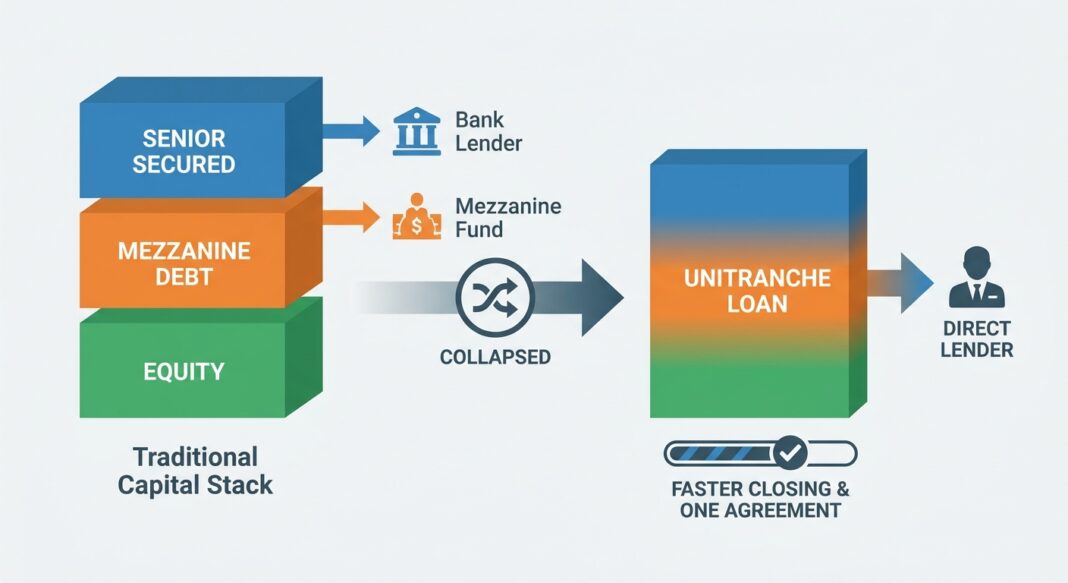
When Two Tranches Become One
For decades, a leveraged buyout required a borrower to assemble a capital stack the way a contractor builds a house, layer by layer. A senior secured term loan from a bank came first. Then a subordinated mezzanine tranche from a separate lender, often at a punishing coupon. Each layer had its own credit agreement, its own covenants, its own legal counsel, and its own intercreditor negotiation. The result was a financing process that could consume 10 to 12 weeks and introduce real execution risk at exactly the moment a deal needed certainty.
The unitranche loan dismantled that architecture. It is now the dominant debt structure for middle-market acquisitions in the United States, having grown from roughly $20 billion in annual issuance in 2015 to over $200 billion in 2025. Understanding why unitranche won (and what it costs) is foundational knowledge for both investors evaluating private credit funds and operators deciding how to finance a transaction.
What a Unitranche Loan Actually Is
Unitranche debt is a single-tranche credit facility that combines what would otherwise be a senior secured loan and a subordinated mezzanine loan into one instrument, governed by a single credit agreement, with a single lender or a tightly coordinated club of lenders.
The name is the mechanism: uni (one) + tranche (slice of debt). Instead of negotiating separately with a bank for first-lien capital and a mezzanine fund for subordinated capital, a borrower executes one set of documents with one counterparty. The result is one negotiation, one closing, one lender to manage post-close, and no intercreditor agreement to fight over.
Behind the scenes, direct lenders often divide the facility internally into a first-out (FO) and last-out (LO) arrangement governed by a private Agreement Among Lenders (AAL). The first-out lender receives principal payments first and holds priority claim on collateral, accepting a lower yield; the last-out lender bears more risk and is compensated with a materially higher interest rate. The borrower never sees this division; they make one payment to one agent, who distributes proceeds per the AAL waterfall.
For the lender, the economics are equally attractive: unitranche allows a direct lender to earn a blended return higher than pure senior pricing while controlling the entire credit position.
How the Numbers Work: A Concrete Example
Consider a private equity sponsor acquiring a regional healthcare services business with $8 million in EBITDA at a 7x purchase price multiple: a $56 million enterprise value.
Under a traditional two-tranche structure, the capital stack might look like this:
- Senior secured term loan: 3.0x EBITDA ($24M) at SOFR + 350 bps ≈ 7.2% all-in
- Mezzanine loan: 2.0x EBITDA ($16M) at 13–15% (often with PIK toggle)
- Sponsor equity: 2.0x EBITDA ($16M)
- Total debt: 5.0x EBITDA | Blended debt cost: ~10.1%
- Timeline: 10–12 weeks, two sets of legal negotiations, intercreditor agreement required
Under a unitranche structure from a direct lender:
- Unitranche facility: 5.0x EBITDA ($40M) at SOFR + 575 bps ≈ 9.4% all-in (based on Q2 2026 SOFR of ~4.3%, per CT Acquisitions, June 2026)
- Sponsor equity: 2.0x EBITDA ($16M)
- Total debt: 5.0x EBITDA | All-in cost: ~9.4%
- Timeline: 3–4 weeks, one credit agreement, no intercreditor complexity
The unitranche costs approximately 71 basis points more in headline rate versus the blended two-tranche alternative. But sponsors frequently justify that premium: if unitranche financing closes 30 to 45 days faster, sponsors can justify 50 to 100 basis points of extra spread by avoiding broken syndications or delayed closings that jeopardize purchase agreements. For a $56 million deal, 75 basis points on $40 million in debt equals roughly $300,000 per year, a modest insurance premium against deal failure.
Current Market Relevance
The unitranche market is not operating in a vacuum. Several converging forces in mid-2026 have sharpened its strategic importance for both operators and investors.
Banks remain structurally constrained. The Federal Reserve’s April 2026 Senior Loan Officer Opinion Survey (SLOOS) reported tighter standards for all categories of non-depository financial institution (NDFI) loans, with significant net shares of banks citing higher premiums on riskier loans, stricter covenants, and shorter maximum maturities. For middle-market borrowers, typically those with revenues under $500 million, bank retrenchment is not a cyclical event; it is a structural shift that began after the 2008 financial crisis and has accelerated.
Unitranche pricing has stabilized in 2026. Unitranche yields remained broadly stable on a spot basis in Q2 2026, with three-month Term SOFR reaching 3.69% in June while credit spreads held largely unchanged quarter-over-quarter. The current all-in range for lower-middle-market unitranche is approximately 500–700 basis points over SOFR, implying total yields in the 8.7%–11.7% range depending on credit quality and leverage.
The private credit market financing this activity is massive. PIMCO estimates global private credit AUM at roughly $3.2 trillion, comprising $2.4 trillion in drawdown funds and approximately $800 billion in semi-liquid vehicles. The top platforms deploying unitranche capital are enormous: Apollo leads with approximately $600 billion in credit AUM, followed by Ares at $464 billion and Blackstone Credit at $354 billion as of Q1 2026.
Loan documentation trends bear watching. Covenant-lite transactions rose to 21% of direct lending deals in 2025, up sharply from 4% in 2023, according to McKinsey’s analysis citing Proskauer data. While still far below the broadly syndicated loan market’s covenant-lite penetration, this trend signals that borrower-friendly terms have migrated into private credit, a risk consideration for investors who previously valued private credit’s tighter documentation as a core protection.
Default rates remain contained but are rising. KBRA projected the annualized direct lending default rate to rise from 1.5% in 2025 to 2.0% by year-end 2026, with credit risk remaining largely idiosyncratic and concentrated in consumer-facing sectors, select 2021 vintage deals, and AI-disrupted business models.
| Metric | Value | Source |
|---|---|---|
| LMM unitranche spread (SOFR +) | 500–700 bps | CT Acquisitions, Jun 2026 |
| 3-month Term SOFR (June 2026) | 3.69% | Valuation Research Corp., Jul 2026 |
| Typical LMM leverage (EBITDA) | 4.0x–6.0x | CT Acquisitions, Jun 2026 |
| Global private credit AUM | ~$3.2 trillion | PIMCO, Jun 2026 |
| Covenant-lite share of direct lending (2025) | 21% (up from 4% in 2023) | McKinsey / Proskauer, Jun 2026 |
| Projected direct lending default rate (YE 2026) | 2.0% | KBRA via Northleaf Capital, May 2026 |
Decision Framework
For Investors Evaluating Private Credit Funds:
Not all unitranche exposure is equal. Investors considering direct lending funds evaluate several dimensions. First, market segment: lower-middle-market unitranche (deals under $100M enterprise value) commands higher spreads (500–700 bps over SOFR) and historically carries tighter covenants, but also higher idiosyncratic credit risk. Upper-middle-market unitranche competes more directly with broadly syndicated loans and offers tighter pricing and looser documentation. Second, covenant trend: with covenant-lite transactions now at 21% of direct lending deals and rising, investors consider which managers maintain documentation discipline as a genuine differentiator. Third, the AAL structure: when evaluating a fund’s unitranche positions, investors examine whether the fund holds first-out or last-out exposure, since these carry fundamentally different risk profiles despite appearing as one line item. Fourth, concentration risk: the top 25 private credit managers accounted for approximately 72% of total closed-end fundraising in 2025, suggesting scale advantages, but also meaningful selection risk among smaller managers.
For Operators Evaluating Unitranche Financing:
Business owners and CFOs evaluate unitranche when speed and certainty outweigh rate. The structure fits best for acquisitions in the $25–$200 million enterprise value range, where bank syndication is impractical and mezzanine coordination adds complexity. Roughly 70–80% of deals in that size range used at least partial unitranche funding in 2026. Operators weigh the all-in cost carefully: original issue discount (OID), prepayment penalties, and amendment fees materially raise the effective cost above the headline SOFR + spread. A 1% OID on a 5-year facility adds approximately 20 basis points to the annual cost. Additionally, operators negotiating in a higher M&A activity environment, with 2025 having surpassed the prior 2021 high in global M&A activity and deal flow remaining strong into early 2026, face competition for lender attention and should prioritize relationships with platform lenders who can deliver repeat execution.
Key Takeaways
- One agreement, one relationship: Unitranche collapses the traditional senior-plus-mezzanine capital stack into a single facility, eliminating intercreditor risk and accelerating closing timelines by 30–45 days versus syndicated alternatives.
- Pricing reflects the blend: The unitranche rate is a blended rate between senior and subordinated cost of capital, higher than senior-only, lower than senior-plus-mezzanine combined. In mid-2026, expect 500–700 bps over SOFR (approximately 8.7%–11.7% all-in) for lower-middle-market transactions.
- The AAL is the hidden architecture: Internally, most unitranche facilities divide into first-out and last-out positions governed by a private Agreement Among Lenders. Investors should understand whether their fund holds FO or LO exposure, the risk profiles are meaningfully different.
- Covenant erosion is a market-wide risk: With covenant-lite terms reaching 21% of direct lending deals in 2025 (up from 4% in 2023), the documentation advantage that historically differentiated private credit from broadly syndicated loans is narrowing at the upper end of the market.
- Bank tightening is structural, not cyclical: The Fed SLOOS continues to report tighter bank C&I lending standards through Q1 2026, reinforcing the structural demand for unitranche capital in the middle market. This tailwind supports the asset class but also means investors and operators must understand the nuances of direct lender underwriting, quality varies significantly across platforms.


