
Why Borrowers and Lenders Are Both Reaching for the Same Instrument
When a private equity sponsor needs to finance a $150 million middle market acquisition, they face a classic trade-off: assemble a traditional capital stack with a senior lender, a mezzanine provider, and an equity co-investor, or close the whole deal with a single lender in under four weeks. Increasingly, they choose the latter. The instrument making that possible is the unitranche loan, and understanding how it works is foundational to understanding modern private credit.
Unitranche lending has migrated from a niche workaround to the dominant structural format in middle market private credit. Unitranche structures continue to dominate new issuance, with coupon spreads generally ranging from 4.75% to 5.50% as of mid-2026. As banks tighten credit windows and sponsors demand execution certainty, the unitranche has become the default architecture for deals between roughly $25 million and $750 million in enterprise value. This article explains exactly how it works, why the blended pricing makes mathematical sense for both sides, and what the current market structure means for investors evaluating the asset class and operators deciding how to finance growth.
What a Unitranche Loan Actually Is
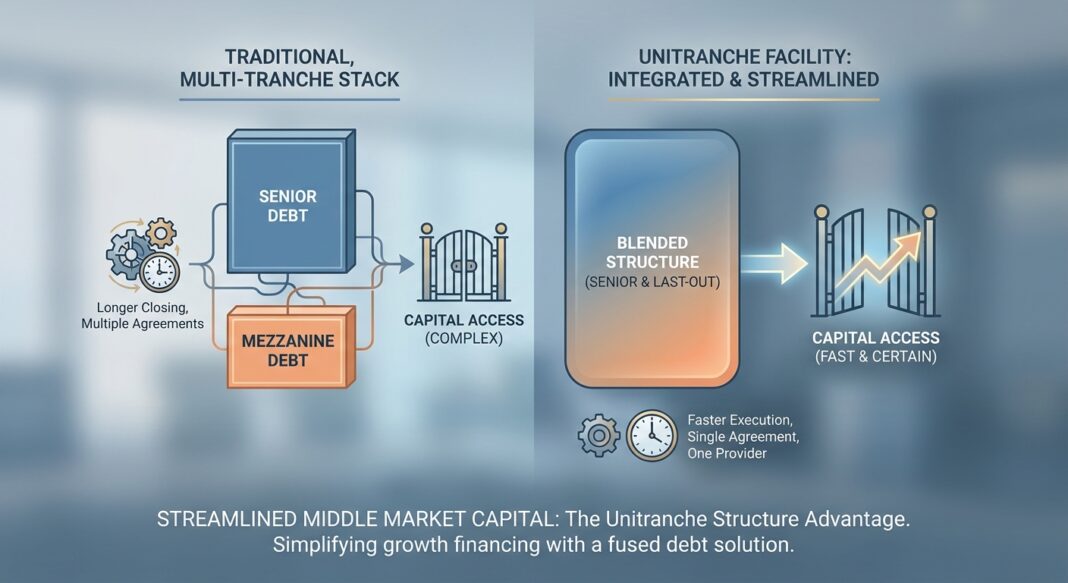
A unitranche facility is a single loan that combines what would traditionally be two separate debt instruments (a senior secured term loan and a junior or mezzanine tranche) into one blended structure provided by a single lender or a coordinated club of lenders. The borrower signs one credit agreement, makes one interest payment, and negotiates with one counterparty. Behind the scenes, however, the lending group may internally allocate risk through an Agreement Among Lenders (AAL), which splits the facility into a first-out (FO) portion (which gets repaid first and carries lower risk) and a last-out (LO) portion (which absorbs first-dollar losses and commands higher yield).
The borrower never sees this internal division. What they see is a single all-in interest rate, typically expressed as Term SOFR plus a credit spread, that sits mathematically between where a pure senior loan and pure mezzanine loan would price separately. That blended rate is what makes unitranche attractive: it is cheaper than assembling a full two-tranche stack when mezzanine costs are factored in, and it eliminates the inter-creditor friction that complicates restructurings in traditional structures.
From the lender’s perspective, the AAL is where the economics get interesting. A first-out participant earns a lower spread but enjoys priority repayment. A last-out participant takes on subordination risk in exchange for a spread premium that can run 150 to 300 basis points above the first-out rate. Large platforms like Blackstone Credit, Ares, Apollo, and Blue Owl frequently retain the entire facility, capturing both economics within one fund vehicle. Smaller managers may syndicate the first-out piece to a bank or senior-focused BDC while retaining the higher-yielding last-out position.
The Math: A Concrete Example
Consider a hypothetical acquisition of a software-enabled services business with $10 million in EBITDA at a 12x purchase multiple, implying a $120 million enterprise value. The sponsor contributes 40% equity ($48 million) and needs $72 million in debt financing.
Traditional two-tranche structure:
- Senior term loan: $54 million at Term SOFR + 325 bps (≈ 7.0% all-in at 3.7% SOFR)
- Mezzanine tranche: $18 million at a fixed 13.0% (cash + PIK)
- Weighted blended cost of debt: ≈ 8.5%
- Closing timeline: 10–14 weeks; two separate credit agreements; inter-creditor negotiation required
Unitranche alternative:
- Single unitranche facility: $72 million at Term SOFR + 525 bps (≈ 9.0% all-in)
- Weighted cost of debt: 9.0%
- Closing timeline: 3–5 weeks; one credit agreement; one lender relationship
The borrower pays approximately 50 basis points more in headline rate but eliminates mezzanine origination fees, legal costs for dual documentation, and, critically, the execution risk that a second lender falls out of the syndicate at the last moment. For a sponsor running a competitive auction process, that certainty is worth more than the incremental interest cost. The lender, meanwhile, earns a spread that reflects the blended risk profile: senior-like collateral coverage with mezzanine-like return on the last-out portion.
Current Market Reality: What the Data Shows
The unitranche market in mid-2026 is navigating a meaningful repricing from the compressed spreads of 2023–2024. Several intersecting forces are reshaping lender-borrower dynamics in ways that make the current vintage particularly instructive for understanding how credit cycles affect structure.
Spreads are widening from cycle lows. According to PitchBook, spreads have widened by roughly 50 to 100 basis points since late 2025. Valuation Research Corporation maintained its credit spread ranges for middle market securities during the second quarter of 2026, following a 25 basis point increase in March 2026.
The bank pullback is structural, not cyclical. The Federal Reserve’s April 2026 Senior Loan Officer Opinion Survey (SLOOS) found that banks reported, on net, tighter standards for all categories of non-depository financial institution (NDFI) loans over the past year, with significant net shares reporting tighter standards for business credit intermediaries. Over the first quarter of 2025, moderate net shares of banks reported having tightened standards on C&I loans to firms of all sizes. This persistent tightening creates a structural opening for private credit unitranche providers to step into financing gaps that banks are deliberately vacating.
Covenant quality is improving for lenders. According to Lord Abbett’s 2026 Midyear Investment Outlook, new loans are increasingly coming with better credit structures: less leverage, more covenants, fewer PIK requests, and tighter documentation. This is a notable reversal from 2022–2024, when competition for deals pushed covenant protection to historic lows. McKinsey noted that covenant-lite transactions rose to 21% of direct lending deals in 2025, up from 4% in 2023, but the 2026 trend suggests that pendulum is swinging back toward lender-protective terms as macro uncertainty rises.
The BSL vs. direct lending gap is compressing. PitchBook’s April 2026 US Private Credit Monitor noted that spreads showed early signs of widening across credit markets, with direct lending leading the move, even as the gap between broadly syndicated loans (BSL) and direct lending pricing continued to compress as the two channels increasingly compete for the same borrowers. This compression means the execution-certainty premium of unitranche is being partially offset by improved pricing in the syndicated market for larger deals.
The scale of the market underscores its systemic importance. According to Preqin’s 2025 Global Private Debt Report, private credit surpassed $2 trillion in assets under management for the first time in 2024. Unitranche direct lending represents the single largest sub-strategy within that universe.
| Metric | Data Point | Source |
|---|---|---|
| Unitranche coupon spread range (Q2 2026) | Term SOFR + 4.75%–5.50% | VRC Q2 2026 |
| Spread widening since late 2025 | +50–100 bps | Lord Abbett / PitchBook, June 2026 |
| Median LBO unitranche spread (2025) | S+475 bps | PitchBook / LCD, Jan 2026 |
| Private credit AUM (global, 2024) | $2.1 trillion | Preqin / Angel Investors Network, June 2026 |
| Banks tightening C&I standards (Q1 2025) | Moderate net share | Federal Reserve SLOOS, April 2026 |
Decision Framework: Investors and Operators
For Investors Evaluating Unitranche Exposure
Investors considering private credit funds or BDCs with significant unitranche exposure evaluate several structural questions that go beyond the headline yield. First, does the manager retain the entire facility or does it syndicate the first-out piece? Retaining the full facility keeps economics in-house but concentrates credit risk. Second, what is the effective loan-to-value at origination? A unitranche at 5.5x leverage on a 12x EBITDA deal implies a meaningful equity cushion of roughly 54%, but that cushion shrinks rapidly if the business underperforms. Third, investors consider the covenant package: a maintenance covenant requiring quarterly EBITDA tests gives the lender early warning and renegotiation leverage, while a covenant-lite structure offers less protection if deterioration is slow and incremental.
More recent headlines around software exposure, AI disruption, non-accruals, and PIK activity have made some capital providers more selective, and together with more transactions to finance, these forces have improved the supply-demand balance for lenders with dry powder, giving them greater ability to negotiate price and structure.
For Operators Deciding Whether to Use Unitranche
Business owners and CFOs evaluating unitranche financing weigh execution certainty against all-in cost. Unitranche is most appropriate when: (1) the acquisition or recapitalization timeline is compressed and a competitive process cannot wait for multi-lender syndication; (2) the business has stable, recurring revenues that support a single-lender relationship without the diversification benefit of a club deal; or (3) the sponsor or management team wants to avoid the inter-creditor complexity that emerges when a senior lender and mezzanine provider disagree on a covenant waiver or amendment. Operators should be aware that unitranche lenders, precisely because they hold the entire risk spectrum, typically insist on stronger information rights, tighter reporting covenants, and more frequent lender calls than a bank offering a comparable senior facility.
Key Takeaways
- Structure simplicity has real economic value. The premium a borrower pays for a unitranche versus a two-tranche stack is often offset by lower transaction costs, faster execution, and reduced inter-creditor legal risk, particularly in competitive M&A processes.
- The AAL determines internal economics, not borrower cost. First-out and last-out allocations are an internal lender mechanism. Borrowers negotiate one rate; investors need to understand which portion of the AAL their fund manager is actually holding.
- The 2026 lender reset is improving unitranche terms. Spread widening of 50–100 bps since late 2025, alongside tighter covenant packages and lower leverage multiples on new deals, means the current vintage is structurally more protective for lenders than 2022–2024 originations.
- Bank tightening is a structural tailwind. Persistent tightening of C&I lending standards by banks, documented across multiple consecutive Federal Reserve SLOOS surveys, continues to create origination opportunities for private credit unitranche providers in the middle market.
- Manager selection drives outcome dispersion. In a market where the top eight managers captured over half of all direct lending capital raised in 2024, the difference between a first-quartile and bottom-quartile fund outcome is primarily driven by origination quality, covenant discipline, and workout capability, not headline spread.


