
The Story: A Storied Brand, a Crushing Debt Load, and a Decision That Changed Everything
By early 2026, Lands’ End (the Dodgeville, Wisconsin-based direct-to-consumer apparel institution) was carrying a problem that had nothing to do with its products or its customers. Sitting on its balance sheet was approximately $234 million in term loan debt, a legacy liability that was consuming cash, restricting strategic flexibility, and compressing the financial profile of a brand that, by any honest reckoning, was worth far more than its stock price suggested.
The brand itself was the asset. Seventy years of consumer trust. Loyal direct-to-consumer and B2B relationships. An intellectual property portfolio (trademarks, licensing agreements, category rights) that had been quietly undervalued for years, sitting on the balance sheet at a fraction of its true market worth. The problem facing CEO Andrew McLean and the Lands’ End board wasn’t growth capital. It wasn’t a broken business model. It was a capital structure problem: how do you unlock the value embedded in your most important asset, your brand, without selling the whole company?
The conventional answer would have been a secondary equity offering, a dilutive raise that would hand new shareholders a piece of the company in exchange for cash to retire the debt. Or a strategic sale, a full exit, with founders and shareholders cashing out entirely. Lands’ End chose neither. Instead, it reached for a third path: a brand IP joint venture with WHP Global, one of the world’s most sophisticated brand management platforms. What followed is a masterclass in non-dilutive capital structure engineering at the corporate level, and a story every operator, family business owner, and capital-allocator should understand.
The Decision: Monetize the IP, Keep the Business
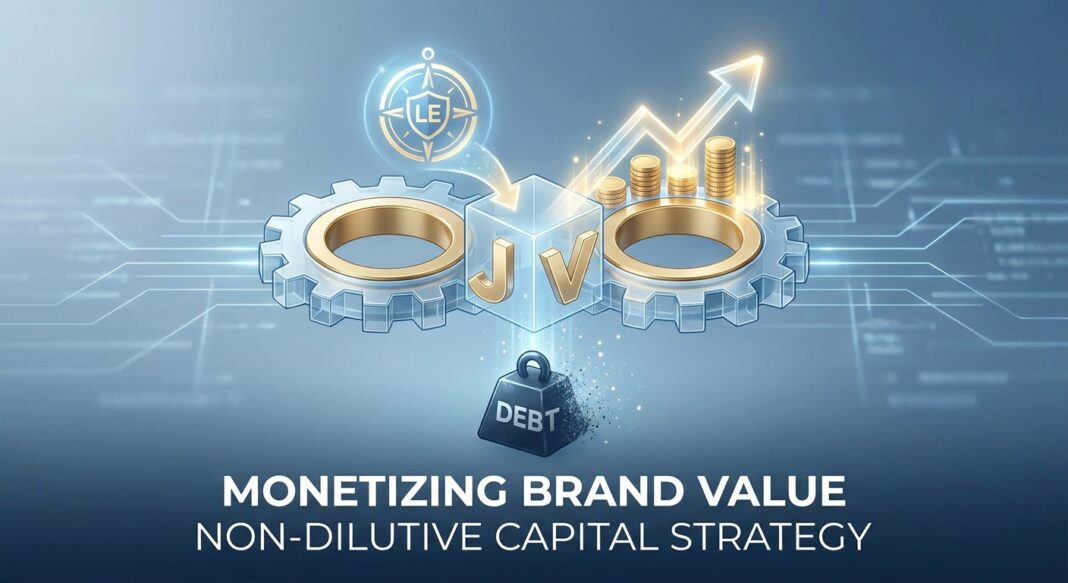
The structure that Lands’ End and WHP Global announced on January 26, 2026 was elegant in its logic. Rather than selling the company or issuing new equity, Lands’ End contributed all intellectual property and related brand assets: its trademarks, existing licensing agreements, and the licensing business, into a newly formed joint venture entity called LE Topco. WHP Global then paid $300 million in cash for a 50% controlling ownership stake in LE Topco. Lands’ End retained the other 50%.
The operating business (the DTC website, the B2B channel, the customer relationships, the supply chain) stayed entirely with Lands’ End. The company then licensed its own brand back from the JV under a long-term License Agreement, paying a guaranteed minimum royalty of $50 million per year for the first 11 contract years. In exchange, it received quarterly profit distributions equal to 50% of the JV’s earnings, participation in WHP Global’s global brand-expansion platform, and a contractual right to exchange its JV stake for equity in WHP Global itself if WHP were ever to undergo a qualifying monetization event such as an IPO or majority sale.
The math was compelling. The brand IP was monetized at an implied valuation of approximately $748.6 million: roughly double what most observers expected. The $300 million in cash proceeds went almost entirely toward retiring the $234 million term loan. Simultaneously, WHP Global launched a tender offer for up to $100 million of Lands’ End common shares at $45 per share: a meaningful premium, providing immediate liquidity for shareholders who wanted it. The announcement sent the stock surging 33.5% in a single session.
No new equity was issued. No ownership of the operating company was surrendered. No venture capitalist received a seat at the board table with a preferred liquidation stack. The capital structure problem was solved using the balance sheet’s most underleveraged resource: the brand itself.
The Outcome: Debt Eliminated, Balance Sheet Transformed, Upside Preserved
The joint venture closed on April 1, 2026. Within weeks, the financial impact was visible across every metric that matters to a capital allocator.
Lands’ End used the proceeds to fully repay its $234 million term loan, leaving the company with no long-term debt outstanding. The transaction generated a $491.6 million GAAP gain on the JV formation, driving reported Q1 2026 net income to $330.7 million, or $10.56 in diluted EPS: a number that dwarfed anything the company had delivered in years. Yes, underlying Adjusted EBITDA was a loss of $6.2 million, reflecting operational headwinds from a distribution center system transition. But the capital structure transformation was real, durable, and irreversible.
The balance sheet now carries a $375.8 million equity method investment representing the JV stake, a productive, income-generating asset replacing the dead weight of term loan liability. The minimum $50 million annual royalty obligation is a known, manageable cost; the 50% quarterly JV profit share is recurring upside. And the upside scenario is genuinely significant: management’s own analysis shows that if the JV reaches $100–$150 million in EBITDA and WHP Global undergoes a monetization at 13–15x, Lands’ End shareholders could see an additional $22 to $38 per share in value: entirely additive to the operational business.
Compare this to the dilutive path. A $300 million equity raise at the pre-announcement share price would have required issuing roughly 10 to 12 million new shares, an ownership dilution of 30% or more. Those shares would represent a permanent, compounding claim on every dollar of future earnings and terminal value. Instead, Lands’ End paid a royalty, shared a JV, and kept the upside for existing holders.
The stock market understood the difference immediately. That 33.5% single-day move on the announcement date said something important: investors recognized a non-dilutive capital structure solution when they saw one.
The Lessons: What Lands’ End Teaches Every Capital Allocator
The Lands’ End / WHP Global deal is not a one-off curiosity. It is part of a broader structural trend in how sophisticated operators are thinking about unlocking value from embedded, underleveraged assets, specifically intellectual property, without surrendering equity in their operating businesses.
The underlying mechanism, contribute an asset into a JV, receive cash for a partial stake, license the asset back, retain operating control: is a cousin of the real estate sale-leaseback, one of the oldest and most powerful tools in the non-dilutive capital playbook. The logic is identical: turn an illiquid balance sheet asset into deployable capital while preserving the operational use of that asset through a structured agreement. As one analysis of sale-leaseback structures noted, commercialsearch.com, the structure lets owners “unlock equity tied up” in assets “while maintaining operational control”, exactly what Lands’ End executed with its brand.
There are three conditions under which this approach works best, and one condition under which it can go badly wrong.
- It works when the asset is genuinely separable from operations. A brand, a patent portfolio, a real estate parcel, a licensed technology, all can be contributed to a JV or SPV and licensed back without disrupting the core business. The key test: can you operate the business without owning the asset? If yes, the structure is viable.
- It works when the asset is meaningfully undervalued on the balance sheet. Lands’ End’s IP was carried at a fraction of its eventual $748.6 million implied value. That gap between book value and transaction value is the opportunity. Companies should regularly audit their balance sheets for assets that accounting rules systematically undervalue, particularly internally generated intangibles that can never be capitalized under GAAP until a transaction surfaces their value.
- It works when the partner brings genuine strategic value, not just capital. WHP Global didn’t just write a check. It brought a global licensing platform, category expansion expertise, and brand management infrastructure that Lands’ End could never have built alone. The $50 million annual royalty is a real cost; it only makes sense if the JV partner’s capabilities generate royalty income and brand extension revenue that exceed it. The structure fails if the partner is purely passive capital.
- It can go wrong when the royalty obligation strains operating cash flow. The $50 million minimum royalty is a fixed charge; it must be paid regardless of revenue performance. For a company already running thin on Adjusted EBITDA, that obligation demands scrutiny. Operators considering IP JV structures must model the royalty coverage ratio carefully across a range of operating scenarios before signing.
The broader market context reinforces the appeal. ctacquisitions.com notes that all-in senior debt at 9.5–11.5% in mid-2026 is already materially cheaper on paper than the 22–28% implied cost of growth equity, and IP-backed structures can often access capital at even more favorable terms when the royalty stream is durable and contracted. Meanwhile, IP-backed financing structures, from royalty facilities to brand JVs, have matured rapidly: beyondelevation.com notes that royalty-backed facilities now offer 50–70% LTV against contracted royalty streams at 6–10% rates, structures that simply did not exist at scale a decade ago.
The Framework: A Decision Tree for IP-Driven Non-Dilutive Capital
Before any operator considers a dilutive equity raise to solve a balance sheet or growth capital problem, this framework, drawn from the Lands’ End case, is worth running:
- Audit the hidden balance sheet. What assets does the business own that are operationally essential but financially undervalued? Brand IP, patents, real estate, long-term contracts, and subscriber relationships are common candidates. What would a sophisticated third-party buyer pay for these assets in an arm’s-length transaction?
- Test the separability condition. Can the business continue to operate normally if it no longer owns, but instead licenses, this asset? If yes, a JV or sale-leaseback structure may be viable. If not, the asset is too deeply integrated and must stay on the balance sheet.
- Model the royalty coverage. At the royalty rate implied by a fair-value transaction, does the business generate enough EBITDA to cover the annual obligation with at least 1.5–2.0x coverage? Stress-test this at 70%, 80%, and 90% of current revenue before committing.
- Assess the partner’s value add. Is the capital partner bringing platform, distribution, expertise, or market access that justifies sharing the asset’s economics? An IP JV with a purely financial partner is really just secured borrowing with extra governance risk, consider simpler structures instead.
- Preserve the upside pathway. Negotiate contractual rights, as Lands’ End did with the WHP monetization exchange option, that allow the operating company to participate in the appreciation of the contributed asset. The goal is non-dilutive capital today with equity upside tomorrow.
Key Insights
- 💡 IP is the new collateral. Brands, patents, and licensing agreements are balance sheet assets that GAAP systematically undervalues, and that sophisticated capital partners will pay significant premiums to access. The Lands’ End brand was implied at $748.6 million in a transaction while the company’s market cap had been a fraction of that figure.
- 💡 A brand JV is a non-dilutive recap. By contributing IP into a joint venture and receiving cash for a partial stake, Lands’ End effectively completed a leveraged recapitalization, retiring $234 million of debt, without issuing a single new share of common equity. The operating company’s ownership structure was entirely preserved.
- 💡 The royalty leaseback is the price of the capital, model it carefully. The $50 million minimum annual royalty Lands’ End pays to the JV is a real, fixed obligation. Non-dilutive does not mean cost-free. The structure works only when the royalty coverage ratio is robust and the partner’s platform generates incremental revenue that more than offsets the charge.
- 💡 Upside optionality can be preserved contractually. Lands’ End negotiated the right to exchange its JV stake for WHP Global equity at the monetization multiple in a qualifying event, potentially delivering $22–$38 per share in additional value. Non-dilutive capital structures can be designed to retain, not surrender, future appreciation.
- 💡 The market rewards structural creativity. Lands’ End shares surged 33.5% on the announcement day alone, before a dollar of debt was repaid. Investors immediately valued the capital structure transformation, confirming that the market will pay a premium for balance sheet clarity and non-dilutive liquidity solutions, particularly when underlying operational cash flows are under pressure.


