
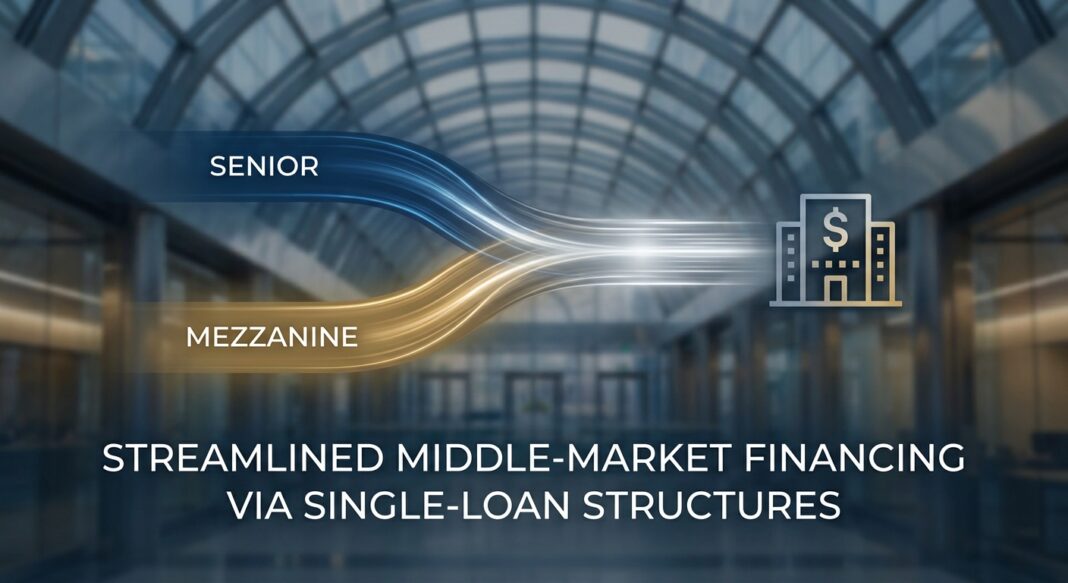
When One Loan Does the Work of Two
Imagine you need to finance a business acquisition. Traditionally, that meant negotiating with a bank for a senior secured loan, then finding a separate mezzanine lender willing to sit behind it: two sets of lawyers, two credit agreements, two intercreditor documents, and two approval processes to manage simultaneously. In the middle market, that complexity was often the bottleneck, not the cost of capital itself.
Enter the unitranche loan: a private credit innovation that collapses the entire debt stack into a single facility with one lender, one credit agreement, and one blended interest rate. Since its emergence roughly a decade ago, the unitranche has grown from a niche middle-market workaround into the dominant acquisition financing structure for companies with enterprise values below $1 billion. Understanding how it works (and when it makes sense) is foundational knowledge for anyone operating in private markets today.
What Is a Unitranche Loan and How Does It Work?
A unitranche facility is a hybrid debt instrument that combines what would otherwise be separate senior (first-lien) and subordinated (second-lien or mezzanine) debt into a single secured credit facility governed by one loan agreement. According to Mayer Brown, the structure offers borrowers simplicity, speed of execution, lower transaction costs, and a blended interest rate that typically sits between what pure senior debt and pure subordinated debt would each cost separately.
From the borrower’s vantage point, the loan feels like a single relationship. Behind the scenes, however, two types of lenders may be present, a first-out lender (who gets repaid first and accepts a lower yield) and a last-out lender (who absorbs losses first and earns a higher yield). Their internal arrangement is governed by an Agreement Among Lenders (AAL), a confidential inter-lender document that the borrower never sees. As noted by Wall Street Prep, the AAL establishes the waterfall payment schedule and allocation of fees and interest, functioning like a private intercreditor agreement embedded within the single loan structure.
This internal bifurcation is what makes the unitranche elegant: lenders can optimize their own risk-return profile internally while the borrower enjoys the operational simplicity of a single-document facility. Total leverage in a typical unitranche transaction runs approximately 4x to 6x EBITDA, according to CT Acquisitions (June 2026).
How the Numbers Work: A Concrete Example
Consider a lower-middle-market software company with $8 million in EBITDA seeking to finance a bolt-on acquisition at a $64 million enterprise value (an 8x EBITDA multiple). The sponsor contributes $24 million in equity (37.5% of EV) and needs to finance the remaining $40 million in debt (5x leverage).
Option A, Traditional Two-Tranche Structure:
- First-Lien Term Loan: $28 million at SOFR + 450 bps (all-in ~8.2%)
- Second-Lien Term Loan: $12 million at SOFR + 900 bps (all-in ~12.7%)
- Two separate credit agreements, two sets of legal counsel, two approval timelines
- Blended cost of debt: approximately 9.4%
Option B, Unitranche Structure:
- Single Unitranche Facility: $40 million at SOFR + 600 bps (all-in ~9.7%)
- One credit agreement, one lender relationship, one closing process
- Estimated legal savings: $200,000–$400,000 in transaction costs, per CT Acquisitions (June 2026)
The unitranche costs roughly 30 basis points more annually on an all-in basis, but it eliminates the intercreditor friction that can delay or kill deals. For a sponsor with a time-sensitive acquisition, the certainty of close is often worth that premium. Private Capital Global notes that private credit can close transactions within four weeks, while bank-led syndicated deals may require six to eight weeks for syndication.
Current Market Relevance
The unitranche is not just a structural curiosity; it has become the backbone of middle-market acquisition finance. The data tell a clear story about why this structure has gained such momentum.
Bank credit conditions remain restrictive. According to the Federal Reserve’s April 2026 SLOOS, banks reported tighter lending standards for commercial and industrial loans to firms of all sizes during Q1 2026, with significant net shares of banks also reporting tighter standards across non-depository financial institution (NDFI) loan categories including stricter covenants, higher premiums on riskier loans, and shorter maximum maturities. This institutional withdrawal from leveraged lending has directly expanded the addressable market for private credit unitranche providers.
Private credit has scaled dramatically to fill the void. According to PwC’s Global Private Credit Survey 2026, private credit now exceeds $2 trillion in global AUM, with a base-case forecast to reach $3.4 trillion by 2030. The asset class has expanded well beyond corporate direct lending into asset-backed finance, infrastructure debt, and specialty finance.
The largest managers have built unitranche at scale. According to S&P Global Market Intelligence (November 2025), Apollo Global Management’s private credit AUM stood at $723 billion as of Q3 2025, while Ares Management reported $391.5 billion in private credit AUM over the same period, each firm running unitranche as a core product. The unitranche market itself grew from roughly $20 billion in annual issuance in 2015 to over $200 billion in 2025, according to CT Acquisitions (June 2026).
Pricing has widened in borrowers’ favor, but structure has tightened. According to Lord Abbett’s 2026 Midyear Outlook (June 2026), citing PitchBook data, spreads have widened by roughly 50 to 100 basis points since late 2025, while new loans are increasingly featuring less leverage, more covenants, fewer payment-in-kind (PIK) requests, and tighter documentation, a materially lender-friendlier environment. Typical lower-middle-market unitranche spreads in 2026 run SOFR + 500 to 700 basis points, per CT Acquisitions (June 2026).
Performance has remained resilient. The Cliffwater Direct Lending Index (CDLI), which covers approximately 21,000 directly originated U.S. middle-market loan holdings totaling $549 billion in assets, returned 9.3% for full-year 2025 and has now delivered a 20-year average annual return of approximately 9.5%, with only one negative year in its history (2008). Interest income of 10.4% for 2025 remained the primary return driver, a figure directly underpinned by unitranche floating-rate structures.
| Metric | Data Point | Source |
|---|---|---|
| LMM Unitranche Spread (2026) | SOFR + 500–700 bps | CT Acquisitions, Jun 2026 |
| Typical Leverage (Unitranche) | 4x–6x EBITDA | CT Acquisitions, Jun 2026 |
| CDLI 2025 Annual Return | 9.3% | Cliffwater, Mar 2026 |
| Private Credit Global AUM | >$2 trillion | PwC, May 2026 |
| Spread Widening Since Late 2025 | +50 to +100 bps | Lord Abbett / PitchBook, Jun 2026 |
Decision Framework
For Investors Evaluating Private Credit Funds with Unitranche Exposure
- Assess first-out vs. last-out positioning: Bifurcated unitranche structures allocate risk differently internally. Investors in a fund holding last-out positions accept higher credit risk and should evaluate whether the yield premium adequately compensates, especially in a tighter documentation environment.
- Examine covenant quality: Post-2025, the market has shifted toward more lender-protective structures. Investors should ask managers whether new originations carry maintenance financial covenants, and what percentage of the portfolio is cov-lite.
- Evaluate credit loss history: The CDLI reported annual credit losses of just 0.75% as of Q2 2025, per Cliffwater data reviewed by Larry Swedroe (August 2025). Investors should benchmark prospective fund managers against this index-level figure to assess relative credit quality.
- Monitor floating-rate duration: Unitranche loans are almost universally floating-rate instruments. In a declining rate environment, all-in yields will compress, a dynamic investors should model across rate scenarios.
For Business Owners and Operators Considering a Unitranche
- Use unitranche when speed and certainty matter: If you are in a competitive acquisition process or have a time-sensitive need for capital, the single-lender, single-document model offers execution speed that bank-led syndicated processes cannot match.
- Compare the true all-in cost: The headline spread premium over a split first/second-lien structure is often 20–50 basis points. But factor in legal fees, process time, amendment costs, and ongoing lender management. The total-cost comparison often favors unitranche for transactions under $200 million in debt.
- Negotiate prepayment flexibility upfront: Unitranche lenders typically require call premiums for early repayment. Operators planning to refinance within the first two years should explicitly negotiate prepayment schedules before signing.
- Understand the AAL exists even if you don’t see it: If a unitranche has multiple lenders internally, the AAL will govern their behavior in a workout or amendment scenario. Operators should understand this dynamic and ask lenders how decisions requiring lender consent are made within their syndicate.
Key Takeaways
- One loan, two roles: A unitranche combines first-lien and subordinated debt into a single facility, the borrower sees one relationship while lenders internally allocate risk via a confidential Agreement Among Lenders (AAL).
- Speed is the structural advantage: Private credit unitranche providers can close transactions in roughly four weeks versus six to eight weeks for bank-syndicated deals, a decisive edge in competitive acquisition processes.
- Pricing has a range and a context: In mid-2026, lower-middle-market unitranche spreads run approximately SOFR + 500–700 bps, with spreads having widened 50–100 bps since late 2025 as lender protections have also improved.
- The market is institutional and growing: With global private credit AUM exceeding $2 trillion and the unitranche market surpassing $200 billion in annual issuance, this is no longer a niche product; it is the default financing mechanism for middle-market M&A.
- Structural quality matters more than headline yield: The 2026 market shift toward tighter covenants, lower leverage, and stronger documentation means the best unitranche lenders are not just offering yield; they are offering disciplined credit structures that protect against downside in a more uncertain economic environment.


