
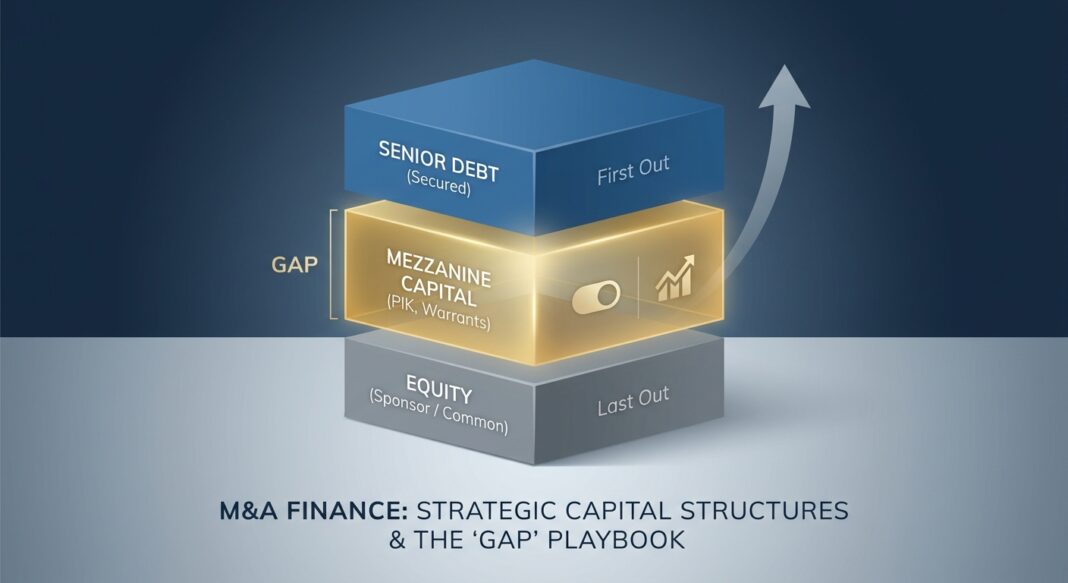
The Growth-Stage Gap Capital Playbook: How to Structure Mezzanine Financing for Acquisitions and Recapitalisations
When senior debt runs out and equity costs too much, the capital stack has a structural answer. Here is how growth-stage operators and sponsors should use it in 2026.
The Financing Challenge: You Have Outgrown Your Senior Lender
A business generating $5 million of EBITDA wants to acquire a bolt-on competitor priced at $30 million. The senior bank will lend 3.5x EBITDA, roughly $17.5 million. Sponsor or owner equity can cover another $10 million. That leaves a $2.5 million to $5 million gap sitting between the top of senior debt and the bottom of the equity cheque. This is the classic gap capital problem, and it surfaces in the same form across acquisition financing, dividend recapitalisations, and growth capital rounds.
The instinct is to solve the gap with more equity. But equity is the most expensive capital in the stack. ctacquisitions.com notes that sponsors targeting 20–25% IRR effectively price equity at the highest cost in any transaction, making it the last, not the first, resort for gap filling. Mezzanine debt (subordinated, PIK-capable, warrant-bearing) exists precisely to widen that gap without full equity dilution. Understanding when to use it, how to price it, and how to negotiate it is a foundational skill for any growth-stage operator or deal sponsor in 2026.
Structure Breakdown: The Capital Stack Layer by Layer
Layer 1: Senior Secured Debt (Cheapest, First Out)
Senior debt is the foundation of the acquisition stack. ctacquisitions.com reports that as of Q2 2026, senior secured lending for lower-middle-market (LMM) businesses runs SOFR plus 400 to 550 basis points, putting all-in coupons in the 9% to 10% range. Leverage is typically capped at 3.5x to 4.5x pro forma EBITDA depending on asset quality, revenue recurrence, and sponsor experience. Asset-based lending (ABL) facilities, where advance rates of 80–85% of eligible accounts receivable and 50–65% of eligible inventory are standard, extend this layer further for asset-heavy businesses.
Layer 2: Mezzanine / Subordinated Debt (The Gap-Filler)
Mezzanine sits below senior secured debt and above equity in the capital structure. Its defining structural features are:
- Cash coupon: a fixed interest payment typically paid quarterly
- PIK (Payment-in-Kind) toggle: accrued interest capitalised into principal rather than paid in cash, preserving operating liquidity during early hold periods
- Equity warrant or co-invest kicker: a small equity participation that closes the gap between the debt coupon and the provider’s target IRR
ctacquisitions.com reports that mezzanine tranches on LMM acquisitions in 2026 typically price between 11% and 13% cash coupon, with an additional 2% to 3% PIK toggle, plus warrants or small equity co-investment sized to yield a 15% to 18% all-in IRR. The PIK feature is what makes mezzanine attractive to growth-stage companies: it defers cash servicing obligations until cash flows mature.
ctacquisitions.com adds that mezzanine allows an operator to push effective debt capacity from the senior cap of roughly 3.5x EBITDA up to a total-debt cap of 4.5x to 5.5x, with warrant coverage, typically 1% to 5% of fully diluted equity, representing the provider’s upside while the operator retains voting control.
Layer 3: Preferred Equity
Where an operator wants to avoid additional debt covenants entirely, preferred equity is an alternative to the mezzanine tranche. ctacquisitions.com notes that a single tranche of preferred equity at 8% to 12% can replace a layer of mezzanine, with the key distinction being that preferred equity holders sit below all debt in a liquidation waterfall, taking higher risk in exchange for a cleaner documentation set.
Layer 4: Common Equity (Most Expensive, Last Out)
Sponsor equity, management rollover, and co-investment form the residual claim. ctacquisitions.com reports that sponsors typically write 40% to 55% of enterprise value as equity in 2026 deals, up from the 30% to 35% norms of 2018–2020, as senior debt multiples have compressed.
Worked Example: A $30M Acquisition with a Mezzanine Gap Layer
Consider an LMM platform company with $5M of EBITDA acquiring a bolt-on target at a 6x multiple, a $30M enterprise value. The buyer brings $8M of rollover or personal equity. Here is how the stack builds:
| Tranche | Amount | Leverage Multiple | Pricing (2026) | Key Features |
|---|---|---|---|---|
| Senior Term Loan | $17.5M | 3.5x EBITDA | SOFR + 450 bps (~9.5% all-in) | 1st lien, springing financial covenant, 1% OID |
| Mezzanine Debt | $4.5M | 0.9x EBITDA (incremental) | 12% cash + 2% PIK + 3% equity warrants | Subordinated, 7-yr term, 3-yr non-call, no maintenance covenants |
| Owner / Rollover Equity | $8.0M | N/A | Target 20–25% IRR | Voting control retained |
| Total | $30M | 4.4x EBITDA | Blended debt cost ~10.4% |
The mezzanine layer costs more on a nominal basis, but it preserves $4.5M of equity capital that would otherwise need to be raised from a dilutive partner. The PIK toggle means the first two to three years of interest can accrete into principal, protecting free cash flow during the integration period. ctacquisitions.com recommends planning the mezzanine refinancing 12 to 18 months before maturity, stress-testing whether senior debt capacity at exit EBITDA can absorb the remaining balance.
Mezzanine vs. Unitranche vs. Preferred Equity: Trade-Offs and Decision Logic
The primary structural alternative to a mezzanine gap layer is a unitranche facility, which collapses senior and subordinated debt into a single instrument. angelinvestorsnetwork.com notes that unitranche simplicity is decisive in competitive auction processes: private credit firms close unitranche deals in roughly four weeks versus six to eight weeks for a traditional senior-plus-mezzanine structure requiring intercreditor negotiation. angelinvestorsnetwork.com also reports that unitranche activity for large-cap borrowers reached $210 billion in 2024, more than double the $94 billion recorded in 2023.
For a strong middle-market credit, ibinterviewquestions.com puts unitranche pricing at SOFR plus 500 to 700 basis points (approximately 10%–12% all-in), compared to SOFR plus 350–475 basis points for traditional senior debt. This blended rate sits below the aggregate cost of a separate senior-plus-mezz structure in many cases, but it sacrifices structural flexibility, particularly the ability to negotiate with a second, independent capital provider on the subordinated layer.
The decision logic breaks down as follows:
- Use unitranche when speed of execution and intercreditor simplicity are paramount, when total leverage need is 4.0x to 5.0x, and when the borrower does not want separate covenant packages to manage.
- Use senior + mezzanine when total leverage needs to exceed 5.0x, when the borrower wants to negotiate independently with the subordinated layer (e.g., to minimise warrant dilution), or when the mezzanine provider offers sector expertise or board-level value-add beyond the capital itself.
- Use preferred equity when the company needs growth capital without the fixed-payment obligations of any debt instrument, and the operator is willing to accept a slightly more complex liquidation preference negotiation.
ctacquisitions.com notes that standalone mezzanine funds provide subordinated debt at 12%–14% cash plus 2%–3% PIK and are most relevant either as the sub-layer in a traditional senior-plus-mezz structure, or as “silver mezz” between a unitranche and equity for borrowers who need 6.5x to 7.5x total leverage.
Current Market Terms: What the 2026 Data Says
Five data points define the current structural environment:
- Mezzanine pricing has compressed. angelinvestorsnetwork.com notes that a decade ago, cash-plus-PIK mezzanine yields ran 14%–16%. Competition has compressed that to roughly 12%–14% today, with the CAIA Level 1 curriculum putting total target returns for mezzanine funds at 12%–17%.
- Unitranche spreads have also tightened. ctacquisitions.com reports that unitranche spreads on LMM buyouts compressed from SOFR plus 675–725 bps in early 2024 to SOFR plus 575–675 bps by mid-2026, with senior leverage typically capped at 4.0x to 4.5x pro forma EBITDA.
- Covenant frameworks are tightening after a period of lender competition. mondaq.com reports that 2026 has shown early signs of a correction, with new originations incorporating more robust covenant packages as lender discipline reasserts itself. In traditional middle-market unitranche deals, lenders rely on a quarterly-tested leverage-based maintenance covenant as an early-warning tool.
- Lenders are demanding more equity cushion. lordabbett.com confirms that new loans are increasingly coming with better credit structures: less leverage, more covenants, fewer PIK requests, and tighter documentation, with spreads widening roughly 50 to 100 basis points since late 2025.
- The private credit market has scaled dramatically. yannecapital.com reports that private credit AUM crossed $2.1 trillion in H1 2026, up from $1.5 trillion two years earlier (PitchBook, H1 2026 Private Credit), deepening the lender universe available to growth-stage borrowers at every point in the capital stack.
The Gap Capital Playbook: Five Steps from Quantification to Close
Step 1: Quantify the Gap
Before approaching any lender, build a lender-grade model with a base case and a downside scenario. Map the use-of-proceeds precisely: every dollar of the raise should be tied to a cash generation outcome. financely-group.com recommends defining the use of funds first and tying every dollar to an outcome that improves cash generation, then building the model with drivers that match how the business actually runs. Calculate senior debt capacity at the likely closing EBITDA (3.5x to 4.5x), subtract total deal cost, and the residual is the mezzanine quantum. Any remaining gap goes to equity.
Step 2: Clean the Data Room
Mezzanine lenders underwrite subordinated risk. They will stress the downside harder than a senior bank. Prepare AR and AP agings that reconcile to the general ledger, three years of audited or quality-of-earnings-reviewed financials, and a working capital analysis that normalises for seasonality. Customer concentration below 25% for the top customer (ideally below 15%) and recurring or contracted revenue are the attributes that determine whether a mezzanine provider will underwrite the full ask or haircut the amount.
Step 3: Run a Parallel Process
ctacquisitions.com reports that on recent LMM transactions in the $6M to $12M EBITDA range in Q2 2026, running three parallel unitranche processes alongside two senior-plus-mezz stacks compressed all-in cost of debt by 85 to 140 basis points versus single-path processes. Target five to ten mezzanine providers simultaneously, segregating by ticket size and sector expertise. Name providers with active programmes in your size band: Audax Private Debt, GoldenTree, HPS Investment Partners, Crescent Capital, Twin Brook Capital Partners, and NewSpring Mezzanine are among the named active participants.
Step 4: Set Controls Upfront
Lenders offering subordinated capital at mezzanine pricing will require information and reporting controls as a condition of pricing. financely-group.com frames these as non-negotiable for better pricing: blocked collections accounts, borrowing base certificates (for ABL layers), monthly management reporting, and lender inspection rights. Agreeing these upfront rather than negotiating them at the last minute avoids late-stage re-pricing.
Step 5: Respond Fast and Consistently
ctacquisitions.com notes that time to term sheet in a well-run LMM capital raise typically runs 45 to 60 days, with time to funding an additional 60 to 90 days. One data room, one point of contact for the process, and deadline discipline across all diligence requests are the operational factors that separate processes that close from those that stall.
Negotiation Guidance: Where Borrowers Have Leverage
For operators and CFOs, the most valuable negotiation points in a mezzanine term sheet are not the headline coupon, that is largely market-set, but the following structural terms:
- PIK toggle vs. mandatory PIK: negotiate for a toggle (your choice to pay cash or accrete) rather than mandatory PIK, which signals distress to future lenders.
- Warrant coverage percentage: ctacquisitions.com confirms that warrant coverage typically runs 1% to 5% of fully diluted equity. Push hard to keep this below 3% if EBITDA growth visibility is strong, as warrant exercise at exit is a meaningful value transfer.
- Call protection: a standard mezzanine structure carries a 3-year non-call period, then a 102/101/par schedule. Negotiate the non-call window down to 24 months if you have a clear path to refinancing at lower cost.
- Covenant headroom: chambers.com reports that financial covenant frameworks in private credit transactions are increasingly incorporating a springing financial covenant applicable only when the revolver is drawn above a set threshold, a borrower-friendly structure worth insisting upon.
- Board observer vs. board seat: most mezzanine providers will accept an observer right rather than a full seat if leverage is below 5.0x total. A board seat shifts governance costs and creates decision-making friction; resist it unless the provider brings tangible strategic value.
For investors and deal sponsors, the primary structural watch points are the intercreditor agreement between senior and mezzanine lenders (ensure standstill provisions do not unduly restrict your ability to refinance), the PIK capitalisation mechanics (confirm they do not trigger leverage covenant breaches at a specified total-debt multiple), and the equity warrant valuation methodology at exit (strike price, anti-dilution protection, and tag-along rights all affect realised returns).
Key Takeaways
- Mezzanine is a gap tool, not a default: deploy it only after maximising senior debt capacity. The right question is not whether to use mezz, but whether the use-of-proceeds (acquisition price, integration capex, or owner liquidity) generates sufficient EBITDA growth to service the combined stack and retire the warrant at exit.
- PIK is a cash-flow bridge, not free capital: payment-in-kind interest compounds into principal. A 2% PIK toggle on a $5M tranche accretes to roughly $5.52M after two years, model the exit debt load before agreeing to toggle provisions.
- Run competitive processes: the 85 to 140 basis point savings from running parallel unitranche and senior-plus-mezz processes is equivalent to roughly $85,000–$140,000 per year on a $10M debt stack, worth the additional process management cost on any deal.
- Covenants are tightening in 2026: after a period of lender competition producing loose structures, new originations are reverting to more robust packages. Negotiate headroom against realistic downside scenarios, not against the base case, and build in EBITDA-addback discipline before submitting financials to lenders.
- Structure the warrant correctly or it will be your most expensive capital: a 5% warrant at a $30M enterprise value costs $1.5M at par, before growth. If EBITDA doubles and the business exits at 7x, that warrant is worth $3.5M+. Treating warrant coverage as a footnote rather than a cost-of-capital input is the most common and most expensive mistake growth-stage operators make at the term sheet stage.


