
Bond Capital • Market & Sector Intelligence • July 23, 2026
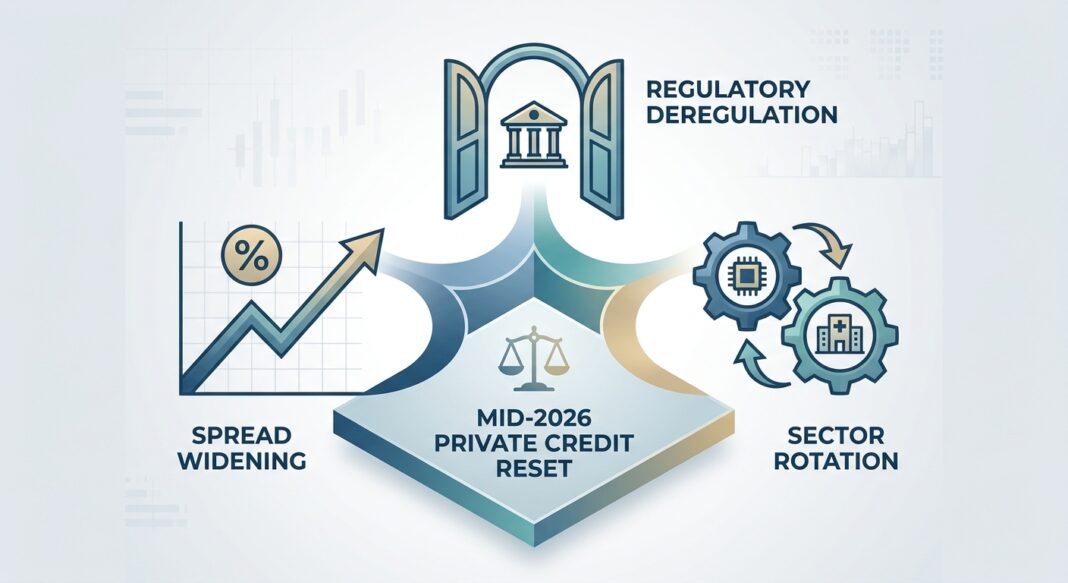
Lender-Friendly Reset: How Spread Widening, Regulatory Deregulation, and Sector Rotation Are Reshaping Private Credit in Mid-2026
A confluence of spread widening, BDC outflows, regulatory deregulation, and AI-driven sector rotation has produced the most significant lender-friendly reset in private credit since 2022. Bond Capital’s mid-2026 market snapshot unpacks the key KPIs, structural shifts, and actionable implications for operators and institutional investors.
I. Market Headline: The Lender Pendulum Swings Back
The first half of 2026 has delivered what many disciplined lenders anticipated but few borrowers wanted: a decisive rotation in bargaining power. After years of spread compression, covenant erosion, and borrower-friendly documentation, the private credit market has undergone a structural reset. The catalyst has been multi-vectored: an AI-driven sell-off in software valuations, net outflows from semi-liquid Business Development Companies (BDCs), a deregulatory sweep of bank leveraged lending guidance, and a Federal Reserve holding rates steady at 3.50%–3.75% through Q1 2026.
The result: lenders with dry powder are now negotiating from a position of strength not seen since late 2022. According to Lord Abbett’s 2026 Midyear Outlook, spreads in the private credit market have widened by roughly 50 to 100 basis points since late 2025, and “new loans are increasingly coming with better credit structures: less leverage, more covenants, fewer PIK requests, and tighter documentation.” That qualitative improvement in structure may matter more to long-term credit outcomes than the spread move itself.
Simultaneously, on the regulatory front, the OCC and FDIC rescinded the 2013 Interagency Leveraged Lending Guidance on December 5, 2025, removing the prescriptive 6x debt-to-EBITDA ceiling that had long channeled deal flow toward non-bank lenders. Banks may now compete more aggressively in leveraged finance, introducing a new competitive variable in the upper middle market. The Federal Reserve has not yet followed suit, leaving the full competitive impact still to materialize, but the direction of travel is clear.
Against this backdrop, Q2 2026 deal volumes tell a stark story: PitchBook LCD data recorded only $29.2 billion across 138 direct lending transactions through late June 2026, well short of the $74.1 billion across 217 deals transacted in Q1, itself the strongest quarter in two years. The volume drop reflects a geopolitically disrupted macro backdrop, a pullback in PE sponsor activity, and a market undergoing selective repricing rather than systemic stress.
II. Quantitative Market Snapshot
The table below synthesizes current pricing, credit quality, and deal-flow metrics across private and public credit markets as of mid-2026. All figures are sourced directly from institutional research and regulatory data.
Key Market Metrics: Mid-Year 2026
| Metric | Current Value (Mid-2026) | Prior Period Comparison | Source |
|---|---|---|---|
| Global Direct Lending Median Spread (New Issue) | ~544 bps over SOFR (year-end 2025); now widening 50–100 bps in H1 2026 | 596 bps (YE 2024); 666 bps (YE 2023); 716 bps peak (Mar 2023) | McKinsey Global Private Markets Report, June 2026 |
| Direct Lending All-In First Lien Yield (New Issue) | ~9.3% (2025 average); floor estimated at 8.0%–8.5% in 2026 given spread rebound | ~10.5% all-in yield in 2024 | Morgan Stanley Investment Management, 2026 Outlook |
| Publicly Syndicated & High Yield Spread Movement (BSL / HY) | Broadly syndicated and HY spreads widened ~15–30 bps on new issues, Q4 2025 to Q1 2026 | Near historically tight levels at YE 2025; now beginning to reprice risk | Northleaf Capital Q1 2026 Private Credit Update |
| New-Issue Leverage Multiple (Avg. Direct Lending) | 4.9x Debt/EBITDA (2025); FSB estimates “true” leverage may approach 7x with EBITDA addbacks | 5.0x (2024); 5.2x (2023) | FSB Vulnerabilities in Private Credit Report, May 2026; McKinsey, June 2026 |
| Interest Coverage Ratio (EBITDA/Interest, Leveraged Borrowers) | Improving from mid-2024 lows; sub-1.0x borrower share fell to 14% (Q4 2025) from 21–23% in 2023 | Average EBITDA/Interest coverage ~3.1x in 2024 vs. 4.0x+ in 2019–2022 | Partners Group Macro Insights, May 2026; Private Capital Global |
| KBRA Direct Lending Index 12-Month Default Rate | 1.5% (par-weighted, trailing 12 months through mid-2026) | KBRA projects rise to 2.0% by YE 2026; Moody’s 2025 range: 1.6%–4.7% incl. soft credit events | Penn Mutual Asset Management, June 2026; Northleaf Capital, May 2026 |
| Fed SLOOS: C&I Tightening (Large & Mid-Market Firms) | Net 8.1% of banks tightening C&I standards for large/mid-market firms (Q2 2026) | C&I tightening persisted across both Jan 2026 and Apr 2026 surveys; NDFI loan standards tightened by a “significant net share” | Federal Reserve April 2026 SLOOS; FRED DRTSCILM, Q2 2026 |
| Q2 2026 Direct Lending Deal Volume | $29.2 billion across 138 transactions (through June 22, 2026) | $74.1 billion across 217 deals in Q1 2026 (best quarter in two years by volume) | PitchBook LCD, July 2026 |
The data composite reveals a critical divergence: while reported headline default rates remain contained, structural risk indicators (PIK income share, EBITDA addback opacity, and BDC redemption flows) point to concentrated stress beneath the surface. The Morgan Stanley 2026 Midyear Private Credit Outlook notes that interest coverage ratios have inched higher and leverage ratios remained stable, concluding that “credit stress remains concentrated rather than systemic.” That distinction, concentrated vs. systemic, will drive lender selectivity for the remainder of the year.
III. Sector Analysis: Healthcare Ascends, Software Reprices, Infrastructure Attracts Capital
Software & Technology: Repricing in Progress
The most consequential sector shift of 2026 is the repricing of software exposure. Private leveraged finance markets carry approximately 20% software exposure versus ~13% in the liquid leveraged loan market, according to Lord Abbett’s midyear analysis citing PitchBook and Morningstar LSTA data. Concerns over AI disruption to software-as-a-service business models, particularly the threat to ARR-based underwriting assumptions, triggered the wave of BDC redemption requests that began in early 2026. As noted by CAIA, one major BDC platform saw investor withdrawal requests exceeding 40% of shares in its technology-focused vehicles. Lenders are actively shifting underwriting frameworks from ARR-based to EBITDA-based metrics for software credits, demanding wider spreads to compensate for uncertainty, per Partners Group.
Healthcare: The New Anchor Sector
Healthcare has overtaken Technology as the leading private credit sector by deal count in 2026. PitchBook LCD’s Q2 wrap confirms healthcare surpassed technology in direct lending transaction share since the year began. According to Octus Data, healthcare led all sectors in 2025 direct lending deals at 19% of total activity, and was the only industry not to experience significant year-over-year spread tightening, indicating lenders are pricing in quality, not just volume. Demographic tailwinds, non-cyclical service models, and stable recurring cash flows continue to make healthcare a preferred home for institutional capital seeking reliable FCCR profiles.
Infrastructure, AI Build-Out & Asset-Based Finance: The Structural Growth Engine
Beyond direct lending, McKinsey’s Global Private Markets Report (June 2026) identifies infrastructure credit as a particularly fast-growing segment, driven by data center, fiber, and power generation demand from the AI build-out. Meta’s use of private markets to finance a $29 billion Louisiana data center project illustrates the scale. Asset-based finance (ABF) fundraising totaled $70 billion in 2025, and McKinsey estimates the U.S. addressable private credit market could exceed $30 trillion as bank balance sheet assets migrate to non-bank lenders. Private credit is also financing large-scale renewable energy developments and, per Chambers & Partners, leading the development of financing structures for AI-related infrastructure at scale.
Commercial Real Estate: Selective Retreat
Private credit appetite for office property has diminished materially. S&P Global Market Intelligence notes that questions around office utilization, compounded by technological and workplace changes, are directly influencing lending decisions, shifting capital toward infrastructure-linked CRE and away from traditional office assets. The April 2026 SLOOS corroborates this: large domestic banks reported an easing of standards on construction and land development CRE (net -10.5%), even as C&I standards continued to tighten.
IV. Implications: What This Means for Borrowers, Lenders, and Institutional Investors
For Borrowers and Operators
The repricing environment is most acute for companies with high software concentration, weak EBITDA conversion, or reliance on PIK-toggle structures. The With Intelligence 2026 Outlook notes that when selective defaults and liability management exercises are included, the “true” private credit default rate approaches 5%, a figure that materially changes lender risk appetite for lower-quality credits. Borrowers in the lower middle market with sub-1.5x FCCR or debt/EBITDA above 5.5x (unadjusted) will face meaningfully tighter documentation, maintenance covenants, and pricing in H2 2026. For better-positioned companies (particularly those in healthcare, industrial services, or infrastructure-adjacent sectors) the reset represents an opportunity to lock in financing at improved structural terms before competition recovers.
Hybrid capital structures have also become a fixture of the market. Octus reports that 2020–2021 vintage deals facing capital structure challenges are turning to hybrid debt-equity solutions to realign balance sheets, allowing PE sponsors to “manage equity check size” in a difficult exit environment. Critically, per Nodem’s NAV Financing Mid-Year Update, 90% of NAV borrowers in H1 2026 elected PIK interest (vs. 10% cash pay), a structural indicator that portfolio-level liquidity preservation is now prioritized over cash debt service.
For Institutional Lenders and Investors
The lender-friendly reset creates a historically attractive vintage opportunity for disciplined deployers. Morgan Stanley Investment Management observes that “periods of investor caution have historically coincided with some of the most attractive lending vintages,” and the current environment increasingly resembles those periods. Lenders with established sponsor relationships and robust origination infrastructure have access to a deal set that is both wider in spread and tighter in documentation than at any point since 2022.
The regulatory landscape adds a further dimension. Mayer Brown’s analysis notes that the OCC and FDIC rescission of leveraged lending guidance “potentially creates additional competition in the private credit loan market” from re-entering banks. However, Winston & Strawn cautions that “banks may continue to remain constrained by capital requirements, liquidity considerations, syndication risk, and investor appetite for higher-leveraged structures”, meaning the competitive displacement of private credit by banks is likely to be gradual and concentrated in the upper middle market rather than the core middle market.
For institutional allocators, the key portfolio management imperative is bifurcation. Moody’s flags that PIK income as a share of BDC investment income has continued to rise, and that “as of March 2026, average PD-implied risk for public BDCs exceeded that of Baa-rated public corporates by the widest margin since post-pandemic normalization.” Monitoring PIK-to-total income ratios and non-accrual trends at the individual fund level is now a primary credit quality KPI.
V. Forward-Looking View: H2 2026 and Beyond
The path forward for private credit is bifurcated at every level: by market segment (lower vs. upper middle market), by sector (healthcare and infrastructure vs. software), by structure (institutional platforms vs. semi-liquid retail vehicles), and by credit quality (EBITDA-generative vs. PIK-reliant). Morgan Stanley’s midyear view states that “forward return potential is more attractive today than it was at the start of the year, supported by wider spreads, stable borrower fundamentals and growing financing demand.”
Three dynamics will define H2 2026. First, the software refinancing wall: Partners Group estimates nearly 50% of software loans maturing through 2030 come due by 2028, with the bulk of refinancing pressure concentrated in mid-2027, providing a meaningful buffer but requiring active monitoring now. Second, M&A-driven deal flow: PitchBook LCD notes that Q2 activity was dominated by non-LBO refinancings and extensions; a recovery in sponsor M&A would materially shift the deal mix toward new origination in H2. Third, the Fed rate path: with the federal funds rate held at 3.50%–3.75%, Northleaf Capital notes that market participants have repriced for rates to “remain higher for a longer period than previously expected,” supporting absolute yield floors in private credit even as spreads partially recover from their 2025 trough.
The broader structural story remains intact: Cleary Gottlieb notes that direct lending now matches the broadly syndicated loan market at $1.5–$2 trillion and is forecast to reach $3 trillion by 2028. Near-term volatility in semi-liquid vehicles and concentrated sector stress represent cyclical friction, not a structural reversal. For long-term institutional allocators, the mid-2026 reset looks increasingly like a vintage entry point for those with capital, relationships, and underwriting discipline.
VI. Key Market Insights
- Spread Widening Is Real but Structural Improvement Is the Bigger Story: Private credit spreads have widened 50–100 bps since late 2025, but the more durable lender benefit is tighter documentation: more covenants, reduced PIK optionality, and lower leverage thresholds on new originations. Operators and borrowers should expect FCCR floors and maintenance covenant tests to return to new deal standards in H2 2026.
- Software Remains a Credit Watchlist Item Through 2028: With ~20% of private credit portfolios exposed to software and nearly $105 billion in directly originated and leveraged software loans maturing by 2028, the refinancing cycle will be the defining credit event for the asset class. Lenders migrating from ARR- to EBITDA-based underwriting frameworks will impose material repricing on legacy credits with sub-threshold cash conversion.
- Healthcare and Infrastructure Are the Preferred Lender Sectors: Healthcare leads 2026 direct lending by deal count, while AI-infrastructure finance and asset-based lending are absorbing capital seeking diversification from compressed direct lending spreads. These segments offer lenders superior FCCR visibility and structural protections unavailable in more competitive upper-market segments.
- Bank Re-Entry Is a Long Game, Not a Near-Term Shock: The OCC/FDIC rescission of leveraged lending guidance enables banks to re-engage in higher-leverage transactions, but capital constraints, syndication risk, and investor appetite for covenant-light structures will limit their competitive impact to the upper middle market in 2026. The core middle market (<$50M EBITDA) remains a structurally protected zone for non-bank lenders.
- PIK-to-Total-Income and Non-Accrual Rates Are the Key KPIs to Monitor: With public BDCs receiving an average of 8% of investment income via PIK, and Moody’s flagging the widest BDC-to-investment-grade PD spread since post-pandemic normalization, PIK trajectory and non-accrual rates are now the leading indicators for private credit portfolio health. Investors should prioritize transparency on these metrics when evaluating manager selection and allocation sizing through year-end.


