
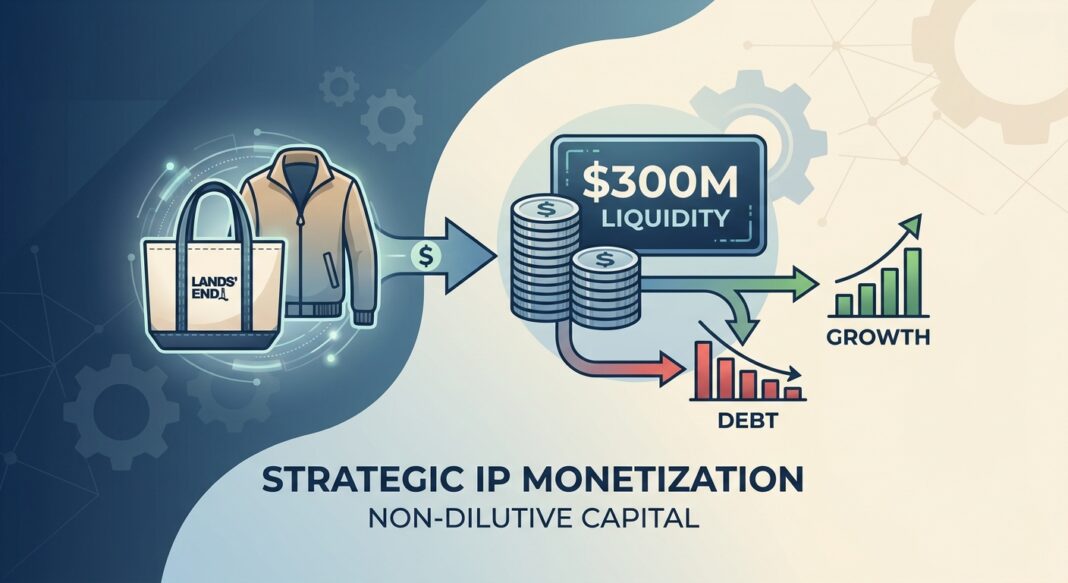
The Story: A $1.3 Billion Brand Hiding on a Struggling Balance Sheet
In January 2026, Lands’ End (NASDAQ: LE) looked, on the surface, like a retailer stuck in neutral. The Dodgeville, Wisconsin apparel company (best known for its no-nonsense outerwear, swimwear, and school uniforms) had posted FY2025 net revenue of $1.34 billion and adjusted EBITDA of $102.3 million. But the balance sheet told a harder story: roughly $234 million in term loan debt was quietly consuming cash, constraining strategic flexibility, and suppressing the stock price.
The business was operationally sound. The brand was genuinely powerful. But the capital structure was working against the company, not for it. Management faced a classic crossroads: raise dilutive equity to pay down debt and fund growth, sell the company outright, or find a third path.
They found the third path.
On January 26, 2026, Lands’ End announced a joint venture with WHP Global, a leading brand management firm. The structure was elegant in its simplicity: Lands’ End would contribute all of its intellectual property: trademarks, licensing agreements, brand assets, into a newly formed entity, and WHP Global would pay $300 million in cash for a 50% controlling interest in that JV. Lands’ End retained the other 50%, kept full operational control of its direct-to-consumer and B2B businesses, and walked away with $300 million to deploy. Shares jumped more than 17% on the announcement day alone.
This was not a sale. This was not a VC round. This was one of the most instructive capital structure moves of 2026, a leveraged recap built on the hidden value of intellectual property.
The Decision: Three Options on the Table
To appreciate what Lands’ End actually did, consider what they didn’t do. The company had three conventional options in front of it:
- Equity raise: Issue new shares to raise capital for debt repayment and growth initiatives. Dilutive. Sends a distress signal to the market. Surrenders upside at a depressed valuation.
- Strategic sale: Sell the company outright to a strategic acquirer or private equity sponsor. Provides full liquidity but ends the story, and likely at a price that does not reflect the brand’s latent global potential.
- IP monetization via structured JV: Carve out the brand’s intellectual property into a separate entity, sell a stake to a specialist partner with a global licensing platform, take in cash proceeds, and retain the operating business and a 50% interest in the IP vehicle.
The structure they chose was deliberately non-dilutive at the operating company level. According to the company’s 8-K filing with the SEC, Lands’ End contributed all IP and licensing assets to the joint venture and received $300 million in cash for a 50% controlling interest granted to WHP Global. The JV implied a $748.6 million valuation for the brand assets alone, a number that had never been visible on the public balance sheet.
The capital deployment plan was equally disciplined. Management used the majority of the $300 million to fully repay the $234 million term loan, eliminating long-term debt entirely. The remainder was earmarked for general corporate purposes, including a freshly authorized $100 million share repurchase program, a further signal of balance sheet confidence.
WHP Global, for its part, gained governance control at the JV level and the right to deploy its global brand-management platform across new licensing categories, international markets, and channel expansions. The deal included a guaranteed minimum royalty of $50 million per year back to the JV for the first 11 contract years, creating a durable, high-margin income stream that neither party could have generated alone.
The Outcome: A Transformed Capital Structure, and a More Complex Operating Model
The transaction closed on April 1, 2026. What happened next is a lesson in both the power of non-dilutive capital engineering and its honest trade-offs.
On the positive side of the ledger, the results were decisive. The $234 million term loan was extinguished in full, materially reducing interest expense and freeing cash flow for reinvestment. Q1 FY2026 net income surged to $330.7 million, driven by a $491.6 million accounting gain on the JV transaction, the gap between the JV’s implied brand valuation and the book value previously carried on Lands’ End’s balance sheet. The board authorized a $100 million share repurchase program running through March 2029. Europe eCommerce revenue rose 14.5% year-over-year to $20.5 million, validating early signs of the global expansion thesis.
WHP Global also completed a $45-per-share tender offer for approximately 7.2% of Lands’ End’s outstanding common stock, injecting an additional ~$100 million of liquidity directly to shareholders, with the offer oversubscribed.
But the Q1 operating numbers were also an honest reminder that restructured capital comes with restructured economics. Adjusted EBITDA swung to a loss of $6.2 million versus a $9.5 million profit a year earlier, partly reflecting new royalty obligations back to the JV, a warehouse management system transition that disrupted fulfillment, and tariff headwinds. Gross margin compressed by approximately 410 basis points. Core revenue fell 8.5% to $238.9 million, much of it attributable to the operational disruption rather than underlying demand weakness.
The counterfactual is instructive. Had Lands’ End instead issued equity to reduce debt, at the stock’s pre-deal trading levels around $11, shareholders would have suffered meaningful dilution at a depressed price. Had they sold outright, the operating team and long-term shareholders would have captured none of the future licensing royalty upside or the potential to exchange their JV stake for WHP Global equity in a future monetization event. The IP monetization path captured immediate de-leveraging, maintained operational independence, and preserved multiple paths to future value creation.
The Lessons: What Every Operator Should Take Away
The Lands’ End / WHP Global transaction is, at its core, a story about recognizing hidden value within a business and finding a capital structure partner willing to pay for access to it. Here are the principles that transfer directly to founders, family businesses, and owner-operators considering their next capital decision.
1. Your Balance Sheet May Contain Monetizable Assets You Have Never Priced
Lands’ End carried its brand IP at book value. The JV implied a $748.6 million market value for those same assets. Intangible assets (brand equity, proprietary technology, customer relationships, licensing rights) are systematically undervalued on traditional balance sheets. A structured IP carve-out, royalty securitization, or sale-leaseback of intangibles can unlock that value without touching the equity table.
2. Non-Dilutive Liquidity Is a Discipline, Not a Fallback
A leveraged recap is not what you do when you cannot raise equity; it is often the more disciplined choice even when equity is available. The leverage taken on is specific, purposeful, and tied to an asset with knowable cash flow characteristics. As data from the lower middle market shows, leveraged recapitalizations typically close at 3x to 5x EBITDA in total debt, with structure and covenants negotiated upfront, giving operators clear visibility on debt service obligations versus the open-ended dilution clock of institutional equity.
3. The Royalty Model Creates Durable, High-Margin Cash Flow
The $50 million guaranteed annual minimum royalty embedded in the Lands’ End JV is a structural innovation worth studying. By licensing back its own brand, the company trades some gross margin for a guaranteed, contractual income stream for the JV. For operators in branded consumer, media, technology, or licensing-adjacent businesses, this framework (monetize the IP, license it back, retain the operations) is increasingly viable and increasingly funded by specialist private credit and brand management firms.
4. Debt Reduction Is Equity Creation
Every dollar of term debt repaid is a dollar of equity value unlocked. This is not a theoretical point. The Lands’ End recap converted $234 million of interest-bearing liability into zero, immediately improving free cash flow, reducing financial risk, and creating room for the $100 million buyback. In an environment where mezzanine debt prices at an all-in yield of 13–17% and senior secured lending remains conservative, operators who can access non-dilutive capital to retire expensive legacy debt are engineering real equity returns for themselves and their shareholders.
5. Structure Future Optionality Into Every Deal
One of the most sophisticated elements of the Lands’ End transaction is the embedded future option: in the event of a qualifying WHP Global monetization (an IPO or majority sale) Lands’ End may exchange its JV stake for WHP Global equity at the same valuation multiple. This is pure optionality, structured into the deal at no additional cost. It is a reminder that well-structured capital transactions do not just solve today’s problem; they create tomorrow’s opportunity.
Key Insights
- IP as collateral: The Lands’ End deal proved that brand intellectual property can be structured as a monetizable asset generating $300 million in immediate, non-dilutive cash, without selling the operating business or issuing a single new share.
- Debt repayment is the best equity play: Eliminating $234 million in term debt instantly improved financial flexibility, enabled a $100 million buyback, and created a clean balance sheet, all from one structurally elegant transaction.
- The JV model beats the full sale: By contributing IP to a jointly governed entity rather than selling outright, Lands’ End retained 50% of the IP upside, full operational control, and an embedded option to participate in WHP Global’s future value creation.
- Market conditions favor the recap right now: With M&A exit activity constrained, IPO windows unpredictable, and dividend recaps surging in H1 2026, the leveraged recap has become a primary, not secondary, liquidity tool for operators and PE sponsors who refuse to sell at the wrong time.
- The royalty trade-off is real and must be modeled: Non-dilutive IP monetization introduces new cost lines: royalty payments, JV governance complexity, and restructured margin economics. The Lands’ End transition quarter showed compressed margins as the new model bedded in. Operators must model the full royalty burden, not just the headline cash proceeds, before executing.
The Decision Framework: Is an IP-Backed Recap Right for You?
| Condition | Favors IP Recap | Disfavors IP Recap |
|---|---|---|
| IP / brand value vs. book value | Large gap, IP significantly undervalued | IP fully reflected in current valuation |
| Existing debt burden | High, recap proceeds reduce leverage | Already clean balance sheet |
| Operating control priority | High, owner wants to remain in the seat | Low, owner ready for full exit |
| Royalty absorption capacity | Strong EBITDA can absorb new royalty line | Thin margins, royalty would impair operations |
| Strategic partner availability | Specialist buyer exists who values the IP | No natural buyer for the IP vehicle |


