
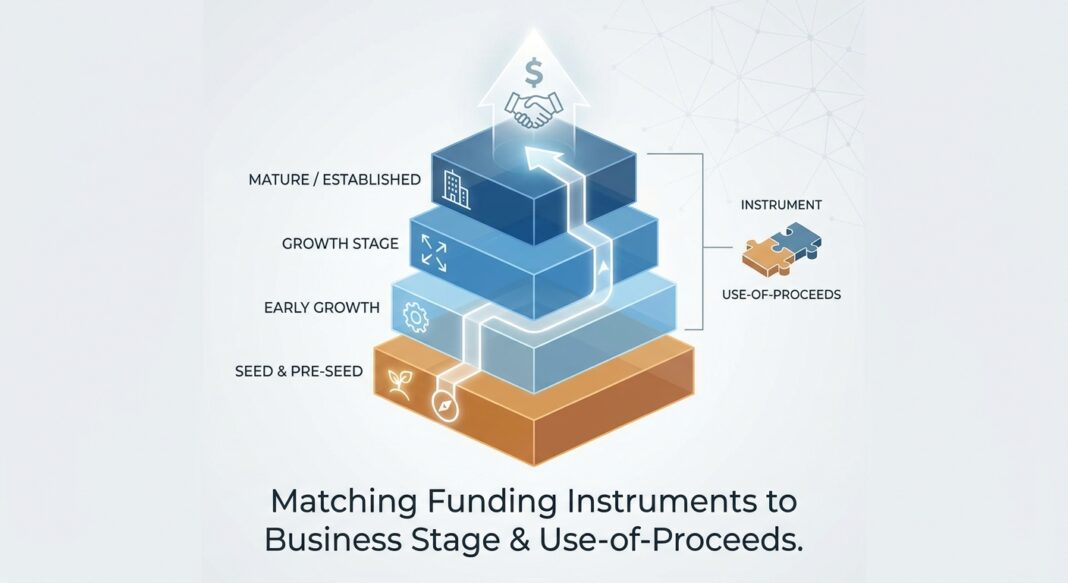
The Capital Gap Is Not a Funding Problem: It Is a Structuring Problem
Most operators and founders experience the capital gap the wrong way: they feel it as a rejection letter, a stalled process, or a term sheet that doesn’t fit. What they are actually encountering is a mismatch between the instrument they pursued and the business stage they occupy. Capital markets are not a single market; they are a layered ecosystem, each layer priced to a distinct risk profile, a distinct use-of-proceeds logic, and a distinct relationship with control.
The cost-of-capital spectrum runs, roughly, from the cheapest and most constrained (senior bank debt) through private credit, mezzanine, preferred equity, and up to common equity: the most expensive, dilutive, but least restrictive layer. Navigating that spectrum is not about finding the lowest rate. It is about matching the instrument’s structure to the moment: the stage of the business, the specific use-of-proceeds, and the cash flow profile that will service (or retire) the obligation.
This article maps that match explicitly, stage by stage, from seed through mature operations, and provides a tactical playbook for quantifying the gap, preparing materials, running the process, and negotiating the structure.
Stage-by-Stage Capital Map: What Each Phase Needs and Why
Stage 1: Seed & Pre-Seed, Concept Capital
Primary use-of-proceeds: Product development, MVP validation, early team hires.
At the earliest stage, there is little to lend against. No recurring revenue, no operating history, no collateral base. The capital stack here is almost entirely equity or equity-adjacent. SAFEs (Simple Agreements for Future Equity) have become the de facto instrument for U.S. pre-seed rounds because they are simpler, carry no maturity date, and remove the debt-repayment clock that convertible notes impose. The risk is asymmetric: investors expect a high failure rate and price accordingly, targeting portfolio-level returns rather than company-level cash yield.
Structurally, the capital available here is the most expensive on a dilution-adjusted basis. Founders giving up 20–30% at a $5–15M valuation cap are paying an implied cost of capital that would look extraordinary on a traditional financing model. The trade-off is access, no bank will write this check, and no private credit fund will structure a term loan against an unproven concept.
Instrument fit: SAFEs, convertible notes (4–8% interest, 18–24 month maturity), and angel equity. Institutional venture capital begins entering at late seed if traction signals exist.
Stage 2: Early Growth (Series A/B), Scaling Capital
Primary use-of-proceeds: Go-to-market buildout, team expansion, market penetration, and infrastructure investment.
Series A capital is deployed once a company has validated its product and initial business model and now needs capital to scale operations, expand the team, and prove it can grow efficiently. The Series A market has become more selective: the median time between seed and Series A has stretched to around 24 months, and the median valuation has reached approximately $47.9M. Investors at this stage want to see unit economics (CAC payback periods, net revenue retention, and gross margin) not just growth curves.
Importantly, this is also where non-dilutive debt begins to make a structural appearance for the first time. Venture debt: typically 20–35% of the last equity round, priced at SOFR plus 400–700 bps with a warrant coverage of 0.5–2.0%, can supplement an equity raise to extend runway without additional dilution. It works best as a bridge instrument when the use-of-proceeds is clearly operational (working capital, hiring, marketing spend) rather than capital-intensive or speculative.
Instrument fit: Institutional VC (Series A leads), venture debt as supplement, revenue-based financing for SaaS companies with predictable ARR. Revenue-based financing typically returns 3–15% of monthly revenue until a 1.1–1.5x cap is repaid.
Stage 3: Growth Stage (Series C and Above, or $5M+ EBITDA), Expansion Capital
Primary use-of-proceeds: Market expansion, acquisitions, geographic entry, platform buildout.
This is the inflection point where the capital stack becomes genuinely multi-layered and the structuring decision has the highest consequence. Companies with $5M+ EBITDA and recurring revenue profiles now have access to the full spectrum: bank revolvers, unitranche term loans, mezzanine, preferred equity, and growth equity. The cost differential between these layers is wide, and the structural implications are wider.
The dominant instrument in sponsor-backed growth-stage transactions in 2026 is the unitranche. Unitranche debt combines what would otherwise be senior and mezzanine layers into a single tranche with one lender and one credit agreement. This structure has become the financing standard for acquisitions valued between $25M and $200M enterprise value, with roughly 70–80% of deals in that range using at least partial unitranche funding. Current 2026 pricing is SOFR + 500–700 bps plus a 2–3% original issue discount (OID) and a 2–3% prepayment fee declining over the first 24 months. All-in cost for a typical 5x leverage deal runs approximately 9.5–11% blended.
The alternative, a traditional senior-plus-mezzanine split, prices at roughly 9–10.5% all-in on a 50/50 senior/sub split, materially similar to unitranche on cost, but with significantly more execution complexity, two intercreditor relationships to manage, and 30–45 additional days to close.
For companies that need more leverage than senior debt alone provides but want to minimize execution friction, unitranche is frequently the optimal path. Where leverage needs exceed what unitranche lenders will provide, typically above 5.0–6.0x EBITDA, mezzanine enters as the gap-fill instrument, sitting subordinated to senior debt and structured with a combination of cash interest (8–12%), PIK interest (2–4% compounding to principal), and equity kickers (warrants covering 1–5% of fully diluted equity) to target a 16–22% all-in IRR for the lender.
Instrument fit: Unitranche ($25M–$200M EV deals), mezzanine for deals requiring leverage above unitranche capacity or where equity dilution must be minimized, bank revolvers for working capital overlay.
Stage 4: Mature / Established, Optimization Capital
Primary use-of-proceeds: Acquisitions, recapitalizations, refinancings, dividend distributions, succession.
Mature businesses with stable EBITDA and collateral depth have access to the cheapest debt in the market: broadly syndicated loans (BSLs) for companies above $300M EV, asset-based lending (ABL) facilities for asset-intensive businesses, and investment-grade revolvers for the largest credits. For companies in the $50M–$300M EV range, private credit unitranche or club syndications remain the most practical execution path.
At this stage, the capital strategy question shifts from access to optimization. The goal is typically to minimize the weighted average cost of capital (WACC), extend maturities to reduce refinancing risk, and preserve flexibility for strategic action. Refinancing into a lower-spread instrument, adding a PIK toggle to preserve cash during integration periods, or layering in preferred equity to fund a dividend recap without triggering senior debt restrictions; these are the structural moves that define mature-stage capital strategy.
Instrument fit: BSLs, ABL revolvers, private credit term loans, preferred equity for recap situations, seller notes for succession transactions.
The Cost of Capital Spectrum: From Banks to Equity
Understanding where each instrument sits on the cost-of-capital spectrum is foundational to structuring decisions. The table below maps the spectrum as it stands in mid-2026:
| Instrument | Typical All-In Cost (2026) | Leverage / Coverage | Covenant Package | Control / Dilution |
|---|---|---|---|---|
| Senior Bank Revolver | SOFR + 175–350 bps (~7–9%) | 2.5–3.5x EBITDA | Maintenance (quarterly) | None (no dilution) |
| Unitranche (Private Credit) | SOFR + 500–700 bps (~9.5–11%) | 4–6x EBITDA | 1–2 maintenance covenants | None (no dilution) |
| Mezzanine / Sub Debt | 12–15% cash + 2–4% PIK + warrants (~16–22% IRR) | Sits above senior; total leverage 5–7x | Incurrence (action-gated) | Equity kicker: 1–5% warrants |
| Preferred Equity | 12–18% (cumulative dividend) | No leverage limit; behind all debt | Governance rights, protective provisions | Dilutive; board seat common |
| Growth / Venture Equity | 20–35%+ (IRR target) | N/A | Board control, information rights | Significant dilution (20–30% per round) |
Sources: CT Acquisitions (2026 Unitranche Guide), Carta Mezzanine Debt Overview, Capstone Partners Winter 2025 Leveraged Finance Report, IBInterviewQuestions Mezzanine Explainer (2025–2026).
The key structural insight: cheaper debt requires more covenant protection and less leverage tolerance; more expensive instruments offer greater flexibility, more leverage, and deferred cash burden: at the cost of dilution or higher overall yield to the capital provider.
Covenant Design: The Overlooked Structural Variable
No capital structure discussion is complete without covenant architecture. Covenants determine when lenders can intervene, what operational restrictions apply, and how much value leakage is possible between a performance deterioration and a formal default event.
There are two fundamental covenant types:
- Maintenance covenants require borrowers to pass financial tests every quarter regardless of any action taken, a recurring trip wire that gives lenders early intervention rights. Common tests include maximum leverage (Total Debt / EBITDA ≤ 5.5–6.0x) and minimum fixed charge coverage (EBITDA / Interest ≥ 2.0–2.5x). These are the standard in private credit and bank lending for mid-market transactions.
- Incurrence covenants are permissioning tests triggered only when a borrower proposes a specific transaction: raising new debt, paying a dividend, or making an acquisition. A borrower can sit on deteriorating financials for quarters without triggering lender intervention rights. This structure is standard in broadly syndicated loans (BSLs) and high-yield bonds.
The market divide is stark: covenant-lite institutional leveraged loans represented 91.7% of large corporate new-issue institutional loans in the United States in 2024 (per PitchBook LCD). By contrast, private credit lenders have maintained firmer positions on covenant inclusion, particularly for mid-market transactions, where most unitranche facilities retain at least one financial maintenance covenant.
Competitive pressure is blurring this line. To match BSL pricing and terms, many private credit funds are now offering “covenant loose” structures, technically containing a maintenance covenant, but set at cushions so generous that triggering is unlikely. Operators negotiating unitranche term sheets in 2026 should push for the widest possible EBITDA definition (with addbacks for non-cash charges, integration costs, and synergies), the highest permissible leverage test threshold, and a minimum 30–35% cushion between projected EBITDA and the test trigger level.
For operators: Maintenance covenants are not inherently punitive, a well-set covenant with adequate headroom provides a structured communication pathway with your lender if performance diverges from plan. The risk is an aggressive step-in trigger that forces a technical default before management has time to course-correct. Negotiate the cushion, not just the rate.
The Gap Capital Playbook: Quantify, Prepare, Process, Negotiate
Step 1: Quantify the Gap
Before approaching any lender or investor, build a precise use-of-proceeds model. This is not a high-level summary; it is a line-item waterfall that answers: What is the total capital need? What does each dollar fund? What is the projected return on that deployment? And what is the cash flow profile that will service the obligation?
Map senior debt capacity first, typically 2.5–3.5x EBITDA for banks, 4–6x for private credit unitranche. The gap between that capacity and the total capital need is the target layer: mezzanine, preferred equity, or additional equity. Sizing this gap precisely determines which instruments are viable and which providers to approach.
Key metrics lenders underwrite to (2026 standards):
- Total leverage: 4.0–6.0x EBITDA for unitranche; up to 6.5–7.0x with mezzanine overlay
- Interest coverage: Minimum 1.5–2.0x for aggressive structures; 2.5x+ preferred by conservative lenders
- Free cash flow conversion: Lenders focus on cash EBITDA less maintenance capex as the true debt service base
- Revenue quality: Recurring, contracted revenue commands higher leverage tolerance; project or cyclical revenue is discounted
Step 2: Prepare Materials
A 2026 private credit lender package for a unitranche acquisition typically requires three years of audited financials plus trailing-twelve-month (TTM) interim statements, a quality of earnings (QoE) report from a recognized accounting firm, a management presentation, five-year projections with capex and working capital build, and a customer and supplier concentration analysis.
The QoE report is the single most heavily scrutinized document. Lenders will not accept management-prepared EBITDA adjustments without independent validation. Sponsors and operators who commission a QoE early, ideally before LOI in an acquisition context, close materially faster than those who begin diligence reactively.
For mezzanine specifically, lenders also underwrite to the equity story: growth trajectory, management quality, and the credibility of the deleveraging plan. Mezz providers are subordinated, their primary protection against loss is equity value, not asset coverage. A compelling narrative about how the business grows into its capital structure is as important as the financial model itself.
Step 3: Run a Competitive Process
Whether accessing unitranche, mezzanine, or preferred equity, run a structured competitive process with a minimum of three to five lender or investor conversations simultaneously. The leverage in negotiating a term sheet comes entirely from having a credible alternative. In a single-lender process, the provider controls terms; in a competitive process, the borrower does.
For unitranche in the lower middle market ($25M–$100M EV), the core lender universe includes Ares Capital, Blue Owl, Antares Capital, Twin Brook, Apollo Direct Lending, Golub Capital, and Monroe Capital. For mezzanine, BDCs (Ares, Blue Owl, Main Street) and specialty funds (Audax Mezzanine, Madison Capital, Maranon Capital) are the primary providers.
Unitranche deals can close in 45–90 days versus 90–150 days for broadly syndicated alternatives, a speed premium that sponsors have consistently shown willingness to pay 50–100 bps in spread to capture.
Step 4: Negotiate the Structure
The highest-value negotiation points in a private credit term sheet, in order of structural importance:
- EBITDA definition and addbacks: The base on which leverage, coverage, and covenant tests are calculated. A broader EBITDA definition directly increases headroom. Negotiate inclusion of run-rate synergies, non-cash charges, and integration costs for a minimum of 12–18 months post-close.
- Covenant cushion: The spread between projected EBITDA and the maintenance covenant test trigger. A 30–35% cushion is standard market for well-underwritten credits. Tighter cushions create unnecessary technical default risk.
- Prepayment / call protection: Standard 2026 unitranche prepayment fee structure is a 2–3% premium declining over the first 24 months. Push for a soft call (premium-only, not make-whole) and a shorter call protection window, 18 months is achievable for strong credits.
- Equity kicker terms (mezzanine): Negotiate the warrant coverage percentage, the strike price or exercise mechanics, and the interaction between warrant value and PIK compounding at exit. Failure to define prepayment interactions with warrant valuation is a frequent source of post-closing disputes.
- Legal fee caps: Lender counsel fees on a $50M unitranche can reach $600K–$1.2M uncapped. A hard cap of $250K–$400K is negotiable and market-standard for lower middle market deals.
Illustrative Term Sheet: Growth-Stage Acquisition Financing
Scenario: A $75M enterprise value B2B software business with $8M EBITDA, 85% recurring revenue, and a PE sponsor seeking acquisition financing.
- Unitranche Term Loan: $36M (4.5x EBITDA): SOFR + 600 bps, 2% OID, 5-year term, bullet maturity, 1% annual amortization. Single maintenance covenant: maximum leverage of 6.5x tested quarterly with 30% cushion. Prepayment: 2% / 1% / 0% in years 1, 2, 3+.
- Revolving Credit Facility: $5M, SOFR + 475 bps, unfunded commitment fee of 50 bps. Used for working capital and seasonal draws.
- Sponsor Equity: $34M (45% equity contribution), common equity.
- Total capitalization: $75M. Total leverage: 4.5x EBITDA. Interest coverage: ~2.6x on SOFR + 600 bps at current rates.
If the sponsor wanted to reach 5.5x total leverage to reduce equity contribution, common in roll-up strategies where follow-on acquisitions are anticipated, a $8M mezzanine tranche (1.0x EBITDA) could be layered in at 12% cash / 3% PIK with 2.5% warrant coverage, bringing total leverage to 5.5x and reducing equity to approximately 28% of capitalization. The all-in blended cost rises from ~10.5% to ~11.2%, a modest increase for the additional leverage and equity preservation.
Key Takeaways
- Match instrument to stage: The capital stack is not a menu, each layer has a home. SAFEs and convertible notes belong at pre-seed; unitranche dominates the $25M–$200M EV acquisition market; mezzanine fills leverage gaps above senior capacity; preferred equity bridges recap and succession transactions.
- Cost of capital is multidimensional: Rate alone is not cost. Dilution, covenant restrictions, call protection, PIK compounding, and warrant coverage are all components of the true cost. Mezzanine advertised at 13% cash interest may carry a 20%+ all-in IRR once PIK and equity kickers are modeled correctly.
- Covenant design is a control mechanism: Maintenance covenants give lenders early intervention rights; incurrence covenants give borrowers operating flexibility between transactions. Know which you are accepting and what it means for lender behavior if performance deteriorates.
- The gap capital playbook requires precision: Quantify the gap before approaching capital providers. Define use-of-proceeds at the line-item level. Commission QoE and financial materials early. Run a competitive process with a minimum of three lenders. The borrower with the best materials and the most alternatives negotiates from strength.
- Unitranche dominates the 2026 lower middle market: Global private credit AUM reached approximately $2.1 trillion in 2025. Unitranche has captured the dominant position in lower-middle-market direct lending: offering speed (45–90 day close), structural simplicity, and 4–6x EBITDA leverage in a single instrument with one lender relationship to manage post-close.


