
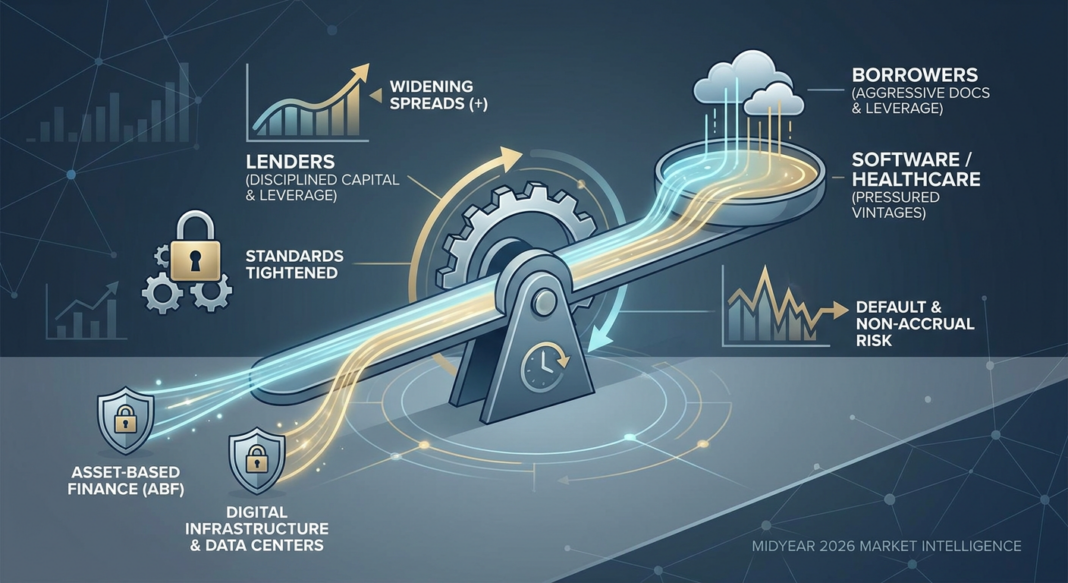
Market Headline: The Credit Cycle Turns, Lenders Reclaim Leverage
The first half of 2026 delivered a structural inflection point across public and private credit markets. After a multi-year regime defined by fierce lender competition, record-low spreads, and borrower-friendly documentation, a convergence of macro headwinds has decisively shifted the supply-demand balance in favor of disciplined capital providers. morganstanley.com summarizes the dynamic precisely: supply and demand dynamics are increasingly shifting in favor of lenders, with the pullback in technology underwriting and net outflows in Business Development Companies (BDCs) contributing to wider spreads on newly originated loans in both direct lending and the broadly syndicated market.
Three converging forces defined the H1 2026 disruption: (1) geopolitical shock from the U.S.-Iran military conflict in late February, which stalled deal activity and tightened underwriting for energy-intensive industries; (2) an AI-driven credit reassessment, concentrated in software, a sector representing roughly 20% of private market exposure versus ~13% in the liquid leveraged loan market; and (3) a wave of BDC and non-traded fund redemptions that exposed structural vulnerabilities in the retail-oriented private credit model. capstonepartners.com
The Federal Reserve held its target range at 3.50%–3.75% through Q1 2026, citing elevated inflation and geopolitical uncertainty, while signaling a potential rate-hike posture, a hawkish pivot that has materially repriced the forward curve and muted refinancing activity across leveraged finance markets. northleafcapital.com The Fed’s April 2026 SLOOS confirmed tighter C&I lending standards across all firm sizes, a structural signal that private credit’s role as a primary corporate financing conduit is deepening further.
Quantitative Market Snapshot
The table below reflects current market pricing across public and private credit markets, drawn from institutional research as of Q2 2026. These metrics form the basis for lender underwriting expectations and borrower cost-of-capital modeling.
| Metric | Current Value (Q2 2026) | Prior Period | Change | Source |
|---|---|---|---|---|
| U.S. Leveraged Loan All-In Yield (LSTA Index) | 8.21% | ~7.5% (H2 2025 avg.) | +~71 bps | morganstanley.com (Q2 2026 Loan Monitor) |
| U.S. Leveraged Loan Nominal Credit Spread (LSTA Index) | S + 312 bps | ~S + 280 bps (H2 2025) | +~32 bps | morganstanley.com (Q2 2026 Loan Monitor) |
| ICE BofA U.S. High Yield Spread | ~275 bps OAS | ~240–260 bps (Q4 2025) | Widening | morganstanley.com (Q2 2026 Loan Monitor) |
| Direct Lending Spreads (New-Issue LBO/Add-On) | +50 to +100 bps vs. late 2025 levels; ~84.4% of LBO deals priced below S+550 | Compressed near record lows (H2 2025) | +50–100 bps widening | lordabbett.com; capstonepartners.com |
| Private Credit Default Rate (Proskauer Index, Q1 2026) | 2.73% | 1.84% (Q3 2025) | +89 bps, rising cycle stress | forbes.com |
| Fitch Broad Private Credit Default Rate (incl. PIK/Deferrals) | 5.8% (12 months to Jan 2026) | Below 2% (headline rate, multi-year avg.) | Highest since Fitch began tracking | forbes.com |
| Fed SLOOS, Net % of Banks Tightening C&I Standards (Large/Mid-Market) | +8.1% net (Q2 2026) | Mixed Q4 2025 (modest tightening) | Continued tightening bias | fred.stlouisfed.org (FRED/SLOOS) |
| Private Credit AUM (2026 Projected) | >$2 trillion | ~$1.8 trillion (mid-2025) | Structural growth; forecast $4T by 2030 | moodys.com |
Key Structural Reference Points: The 3-month SOFR rate is hovering around ~3.7% and is expected to remain near that level through the next several quarters, per capstonepartners.com. Critically, 60% of defaults tracked by the Fitch broad methodology involved interest payment deferrals or conversion to payment-in-kind (PIK) arrangements, not outright missed payments, signaling that the true cost of credit deterioration is being structurally obscured in portfolio reporting. forbes.com Meanwhile, KBRA projects direct lending defaults will rise to 2.0% by volume in 2026 from 1.5% in 2025, noting that assessment downgrades have outpaced upgrades for eight consecutive quarters. kbra.com
Sector Analysis: Hot Sectors, Cold Sectors, and Structural Rotation
Software & Technology: Tighter Standards, Rising Stress
Software is the epicenter of private credit stress in 2026. Private leveraged finance markets carry roughly 20% allocation to software versus ~13% in the liquid market, per PitchBook/Morningstar LSTA data cited by lordabbett.com. A large cohort of enterprise software deals originated between 2019–2022 (when rates were near zero and AI disruption was not an underwriting variable) are now under structural pressure. Non-accrual rates among BDCs have been led by healthcare and select software vintage loans. The Fed’s January 2026 SLOOS revealed that banks are now more likely to approve loans to firms benefiting from AI and less likely for those adversely affected, a material bifurcation in lender appetite with direct implications for underwriting. federalreserve.gov
Asset-Based Finance (ABF): The Breakout Sector
ABF is the defining strategic rotation of 2026. moodys.com projects ABF to lead private credit growth as banks remain constrained, with alternative managers increasingly targeting consumer loans and data infrastructure credit. The investable ABF market exceeds $5.5 trillion, yet private lenders currently provide less than 5% of financing, creating an asymmetric opportunity. brookfield.com confirms that 58% of private credit managers plan to prioritize ABF strategies in 2026, and 44% of insurers intend to expand long-term allocations to ABF. ABF’s structural advantage is clear: repayment is secured against diversified pools of contractual cash flows (mortgages, equipment leases, receivables) rather than single-company EBITDA, reducing idiosyncratic borrower risk. macfarlanes.com However, recent high-profile collateral disputes (First Brands, Tricolor) have introduced structural caution, prompting some bank lenders to retrench and creating funding gaps that well-structured non-bank lenders can fill.
Digital Infrastructure & Data Centers: Capital-Intensive but Lender-Favored
Digital infrastructure (data centers, fiber networks, and energy grid assets) is emerging as one of the highest-conviction sectors for private credit deployment. tpg.com notes that data center and digital infrastructure ABF issuance is growing rapidly, driven by predictable cash flows that lenders can underwrite with confidence. freshfields.com expects pension funds and infrastructure-dedicated vehicles to increasingly enter this space in 2026, with hybrid financing forms expanding for investment-grade entities beyond the data center sector.
Healthcare: Under Active Watch
Healthcare has led all sectors in loans placed on non-accrual status over the past year, prompting major direct lenders including Morgan Stanley Investment Management to maintain a significant underweight. morganstanley.com Operational complexity, reimbursement risk, and elevated leverage among healthcare rollup platforms have combined to make it one of the most scrutinized sectors in current lender underwriting.
Industrial & Energy-Intensive Sectors: Macro-Sensitive Tightening
Lenders have responded to geopolitical-driven energy cost volatility by tightening underwriting standards for energy-intensive industries and businesses whose leverage was predicated on stable energy costs. capstonepartners.com For industrial operators accessing project-level financing, the practical reality is a structurally narrowed pool of bank lenders, with private credit now the primary counterparty, at a cost premium of 100–300 basis points above comparable bank financing, depending on asset type and structure. environmentenergyleader.com
Implications: Borrowers, Operators, and Institutional Investors
For Borrowers and Operators
The lender-friendly reset has real operational costs. The era of borrower-favorable loan documents (loose covenants, elevated leverage, PIK-heavy structures) is giving way to a more disciplined underwriting regime. New loans are increasingly coming with less leverage, more covenants, fewer PIK requests, and tighter documentation, per lordabbett.com. Operators should anticipate tighter FCCR and debt-service coverage thresholds as lenders reassert floor coverage requirements, especially in sectors with volatile EBITDA profiles or AI-related disruption risk.
Critically, environmentenergyleader.com flags that organizations still modeling project hurdle rates against bank financing baselines are working from an outdated cost-of-capital framework. Private credit premiums of 100–300 bps above bank rates are not cyclical; they are structural. CFOs and capital structure teams should build lender relationships before a specific financing need arises; organizations accessing the best private credit terms in 2026 established those relationships proactively. Additionally, nearly $1 trillion in U.S. corporate debt is set to mature between 2026 and 2028, much of it low-rate-era direct lending with bullet maturities, creating a refinancing wall that will test borrower FCCRs at current rate levels. brookfield.com
For Institutional Investors and Lenders
alliancebernstein.com draws an important distinction: first-half performance in direct lending was shaped mainly by wider spreads and mark-to-market volatility, not deterioration in underlying credit quality or borrower distress. Investors with fresh dry powder are entering an environment with materially more attractive entry points than existed twelve months ago. morganstanley.com notes that periods of investor caution have historically coincided with some of the most attractive lending vintages.
However, regulatory pressure is accelerating. The Financial Stability Board’s May 2026 report identified four vulnerability clusters in private credit: bank interconnections, borrower credit quality and valuation opacity, concentration and liquidity mismatches, and data gaps. forbes.com Banks have extended nearly $320 billion in credit to private credit funds, BDCs, and CLOs, a deeply interconnected exposure profile that regulators are now formally examining. In the EU, AIFMD II is requiring private credit managers to operate more like regulated lenders, with leverage limits, liquidity reporting, and enhanced governance, per pwc.com. Institutional allocators should scrutinize manager vintage exposure (particularly 2019–2022 originations in software and healthcare) and demand transparency on PIK income as a percentage of total portfolio returns, currently averaging 8% of investment income across public BDCs. withintelligence.com
Forward-Looking View: H2 2026 and Beyond
The second half of 2026 is likely to be defined by dispersion (across managers, sectors, and deal structures) rather than broad asset-class beta. lordabbett.com Spreads on newly issued direct lending deals are expected to widen by an additional 25–50 bps in lower-quality or difficult-to-finance sectors over the next six months, per PitchBook survey data cited by capstonepartners.com.
M&A activity, the dominant engine of new-money deal flow, is expected to broaden in H2 2026 as private equity sponsors face mounting pressure to monetize long-tenured assets. By 2029, the net value of unsold PE assets at the end of their 12-year theoretical life could nearly double to $903 billion, sustaining structural demand for bespoke and hybrid financing solutions. morganstanley.com Meanwhile, Moody’s baseline GDP growth forecast of ~1.5%, just above the historical stall speed at which defaults accelerate, means there is a narrow margin of safety: even a modest growth shock could rapidly surface stress in less liquid pockets of the credit market. moodys.com
Structurally, the private credit market is forecast to reach $3 trillion in direct lending alone by 2028, with ABF and infrastructure debt representing the fastest-growing sub-strategies. clearygottlieb.com European private credit is attracting increasing allocator interest as U.S. direct lending becomes more commoditized, with Basel IV implementation expected to accelerate a major shift away from bank lending, currently ~70% of total European credit, toward private debt funds. withintelligence.com
Key Market Insights
- Spread Widening is Real but Incomplete: Direct lending spreads have widened 50–100 bps since late 2025, while the U.S. Leveraged Loan Index now trades at S+312 bps with an all-in yield of 8.21%. The more durable advantage for lenders is structural: improved covenants, tighter documentation, and lower leverage on new originations, not just higher headline spreads. lordabbett.com
- Bank Tightening Validates Private Credit's Structural Role: The April 2026 SLOOS recorded a net 8.1% of domestic banks tightening C&I standards for large and middle-market firms, reinforcing that banks are not filling the financing gap that private credit now structurally occupies. fred.stlouisfed.org
- The True Default Picture is Obscured by PIK Activity: The Fitch broad default rate of 5.8%, versus the headline rate below 2%, reflects that 60% of credit events involved PIK conversion or interest deferrals. Operators and investors must model FCCR and debt-service coverage on cash-pay terms, not accrual-basis income. forbes.com
- ABF is the Strategic Rotation Trade of 2026: With 58% of private credit managers prioritizing ABF and private lenders representing less than 5% of the $5.5 trillion addressable market, ABF offers the most compelling risk-adjusted supply-demand profile in credit today, provided managers maintain firm structural protections over underlying collateral pools. brookfield.com
- Regulatory and Interconnectivity Risk is Building: With $320 billion in bank exposure to private credit funds, FSB vulnerability cluster warnings, Treasury scrutiny of insurer allocations, and AIFMD II operational requirements tightening in Europe, the regulatory cost of participation in private credit is rising. Institutions with complex, layered exposures, particularly PE-affiliated insurers, should model tail-risk scenarios involving simultaneous stress across portfolio companies, NAV loan covenant breaches, and redemption pressure. forbes.com; pwc.com


