
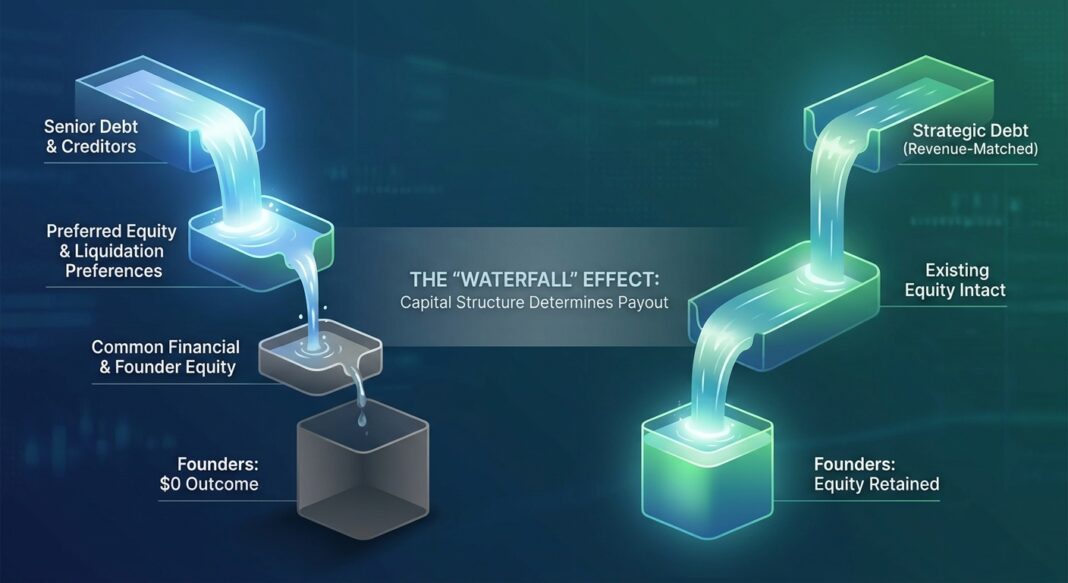
The Waterfall Moment: How Capital Structure, Not Revenue, Determined Who Got Paid in Two $1B+ Exits
Divvy Homes sold for $1 billion and the founders walked away with zero. Cohesity raised $3.1 billion in strategic debt and kept its equity undiluted. Same era. Opposite outcomes. The difference had nothing to do with the products, the markets, or the talent. It had everything to do with the capital structure chosen years before exit day arrived.
The Story: A Billion Dollars, and Then Nothing
In January 2025, the proptech world watched Divvy Homes (a San Francisco rent-to-own startup backed by Andreessen Horowitz, Tiger Global, and GGV Capital) close a headline-grabbing acquisition by Brookfield Properties for approximately $1 billion. For a sector battered by rising interest rates and a string of bankruptcies, a ten-figure exit looked like a triumph.
It was not a triumph. It was a masterclass in how capital structure can quietly detonate founder wealth long before a single term sheet is signed for an exit.
CEO and co-founder Adena Hefets sent a letter to shareholders confirming the brutal arithmetic: after repaying outstanding debt and fulfilling liquidation preferences for preferred shareholders, neither common shareholders nor founders’ preferred stock would receive any proceeds. A company that had raised hundreds of millions of dollars from some of the most recognizable names in venture capital (and had genuinely helped over 2,000 families access homeownership) produced exactly zero dollars for the people who built it.
Now hold that image alongside a different story from the same era.
Cohesity, a web-scale data management and security platform, had already raised more than $800 million in equity across multiple institutional rounds. When it needed capital to fund its acquisition of Veritas Technologies’ data protection business, a deal that valued the combined company at approximately $7 billion, Cohesity did not reach for another equity round. It reached for debt. Specifically, $3.1 billion in debt financing, structured to match its recurring revenue model and predictable infrastructure economics. Existing equity holders retained their stakes. Founders did not get diluted. The ownership structure was preserved at the exact moment the company was making its most consequential move.
Same era. Opposite choices. Radically different outcomes.
The Decision: What Each Company Chose, and Why It Mattered
Divvy: Equity Stacked on Equity, Then Debt on Top
Divvy Homes built an inherently capital-intensive model: purchase homes for customers, lease them back while those customers accumulate down-payment savings, then facilitate ownership after three years. The model required continuous capital deployment into real estate assets. To fund that deployment, Divvy raised aggressively through the venture ecosystem (a Series A, B, C, and D in rapid succession) reaching a peak valuation of $2.3 billion in 2021. Then, in October of that same year, the company layered on approximately $735 million in debt financing to further accelerate home acquisitions.
On paper, this looked like sophisticated capital stacking. In practice, it created a catastrophic liability structure. The equity rounds came with the standard architecture of institutional venture capital: multiple series of preferred stock, each carrying liquidation preferences that guaranteed investors got repaid (at par or better) before common shareholders and founders saw a single dollar. By the time Divvy stacked Series A through Series D preferences on top of $735 million in debt, the company’s effective breakeven exit value, the price at which founders could expect any proceeds, was almost certainly north of the $1 billion acquisition price.
When interest rates surged in 2022, Divvy’s model fractured. Three rounds of layoffs followed. New home acquisitions were paused entirely in 2023. The Brookfield acquisition in early 2025 was a rescue, not a celebration. The waterfall was devastating: debt repaid first, preferred liquidation preferences consumed the remainder, and founders were left with nothing. Hefets wrote candidly to shareholders that this was “not the ending I had hoped for.”
Cohesity: Debt After Equity, Calibrated to Cash Flow
Cohesity’s capital decision was structurally different in a critical way: it used debt as a deliberate instrument against a backdrop of proven, subscription-based recurring revenue, not as emergency fuel to fund a model that was still maturing.
The $3.1 billion debt package, in which JPMorgan beat out a competing proposal from a coalition led by Oak Hill Advisors and Apollo Global Management, was sized and structured around Cohesity’s demonstrated cash flows. The recurring revenue model provided predictable debt service coverage. The acquisition target, Veritas’ data protection business, had defined, underwritable assets. The debt was acquisition financing: purposeful, asset-backed, and matched to the business’s capacity to service it.
Crucially, the company did not issue new equity to fund the Veritas deal. Existing shareholders (including SoftBank Vision Fund, Sequoia Capital, and NVIDIA) retained their positions. The equity table was not reshuffled. The cap table did not lengthen. The waterfall did not deepen.
“How you raise money matters more than how much.”: David Spreng, CEO, Runway Growth Capital (2024–2025 Venture Debt Review)
The Outcome: Numbers That Tell the Full Story
The contrast in outcomes is not subtle. It deserves to be rendered in plain numbers.
| Metric | Divvy Homes | Cohesity |
|---|---|---|
| Peak Valuation | $2.3B (2021) | $7B (post-Veritas deal, 2024) |
| Primary Capital Instrument | Preferred equity (Series A–D) + $735M debt | $800M+ equity, then $3.1B strategic debt |
| Exit / Outcome | $1B acquisition by Brookfield (Jan 2025) | Acquisition of Veritas; combined entity at $7B |
| Founder Proceeds | $0 | Equity retained intact |
| Common Shareholder Proceeds | $0 | Ownership undiluted |
| What Consumed the Exit Value | $735M+ debt + preferred liquidation preferences | Debt service structured against recurring revenue |
| Model-to-Instrument Match | Poor, asset model funded with short-horizon VC equity | Strong, SaaS recurring revenue matched to debt capacity |
The counterfactual for Divvy is sobering. Had the company funded its home acquisition engine with structured asset-backed financing (facilities specifically matched to the real estate collateral it was accumulating, rather than venture equity carrying compounding liquidation preferences) the exit waterfall would have looked fundamentally different. The $1 billion acquisition price might have left meaningful proceeds for founders and employees. The problem was not the business; it was the mismatch between instrument and model.
For Cohesity, the counterfactual cuts the other way. Had the company funded the Veritas acquisition with a new equity round instead of $3.1 billion in debt, existing shareholders would have absorbed significant dilution at precisely the moment the company was executing its most value-creating transaction. The institutional lenders (including JPMorgan and a competing Apollo-led consortium) were, in effect, bidding to be the party that did not own equity. Cohesity’s founders and investors got to keep the upside. The debt holders got the coupon.
The record $53 billion in venture debt deal value logged in 2024, even as deal count fell to its lowest level in a decade, reflects a broader recognition of exactly this dynamic. Founders are doing fewer, larger, and more deliberate debt transactions because they understand what the Divvy waterfall illustrates: equity is permanent dilution, and debt, when calibrated correctly, is not.
The Lessons: A Framework for Founders Facing the Same Decision
1. Liquidation Preferences Are a Hidden Breakeven Threshold
Every round of preferred equity raises the floor that an exit must clear before founders participate. Carta’s founder ownership data shows the median founding team owns just 36.1% of their company after a Series A, and 23% after a Series B. By Series D, investor ownership often reaches 70% or higher, and those investors’ liquidation preferences are senior to common stock. In a down-market exit, the waterfall consumes everything below that threshold first. Founders who understand this math before they raise can structure their capital needs to minimize liquidation preference depth.
2. Match the Instrument to the Model
Divvy’s structural failure was not that it used debt; it was that it funded a rate-sensitive, asset-heavy model with equity that carried rigid repayment-equivalent economics (liquidation preferences) while simultaneously layering on balance sheet debt that served as first lien. Cohesity’s success was not that it used debt; it was that it matched debt capacity to recurring, predictable cash flows. The rule is simple: debt works when the business generates durable, forecastable income to service it. When that condition holds, debt preserves equity. When it doesn’t, debt becomes the first-in-line creditor that consumes the exit.
3. The Private Credit Market Has Changed the Calculus
The financing environment available to founder-owned businesses today is materially different from five years ago. Private credit’s global AUM has grown roughly five times since 2009, and direct lending now matches the broadly syndicated loan market at $1.5–2 trillion in size with forecasts to reach $3 trillion by 2028. Non-sponsor direct lending (capital provided to founder- or family-owned businesses without requiring a PE intermediary) has moved from niche to mainstream. Lower-middle-market companies with $10–75 million in EBITDA, long underserved by institutional capital, now have access to bespoke structures including delayed-draw term loans, unitranche facilities, and hybrid overlays that simply did not exist at scale a decade ago. The third path between bank lines and institutional equity is now a real, functioning market.
4. Leveraged Recapitalizations Are the Middle-Market Equivalent of Cohesity’s Playbook
For privately held companies that are not yet executing billion-dollar acquisitions, the same principle applies via a different instrument: the leveraged recapitalization. A lower-middle-market business generating $10–15 million in EBITDA can typically access 3x–5x EBITDA in senior debt (per the Pepperdine Private Capital Markets Report, 2024), distributing proceeds to owners as a special dividend while retaining full operational control and future upside. The owner extracts partial liquidity, the business assumes manageable leverage, and the cap table is not touched. No new equity investors. No liquidation preferences. No board seats ceded.
5. Timing Is the Final Variable
Neither debt nor equity is universally superior. Equity remains essential for pre-revenue, capital-intensive, or network-effect-driven businesses where cash flows cannot yet support a repayment schedule. But the reflexive assumption that institutional equity is the only path to growth capital for a scaling company, especially one with proven revenue, is increasingly a product of habit rather than analysis. The founders who ask the matching question before they raise are the ones who walk away whole when the waterfall finally arrives.
Key Insights
- The waterfall is written at the term sheet, not the exit. Every liquidation preference negotiated in a funding round silently raises the minimum exit price founders need to receive any proceeds. Divvy’s founders needed a $1B+ exit just to break even, and got exactly that amount, with nothing left over.
- Debt that matches revenue is fundamentally different from debt that doesn’t. Cohesity’s $3.1B debt financing worked because recurring subscription revenue provided predictable debt service coverage. Divvy’s $735M debt failed because it was layered onto a rate-sensitive, asset-acquisition model with no natural hedge against rising rates.
- The private credit market now provides a genuine third path. Founder-owned companies with $10M–$75M in EBITDA can access bespoke non-dilutive structures (unitranche facilities, delayed-draw term loans, dividend recaps) that previously required a PE sponsor intermediary. That intermediary is no longer necessary.
- The median founding team owns 23% of their company after Series B. By Series D, investors collectively own 70% or more. The compounding math of preferred equity dilution is severe, permanent, and largely irreversible. Founders who preserve equity through debt at the right stages keep far more of the value they create.
- A leveraged recap is the middle-market version of Cohesity’s playbook. For owner-operated businesses generating stable EBITDA, a leveraged recapitalization provides partial personal liquidity, maintains operational control, and leaves the cap table entirely unchanged: no new investors, no liquidation preferences, no governance concessions.


