
The Growth-Stage Financing Problem Nobody Talks About Plainly
You run a lower-middle-market business generating $4M in EBITDA. You have identified a bolt-on acquisition target at a $20M enterprise value. Your commercial bank will lend 3.0x EBITDA, roughly $12M, leaving an $8M gap between the senior debt proceeds and the purchase price. You do not want to give up equity. Your timeline is 60 days. What do you do?
This is the defining capital challenge of the growth stage: a proven business with real cash flow, a clear use of proceeds (an acquisition), but a structural shortfall between what conventional lenders will provide and what the transaction actually requires. The gap is not a credibility problem. It is a lending constraint, and it has a set of well-established structural solutions.
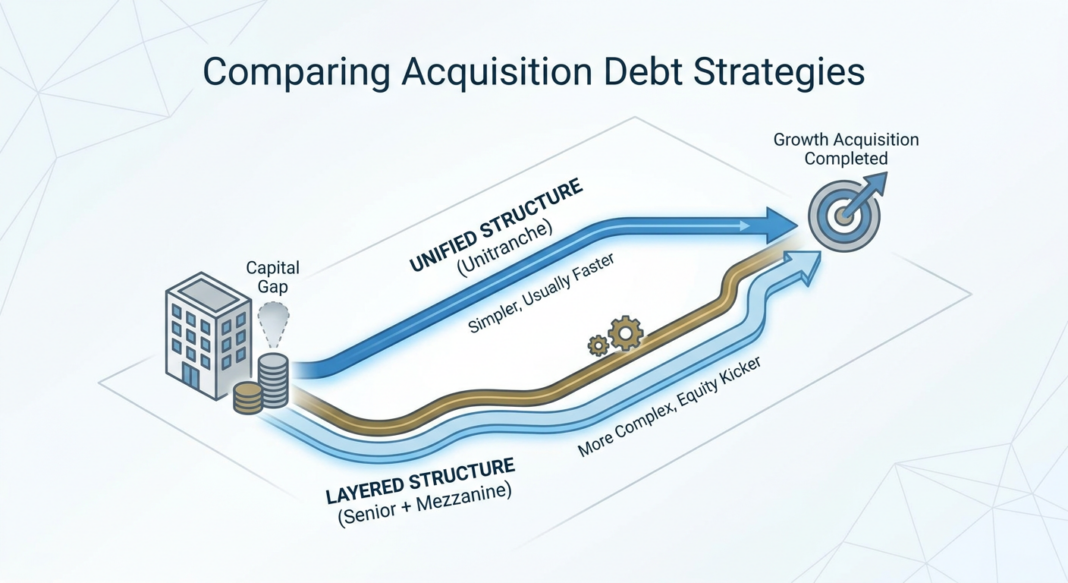
The core decision is this: do you bridge that gap with a unitranche facility that collapses the entire debt stack into one instrument, or do you layer in mezzanine debt above your senior loan to reach the total quantum you need? Both paths work. Each has a materially different cost, covenant, and complexity profile, and getting the decision wrong costs you either money, control, or the deal itself.
This article maps the capital stack at the growth stage, prices out both options with 2026 market data, and gives you a step-by-step playbook for quantifying the gap, preparing the process, and negotiating the structure.
Mapping the Capital Stack at the Growth Stage: From Banks to Equity
Before selecting a structure, operators and sponsors need to map the full cost-of-capital spectrum available to a lower-middle-market company in 2026. The hierarchy runs from cheapest and most senior to most expensive and most subordinated.
Layer 1: Senior Secured Debt (Banks & Asset-Based Lenders)
This is the foundation. Commercial bank term loans and revolving credit facilities are priced at the lowest point on the spectrum, typically SOFR + 200–350bps for a creditworthy middle-market borrower, and are secured by a first lien on substantially all assets. The constraint is quantum: most commercial banks cap leverage at 2.5x–3.5x EBITDA for a cash flow business, and asset-based lenders are limited by the liquidation value of eligible receivables and inventory. Senior debt is the cheapest dollar in the stack; the problem is there usually are not enough of those dollars.
Layer 2: Unitranche (Private Credit / Direct Lending)
Unitranche debt is a single-tranche acquisition loan that combines what would otherwise be senior debt and mezzanine or subordinated debt into one instrument, one lender, and one credit agreement. It is the workhorse of lower-middle-market acquisition finance in 2026. Pricing in 2026 runs SOFR + 500–700bps, with a 2–3% original issue discount (OID) and a 2–3% prepayment fee declining over the first 24 months, producing an all-in cost of 9.5–11% blended for a typical 5x leverage deal. Total leverage sits at 4–6x EBITDA. One negotiation, one closing, one lender to manage post-close.
Layer 3: Mezzanine Debt
Mezzanine debt fills the gap between the senior-debt cap and total equity-like exposure. It is subordinated, typically unsecured, and carries a layered cost structure: cash-pay interest, PIK (payment-in-kind) interest that accrues into principal rather than paying in cash, and equity kickers in the form of warrants or co-investment rights that give the lender upside participation. In 2026, the all-in cost of mezzanine runs 10–14% (8–12% cash coupon + 2–4% PIK + 1–5% equity in warrants), targeting a lender IRR of 16–22%. Mezzanine is more expensive than unitranche on a nominal rate basis, but it can push total debt capacity from a senior cap of ~3.5x EBITDA up to 5.5x EBITDA without requiring equity dilution.
Layer 4: Preferred Equity
Preferred equity sits above common equity but below all debt in the payment waterfall. It carries negotiated liquidation preferences, dividend rights (often PIK), and board or governance rights. For growth-stage companies, preferred equity is typically the bridge to a full equity raise, used when debt markets simply cannot provide the quantum needed or when the company lacks the cash flow coverage to service additional debt. Costs run 14–18% depending on structure and terms.
Layer 5: Common Equity (Growth Equity / Private Equity)
Common equity is the most expensive form of capital, investors require 20%+ returns and typically take 20–35% ownership in a growth equity minority investment. It has no fixed repayment obligation and provides maximum operational flexibility, but it permanently dilutes ownership and often introduces governance concessions. Equity is the right instrument when the business has no free cash flow to service debt, when total debt capacity has been exhausted, or when the growth thesis requires a strategic partner rather than just capital.
Structure Breakdown: The $20M Acquisition Example
Let’s return to the scenario above. A $4M EBITDA business acquiring a target at $20M EV. Here is how both structures play out in practice.
Option A: Unitranche
A direct lender offers a $18M unitranche facility at 5x EBITDA (the remaining $2M comes from cash on hand or seller equity rollover). Pricing: SOFR + 600bps, with a 2% OID and 2% prepayment fee. All-in cost: approximately 10.5%. Single credit agreement. No intercreditor negotiations. Estimated time to close: 45–60 days. The covenant package includes a single maintenance leverage covenant tested quarterly. No warrants. No PIK. Clean structure.
The trade-off: you are paying a blended rate that prices the subordinated risk into every dollar of the facility, even the first-lien dollars that might otherwise be cheaper at a bank. But you are also buying speed, simplicity, and a single lender relationship. Unitranche dominates the lower-middle-market direct lending channel in 2026, with roughly 70–80% of $25M–$200M EV deals using at least partial unitranche financing.
Option B: Senior + Mezzanine Split
Your commercial bank lends $12M (3x EBITDA) at SOFR + 300bps (~7.5% all-in). A mezzanine fund provides $6M at a 12% cash coupon + 2% PIK + warrants covering 2% of equity at a nominal strike price. Total debt: $18M. Blended rate across the two layers: approximately 9–10%. On paper, this is marginally cheaper than the unitranche. But the cost comparison misses the full picture.
You now have two separate sets of loan documents, two separate counsel negotiations, an intercreditor agreement that must be negotiated between the senior lender and the mezz fund, and a warrant overhang on your cap table. Close timeline: 90–120 days minimum. Every future amendment (an add-on acquisition, a covenant waiver, a dividend recap) requires both lenders to agree. And the mezz lender’s IRR target of 16–22% means the warrants will be exercised at exit, reducing your proceeds.
As one practitioner framework describes it, “the sponsor just wants to grow the company… but the mezzanine investor really just wants to get paid back and keep their warrants”, a misalignment that plays out in every future decision requiring lender consent.
Unitranche vs. Senior + Mezz: The Real Trade-Offs
| Dimension | Unitranche | Senior + Mezzanine |
|---|---|---|
| All-in cost (2026) | 9.5–11% | 9–10.5% (cash) + equity kicker IRR 16–22% |
| Leverage capacity | 4–6x EBITDA | Senior 3–3.5x + Mezz 1–2x = 4.5–5.5x total |
| Close timeline | 45–90 days | 90–120 days |
| Covenant structure | Single maintenance covenant (leverage) | Two separate covenant packages + intercreditor |
| Equity dilution | None (no warrants) | 1–5% warrant coverage at mezz layer |
| Future amendment flexibility | Single lender consent required | Both lenders must agree; intercreditor governs |
| Optimal use case | Speed-sensitive acquisitions; $25M–$200M EV | Large transactions; rate-sensitive borrowers willing to accept complexity |
The key insight: the nominal rate advantage of senior + mezzanine over unitranche is small, and is often eliminated when you account for the equity kicker, the longer close timeline, and the ongoing complexity cost of managing two lender relationships. For most lower-middle-market acquisitions in the $25M–$200M EV range, unitranche wins on a total-cost-of-ownership basis.
Mezzanine retains its relevance in specific scenarios: very large transactions where a single direct lender cannot provide the full quantum needed; deals where the sponsor wants to maximize cheap senior debt first and only then layer on sub-debt; and add-on acquisitions where the existing senior credit agreement prohibits additional senior debt but permits subordinated borrowings.
Current Market Terms: What 2026 Looks Like on the Ground
The following data points reflect current market conditions as of mid-2026, drawn from market participants and published research.
- Unitranche pricing: SOFR + 500–700bps for core lower-middle-market deals, with upper-middle-market sponsored transactions pricing tighter at SOFR + 425–475bps, according to Capstone Partners’ Winter 2025 Leveraged Finance Report. Deals with meaningful leverage step-down milestones may secure 50–100bps spread reductions on performance.
- OID and fees: Average OID on private credit deals runs 2–3% of funded principal, paid at closing and amortized for accounting purposes, with upfront arrangement fees adding to the effective cost.
- Mezzanine pricing: Cash coupons of 8–12%, plus 2–4% PIK accruing to principal, plus warrant coverage of 1–5% equity. All-in lender IRR target: 16–22%. Performing companies can expect 60–90 days from term sheet to close for a mezzanine tranche.
- Leverage multiples: Average total leverage in sponsored middle-market unitranche deals hovered around 5.0x EBITDA in mid-2024 as lenders focused on free cash flow and covenant headroom, per PitchBook data. For the lower-middle-market (EBITDA $7.5M–$30M), deals typically carry lower leverage and stronger covenant packages than the core or upper middle market.
- Covenant design: The broadly-syndicated loan market has seen covenant-lite structures reach 91.7% of large-corporate new-issue institutional loans in 2024, per PitchBook LCD. But private credit and direct lending tell a different story: most middle-market unitranche facilities retain at least one financial maintenance covenant (typically a leverage or interest-coverage test) providing lenders with early-intervention rights that cov-lite structures do not afford. The lower-middle-market segment in particular maintains strong covenant packages, reflecting its smaller deal sizes and fewer lender participants.
- Private credit market size: Global private credit assets under management reached approximately $2.1 trillion in 2025, with direct lending representing 52% of global private credit AUM, according to PitchBook and Morgan Stanley Investment Management data. The market is forecast to reach $3 trillion by 2028.
One broader market dynamic to watch: as of mid-2026, the private credit market has reset in a more lender-friendly direction. Stronger deal flow from recovering M&A activity, more selective capital, and improving documentation standards have shifted bargaining power toward disciplined lenders. Borrowers who ran processes in 2022–2024 may find that covenant and pricing flexibility has tightened modestly entering the second half of 2026.
The Gap Capital Playbook: From Quantifying the Need to Closing the Deal
Here is the step-by-step process for an operator or sponsor navigating a growth acquisition from capital need to funded close.
Step 1: Quantify the Gap (Before You Call Anyone)
Start from EBITDA, not from a target raise number. A lower-middle-market business in 2026 can access roughly 3.0–5.5x EBITDA in debt (senior + mezzanine combined) and equity capacity limited only by ownership willingness. Map the use of proceeds (acquisition price, transaction fees, working capital buffer, integration costs) against available debt capacity. If the gap between what the senior lender will provide and what the transaction requires is less than 2.0x EBITDA, a single unitranche facility likely covers it cleanly. If the gap exceeds 2.0x EBITDA, you are looking at a two-tranche structure, additional equity, or a smaller transaction.
Step 2: Prepare the Package
Direct lenders and mezzanine funds underwrite on cash flow, not collateral. Your materials package needs to include: trailing-twelve-month EBITDA with clear add-back support; a 3-year financial model showing base, upside, and downside scenarios; customer concentration data and contract duration; a management team overview; and a use-of-proceeds statement that maps each dollar to a specific capital deployment. Lenders evaluate EBITDA coverage ratios, free cash flow conversion, customer concentration, industry cyclicality, and management track record.
Step 3: Run the Process (Competitive, Not Serial)
For a unitranche, run a competitive process across 4–6 direct lenders simultaneously. The market is deep: Ares Capital, Blue Owl Capital, Antares Capital, Twin Brook Capital Partners, Golub Capital, and Monroe Capital lead the $25M–$200M EV segment. For a two-tranche structure, identify your senior lender first, their credit agreement will govern the intercreditor parameters, then run the mezzanine process in parallel. Budget 45–60 days for unitranche close and 90–120 days for a senior-plus-mezz structure.
Step 4: Evaluate Term Sheets on Total Cost, Not Rate
The rate on the term sheet is only the starting point. Calculate the all-in cost including OID, upfront fees, prepayment premiums, and, critically, the equity kicker if warrants are included. A mezzanine facility advertised at a 12% cash coupon is not a 12% cost of capital: it is 12% plus PIK accrual compounding over a 5-year term, plus warrant dilution at exit, plus 1–2% upfront origination fees. Run the math under multiple exit scenarios before signing the term sheet.
Negotiation Guidance: What to Push On and What to Accept
For Borrowers and Operators
Push hard on covenant headroom. A maintenance leverage covenant set at 6.0x when your starting leverage is 5.0x gives you only 20% EBITDA cushion before a breach. Negotiate for 30–35% headroom at close, request a covenant set at 6.5x or build in a 12-month step-down schedule. Also negotiate the EBITDA definition carefully: ensure that reasonable run-rate add-backs for one-time transaction costs, integration expenses, and synergies are included in the covenant calculation.
Limit prepayment penalties. Standard unitranche terms include a 2–3% prepayment fee declining over 24 months. Push for a 101% soft call (only a 1% fee) after month 12, and no prepayment premium after month 18. This preserves refinancing optionality if market conditions improve or if you hit a growth milestone that warrants a ratings-grade facility.
Negotiate PIK flexibility carefully. If your structure includes a PIK component, ensure the PIK toggle, the right to elect PIK rather than cash pay, is borrower-controlled, not lender-controlled, and that there is no spread step-up when you elect PIK. A PIK toggle that adds 50–100bps to the coupon during a PIK period undermines the cash conservation benefit the toggle was meant to provide.
On warrants: if you cannot avoid them (typically the case with traditional mezzanine), negotiate the strike price, the warrant coverage percentage, and the anti-dilution provisions carefully. A nominal $0.01 strike warrant covering 3% of fully diluted equity may be worth very little today, or very significant proceeds at a 7x exit multiple. Model it explicitly under three exit scenarios before accepting any coverage level.
For Investors and Lenders
Insist on a financial maintenance covenant even in competitive processes. The data is clear: restructurings initiated at the covenant-breach stage, before a payment default, produce materially higher recoveries than those triggered by missed payments. The early-warning function is not a documentation formality. In a growth-acquisition context, a leverage covenant tested quarterly is the primary tool for identifying underperformance before it becomes irreversible. Additionally, scrutinize the PIK activity in your portfolio: PIK instruments that compound without a credible deleveraging path can obscure borrower financial health and elevate loss severity at maturity.
Key Takeaways
- Map the gap before you map the market. Quantify the use-of-proceeds shortfall relative to senior debt capacity first. The structure follows the gap size, not the other way around.
- Unitranche wins on total cost for most growth acquisitions. The nominal rate premium over a senior-plus-mezzanine split is marginal (typically 0–150bps), but the simplicity, speed, and absence of equity dilution from warrants make unitranche the structurally superior choice for the majority of $25M–$200M EV transactions.
- Mezzanine is not dead; it is specialized. Traditional mezzanine with PIK and equity kickers remains relevant for large transactions, add-on acquisitions constrained by existing senior credit agreements, and situations where maximizing cheap senior leverage first is worth the intercreditor complexity.
- Covenant design is a negotiation, not a formality. Maintenance covenants with 30–35% headroom, clean EBITDA definitions, and borrower-controlled PIK toggles are the structural features that determine whether the debt serves the business or constrains it.
- The 2026 market favors disciplined borrowers. Private credit has reset toward lender-friendly terms mid-year, with improving documentation, more selective capital, and better covenant packages. Operators who run competitive processes with clean financials and a well-mapped use of proceeds will price better than those who approach the market reactively.


