
One Loan, One Lender, One Set of Terms, But It’s More Complicated Than It Looks
When a private equity sponsor closes a $150 million leveraged buyout today, the odds are strong that the debt behind it is not a senior bank loan layered beneath a mezzanine tranche from two separate lenders. Instead, it is likely a single instrument called a unitranche loan: one credit agreement, one interest rate, one lender relationship. This structure has quietly displaced the traditional multi-tranche capital stack for the majority of middle-market transactions, and understanding how it works is foundational for anyone evaluating private credit as an investor or seeking growth capital as a business owner.
The unitranche is not merely a convenience product. It reflects a structural shift in who provides capital to private companies, on what terms, and at what cost. As the Federal Reserve’s April 2026 SLOOS confirmed, banks continued tightening lending standards for commercial and industrial loans across firms of all sizes during Q1 2026, the same environment that keeps middle-market borrowers reaching for private credit solutions. The unitranche is the primary vehicle through which that capital flows.
What a Unitranche Loan Actually Is
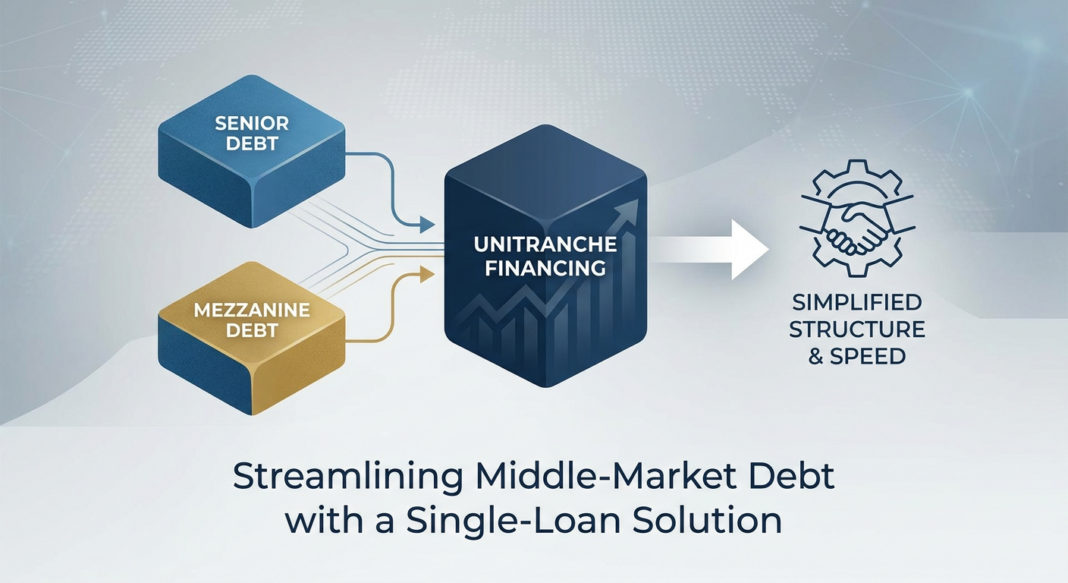
A unitranche loan is a hybrid debt instrument that combines what would traditionally be separate senior secured debt and subordinated (mezzanine) debt into a single credit facility with one blended interest rate. As Wall Street Prep explains it, the instrument rolls first-lien and second-lien debt into one offering: meaning a borrower interacts with a single lender, signs one credit agreement, and makes one interest payment at a blended rate that sits between what pure senior and pure mezzanine debt would each cost separately.
Internally, the structure can be more nuanced. In bifurcated unitranche deals, a “first-out” lender (often a bank or lower-risk institution) receives repayment priority and accepts a lower yield, while a “last-out” lender (typically a private credit fund or BDC) takes the riskier subordinated position in exchange for higher returns. The terms between these lenders are settled in an Agreement Among Lenders (AAL): a document that remains invisible to the borrower. As Regions Bank notes, the borrower simply sees a single set of loan terms with one blended cost of capital and one amortization schedule.
The pricing sits at a blended rate: higher than a pure senior secured loan (which would require stronger collateral coverage and lower leverage), but lower than standalone mezzanine debt. The borrower pays a premium for simplicity, speed, and the ability to borrow at leverage levels that traditional senior bank lenders would decline.
A Concrete Example: Traditional Structure vs. Unitranche
Consider a hypothetical acquisition of a software services company with $20 million in EBITDA at a 5.0x purchase multiple ($100 million enterprise value). The buyer plans to finance half with debt ($50 million) and contribute $50 million in equity.
Traditional Senior + Mezzanine Structure:
- Senior secured term loan: $35 million at approximately SOFR + 400 bps (~7.5% all-in in mid-2026)
- Mezzanine debt: $15 million at approximately 12% cash + 2% PIK (~14% all-in)
- Blended cost of debt: approximately 9.45%
- Two separate credit agreements, two lender relationships, one intercreditor agreement
- Typical time to close: 100–130 days
Unitranche Structure:
- Single unitranche facility: $50 million at SOFR + 500–700 bps (approximately 9.5–11% all-in in mid-2026 per CT Acquisitions, June 2026)
- One credit agreement, one lender, one covenant package
- Typical time to close: 60–90 days
- Trade-off: roughly 50–100 basis points more expensive than the traditional blended structure, but dramatically simpler and faster to execute
The cost premium for a unitranche is real but often modest relative to the execution advantages. For a time-sensitive acquisition in a competitive auction, where certainty of close is as important as pricing, the unitranche structure frequently wins on overall value to the borrower.
Current Market Relevance: What the Data Shows in 2026
The unitranche is not a niche product anymore. CT Acquisitions (June 2026) estimates the market grew from roughly $20 billion in annual issuance in 2015 to over $200 billion in 2025 as direct lenders displaced traditional bank syndication for sub-$1 billion EBITDA borrowers. The structure now dominates the lower middle-market direct lending channel.
On pricing, Valuation Research Corporation’s Q2 2026 Private Markets Update reported that unitranche structures continue to dominate new issuance, with coupon spreads ranging from 4.75% to 5.50%, nearly 25 basis points higher than year-end 2025 levels, and original issue discounts holding between 98.75 and 99.25 for standard transactions. Overall unitranche yields ranged between approximately 9.00% and 9.75% in Q2 2026, representing a decline of roughly 250 basis points from late 2023 peak levels of 11.5%–12.5%, but remaining materially above the pre-2022 historical range of approximately 7%–8%.
The broader private credit market backdrop amplifies unitranche demand. PwC’s Global Private Credit Survey 2026, based on 120+ portfolio managers surveyed January–March 2026, confirmed that private credit now exceeds $2 trillion in AUM, with a base-case growth forecast to $3.4 trillion by 2030. Meanwhile, the Federal Reserve’s April 2026 SLOOS reported that banks tightened lending standards for C&I loans across firms of all sizes in Q1 2026, keeping the structural tailwind for private credit lenders intact.
On the lender side, Lord Abbett’s 2026 Midyear Outlook (June 2026) noted that new loans are increasingly structured with better credit terms: less leverage, more covenants, fewer PIK requests, and tighter documentation. Spreads have widened roughly 50–100 basis points since late 2025, according to PitchBook data cited by Lord Abbett, a reset that improves the risk-adjusted case for disciplined unitranche lenders.
| Metric | Data Point | Source |
|---|---|---|
| Unitranche all-in yield range (Q2 2026) | ~9.00%–9.75% | VRC Q2 2026 Update |
| Coupon spread range, new issuance | SOFR + 475–550 bps | VRC Q2 2026 Update |
| US private credit AUM (2025) | $2 trillion+ | PwC Global Private Credit Survey 2026 |
| Annual unitranche issuance growth (2015–2025) | ~$20B → $200B+ | CT Acquisitions, June 2026 |
| Bank C&I lending standards, Q1 2026 | Tighter, on balance, all firm sizes | Federal Reserve SLOOS, April 2026 |
Decision Framework: What This Means for Investors and Operators
For Investors Evaluating Private Credit:
Unitranche funds occupy a specific risk-return niche in the capital stack. Because the instrument blends senior and junior risk into one position, investors should evaluate several factors when assessing a unitranche-focused fund or BDC:
- Leverage levels: Unitranche facilities typically run 4.0x–6.0x EBITDA. Higher leverage multiples compress the equity cushion and reduce loss-given-default protection for the lender.
- Spread vs. risk: Current spreads of SOFR + 475–550 bps reflect tighter documentation and more defensive terms than 2021–2022 vintages. Investors may evaluate whether the spread adequately compensates for the subordinated risk embedded in the blended structure.
- Covenant quality: A unitranche with a maintenance covenant (tested quarterly regardless of revolver usage) offers meaningfully more early-warning protection than a covenant-lite structure. The post-2025 lender-friendly reset has improved covenant inclusion in new issuance.
- Manager origination: Because unitranche dominates middle-market deal flow, fund managers with direct origination relationships, rather than reliance on secondary market purchases, tend to access better documentation and pricing terms.
For Business Owners and Operators Evaluating Financing Options:
The unitranche is typically most appropriate when several conditions are present:
- Speed is critical: Unitranche deals close in 60–90 days vs. 100–130 days for a traditional senior/mezz structure. In competitive acquisitions or time-sensitive recapitalizations, this matters.
- Complexity is a burden: Managing two separate lender relationships, two credit agreements, and an intercreditor agreement is administratively costly and introduces negotiation friction, particularly in covenant discussions post-close.
- Bank access is constrained: Middle-market companies with EBITDA under $50 million, limited hard assets, or leverage above 4.0x EBITDA will frequently find traditional bank credit unavailable, as confirmed by the Federal Reserve’s April 2026 SLOOS findings. The unitranche fills that gap.
- Equity preservation is the priority: Operators who want to grow without diluting ownership benefit from the unitranche’s capacity to fund at higher leverage multiples than senior bank debt alone would support, preserving equity while still accessing meaningful capital.
5 Key Takeaways
- One agreement, blended risk: A unitranche combines senior and subordinated debt into a single instrument with one rate, one lender, and one covenant package, but the internal risk hierarchy is preserved via an Agreement Among Lenders (AAL) that the borrower never sees.
- Price premium, execution advantage: Unitranche pricing typically runs 50–100 basis points above the blended cost of a traditional senior/mezz structure, but investors and operators consider that premium in the context of faster execution (60–90 days), reduced documentation complexity, and single-lender management post-close.
- Current yields remain above pre-2022 norms: At 9.00%–9.75% all-in as of Q2 2026, unitranche yields have compressed from late 2023 peaks but remain materially higher than the 7%–8% pre-rate-hike baseline, a dynamic that continues to attract institutional capital to the strategy.
- Bank retrenchment is structural, not cyclical: Two consecutive quarters of tightening C&I lending standards (per the Federal Reserve’s January and April 2026 SLOOS) reinforce that the demand pipeline for private unitranche capital is not a temporary phenomenon; it is driven by durable regulatory constraints on bank balance sheets.
- Documentation quality matters more than ever: The 2026 lender-friendly reset has produced new issuance with better covenants and less PIK usage than the prior cycle. Investors and operators alike benefit from understanding what protections are embedded (or absent) in a given unitranche facility before committing capital or signing a credit agreement.


